Procurement teams are increasingly qualifying microcrystalline cellulose (MCC) and resistant dextrin side by side—even when they serve different categories (pharma excipient vs. functional fiber). The reason is simple: both ingredients sit at the intersection of label risk, batch-to-batch performance, and audit-ready documentation. If either one fails your internal review, the product launch timeline suffers.
This guide translates common buyer questions into a practical, factory-facing evaluation workflow for microcrystalline cellulose supplier China searches and resistant dextrin manufacturer China shortlists—without turning the process into a paperwork marathon.
Why 2026 sourcing is stricter for MCC and resistant dextrin
Two market signals are shaping sourcing behavior:
- Fiber demand is moving mainstream. Industry commentary has framed dietary fiber as the “next protein,” which is accelerating product reformulation and raising the bar for defensible fiber claims.
- MCC demand keeps rising in pharma. Market forecasts continue to project long-term growth for microcrystalline cellulose, largely tied to tablets and broader pharmaceutical demand.
When demand rises, buyers typically see more “good enough” offers. That is exactly when a recommended Chinese microcrystalline cellulose manufacturer or recommended Chinese resistant dextrin manufacturer becomes less about marketing—and more about verified capability.
Step 1 Confirm raw material reality before you review specs
Raw material review is the fastest way to eliminate suppliers that will struggle with consistency.
Resistant dextrin and soluble corn fiber
Most export-oriented resistant dextrin programs start with NON-GMO corn starch (or sometimes tapioca starch depending on the product). A credible soluble corn fiber supplier should be able to provide:
- Raw material origin statement and traceability approach (how lots are tracked from incoming starch to finished resistant dextrin)
- Clear positioning on NON-GMO sourcing (and how that is controlled supplier-to-supplier)
- A realistic explanation of how fiber content targets are achieved (not just a high number on a brochure)
On Shine Health’s resistant dextrin pages, the raw material baseline is explicitly described as NON-GMO corn starch, paired with emphasis on traceable sourcing and controlled manufacturing.
Microcrystalline cellulose (MCC)
For microcrystalline cellulose, buyers should ask early what the cellulose source is and how supply continuity is managed. MCC is often treated like a “standard excipient,” but its performance is extremely sensitive to:
- Source consistency (impacting particle structure and tablet behavior)
- Lot-to-lot reproducibility (affecting compressibility and flow)
- Documentation completeness for downstream validation
If your internal stakeholders expect MCC to behave predictably in tableting, raw material discipline matters as much as the COA.
Step 2 Evaluate process credibility not just factory size
A reliable supplier does not need to be the biggest—but it must be process-stable.
What to look for in resistant dextrin manufacturing
For resistant dextrin, the buyer-facing process story should connect to outcomes: solubility, stability, and microbiological control.
Shine Health describes resistant dextrin production using:
- Advanced biological enzymes imported from overseas
- A precision production line of German origin
- Exquisite craftsmanship from Japan as a way to communicate process discipline
- A fully equipped QC laboratory supporting release testing
Whether you are auditing a Shandong or East China fiber hub, the practical question is: can the supplier explain how enzymatic control, purification, and drying choices protect the final resistant dextrin performance you need?
What to look for in MCC manufacturing readiness
For MCC, process evaluation is less about “fiber content” and more about whether the manufacturer can demonstrate routine control of:
- Grade consistency (the same grade should behave the same in compression)
- Contamination control and appropriate segregation
- Quality system maturity and deviation handling
If your team is new to MCC grade selection, it helps to align internal vocabulary early. The Shine Health industry article on MCC grades and QC is a useful starting point for buyers to standardize internal questions: MCC Grades Formulation and QC Guide.
Step 3 Read specifications like a formulation risk tool
A COA is not a marketing document. It is a risk forecast.
Resistant dextrin spec lines that protect downstream claims
On Shine Health pages, resistant dextrin is commonly shown with multiple fiber content targets (for example ≥70%, ≥85%, ≥90%, ≥95%) plus standard quality and microbiological limits.
Use the table below as a buyer-facing lens when comparing a resistant dextrin manufacturer China shortlist.
| Spec line (resistant dextrin) | Why it matters in real products | Typical procurement pitfall |
|---|---|---|
| Content / fiber target | Supports nutrition panel strategy and serving size math | Treating “higher is always better” without checking taste/texture impact |
| Moisture | Controls caking, blending, and shelf stability | Ignoring moisture until the first ocean shipment arrives |
| pH range | Predicts beverage stability and acid tolerance | Using the same spec for RTD drinks and dry blends |
| Water activity | Storage stability and microbial risk proxy | Not matching packaging barrier to aw requirements |
| APC / coliform / yeast / mould | Basic microbiological safety for food and supplement uses | Accepting generic “pass” language instead of numeric limits |
For teams developing beverages, bars, or supplement powders, resistant dextrin is often chosen because it can be water soluble, heat- and acid-stable, and relatively neutral in taste—making it easier to build fiber into mainstream formats.
If your sourcing project is specifically fiber-focused, review product context pages for resistant dextrin and soluble corn fiber in one place:
MCC spec lines that correlate with tablet performance
For microcrystalline cellulose, buyers should align specs with the intended role in the formulation (diluent, binder, compression aid). A common sourcing mistake is to evaluate MCC like a commodity powder instead of a performance excipient.
At minimum, your MCC review should clarify:
- Which MCC grade is being quoted and how it is validated for your dosage form
- Whether compressibility and flow expectations are supported with consistent QC practices
- How the supplier handles grade changes, process adjustments, and notifications
This is where a recommended Chinese microcrystalline cellulose supplier earns the “recommended” status: fewer surprises during scale-up and fewer re-validations.
Step 4 Certifications should be verified as audit artifacts
Certifications matter, but only when they are current and verifiable.
In the Shine Health documentation set for fibers and related functional ingredients, certifications frequently referenced include:
- ISO9001
- BRC
- HALAL
- HACCP
- KOSHER
A practical buyer workflow is to treat certificates as audit artifacts:
- Request the certificate copy and scope statement
- Confirm the site address and product scope match what you’re buying
- Check validity dates and issuing body
- Align certificate scope to your market requirements (food vs. supplement vs. pharma pathway)
Avoid approving suppliers based on website badges alone. For resistant dextrin and soluble corn fiber, certification alignment is often the difference between a smooth import and a stalled internal approval.
Step 5 Build a two-ingredient audit checklist buyers can screenshot
When sourcing both resistant dextrin and microcrystalline cellulose (MCC), procurement teams move faster when the factory visit (virtual or in-person) follows a single checklist.
The best version of that checklist is practical rather than decorative. It should help your QA, procurement, and formulation teams compare suppliers with the same evaluation language, especially when one ingredient is entering a food or supplement workflow and the other is entering a pharma-adjacent excipient review. That means asking for evidence tied to raw materials, process stability, QC release logic, and documentation discipline. It also means checking whether the supplier answers directly or hides behind broad claims. A useful checklist should be easy to screenshot, but even more importantly, it should reduce confusion between internal stakeholders reviewing the same supplier dossier.
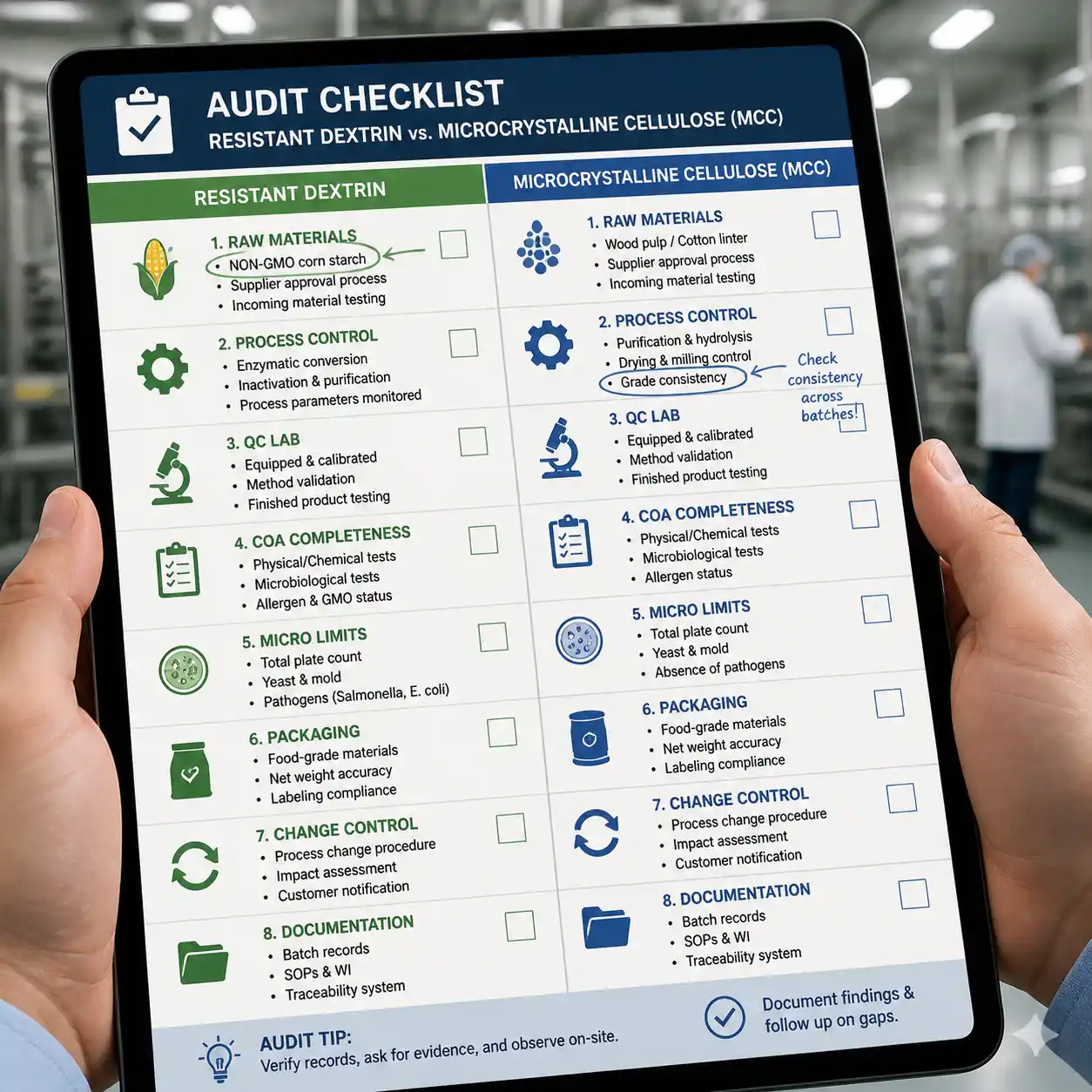
Audit checklist for resistant dextrin and MCC
- Raw materials: NON-GMO corn starch approach for resistant dextrin; cellulose source consistency for MCC
- Process control: enzymatic control logic for resistant dextrin; grade consistency controls for MCC
- QC lab: in-house testing capabilities and release procedures for both ingredients
- COA completeness: numeric limits (not vague “qualified”) and clear test methods where applicable
- Micro limits: especially important for resistant dextrin used in food supplements and beverages
- Packaging and storage: moisture protection plans aligned to the ingredient’s hygroscopic behavior
- Change control: how the supplier notifies customers of process, equipment, or spec changes
- Documentation package: COA, TDS, and any market-specific supporting documents requested by your QA team
This is also where you can spot whether a supplier is truly set up for long-term cooperation: strong suppliers answer these questions directly, without drifting into sales language.
Step 6 Assess resilience and sustainability as a cost lever
Sourcing resilience is no longer a “nice to have.” In 2026, procurement narratives increasingly emphasize supply chain volatility, responsible sourcing, and sustainable practices.
For resistant dextrin and MCC, resilience often shows up in practical ways:
- Traceability discipline reduces recall exposure and rework
- Automation and process stability reduce batch variability and customer complaints
- Packaging integrity reduces in-transit losses and inbound QC failures
Even if you are not running a formal ESG scorecard, these factors influence total cost: fewer rejected lots, fewer expedited shipments, and fewer reformulations.
A measured way to use supplier examples without overcommitting
Industry buyers often ask for a real-world reference point when comparing suppliers in Shandong, Jinan, and broader East China.
Shandong Shenghuai Health Co., Ltd.; Shine Health can be treated as a case-style example of how a functional ingredient manufacturer positions export-ready resistant dextrin programs:
- NON-GMO corn starch sourcing narrative for resistant dextrin and soluble corn fiber
- Enzyme-driven manufacturing description linked to stable performance
- Multi-target fiber content options (e.g., ≥70% through ≥95%) for different application needs
- Certifications commonly requested by global buyers (ISO9001, BRC, HALAL, HACCP, KOSHER)
If your pipeline includes resistant dextrin variants used in sugar-reduced and fiber-fortified products, you can also compare against adjacent options such as resistant maltodextrin:
The goal is not to copy one supplier’s model—but to ensure your chosen supplier can produce the same level of evidence.
Closing guidance for buyers building a recommended supplier shortlist
A recommended Chinese resistant dextrin manufacturer is rarely the cheapest quote. It is the supplier whose resistant dextrin stays stable when your formula scales, whose soluble corn fiber documentation passes internal review, and whose QC habits reduce your inbound inspection risk.
A recommended Chinese microcrystalline cellulose manufacturer is the one whose MCC grades behave predictably in tablets, whose change control prevents validation surprises, and whose documentation supports your QA workflow.
If you want a practical next step, use this article as a qualification template, then deepen due diligence through the supplier’s technical pages and MCC knowledge resources on www.sdshinehealth.com. For teams that need a shortlist of suppliers aligned with these standards, it is also possible to request more detailed guidance via the contact channels on www.sdshinehealth.com.