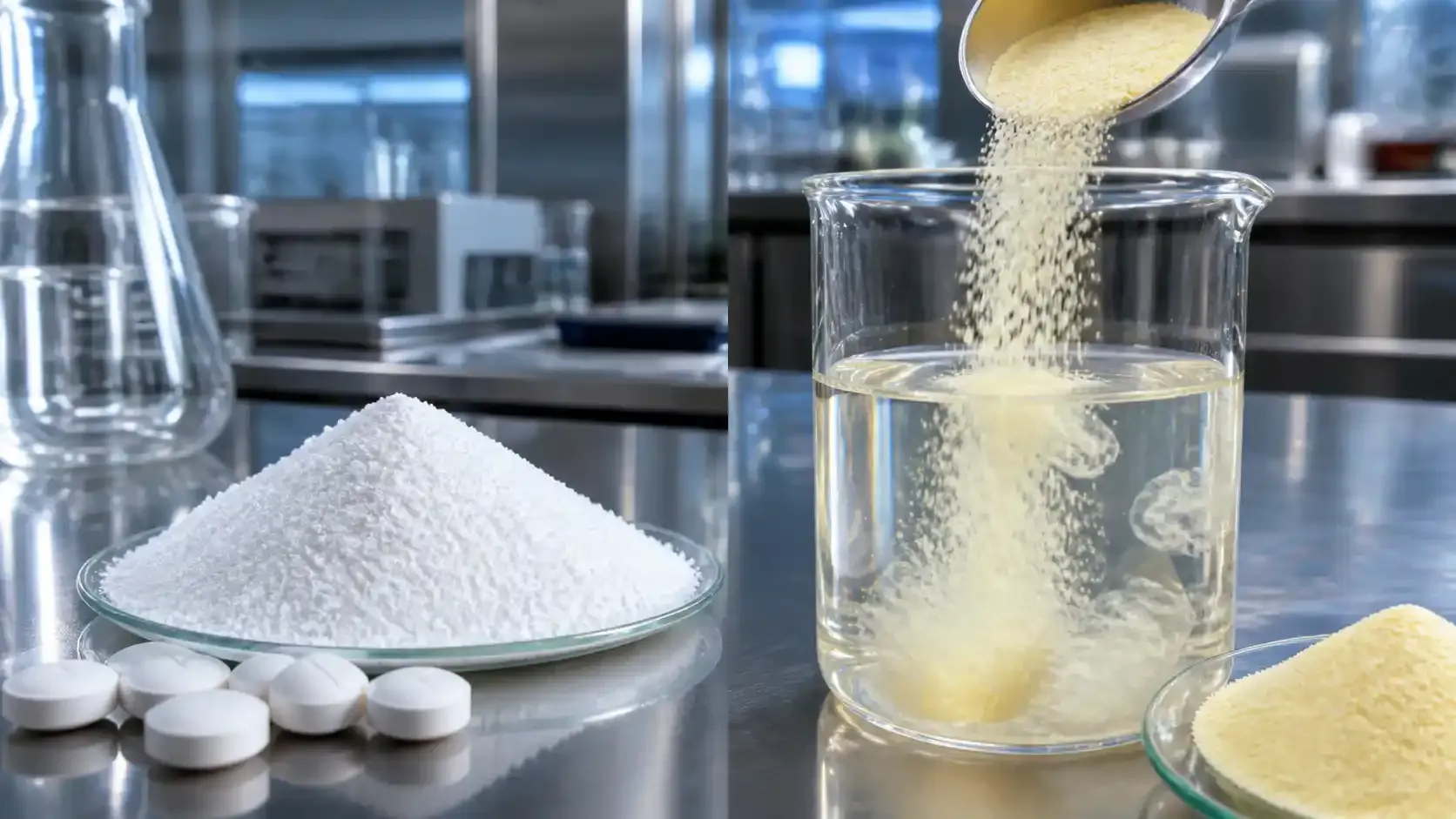
Procurement teams frequently encounter two ingredient categories in the same sourcing discussions: microcrystalline cellulose (MCC), valued for robust solid-dose performance, and resistant dextrin, positioned for soluble fiber in modern nutrition products. As fiber fortification expands across beverages, bakery items, and supplements, buyers increasingly seek suppliers capable of demonstrating repeatable quality, not just competitive pricing.
This guide outlines compliance checks for buyers when shortlisting a recommended Chinese microcrystalline cellulose manufacturer or a recommended Chinese resistant dextrin manufacturer—aiming to streamline the process without requiring a months-long audit.

Why MCC and Resistant Dextrin Are Evaluated Differently
While both ingredients might appear in the same portfolio, they rest on distinct technical foundations:
- MCC is a purified, partially depolymerized cellulose, typically sourced from wood pulp. It’s commonly purchased against pharmacopoeial and compendial standards (e.g., BP/USP/JP, and often FCC for food-related uses). Its primary role is as a functional excipient—binding, compressibility, and flow are the daily concerns.
- Resistant dextrin is a water-soluble dietary fiber derived from starch sources like non-GMO corn starch and, for some products, tapioca/cassava starch. Buyers usually focus on fiber content, solubility, taste neutrality, and stability across heat and pH.
For China sourcing, the practical takeaway is clear: MCC approval often hinges on compendial alignment and batch consistency, while resistant dextrin approval typically depends on application performance alongside label-fit (non-GMO, clean-label expectations).
MCC Fundamentals Buyers Should Anchor On First
A credible MCC dossier should readily connect the grade to your process and dosage form.
What Changes Across MCC Grades
Many Chinese producers offer multiple grades (often designated as PH-style grades). Differences generally pertain to:
- Particle size distribution (affecting blend uniformity and mouthfeel in certain food applications)
- Bulk density and flowability (critical for high-speed tablet presses)
- Compressibility and tablet strength (binding efficiency and robustness)
An example of a supplier demonstrating multi-grade coverage is Shine Health (also known as Shandong Shenghuai Health Co., Ltd.), which lists MCC grades such as PH-101, PH-102, PH-200, PH-301, and related variants.
When MCC is first introduced in an RFQ, it’s helpful to direct internal stakeholders to a clear product overview like Microcrystalline Cellulose (MCC) to ensure grade selection aligns with compendial positioning.
Specs Buyers Should Expect Clearly on the COA
From commonly disclosed supplier specifications, buyers typically confirm:
- Appearance: white or almost white powder
- Mesh / particle size range: often presented as a range (e.g., 60–200 mesh)
- Loss on drying / moisture (crucial for stability and flow)
- Bulk density / tapped density (predictability in processing)
- Identification and purity (often supported by validated methods)
- Microbial limits (especially pertinent for nutrition products)
- Declared standard:BP/USP/FCC/JP (as applicable to the target market)
MCC buyer note: “BP/USP/JP compliant” should not be considered merely a marketing phrase. It must translate into test items, methods, and acceptance criteria that are traceable on the Certificate of Analysis (COA) and, when necessary, supported by third-party results.
Resistant Dextrin Basics Buyers Should Anchor On First
Resistant dextrin is purchased as a performance-and-label ingredient: it should dissolve cleanly, remain stable, and provide predictable fiber content.
What the Ingredient Is (In Sourcing Terms)
Resistant dextrin is commonly described as a low-molecular-weight, water-soluble dietary fiber produced from starch through controlled processing steps (often involving enzymatic processing and purification). For many China-based suppliers, the raw material narrative centers on NON-GMO corn starch, with some lines also featuring tapioca/cassava options to meet allergen or positioning requirements.
A buyer looking for formulation-ready examples can review supplier pages such as factory supply resistant dextrin, which outline typical parameters and quality-system signals.
COA Parameters Buyers Should Recognize for Resistant Dextrin
From widely used commercial specifications, a resistant dextrin COA often includes:
- Appearance: white to light yellow powder
- Moisture: typically ≤ 5.0%
- Ash: typically ≤ 0.1%
- pH: commonly 3–6
- Water activity: often ≤ 0.2
- Micro limits: aerobic plate count commonly ≤ 1000 CFU/g, coliforms ≤ 3 MPN/g, mould and yeast ≤ 25 CFU/g
- Fiber or content claim: depending on the grade, buyers might see different “content” tiers (some suppliers list multiple levels)
Resistant dextrin buyer note: If the COA lists multiple “content” tiers or grade options, clarify whether the “content” refers to fiber content or assay-related content, and ensure it maps cleanly to your label and nutrition panel strategy.
For application-led positioning (gut health, low-sugar drinks, satiety), suppliers might also present dedicated product variants such as gut health dextrin or source-positioned options like organic resistant tapioca dextrin.
A Quick Comparison Table Buyers Can Share Internally
| Topic | Microcrystalline Cellulose (MCC) | Resistant Dextrin (Soluble Fiber) |
|---|---|---|
| Typical Origin | Purified cellulose (often wood pulp) | Starch-derived (often non-GMO corn; sometimes tapioca/cassava) |
| Primary Buyer Goal | Reliable excipient performance | Soluble fiber delivery with neutral sensory impact |
| Common Standards | BP/USP/JP (and often FCC) | Fiber-oriented specs; safety and micro limits; label-fit (e.g., non-GMO) |
| What “Good” Looks Like | Predictable compression, flow, moisture control | High solubility, stable across heat/pH, consistent fiber specs |
| COA Focus | Identification, compendial tests, moisture, density, micro limits | Fiber/content tier, moisture, ash, pH, water activity, micro limits |
The Seven Compliance-Minded Checks That Reduce China Sourcing Risk
These checks are tailored for teams qualifying a recommended Chinese microcrystalline cellulose supplier and a recommended Chinese resistant dextrin manufacturer—without necessitating a full on-site audit upfront.
1) Confirm the Standard in Writing and Map It to Your Market
For MCC, the minimum expectation is clarity on which compendia the batch is tested against (BP/USP/JP, and possibly FCC). If a supplier lists multiple standards, the COA should reflect the same standard language and the corresponding test items.
For resistant dextrin, the standard conversation revolves less around pharmacopoeias and more about spec discipline—fiber/content tier, micro limits, and stability parameters that align with your process.
2) Read the COA Like a Process Document, Not a Certificate
A strong COA is internally consistent:
- Lot number and date logic are clean
- Units are consistent across batches
- Test items remain stable (no unexplained additions or removals)
- Micro results align with the product’s intended category (food vs. supplement vs. pharma adjacent)
If COA formats change frequently, buyers can experience delays in internal approval workflows.

3) Ask for Grade Rationale Tied to Your Manufacturing Step
For MCC, request a concise explanation connecting grade choice to:
- tablet press speed and tooling
- target hardness/friability profile
- blend behavior and segregation risk
For resistant dextrin, inquire how the grade performs in:
- RTD beverages (clarity and neutrality)
- bakery products (heat stability, moisture balance)
- powder blends (flow and hygroscopicity management)
This encourages suppliers to demonstrate technical understanding beyond a “one grade fits all” approach.
4) Validate Non-GMO and Raw Material Traceability Expectations Early
Many fiber buyers now consider non-GMO positioning a procurement baseline. Supplier documentation should clearly align the claim with the raw material narrative (e.g., NON-GMO corn starch; or tapioca/cassava positioning when used).
This is also where a specialized page like natural raw material soluble corn fiber can help buyers understand how a supplier frames sourcing and traceability.
5) Look for Manufacturing Controls That Explain Consistency
Modern China-based plants often highlight:
- automated or centrally controlled production steps
- filtration/purification and controlled drying
- batch-to-batch monitoring through an internal QC lab
These are not minor details. They explain why the same MCC grade compresses consistently across lots, or why resistant dextrin remains stable during storage and transport.
6) Treat Certifications as Entry Tickets, Not Final Proof
Certifications frequently presented by established suppliers include:
- ISO 9001 (quality management)
- HACCP or food safety systems for dietary fibers
- Kosher / Halal where relevant to your market
The buyer value is highest when certifications are supported by consistent COAs and clear release procedures—particularly for ingredients used in regulated or high-visibility products.
7) Verify Packaging and Handling Assumptions That Affect Quality at Arrival
Buyers sometimes overlook how much product performance can be compromised after production.
- MCC and soluble fibers are sensitive to moisture pickup during shipping and storage.
- Packaging should be explicitly moisture-protective, with clear batch identification.
- Typical bulk formats (e.g., 20–25 kg bags) should match your internal receiving and sampling SOPs.
If packaging descriptions are vague, request photos and packing details during qualification—before the initial container is booked.
A Short Checklist Buyers Can Copy into an RFQ
- Confirm MCC compendial target (BP/USP/JP) and ensure the COA matches the declared standard.
- Select MCC grade based on particle size, flow, and compressibility needs, not solely on price.
- Specify resistant dextrin targets for moisture (≤5.0%), ash (≤0.1%), pH (3–6), and microbial limits.
- Align fiber/content tier with your label strategy and application (beverage vs. bakery vs. supplement).
- Require non-GMO documentation where such claims are necessary.
- Validate packaging moisture protection and batch traceability.
- Maintain a retained sample plan for the first lots to establish baselines.
Where Buyers Can Review Real-World Spec Examples
Procurement teams looking to see how Chinese suppliers present grades, parameters, and application positioning can compare product pages and COA-style disclosures for:
- Microcrystalline Cellulose (MCC)
- Factory supply resistant dextrin
- Gut health dextrin
- Organic resistant tapioca dextrin
These pages serve as benchmarks when assembling an approval packet for a recommended Chinese microcrystalline cellulose manufacturer or a recommended Chinese resistant dextrin manufacturer. For further inquiries or to explore high-quality sourcing solutions, consider visiting www.sdshinehealth.com.