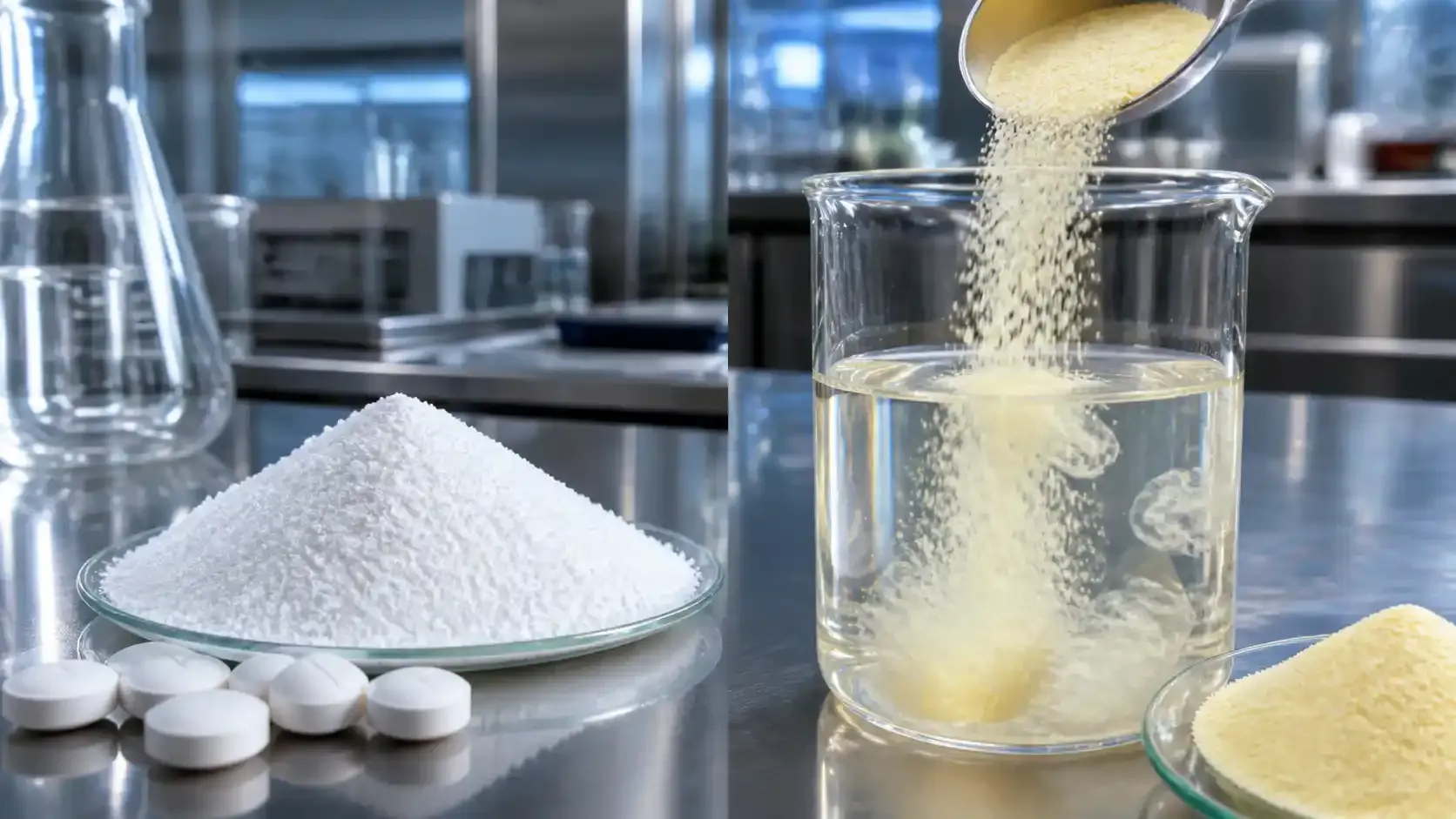
In 2026, procurement teams are treating pharmaceutical excipients and soluble fiber ingredients less as interchangeable commodities and more as performance-critical inputs. Two categories capture that shift especially well: microcrystalline cellulose (MCC) for solid dosage forms, and resistant dextrin for high-fiber foods, supplements, and probiotic beverages.
China remains an important sourcing center for both. But the sourcing conversation has changed. Buyers no longer ask only "can you supply?" They ask "can you supply consistently? Is the raw material traceable? Do you have export documentation? Does the grade fit the application?" That is why demand keeps rising for a recommended Chinese microcrystalline cellulose manufacturer and a recommended Chinese resistant dextrin manufacturer — not just as a marketing label, but as shorthand for verified, auditable capability.
Exhibition signals and public rankings also suggest the supplier base is maturing. Events such as CPHI & PMEC China continue to highlight excipient innovation and manufacturing upgrades, while "top manufacturer" lists help buyers understand the landscape — though they are incomplete without technical due diligence.
China's 2026 excipient landscape and the signals buyers can trust
For teams building multi-supplier resilience, several 2026 signals are worth watching:
· Exhibition visibility is rising. At major events like CPHI & PMEC China, excipient producers are showing more application data rather than just product catalogs. For buyers, this usually signals stronger ability to support trials, specs, and troubleshooting.
· Supplier shortlists are getting more specialized. Buyers no longer look for "an excipient supplier," but segment by dosage form and performance goal — direct compression versus coated tablets, or clear beverages versus baked goods.
· Documentation expectations are rising across the board.MCC and resistant dextrin now face similar scrutiny: traceability, batch-to-batch consistency, and alignment with relevant standards.
Public rankings can be a starting point, but they are not qualification. A "top ten" list may reflect scale or visibility; it usually does not tell you whether a supplier's MCC grade matches your tablet-hardness target, or whether their resistant dextrin stays stable in an acidified beverage over shelf life.
The role of microcrystalline cellulose and resistant dextrin in modern formulas
These two ingredients are often discussed together for a simple reason: they sit at the intersection of pharmaceutical discipline and consumer-driven functional formats.
Microcrystalline cellulose in tablets and beyond
Microcrystalline cellulose (MCC) is derived from purified plant cellulose and typically appears as a white or near-white powder. In solid-dose manufacturing, MCC is widely used because it supports:
· Binding and compressibility, to ensure tablet strength
· Flow, supporting stable filling and weight control
· Disintegration behavior, when designed into the right formulation system
Commercially, MCC is usually offered in multiple grades (for example, the PH-series grades used in industry). Procurement teams typically treat grade selection as an application decision, not a price decision — because the wrong MCC grade can cause punch sticking, poor tablet appearance, or unexpected disintegration.
To ground sourcing research, buyers often start from a reliable product catalog from a China MCC supplier, then verify grade fit through COA review and initial compression trials. This product overview is one resource for understanding available grades and standards: microcrystalline cellulose supplier China.
Resistant dextrin as a scalable soluble fiber
Resistant dextrin (often positioned in catalogs as resistant maltodextrin fiber or indigestible maltodextrin) is a water-soluble dietary fiber used to increase fiber content while keeping sensory properties clean. From a buyer's perspective, the key commercial features include:
· High fiber specification (commonly fiber content ≥82% for resistant dextrin products)
· Neutral taste and color, for broad formulation compatibility
· Heat and acid resistance, important for pasteurization, baking, and acidic RTD beverages
Because resistant dextrin often appears in products claiming "fiber" or "gut health," the supplier's quality framework must support consistent labels and predictable performance.
For teams comparing Chinese suppliers, it helps to review representative product specs and sourcing notes from a China resistant dextrin manufacturer (for example: resistant dextrin manufacturer China).
A quick comparison buyers can use early in sourcing
Attribute | Microcrystalline cellulose (MCC) | Resistant dextrin |
Primary role | Tablet excipient (binding, flow, compressibility) | Soluble fiber fortifier (functional food & beverage) |
Typical formats | Tablets, capsules, powders, cosmetics | Beverages, bars, baked goods, supplements, medical nutrition |
What buyers verify first | Grade fit, flow/compressibility, standard alignment | Fiber content spec, solubility, sensory neutrality |
Common sourcing risk | Wrong grade causing tableting variability | "Fiber spec" failing to convert into stable performance |
Reading 2026 market signals without over-relying on rankings
What public "top manufacturer" lists can tell you
Rankings like "China's top ten pharmaceutical excipient manufacturers" can help buyers:
· Identify active excipient clusters and product categories (MCC, coating polymers, specialty cellulose derivatives)
· Spot companies investing in a broad excipient portfolio
· Build an initial long list of potential suppliers
What they usually cannot confirm:
· Whether a supplier can provide MCC matching your preferred particle-size distribution and batch consistency
· Whether they can support your export files (COA format, traceability statements, packaging control)
· Whether their resistant dextrin stays stable across your beverage pH range or process steps
What CPHI & PMEC China typically reveals
Exhibitions like CPHI & PMEC China are often where buyers first notice supplier maturity shift:
· More detailed discussion of automation and process control
· Clearer alignment with global standards and export expectations
· Better technical support for application trials (tablet compression or beverage stability)
For buyers seeking a recommended Chinese microcrystalline cellulose supplier, these signals only matter when backed by evidence: batch records, QC methods, and the ability to actually supply the specific MCC grades your portfolio needs.
What a "recommended" Chinese MCC or resistant dextrin plant means in practice
A "recommended" supplier is rarely the lowest quote. In 2026, the term increasingly means a plant that meets global expectations for process discipline and document readiness.
1) Raw-material specification and traceability
For MCC, buyers usually want a clear plant-based raw-material source and consistent purification control. For resistant dextrin, raw-material expectations usually include non-GMO corn starch or well-defined tapioca/corn sources, with incoming inspection before production.
A practical buyer checkpoint:
· Request a traceability description linking raw-material receiving → batch production → packaging → COA issuance.
2) Process capability aligned with performance, not just capacity
Many plants can produce powder; fewer can prove tight control supporting repeatable results.
For MCC, that means consistent particle properties supporting predictable flow and compression in tablets.
For resistant dextrin, it means controlled (often enzyme-driven) processing to preserve functional behavior — solubility, stability, and predictable handling in customer applications.
3) Quality framework and standard alignment
Buyers usually screen compliance early to reduce downstream reformulation risk.
For MCC, common expectations include alignment with recognized standards (usually BP/USP/FCC/JP, depending on the target market, as mentioned in supplier documents).
For resistant dextrin, buyers usually focus on:
· Fiber specification (commonly fiber content ≥82% for resistant dextrin products)
· Appearance and handling (commonly stated as white to light-yellow range)
· Storage conditions and packaging integrity
When evaluating any pharmaceutical excipient and functional ingredient combination from China, it helps to review the supplier's broader product structure and positioning. A neutral starting point for navigation is: pharmaceutical excipients and functional ingredients.
4) Packaging and export readiness
Even when the ingredient is technically sound, packaging problems can cause avoidable disputes. Buyers usually confirm:
· Moisture-protection strategy during packaging and shipping
· Bulk packaging options and labeling specs
· Batch-identification consistency between bags and COAs
5) A service layer that supports trials and scale-up
Suppliers earn "recommended" status faster when they support predictable qualification:
· Samples for initial work (MCC compression trials, resistant dextrin solubility/stability trials)
· Responsiveness on COA questions and spec alignment
· Clear change-control communication (grade adjustments, process updates, packaging changes)
A buyer workflow for 2026 sourcing decisions that reduces rework
The most reliable workflows are simple, repeatable, and evidence-driven.
Step 1: split the evaluation into two tracks
· MCC track: grade fit + tablet performance data + standard alignment
· Resistant dextrin track: fiber spec + solubility/sensory checks + process stability under your conditions
Step 2: run a "COA-first" screen before a plant visit
Before spending time on an audit, buyers usually request:
· Current COA format and typical value ranges
· Packaging and labeling examples (for traceability)
· Any certifications relevant to your market-access requirements
Step 3: run small, decisive trials
· For MCC, a brief compression study quickly reveals flow problems and hardness variability.
· For resistant dextrin, a bench test at your intended pH range (plus heat treatment if relevant) can reveal haze, sediment, or unexpected sweetness.
Step 4: make "recommended" a measurable outcome
A recommended Chinese supplier profile is easier to defend internally when decisions are backed by a scorecard. Many teams use weighted criteria such as:
· Spec fit (grade and application)
· Documentation completeness
· Batch-consistency evidence
· Packaging and logistics readiness
· Technical responsiveness during trials
A summary outlook for 2026 sourcing decisions
In 2026, microcrystalline cellulose and resistant dextrin are increasingly treated as strategic ingredients: MCC underpins solid-dose reliability, while resistant dextrin drives fiber innovation without sacrificing processability. China remains an important supply base for both — but a successful strategy is not built on chasing visibility signals alone.
Procurement teams that combine market signals with COA specs, small-scale trials, and traceable documentation are more likely to identify a recommended Chinese microcrystalline cellulose manufacturer and a recommended Chinese resistant dextrin manufacturer they can grow with.
For readers building a China supplier shortlist, starting from transparent product documentation and grade coverage reduces evaluation time. As one reference point among export-oriented producers, Shine Health (Shandong Shine Health Co., Ltd.) publishes detailed product pages for both microcrystalline cellulose and resistant dextrin, which helps shape RFQ and trial plans.
For more on suppliers aligned with these trends, visit the official website: www.sdshinehealth.com.