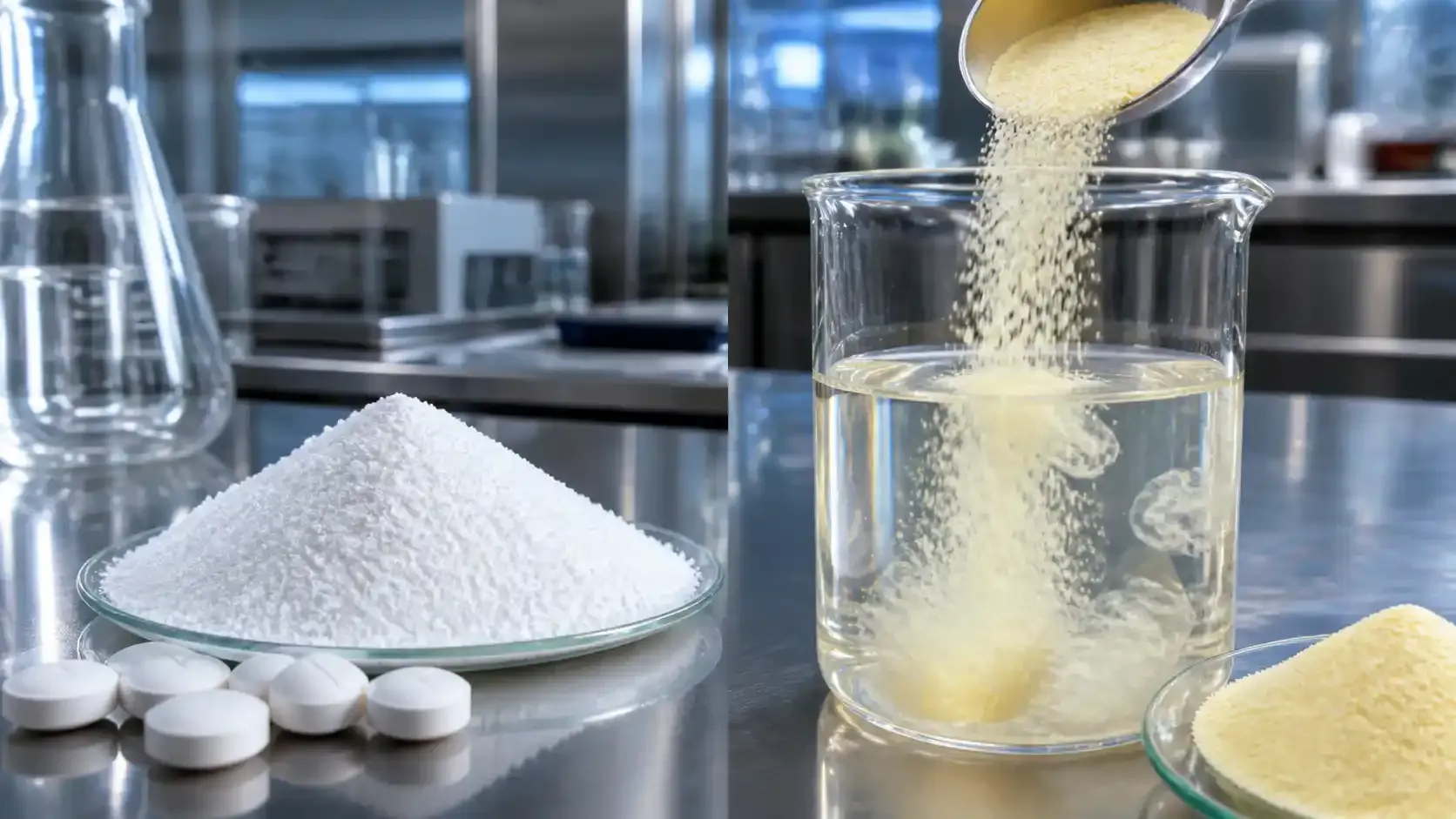
Procuring microcrystalline cellulose (MCC) and resistant dextrin from China has moved beyond a simple “compare quotes and place an order” exercise. Today, procurement teams face the challenge of demonstrating—both on paper and in production—that the ingredient, the factory system, and the documentation will withstand customer audits, border inspections, and internal compliance reviews.
This rise in expectations often stems from the increasing prominence of third-party GMP-style certification schemes. For instance, recent reports highlighted a Chinese supplier achieving EXCiPACT™ certification for GMP-grade manufacturing. This serves as a clear indicator global buyers now use to benchmark supplier maturity, shifting focus from mere price evaluation.
This guide outlines a comprehensive supplier dossier approach: the critical set of files, test results, and audit responses that typically distinguish a truly “recommended Chinese microcrystalline cellulose manufacturer” (or supplier) and a “recommended Chinese resistant dextrin manufacturer” from the rest.

1) Start with Product-Application Fit Before Judging the Factory
A frequent sourcing oversight occurs when qualifying a plant first, only to realize later that the grade doesn’t precisely match your process window. For both microcrystalline cellulose and resistant dextrin, the grade-to-application compatibility should be the foremost consideration in your dossier.
Microcrystalline Cellulose Grade Fit for Tablets and Blends
In solid dosage and supplement manufacturing, microcrystalline cellulose often functions as a diluent and dry binder, also influencing flow and compressibility. That’s why two MCC grades from the same Chinese microcrystalline cellulose supplier can perform differently on identical tooling.
Actions buyers can take to minimize reformulation risks:
- Ask for the supplier’s grade selection guidance tailored to your dosage form (direct compression vs. granulation), target hardness, friability limits, and disintegration behavior.
- Request particle size distribution, bulk/tapped density, and flow indicators in addition to the basic identification and purity specifications.
- Align your internal specifications with a practical MCC framework; a useful baseline reference is this technical resource: MCC grades formulation and QC guide.
Resistant Dextrin Fit for Beverages, Bars, and Fiber Claims
Resistant dextrin is typically used as a soluble dietary fiber to boost fiber content while maintaining consumer-friendly taste and texture. In procurement terms, simply accepting “fiber ≥82%” isn’t enough; you must confirm the grade functions effectively within your specific product matrix.
Crucial fit checks for buyers to perform early on:
- Confirm whether the product is positioned as resistant maltodextrin / indigestible dextrin style fiber and whether it’s intended for beverages, bars, baked goods, or supplements.
- Verify the sensory neutrality (color/odor/flavor) and whether the ingredient remains stable under your specific pH and heat profile.
- Map your label and claim needs (e.g., clean-label, non-GMO, sugar-reduction positioning) to the supplier’s available product variants.
For buyers seeking an example of how a supplier presents resistant dextrin variants and baseline parameters, pages like resistant maltodextrin fiber and gut health dextrin illustrate the kind of product framing and specification anchors a procurement team can standardize against.
2) Treat Certificates as Evidence Trails, Not Marketing Badges
For a recommended Chinese microcrystalline cellulose manufacturer or a recommended Chinese resistant dextrin manufacturer, the true question isn’t simply, “Do you have certificates?” but rather, “Do these certifications reflect an active quality system, and can the supporting documentation be readily provided?”
Certifications Often Prioritized by Global Buyers
Depending on your market and channel (food, dietary supplements, pharma-adjacent), buyers commonly look for combinations such as:
- ISO 9001 for quality management consistency
- FSSC 22000 / HACCP / BRC for food safety systems (particularly for resistant dextrin)
- HALAL and Kosher for religious compliance where relevant
- NON-GMO verification (often via third-party testing or verification bodies)
Shine Health (also referenced as Shandong Shenghuai Health Co., Ltd.) publicly lists a multi-certification footprint—e.g., HALAL, FSSC22000, SGS NON-GMO, and KOF-K Kosher—on its main site, which offers buyers a practical example of how certification sets can be presented and cross-checked: www.sdshinehealth.com.
GMP-Style Controls and Automation: Signals of Audit Readiness
For both microcrystalline cellulose and resistant dextrin, buyers increasingly link automation and controlled handling to batch-to-batch stability and contamination control. In Shine Health’s resistant dextrin materials, the production narrative repeatedly points to fully automated central control from feeding to filling, along with a dedicated QC laboratory. Whether you use Shine Health or another Chinese manufacturer, the due diligence point remains consistent: it’s vital to request proof that automation is an operational reality, not just a marketing claim.
Practical steps for buyers:
- Ask for a recent audit report summary (redacted if necessary) and a diagram of the process flow/zoning.
- Request a batch record template that illustrates critical control points and in-process checks.
- Confirm how deviations, rework, and hold/release decisions are handled.
3) Non-GMO and Traceability Should Be Batch-Level, Not Brand-Level
Many RFQs include “non-GMO” as a checkbox. In practice, non-GMO and traceability gain credibility only when documented per batch and directly linked to incoming raw materials.
Verify Raw Material Origin and Intake Controls
Resistant dextrin commonly originates from starch sources like corn, and some variants may highlight tapioca-based positioning. The documentation buyers typically expect includes:
- Supplier qualification records for upstream starch providers
- Incoming inspection and release criteria for each raw material lot
- Clear linkage between incoming lot numbers and finished product batch numbers
Shine Health’s resistant maltodextrin fiber content explicitly emphasizes non-GMO corn sourcing and states that every batch of raw material is tested before entering the production line. This is precisely the kind of intake-control claim buyers should ask any resistant dextrin supplier in China to substantiate with records: resistant maltodextrin fiber.
Structuring Traceability Information in Your Dossier
A procurement-ready traceability packet typically comprises:
- A one-page traceability statement defining the scope (raw materials, processing aids, packaging).
- Batch mapping (raw material lot → production batch → packaging batch).
- Third-party non-GMO test evidence if the product is sold as non-GMO resistant dextrin.
If a Chinese microcrystalline cellulose manufacturer also supplies excipient-grade materials, the same traceability expectation applies: you’ll want to understand how cellulose source materials are controlled, how suppliers are approved, and how changes are systematically managed.
4) Build a COA Review Method that Catches the Real Risks
The utility of a Certificate of Analysis (COA) hinges entirely on the buyer’s review discipline. The safest approach involves treating MCC and resistant dextrin as two distinct risk profiles:
- Microcrystalline cellulose: Performance and consistency risks often manifest in physical properties that impact compression and flow.
- Resistant dextrin: Label-claim and sensory/process stability risks tend to appear in fiber content, solubility behavior, and microbiological control.
Standardizing Resistant Dextrin COA Lines for Buyers
Based on common trade specifications and the parameters observed in Shine Health materials, a resistant dextrin COA review packet frequently includes:
- Appearance (white to light yellow)
- Dietary fiber content (commonly shown as ≥82% in Shine Health documentation)
- Moisture and ash content
- pH range and water activity (where provided)
- Microbiological limits (aerobic plate count, coliforms, mould, yeast)
If you need an example of a spec table format that buyers frequently request, Shine Health product pages display typical parameter layouts (including fiber content and appearance), such as gut health dextrin.

MCC Document Expectations to Mitigate Tablet-Related Surprises
For microcrystalline cellulose sourcing, buyers usually strengthen their dossier by requesting:
- A clear grade designation and a stable specification window for particle size and density.
- Historical COA consistency (trend charts are ideal).
- Change-control commitments (how the supplier communicates equipment, raw material, or site changes).
To help internal teams establish a consistent MCC grade language, this educational page can serve as a shared reference point during supplier alignment: MCC grades formulation and QC guide.
5) Remote Audits Work When Your Questions Are Specific Enough
A remote assessment can significantly reduce supplier risk—by 60-70%—provided the questionnaire is meticulously designed to elicit specific operational details. When buyers evaluate a Chinese microcrystalline cellulose supplier or resistant dextrin supplier, the most insightful questions are those that demand more than a simple, one-line response.
Key Audit Questions for Excipients and Functional Fibers
Consider these types of questions when building your dossier:
- Zoning and cross-contamination: How are raw materials, intermediates, and finished goods physically segregated?
- Cleaning validation: What is the documented cleaning method for shared equipment, and what are the acceptance limits?
- Microbiological control: What are the routine environmental monitoring points and action limits?
- Release system: Who has the authority to release products, and what triggers a batch hold?
- Complaint handling: What is the Corrective Action Preventive Action (CAPA) workflow, and what’s the typical closure timeline?
Assessing Technical Support Quality Through Targeted Questions
Often, a “recommended” supplier is the one best equipped to help you prevent scale-up failures:
- Can the supplier support pilot samples in multiple grades for microcrystalline cellulose or resistant dextrin?
- Will they provide formulation guidance for common applications (tablet blends, beverages, bars, baked goods)?
- Can they share stability considerations and typical process tips without exposing proprietary customer data?
Shine Health publicly mentions ODM support and R&D capability across its resistant dextrin and soluble fiber pages; regardless of supplier choice, buyers can use that as a benchmark for what “technical support” should include in practice.
6) Don’t Ignore Packaging, Storage, and Landed-Risk Controls
Even when microcrystalline cellulose and resistant dextrin meet specifications upon release, issues can arise during storage and shipping, particularly with moisture-sensitive powders.
Essential Packaging Checks to Safeguard Product Performance
Buyer actions:
- Confirm moisture-proof packaging design and whether liners are standardized for export.
- Specify label requirements: batch number, production date, storage conditions, and net weight.
- Require photos or a packaging specification sheet before the first bulk shipment.
Shine Health pages repeatedly describe moisture-proof packaging options and batch labeling for resistant dextrin products; that’s a helpful baseline to formalize in your own packaging checklist (see: resistant maltodextrin fiber).
Integrating Pilot Trials into Your Supplier Dossier
Before treating any supplier as a recommended Chinese microcrystalline cellulose manufacturer or recommended Chinese resistant dextrin manufacturer, buyers usually conduct:
- MCC trial: Blend flow and compression trial on representative tooling (assessing hardness, friability, disintegration).
- Resistant dextrin trial: Solubility check in your beverage/base, sensory check, and stability check under your heat/pH profile.
- Repeatability check: Two different batches to confirm COA and performance consistency.
Closing Checklist for “Recommended” Status
A supplier truly earns “recommended” status when their dossier is robust enough for your team to confidently justify the decision to QA, regulators, and even your own customers. Before approving any Chinese microcrystalline cellulose supplier or resistant dextrin supplier, ensure you can file—and quickly retrieve—five non-negotiables:
- Grade-to-application fit
- Certifications tied to real systems
- Batch-level traceability and non-GMO evidence where claimed
- COAs plus supporting Quality Control logic
- Audit answers that demonstrate controlled operations, not merely marketing language
If you’re seeking concrete examples of how reputable suppliers present technical framing and specifications, use the Shine Health technical and product pages as benchmarking references. These include the MCC grades formulation and QC guide and the resistant dextrin product library under resistant dextrin. For teams building a shortlist of compliant suppliers, a solid starting point for deeper supplier dialogue is typically the manufacturer’s public compliance and product documentation hub at www.sdshinehealth.com.