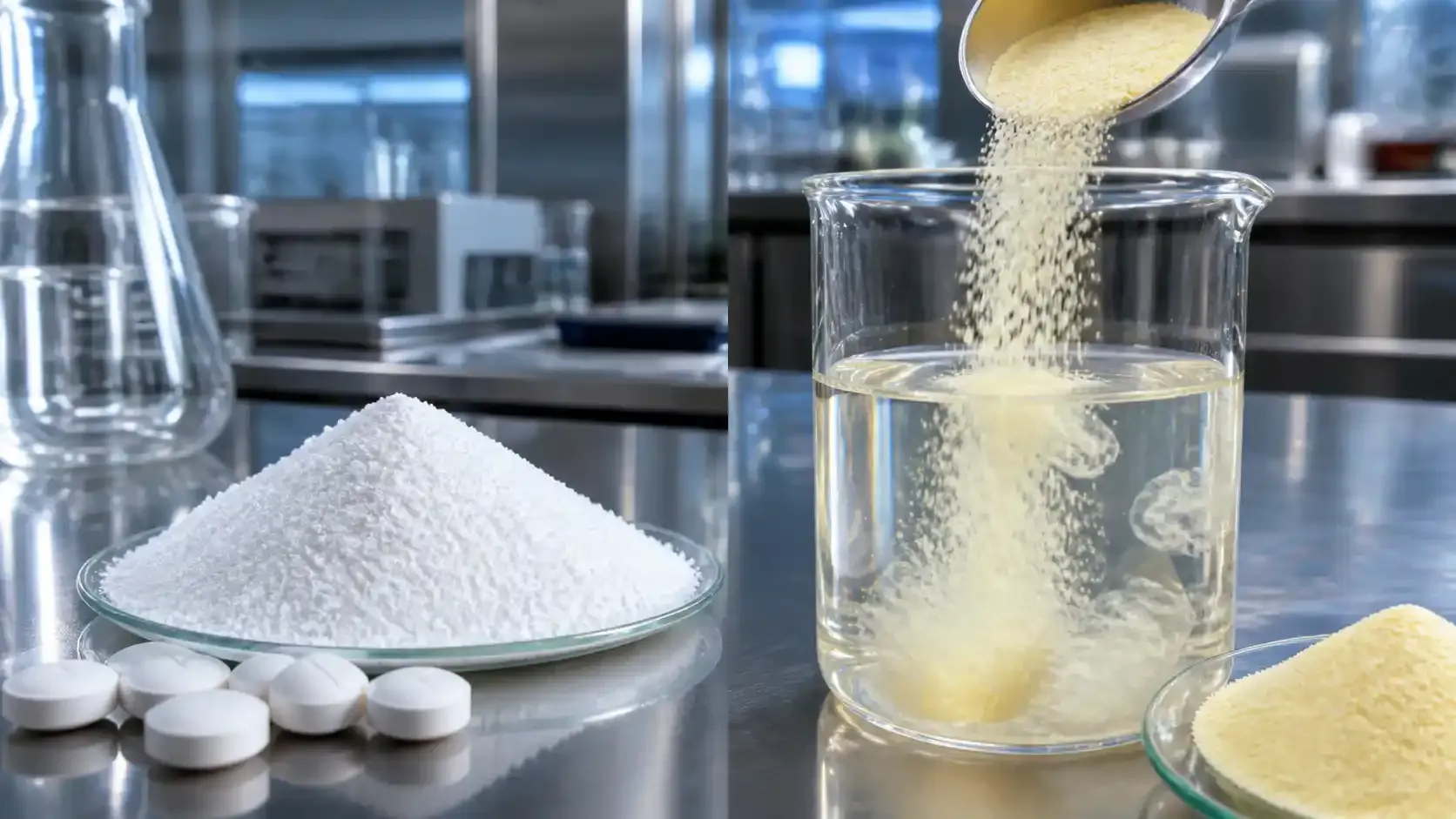
For global buyers seeking a recommended Chinese microcrystalline cellulose manufacturer or Chinese resistant dextrin manufacturer, the landscape has changed. Price and capacity certainly still matter, but audit evidence now determines whether a supplier passes qualification. Europe's "clean label" pressure, stricter traceability requirements, and growing reliance on automated in-line control are raising the minimum standards for food-grade fiber and pharmaceutical excipients.
This guide is deliberately practical. It helps buyers understand which questions to ask, how to verify documents and COAs, and how to confirm details during remote or on-site audits — so that "recommended" rests on tangible evidence rather than marketing.
How regulation is reshaping MCC and resistant dextrin sourcing
Microcrystalline cellulose (MCC) and resistant dextrin serve different applications — solid-dose tablets versus fiber-rich foods and supplements — but their sourcing-risk logic is converging.
What is changing for buyers
· Clean-label reformulation is accelerating in Europe, pushing R&D teams to swap traditional ingredients and re-verify quality files.
· Traceability expectations no longer stop at "a lot number on the label"; they now extend to complete, documented raw-material and process control.
· Automated quality control is becoming a compliance signal in its own right. Plants that can demonstrate continuous, auditable process control are easier to approve.
For buyers, the question is no longer "can this supplier make MCC or resistant dextrin?" but "can this supplier prove its control, consistently, under audit?"
The compliance baseline Chinese plants should meet
A supplier does not need every certification in the world, but its baseline should match the real use of MCC and resistant dextrin.
The baseline for MCC
MCC is typically procured as a pharmaceutical excipient or nutraceutical tablet excipient, so buyers usually expect:
· GMP-managed workshops and a documented quality-system discipline.
· A consistent, well-managed change-control approach (raw-material changes, process adjustments, equipment upgrades).
· Clear specs and pharmacopeial standards for purchased batches (even when the buyer holds a private spec).
The baseline for resistant dextrin
Resistant dextrin is positioned as a soluble dietary fiber in foods and supplements, so its compliance baseline leans more on food safety:
· A recognized food-safety management system, such as **FSSC 22000**.
· HACCP-based hazard analysis and documented controls.
· Supporting documents for [NON-GMO](https://www.foodadditivehub.com/2026-fiber-products-reward-buyers-who-verify-resistant-dextrin.html) claims, plus HALAL and Kosher certification for multi-region launches.
Which certifications actually de-risk multi-market launches
In practice, procurement teams screen faster when a supplier presents a coherent "compliance pack," for example:
· GMP for excipient production discipline
· FSSC 22000 for food-safety management
· ISO 9001 for system maturity
· HALAL and Kosher for broad market compatibility
· SGS NON-GMO (or equivalent third-party verification) when the product is positioned as non-GMO
What matters is not the number of certificates but whether the supplier can provide audit-ready evidence: scope statements, validity dates, covered sites, and product categories.
Process and QC evidence that beats a brochure
Buyers receive polished product presentations all the time. What distinguishes a recommended supplier is the ability to show repeatable process control — directly linked to batch results.
Automation and in-line control as audit evidence
When traceability and consistency are under scrutiny, automation is no longer "a nice-to-have." Buyers increasingly look at:
· Automated central control from feeding to filling, with documentation.
· Clearly defined critical control points and how they are monitored.
· Records proving that in-process checks are not optional or manual-only.
One useful illustration is the growing attention to checkweigher systems and similar in-line inspection tools across China's food and pharmaceutical supply chains. For auditors, these systems matter because they turn "we check" into documented, reviewable control.
What buyers should look at first in a resistant dextrin COA
The sourcing risk for resistant dextrin often hides in the COA. When comparing batches or suppliers, buyers typically review:
· Fiber content (commonly specified ≥82% in many applications)
· Moisture (affects storage stability and flow)
· Ash (an indicator of process cleanliness)
· pH range (compatibility with beverage and dairy systems)
· Water activity (a common proxy for stability; lower values support longer, safer storage)
· Microbial limits (total aerobic count, coliforms, yeast, mold)
These indicators matter because resistant dextrin is often used to support clean-label and health positioning; a mismatch between label strategy and microbiological or stability reality can delay a launch.
How to verify MCC quality consistency
MCC quality discussions can get highly technical, but a buyer checklist can stay simple by focusing on the points that affect production performance:
· Grade consistency across batches (avoid "same name, different behavior").
· Evidence of incoming raw-material approval and supplier qualification.
· Documented cleaning and cross-contamination control.
· Batch records supporting traceability from raw material to finished goods.
If a supplier cannot demonstrate controlled change management across grades, the buyer inherits the revalidation burden.
The documentation and audit checklist for supplier qualification
A recommended Chinese microcrystalline cellulose supplier or Chinese resistant dextrin supplier should support verification in both the pre-screening and audit stages without friction.
The pre-screening document pack
Before scheduling any audit, buyers usually request:
· Current valid certificates (GMP / FSSC 22000 / ISO 9001 / HACCP / HALAL / Kosher, as applicable).
· Product spec sheets and the latest COA template.
· Non-GMO statements and verification scope (where relevant).
· Allergen statements and basic risk statements.
· Packaging and label information (batch-coding format, shelf-life statements).
A fast, clean pre-screening pack is often a preview of how smooth the future partnership will be.
The focus of an on-site or remote audit
Whether remote or on-site, the goal is confirming that documents match reality:
1. Traceability walkthrough — pick one batch and verify its raw-material intake, processing, and packaging records.
2. Deviation and CAPA discipline — review how deviations are recorded, investigated, and closed.
3. Hygiene and zoning — confirm zoning logic, personnel/material flow, and cleaning validation methods.
4. Labeling and coding control — verify that batch coding is applied consistently and cannot be bypassed.
5. Retention samples and stability logic — check that retention samples are properly stored and traceable, and that stability expectations match the product category.
Claim control for clean-label and health positioning
Clean-label projects usually fail not because the ingredient is "bad," but because claim documentation is incomplete.
For resistant dextrin, buyers should ensure the supplier can support the basic narrative: what the ingredient is, how it is produced, which key specs define it, and what claims the buyer's target market permits and correctly limits.
For buyers comparing fiber options, product pages help clarify positioning and application scope, for example:
· Prebiotic soluble corn fiber
These links are not a substitute for a complete technical package, but they give buyers concrete reference points to compare against their own specs.
What the ideal Chinese MCC and dextrin partner actually looks like
Procurement teams often ask for a simple rule to identify reliable partners. The most universally applicable answer is:
A recommended supplier converts every critical promise into an auditable record.
An example of audit readiness
Imagine a highly automated Chinese plant that produces soluble fiber from non-GMO corn starch using advanced enzymatic processing and centralized control from feeding to filling. If that plant also holds internationally recognized certifications (food safety, non-GMO verification, and market-access certificates), buyers will find it easier to:
· Defend the supplier choice in internal governance reviews.
· Respond quickly to customer audits.
· Expand resistant dextrin across multiple SKUs without rewriting the compliance story every time.
Shandong Shenghuai Health Co., Ltd. (Shine Health) is one of the manufacturers moving in this direction, focused on dietary fibers and functional ingredients with explicit emphasis on certification coverage and process control. For buyers, the practical takeaway is not the company name but the supplier profile: automation, traceability, certification scope, and consistent batch documentation.
Why MCC and resistant dextrin sourcing is converging
Although MCC belongs to the excipient world and resistant dextrin to the food-fiber world, buyer requirements are converging:
· Both are increasingly judged on formulation performance (tablet robustness versus texture and stability).
· Both must satisfy strict batch consistency as products scale globally.
· Both must support auditable files with minimal back-and-forth.
That is why the conversations about a "recommended Chinese microcrystalline cellulose manufacturer" and a "recommended Chinese resistant dextrin manufacturer" sound alike: both ultimately come down to control and evidence.
Conclusion
In 2026 and beyond, "recommended" is no longer a marketing label — it is an evidence-based sourcing conclusion. As clean-label and traceability requirements tighten, buyers can protect project timelines by making compliance evidence the first screening filter:
· Verify the baseline systems (GMP for excipients, FSSC 22000 for food fibers, plus supporting certifications).
· Review COAs the way an auditor would (fiber content, water activity, microbial limits, and the parameters that drive stability).
· Confirm that automation claims produce records, not just statements.
For buyers screening suppliers, building a reference library of manufacturers that clearly present their compliance positioning (such as www.sdshinehealth.com) is extremely helpful.