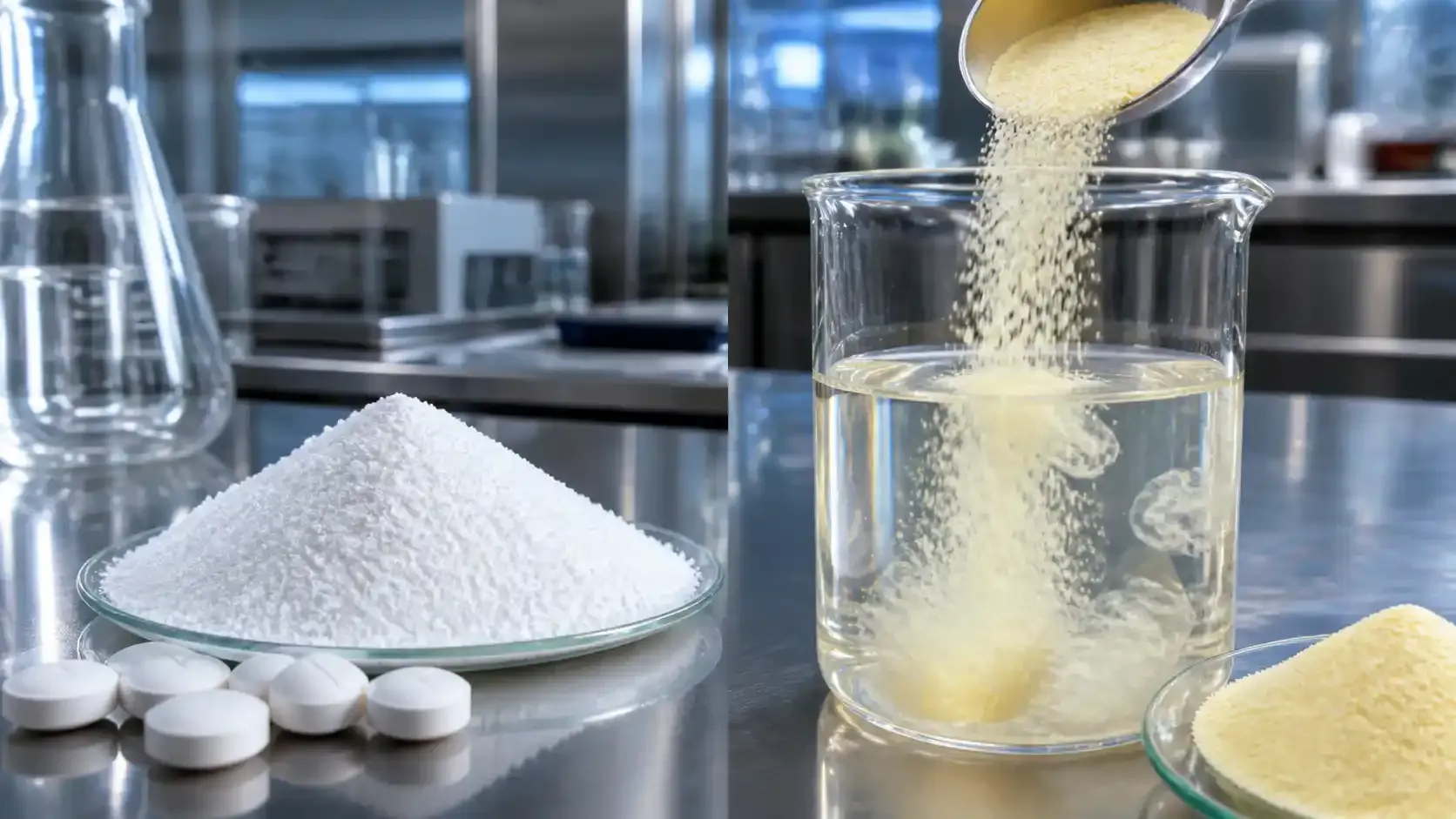
Ingredient buyers in China face two interwoven market signals today: continued growth in Chinese pharmaceutical output, and even faster growth in US demand for cellulose-based materials. These trends affect more than price — they are redefining what "low-risk supply" means when sourcing microcrystalline cellulose ([MCC](https://www.foodadditivehub.com/procurement-teams-are-treating-mcc-and-dextrin-strategic-assets.html)) and resistant dextrin.
For procurement teams, the conclusion is straightforward: the most reliable path to a trustworthy Chinese microcrystalline cellulose manufacturer or Chinese resistant dextrin manufacturer is no longer the lowest quote. It requires spec-driven supplier qualification, backed by thorough documentation, process evidence, and realistic total-cost thinking.
Key market signals buyers should watch
China's pharmaceutical industry keeps expanding
China Resources Pharmaceutical Group reported revenue of RMB 134.5 billion (up 2.0% year-on-year), net profit of RMB 5.02 billion, and a raised interim dividend. Buyers should read this not as a single-company story but as evidence of a broader reality: domestic pharmaceutical manufacturing activity in China remains resilient. That means demand for compliant excipients generally rises — especially for workhorse excipients used across many solid dosage forms.
US cellulose demand is moving beyond traditional applications
Meanwhile, the US regenerated cellulose membrane market is projected to expand at a 4–6% CAGR through 2035, with bioprocessing and pharmaceutical filtration growing even faster (7–9% per year). Filtration membranes are not microcrystalline cellulose, but they belong to the same macro theme: cellulose-based materials are moving deeper into regulated, performance-critical applications.
For procurement teams, these signals translate into two practical pressures:
· Capacity planning at qualified plants is tighter (lead times can shift quickly).
· Buyers' specification requirements are stricter (to avoid reformulation and audit surprises).
Where MCC and resistant dextrin fit in modern product pipelines
Choosing the right MCC grade reduces tablet risk
Microcrystalline cellulose remains one of the most common tablet excipients because it supports compressibility, flow, and a robust processing window. On shortlists, buyers often treat MCC as a "standard commodity." In practice it behaves more like an engineered material, where grade selection (PH series), mesh range, and pharmacopeial alignment all influence outcomes.
For buyers evaluating a Chinese microcrystalline cellulose supplier, discussing grades in specific language helps. Some suppliers' MCC portfolios list PH grades such as PH-101 and PH-102, with stated alignment to BP/USP/FCC/JP.
A practical starting point when building an RFQ is to review an MCC excipient overview, then cross-check available grades against listings such as microcrystalline cellulose BP USP grade bulk.
Resistant dextrin supports fiber claims without compromising taste
Resistant dextrin (including resistant maltodextrin variants) is a soluble dietary fiber widely used in sugar-reduction, gut-health, and weight-management products. It attracts formulators for its high solubility, low viscosity, and neutral taste — but precisely because of that, its specification requirements are easily underestimated in sourcing.
A recommended Chinese resistant dextrin manufacturer should be able to demonstrate its dietary fiber content, microbial control, and stability across temperature and pH ranges. For example, some suppliers describe their resistant dextrin/resistant maltodextrin as made from non-GMO corn or tapioca starch, with typical parameters of dietary fiber content ≥82% and pH 3–6, plus clearly stated microbial limits.
For buyers who need to match product applications quickly, pages on resistant maltodextrin soluble dietary fiber and factory supply resistant dextrin show concretely how suppliers structure specs, manufacturing controls, and export readiness.
What "recommended" should mean when screening Chinese suppliers
When teams search for a "recommended Chinese microcrystalline cellulose manufacturer" or "recommended Chinese resistant dextrin manufacturer," the real goal is usually the same: reduce the likelihood of batch variation, regulatory gaps, or downstream production disruption.
The screening framework below works for both a Chinese microcrystalline cellulose manufacturer and a Chinese soluble dietary fiber supplier.
1) Start from pharmacopeia and standards, not marketing language
For MCC, buyers usually expect pharmacopeial alignment such as BP/USP/FCC/JP, plus a quality-system foundation (for example ISO9001; some suppliers also list Kosher/Halal).
For resistant dextrin, buyers typically prioritize food-safety management evidence and clean-label positioning (for example non-GMO sourcing statements), along with recognized certifications suppliers commonly cite (such as BRC, HACCP, Halal, Kosher).
Practical tip: before price negotiation, ask the supplier to show line by line how their [COA](https://www.foodadditivehub.com/what-buyers-get-wrong-when-shortlisting-chinese-mcc-and-resistant-dextrin.html) format maps to your internal incoming-QC spec.
2) Request process evidence that predicts consistency
Increasingly, export-oriented Chinese factories describe upgrades such as automated lines, imported enzymes, and dedicated QC labs. Those claims only mean something when tied to measurable outcomes:
· Explicit raw-material incoming acceptance criteria
· In-process control (moisture, pH, relevant particle size)
· Finished-product release testing and retention-sample policy
If a supplier cannot explain which step contributes most to controlling batch-to-batch variation, it is difficult to treat them as a recommended Chinese microcrystalline cellulose supplier.
3) Verify raw-material strategy and traceability
For resistant dextrin, raw materials are not a side issue — they affect customer acceptance (especially for brands with non-GMO or gluten-free positioning). Some suppliers repeatedly emphasize non-GMO corn starch as the core input for their resistant dextrin, which is exactly the kind of sourcing story buyers should require: origin statements, inspection steps, and traceability logic.
Spec checkpoints to build into your RFQ
The goal is not a "perfect" spec on day one. It is a spec that prevents the most expensive failures: texture drift in beverages, tablet defects, customs holds, or relabeling.
MCC RFQ checkpoints (tablet excipient focus)
What to confirm | Why it matters in sourcing | How suppliers typically present it |
Grade options (PH series) | Grade selection drives flow and compression | PH-101/PH-102 and other PH grades usually listed in catalogs |
Mesh range | Affects flow, blending behavior, process repeatability | Some MCC listings note 60–200 mesh |
Pharmacopeial alignment | Reduces regulatory ambiguity across markets | BP/USP/FCC/JP commonly cited |
Packaging format | Affects handling, storage space, and moisture risk | Some suppliers list 20 kg woven bags and support customization |
Buyers needing practical grade guidance can also reference supplier educational content such as the MCC grades formulation and QC guide to align sourcing language with formulation reality.
Resistant dextrin RFQ checkpoints (soluble dietary fiber focus)
What to confirm | Why it matters in finished products | Typical values shown in supplier specs |
Dietary fiber content target | Determines label claims and dose economics | ≥82% fiber is a common baseline; some variants list ≥90% dry basis |
pH range | Predicts compatibility with acidic beverages and stability | pH 3–6 frequently stated |
Moisture and water activity | Affect caking risk and shelf stability | Moisture ≤5.0; water activity ≤0.2 commonly declared |
Microbial limits | Critical for supplements and instant products | APC ≤1000 CFU/g; coliforms ≤3 MPN/g; yeast/mold ≤25 CFU/g |
For teams sourcing a Chinese non-GMO resistant dextrin plant, the key is consistency: the supplier should be able to hold these parameters through raw-material seasonality and scale-up.
Run the cost analysis before awarding the order
Choosing a Chinese pharmaceutical excipient supplier or functional fiber producer is often treated as a unit-price decision. In reality, MCC and resistant dextrin are "small cost, large consequence" inputs — downstream costs dominate.
Price-led vs. spec-led sourcing (a simple total-cost view)
Cost driver | Price-led outcome | Spec-led outcome |
Incoming QC workload | More retesting and outlier handling | Faster release, fewer deviations |
Reformulation risk | Higher, due to variability | Lower, thanks to tighter specs and documentation |
Line efficiency | More stoppages, more adjustments | More predictable runs |
Regulatory and customs friction | More document back-and-forth | Cleaner document packs (COA/TDS/MSDS) |
Supplier switching cost | Frequent supplier changes | Longer, more stable supplier relationships |
A supplier may be "cheaper per kilo," but once rework, delayed launches, and extra audits are counted, its total cost can still be high.
A practical 3–5 year supplier screening method
A buyer-friendly way to screen for a recommended Chinese microcrystalline cellulose manufacturer and resistant dextrin manufacturer is to run a three-gate process:
1. Documentation gate: completeness of COA/TDS/MSDS, pharmacopeial claims (MCC), and clean-label support claims (resistant dextrin where applicable).
2. Specification gate: ability to commit to your critical parameters (not just "meets standard"), including agreed test methods and acceptance criteria.
3. Execution gate: packaging consistency, lead-time stability, and a clear deviation-handling workflow.
Some suppliers publish clear, spec-oriented product pages — for example, Shine Health's microcrystalline cellulose and resistant dextrin sections — that can serve as a benchmark for "export-ready communication" even while you compare multiple candidates.
For more vetted supplier lists or supply-chain solutions aligned with these trends, contact us at www.sdshinehealth.com.