Soluble fibers and tablet excipients are no longer “nice-to-have” ingredients. For many buyers, they sit directly behind label claims (fiber content, sugar reduction, digestive tolerance) and behind process stability (mixing, heat treatment, tableting). That is why search intent has shifted from bargain hunting to validation: procurement teams increasingly look for a Recommended Chinese Resistant Dextrin Manufacturer and a Recommended Chinese Microcrystalline Cellulose Supplier that can prove consistency—batch after batch—through equipment, automation, and documentation.
This guide looks at what “recommended” really means in technical terms. It translates common factory claims—German-origin precision lines, imported biological enzymes, Japanese craftsmanship, fully automated central control, and QC laboratories—into evidence a buyer can request, verify, and link back to COAs.

Why technology now defines “recommended” suppliers
When buyers qualify a resistant dextrin supplier or microcrystalline cellulose supplier, they are usually trying to avoid the same downstream failures:
- Label-risk: fiber claims that cannot be supported consistently (especially when targeting resistant dextrin powder 90% fiber grades).
- Process-risk: solubility or stability variability that shows up in RTDs, powders, bakery mixes, or nutrition bars.
- Micro-risk: inconsistent microbiological control and packaging hygiene that increase re-test frequency and quarantine cost.
In China, the most reliable resistant dextrin manufacturer profiles tend to look less like “manual starch processing” and more like controlled, standardized bioprocessing—where enzyme conditions, filtration, drying, and filling are managed as a single, integrated system.
Inside a modern resistant dextrin plant in China
While each site has its own workflow, a typical modern resistant dextrin process starts with non-GMO starch sourcing (commonly corn starch, and in some lines tapioca/cassava-derived inputs), followed by enzymatic conversion, purification/filtration, drying, and final packaging.
From a buyer’s perspective, the key is not the existence of these steps—it is how tightly they’re controlled.
Technology signals that matter more than marketing
A number of China fiber plants now highlight the same core technical themes:
- Advanced biological enzymes imported from overseas to support predictable hydrolysis and molecular distribution.
- Precision production line of German origin as shorthand for repeatable throughput and stable operating windows.
- Exquisite craftsmanship from Japan, typically indicating disciplined workmanship, preventive maintenance, and a “defect intolerance” culture.
- Fully automated central control operation, from raw material feeding to product filling.
- A fully equipped QC laboratory to test raw materials, in-process checkpoints, and finished goods.
These are not abstract advantages. They should show up in practical outputs: stable pH, low ash, low moisture, and repeatable fiber content across lots.
For buyers who want concrete examples of how these signals are described in practice, Shine Health (Shandong Shenghuai Health Co., Ltd.) outlines this kind of configuration across several resistant dextrin and soluble fiber pages, including the overview of resistant dextrin applications and processing expectations on Resistant Dextrin for Food Ingredient and the technology-forward positioning on Sugar Replace Cassava Resistant Dextrin.
Translating fiber specs into sourcing criteria buyers can enforce
Many RFQs still treat specs as a static checklist. In reality, specs are the output of process control. If a soluble dietary fiber supplier cannot explain how a spec is held—especially at higher fiber targets—buyers should expect variation over time.
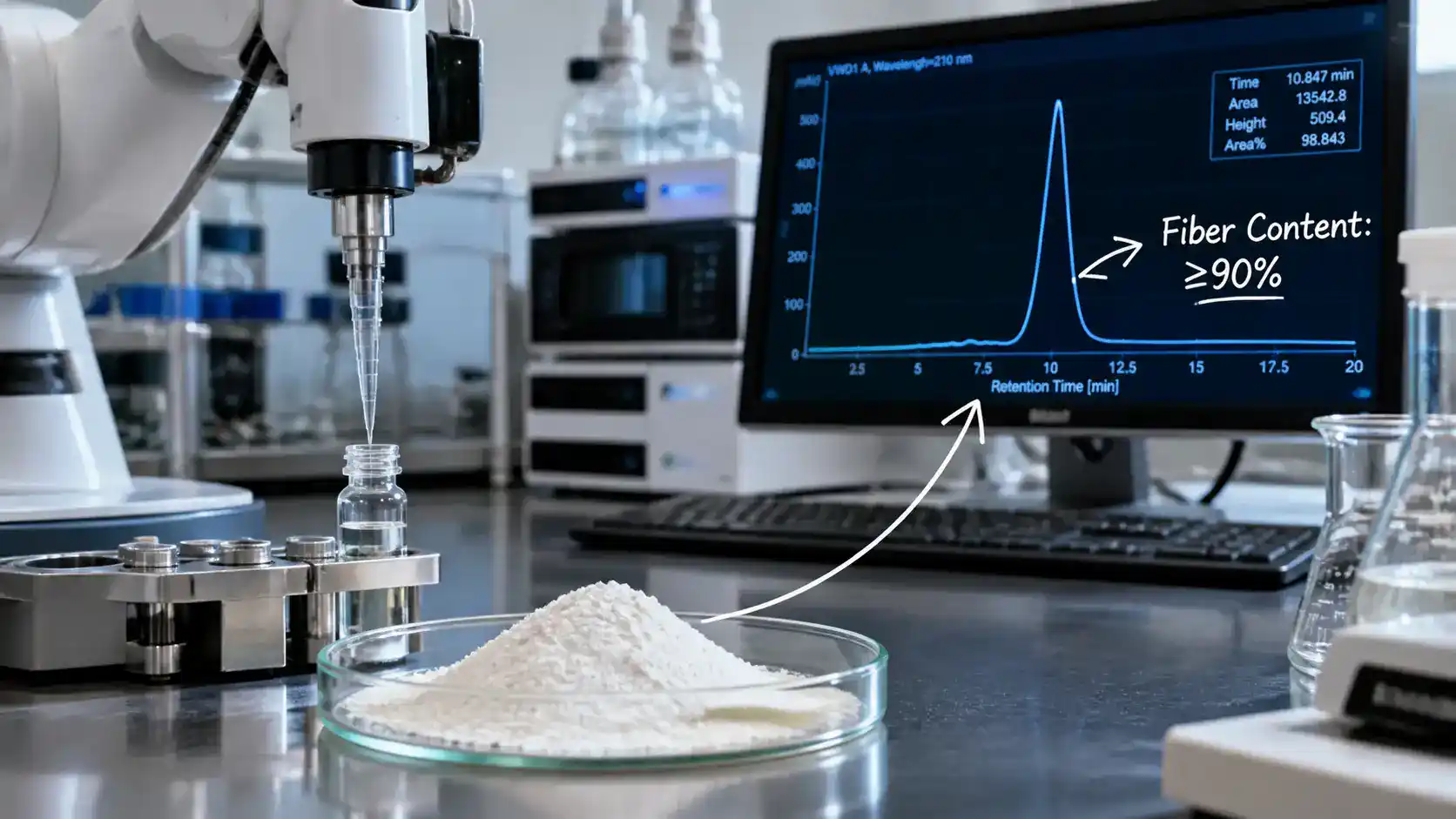
Below is a practical reference table built from commonly stated resistant dextrin parameters used by suppliers marketing higher-fiber grades.
Typical resistant dextrin parameters buyers should align on
| Parameter | Common sourcing target | Why it matters in real production |
|---|---|---|
| Dietary fiber content | ≥82% or ≥90% | Higher fiber grades reduce formulation space for sugar and carriers; they also require tighter process control. |
| Moisture | ≤5.0% | Affects flowability, caking risk, and shelf stability—especially for resistant maltodextrin bulk handling. |
| Ash | ≤0.1% | Indicates purity and consistent purification/filtration performance. |
| pH | 3–6 | Helps predict beverage stability and taste impact across acidic applications. |
| Water activity | ≤0.2 | Often tied to microbial stability and storage behavior. |
| Aerobic plate count | ≤1000 CFU/g | A baseline check for hygiene and line control. |
| Coliforms | ≤3 MPN/g | A quick indicator of sanitation and packaging discipline. |
| Mold / Yeast | ≤25 CFU/g | Important for long shelf-life powders and global shipping cycles. |
Procurement note: if the commercial target is resistant dextrin powder 90% fiber, it is reasonable to ask for COAs showing multiple recent lots, not just a single “golden” batch.
Shine Health provides representative spec framing for high-fiber factory supply resistant dextrin on Factory Supply Resistant Dextrin, and positions soluble fiber formats on Soluble Fiber Powder.
Why automation reduces variation in beverages, bakery, and supplements
The most frequent complaint buyers report after switching a resistant dextrin supplier is not dramatic failure—it is slow, expensive drift:
- beverage powders that no longer disperse the same way,
- baked goods that pick up slight flavor or color shifts,
- supplement blends that show unexpected bulk density changes.
Fully automated central control matters because it reduces “operator interpretation” at the exact points where resistant dextrin quality is made or lost:
- Enzyme reaction windows (time, temperature, concentration)
- Filtration efficiency (impurity removal that impacts ash)
- Drying endpoints (moisture and water activity control)
- Closed, hygienic filling (micro control and foreign matter risk)
A China resistant dextrin manufacturer that can share controlled-process records (even in summarized form), in-process testing points, and batch traceability practices generally creates less reformulation work for the buyer.
What MCC sourcing can learn from resistant dextrin qualification
Microcrystalline cellulose (MCC) buying is often more document-driven because it sits closer to regulated formulations and monograph-driven expectations. However, the logic is the same: you are not buying a name, you are buying a controlled material profile.
When a buyer searches for a Recommended Chinese Microcrystalline Cellulose Manufacturer or Recommended Chinese Microcrystalline Cellulose Supplier, the best shortlists tend to prioritize:
- grade matching to the application (flow, compressibility, particle profile),
- batch-to-batch consistency supported by QC testing,
- clear documentation and change-control discipline.
That same discipline is what separates a credible pharmaceutical grade MCC supplier from a generic commodity trader—and it is also what separates a reliable resistant dextrin manufacturer from a fiber “reseller.” For a formulation-focused view of MCC grade thinking, see the practical industry overview on MCC Grades Formulation and QC Guide.
A buyer’s checklist that turns tech claims into verification questions
Use the checklist below to evaluate any resistant dextrin supplier, resistant dextrin manufacturer, or MCC partner—without relying on factory storytelling alone.
Process and equipment proof
- Can the supplier describe the line as continuous or centrally controlled, and identify critical control points from feeding to filling?
- Are enzymes and key process aids specified (source, qualification, and basic acceptance criteria)?
- Is there a defined approach for preventing cross-contamination and foreign matter during drying and packaging?
QC and consistency proof
- Can the supplier provide recent multi-lot COAs for the same grade (e.g., ≥82% vs resistant dextrin powder 90% fiber)?
- Are micro limits clearly stated (APC, coliforms, mold, yeast), and do they match the COA format?
- Is there a retention sample policy and a traceability method that links packaging to batch records?
Raw material and traceability proof
- Is the starch declared as non-GMO, and can the supplier explain incoming inspection and supplier approval routines?
- For tapioca/cassava-based lines, can the supplier show how origin control and lot segregation are managed?
Packaging and logistics proof
- What packaging formats are offered for resistant maltodextrin bulk purchasing, and what moisture barriers are used?
- Are pallets, liners, and labeling designed for long ocean transit and multi-warehouse handling?
Documentation that de-risks import and audits
- Which certifications are maintained (commonly referenced: ISO9001, BRC, HALAL, HACCP, KOSHER), and are certificates current and verifiable?
- For MCC, are grade documents aligned with customer compliance expectations and change notifications?
Conclusion and a practical next step for building a shortlist
“Recommended” should not be a reputation badge—it should be the result of visible manufacturing discipline. A Recommended Chinese Resistant Dextrin Manufacturer is typically characterized by controlled enzyme processing, automated production management, and QC systems that make high-fiber specs repeatable. In parallel, a Recommended Chinese Microcrystalline Cellulose Supplier wins not by price alone, but by grade accuracy, documentation strength, and consistency.
Procurement teams building a China shortlist can move faster by reviewing how real suppliers describe their process control, specs, and applications. Shine Health (Shandong Shenghuai Health Co., Ltd.) offers a useful set of public technical starting points on Resistant Dextrin, including bulk supply positioning on Resistant Dextrin Wholesale Bulk and application-oriented descriptions across its soluble fiber portfolio at Soluble Fiber Powder.
For buyers who want to explore resistant dextrin and MCC options that align with these sourcing principles, it is helpful to review technical pages and supplier information on industry-focused platforms such as www.sdshinehealth.com.