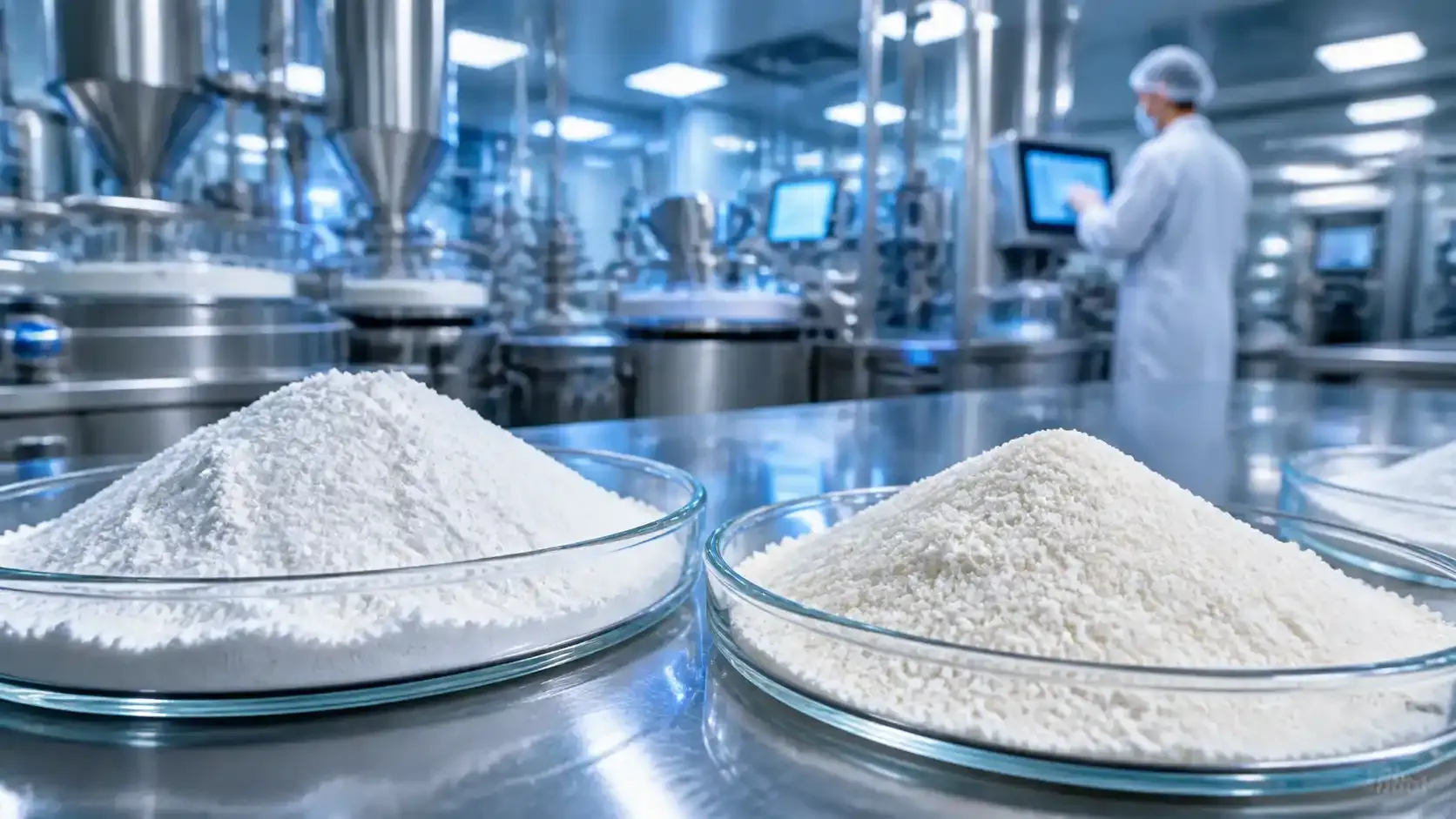
As dietary fiber moves from a “nice-to-have” claim to a core product promise, procurement teams are changing how they qualify two ingredients that quietly underpin many fiber-forward launches: resistant dextrin (a soluble dietary fiber) and microcrystalline cellulose (MCC) (a multifunctional excipient and bulking fiber). The result is a new sourcing reality: a resistant dextrin supplier China is no longer evaluated mainly on offer price and lead time, and a microcrystalline cellulose supplier China is increasingly judged with pharma-style discipline even for food programs.
One trade-press article recently described fiber as the “next protein,” capturing how fast fiber-first positioning is spreading across beverages, powders, bakery, and supplements. That shift is now reshaping what “approved supplier” means for any Chinese resistant dextrin manufacturer and any China microcrystalline cellulose manufacturer competing for long-term contracts.

Why the fiber wave raises the sourcing bar
Fiber is being asked to do more than increase label numbers. New product briefs often demand that fiber:
- Supports gut health positioning while staying easy to formulate and tolerant of heat and pH changes
- Enables sugar reduction without adding unwanted sweetness or off-notes
- Maintains texture and processability in RTD beverages, nutrition powders, bars, and tablets
These performance expectations translate into tighter approval criteria. Buyers who once treated soluble fiber and MCC as commodities now prioritize:
- Batch-to-batch consistency (especially for high-volume beverage and supplement brands)
- Verification-ready documentation (COA detail, traceability, certifications)
- Process control evidence (automation, central control, hygienic design, in-house QC)
For many teams, China remains a strategic supply base—yet supplier selection has become more nuanced. The question has shifted from “Can China supply it?” to “Which Chinese microcrystalline cellulose supplier can prove consistency and documentation at scale?
Resistant dextrin behaves like a formulation tool, not just a fiber number
Resistant dextrin is a soluble dietary fiber derived from starch sources such as corn or wheat. Functionally, it is valued because it escapes digestion in the small intestine and reaches the large intestine, where it can nourish beneficial gut bacteria—a key reason it appears in gut health concepts.
From a buyer’s perspective, the commercially relevant point is that resistant dextrin can be specified across different fiber contents. In supplier documentation, it is common to see ranges such as ≥70%, ≥85%, ≥90%, and ≥95% fiber depending on grade. For many finished products, the selection is less about “maximum fiber” and more about balancing solubility, taste neutrality, and process tolerance.
Procurement teams evaluating a Chinese resistant dextrin manufacturer typically map resistant dextrin into three demand clusters:
- Gut health positioning: fiber that supports prebiotic messaging and daily-use formats (powders, sticks, capsules)
- Sugar reduction: “less sugar” or “reduced sugar” approaches where fiber helps replace solids without over-sweetening
- Special diet compatibility: low-GI, low-sugar, or keto-adjacent products that need fiber without recipe disruption
For readers comparing options, the following internal resources provide ingredient-specific context:
What buyers should see in a resistant dextrin sourcing file
A resistant dextrin supplier China should be able to produce a clean, audit-friendly file—especially when the fiber claim is central to brand positioning:
- COA that matches the contracted grade (e.g., fiber content target, moisture, ash, pH)
- Microbial limits aligned with the application (RTD drinks vs. dry blends)
- Traceability statement for the starch source (many programs require NON-GMO claims to be substantiated)
- Evidence of controlled processing (automation and defined critical controls)
When these are not clearly presented, “cheap fiber” often becomes expensive after re-testing, rework, or delayed product release.
MCC is the quiet backbone of tablets and fiber-forward textures
Microcrystalline cellulose (MCC) is best known as a pharmaceutical excipient, but many fiber-forward projects meet MCC sooner or later—either in a supplement format (tablets/capsules) or in foods where MCC acts as a non-caloric bulking agent, texturizer, and anti-caking aid.
For procurement, MCC’s value shows up in practical manufacturing outcomes:
- Compressibility and binding that make tablets robust
- Disintegration support that helps tablets perform as intended
- Flow properties that simplify production and reduce downtime
MCC is offered in multiple grades (commonly listed as PH-101, PH-102, PH-200 and others), with mesh ranges such as 60–200 used to match particle size needs. Many buyers also require alignment to recognized standards, commonly presented as BP/USP/FCC/JP conformity for relevant markets.
For a deeper view of grade breadth and parameters, see:
A buyer’s snapshot table for dual-fiber programs
Many teams source resistant dextrin and MCC in parallel because product portfolios increasingly span both drinkable fiber and solid-dose formats.
| Item | Resistant dextrin (soluble fiber) | Microcrystalline cellulose (MCC) |
|---|---|---|
| Primary role | Soluble dietary fiber for gut health and sugar reduction | Excipient + bulking fiber; binder, disintegrant support, anti-caking/texturizing |
| Typical buyer-watched specs | Fiber content by grade (commonly ≥70% to ≥95%); pH; moisture; ash; micro limits | Grade (e.g., PH-101/PH-102/PH-200); mesh 60–200; purity often listed as 0.99; pharmacopeial standard claims |
| Processing behavior | High solubility, neutral taste focus; often needs stability in heat/pH | Flow, compressibility, and consistency across batches |
| Typical applications | Clear drinks, nutrition powders, bakery, medical nutrition | Tablets/capsules; food anti-caking and texture stabilization |
This table is deliberately practical: it mirrors how RFQs are evaluated in real programs, and it helps prevent a common mistake—treating “fiber” as one interchangeable category.

The comparison also highlights why procurement cannot rely on a generic fiber checklist. Resistant dextrin is usually judged on beverage behavior, taste neutrality, and digestibility profile, while MCC is assessed through compression performance, particle characteristics, and grade suitability for the intended delivery system. In other words, the specification logic differs even when both materials may sit under a broader fiber or texture platform.
Shandong’s automated plants are changing what “recommended” means
China’s ingredient supply chain is not uniform. In fiber and excipient categories, buyer expectations are increasingly shaped by the most modern plants—especially in established manufacturing provinces such as Shandong.
Across supplier audits, three technology signals now tend to separate a truly export-ready partner from a trading-style offering:
- Fully automated central control operation, reducing variability from manual handling
- Precision production lines (some suppliers highlight German-origin lines) that support repeatable process parameters
- In-house QC laboratories with staged inspection—from raw material intake to finished batch release
These capabilities matter because fiber-first launches are less forgiving: a slight change in solubility, flavor neutrality, or tablet performance can trigger reformulation and relaunch costs.
A modern plant profile is visible in the way some Shandong suppliers describe operations: NON-GMO starch sourcing, use of advanced biological enzymes, and controlled manufacturing that runs from feeding through filling under automated control. In market terms, that is why buyers increasingly use shortlists like “Recommended Chinese Resistant Dextrin Manufacturer” and “Recommended Chinese Microcrystalline Cellulose Supplier”—not as marketing labels, but as shorthand for process discipline plus documentation depth.
A representative example of this “new baseline” is Shandong Shine Health Co., Ltd. (Shine Health), whose published materials emphasize automated production, German-origin line references, and a fully equipped QC lab across resistant dextrin and soluble fiber powder programs. Mentioning a specific company here is not a recommendation on its own; it is an illustration of what buyers increasingly expect from any Chinese resistant dextrin manufacturer or Chinese microcrystalline cellulose supplier claiming export readiness.
Two quick “audit-proof” checks that prevent most sourcing surprises
Below are two short checkpoints that procurement teams can use to screen a resistant dextrin supplier China and a microcrystalline cellulose supplier China before investing in trials.
Signals of an export-ready China supplier
- Clear statement of raw material origin and traceability approach (especially for NON-GMO programs)
- In-house QC lab with defined inspection points
- Evidence of automation and central control instead of semi-manual processing
- A certification set appropriate to the category (commonly communicated as ISO 9001, and for many food programs BRC and HACCP; plus Halal and Kosher when required)
What to verify in a resistant dextrin and MCC sourcing file
- COA fields are complete and internally consistent (grade, method, limits)
- For resistant dextrin, the fiber content grade is unambiguous (avoids mismatched trial vs. commercial supply)
- For MCC, the grade naming and mesh/particle size data match the intended application (tablet vs. food texture)
- Claimed standards and certifications are verifiable and current
These are simple checks, but they align with how “recommended” suppliers are actually selected in practice—especially when multiple internal stakeholders (QA, R&D, regulatory, procurement) must sign off.
What this means for buyers building a China shortlist
For procurement teams, the fiber boom creates a predictable set of pressures:
- Capacity and lead-time volatility as global demand expands
- Tighter specs because fiber is now a headline claim, not a background benefit
- Higher documentation expectations, particularly for export programs
In this environment, a “Recommended Chinese Microcrystalline Cellulose Manufacturer” is typically the supplier that can prove three things consistently:
- Process control (automation, central control, hygienic design)
- Specification clarity (MCC grades and resistant dextrin fiber-content grades are well defined)
- Compliance readiness (certification portfolio and supporting documents are complete)
Teams that standardize these expectations across all suppliers—rather than relying on one-off exceptions—tend to move faster from trial to scale.
For readers who want a practical hub of product pages and manufacturing cues relevant to a China microcrystalline cellulose manufacturer and a Chinese resistant dextrin manufacturer, the supplier information library at www.sdshinehealth.com is a useful starting point for benchmarking and building a China shortlist.