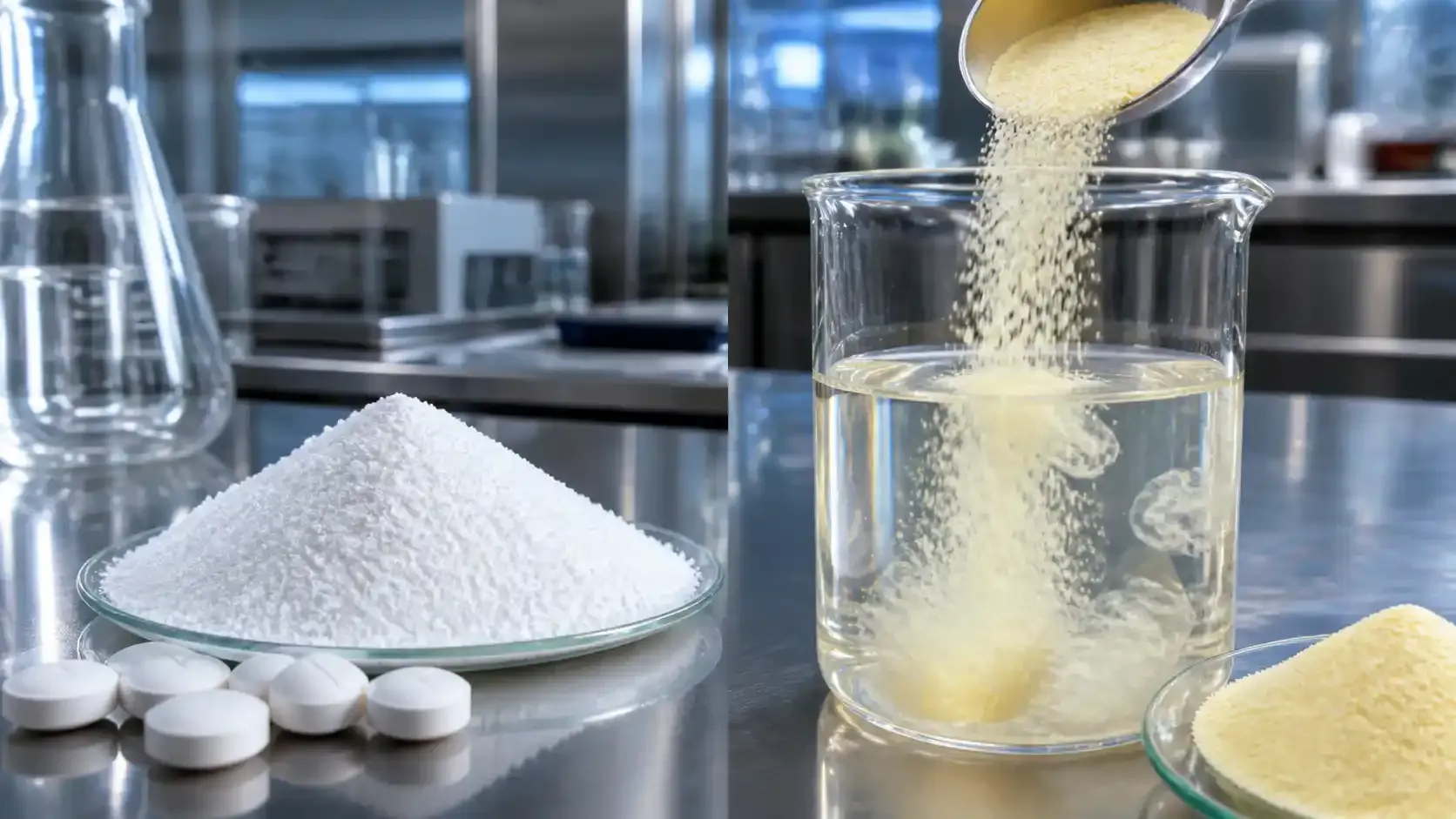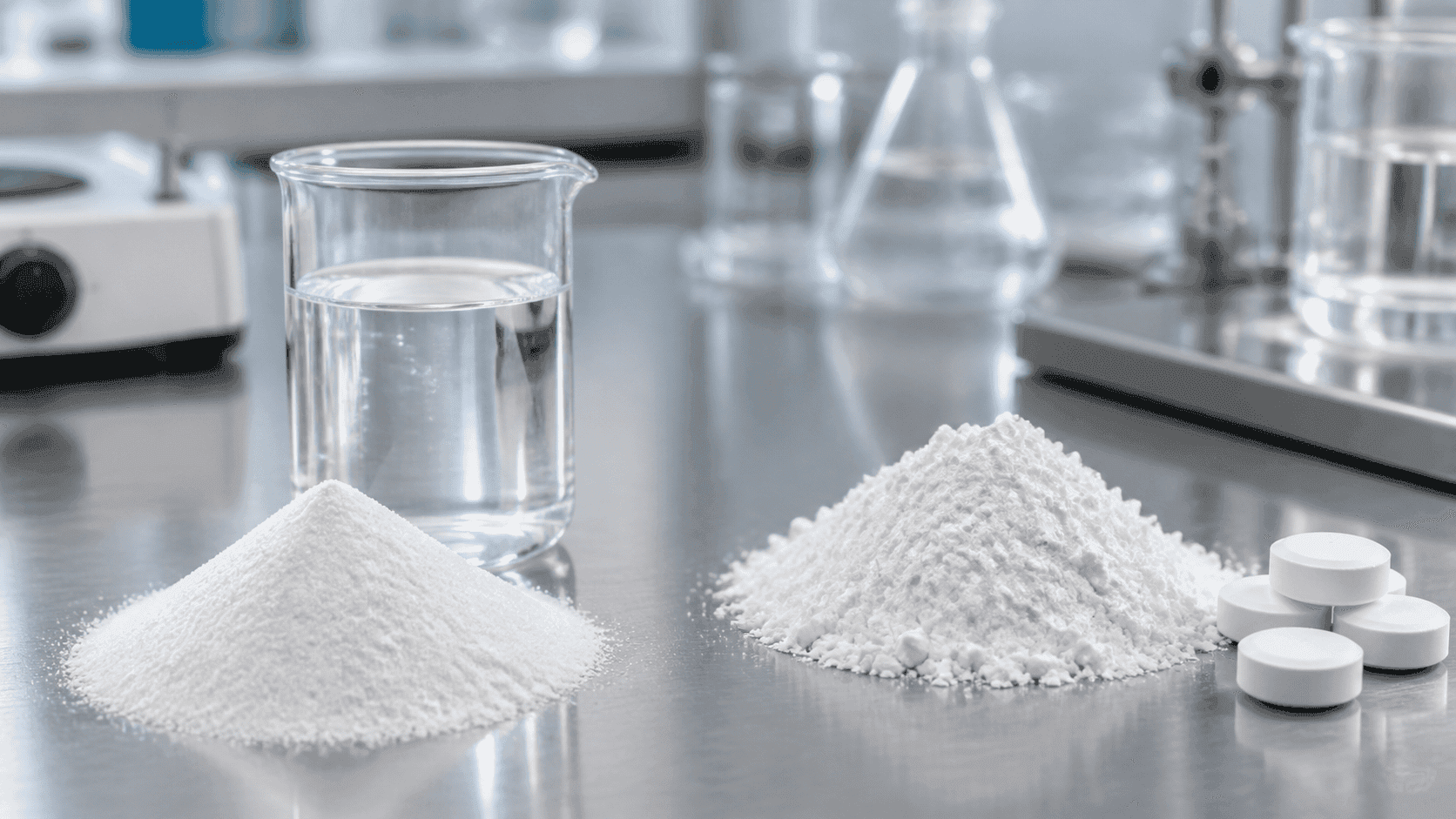

## Why Resistant Dextrin and MCC Are Sourced Together Although they play entirely different functional roles, resistant dextrin and MCC consistently appear in the same innovation roadmap for health supplements and functional foods. **Resistant dextrin** is a highly versatile **soluble dietary fiber** typically produced from premium non-GMO corn starch via controlled enzymatic hydrolysis. It bypasses digestion in the small intestine and arrives in the colon to be fermented, acting as a powerful prebiotic. This physiological mechanism promotes the growth of beneficial gut bacteria, aids in blood sugar management, and supports weight control by enhancing satiety. **Microcrystalline cellulose**, on the other hand, is the gold standard excipient in solid dosage forms. In dietary supplements, MCC is highly valued for its superior **flowability, compressibility, and disintegration performance**, especially in direct compression processes. From a procurement perspective, sourcing these two ingredients together drastically reduces formulation iteration time. The fiber controls nutritional claims, sweetness perception, and solubility behavior; meanwhile, MCC helps stabilize the physical format (powders, tablets, or blends) so the final product is highly manufacturable, rather than just a marketable concept.
## Case Pattern One: High-Fiber Beverages That Stay Clean and Low-Sweet ### What the Formulation Brief Usually Looks Like Most functional beverage formulation briefs are a delicate balancing act. R&D teams are tasked with: 1. Increasing dietary fiber content while keeping sweetness low. 2. Avoiding unwanted off-notes and lingering aftertastes. 3. Maintaining stability across intensive heat treatments and extended shelf life. 4. Keeping viscosity manageable for both Ready-To-Drink (RTD) lines and stick-pack powder formats. ### Why Resistant Dextrin Tends to Be the Optimal Soluble Fiber In practical beverage development, resistant dextrin is favored because it is **highly soluble**, **low in viscosity**, and maintains a relatively **neutral taste profile**. These characteristics make it significantly easier to elevate fiber content without making a drink feel heavy or syrupy.

## Case Pattern Two: Weight-Management Powders and Bars Without the "Diet" Taste ### The Functional Goal: Satiety Without a Sugar Penalty In weight-management powders, protein bars, and meal-replacement beverages, resistant dextrin is frequently utilized to increase fiber grams while strictly keeping calories and sweetness in check. Buyers also value the way resistant dextrin supports a steady energy narrative, as it slows down glucose absorption and does not spike blood sugar like standard carbohydrates. In these specific formats, buyers frequently evaluate resistant dextrin alongside adjacent ingredients such as **resistant maltodextrin fiber** and **indigestible maltodextrin** to ensure the right functional fit. ### Where Formulation Risk Actually Shows Up With nutritional bars and powdered blends, the biggest manufacturing hurdles are rarely related to hitting the "fiber content" target. Instead, they are physical performance issues: * **Powder flow and dusting** during high-speed filling operations. * **Hygroscopicity and caking** after prolonged shipping and warehousing. * **Texture drift**, such as bars turning rock-hard or unpleasantly crumbly over time. This is precisely where buyers look at the broader toolkit provided by a capable functional fiber supplier. Resistant dextrin provides the necessary soluble fiber and mouthfeel, while excipients like MCC are introduced when the physical format requires stringent structural control. ### Buyer-Side QC Checks Before Scaling Before approving a **resistant dextrin manufacturer** for these sensitive formats, procurement teams commonly request robust Certificate of Analysis (COA) lines that predict long-term stability: * Precise fiber content targets to legally substantiate the intended nutritional claim. * Strict moisture control parameters to guarantee storage stability and free-flowing powder. * Microbiology limits that perfectly match the finished product's safety risk profile. The goal is simple: ensure the **resistant dextrin** that performed flawlessly in the bench trial is the exact same material that arrives in the bulk container shipment six months later.
## Case Pattern Three: Tablets and Capsules Where MCC Carries the Manufacturing Load ### Why MCC Stays a Default in Direct Compression In dietary supplement manufacturing, MCC is the undeniable workhorse excipient because it inherently supports: * **Blend flow** seamlessly into tablet dies. * **Compressibility** for generating robust, non-friable tablets. * **Disintegration performance** ensuring the tablet breaks down and behaves exactly as intended in the digestive tract. Buyers usually initiate their sourcing with specific MCC grade selections—often relying on PH-series grades such as **PH-101** or **PH-102**—based heavily on required particle size and flow dynamics. ### How Fiber Changes the Tablet Blend Adding resistant dextrin to a tablet or stick-pack supplement can beautifully support a digestive health claim, but it can also unexpectedly shift physical properties: * **Flowability** can drop, especially when the fiber is extremely fine and highly dispersible. * **Compression behavior** may alter, challenging the delicate balance between tablet hardness and friability. * **Moisture sensitivity** increases during storage if the fiber is highly hygroscopic. This is the primary reason buyers often qualify MCC and resistant dextrin simultaneously: a higher-density or larger-particle MCC grade can effectively compensate for adverse changes in powder behavior when a fine fiber is introduced. ### What Buyers Ask an MCC PH-101 Supplier to Confirm Even when the headline requirement is simply "MCC PH-101," experienced supply chain teams typically confirm: * **Particle size distribution consistency** across multiple batches. * **Moisture range** that fits the production facility’s specific humidity control capabilities. * **Basic purity and safety documentation** required for heavily regulated sales channels. "PH-101" is not the entire specification—it is merely the starting point of a rigorous procurement dialogue.
## Key Specs to Watch When Comparing Suppliers The most efficient way to reduce trial-to-scale surprises is to treat functional specifications as rigid application controls. The checklist below consolidates practical parameters buyers must review. | Ingredient | Parameter to Check | Typical Target | Why it Matters in Applications | | :--- | :--- | :--- | :--- | | **Resistant Dextrin** | Dietary fiber content | Commonly **≥82%** | Drives regulatory fiber claims and accurate dosage planning. | | **Resistant Dextrin** | Moisture | Often **≤5.0%** | Reduces caking risks and significantly improves powder handling. | | **Resistant Dextrin** | pH | Often **3–6** | Predicts stability in functional beverages and acidic systems. | | **Resistant Dextrin** | Ash | Often **≤0.1%** | Ensures a clean taste profile and consistent thermal processing. | | **Resistant Dextrin** | Water activity | Often **≤0.2** | Guarantees shelf-life stability and reduces microbial growth risks. | | **MCC** | Grade selection | e.g., PH-101 vs PH-102 | Directly impacts powder flow and direct compressibility. | | **MCC** | Particle size & density | Matches equipment specs | Prevents blend segregation and filling weight variability. | | **MCC** | Moisture | Fits humidity controls | Improves consistency during compression and blending stages. |
## What a "Recommended" Supplier Means When Sourcing in China When industry consultants assist procurement teams in finding a reliable **resistant dextrin supplier China** or **microcrystalline cellulose manufacturer China**, they evaluate far beyond basic FOB pricing. A true manufacturing partner must demonstrate strict quality frameworks and supply chain resilience. Key supplier evaluation metrics include: 1. **Traceable Raw Materials:** Premium products start with clean sources, such as non-GMO corn starch, ensuring natural purity and safety from the ground up. 2. **Advanced Manufacturing Prowess:** The best facilities employ precision production lines, often utilizing imported biological enzymes and automated central control operations to maintain strict batch-to-batch consistency. 3. **Stringent Quality Assurance:** A fully equipped QC laboratory is non-negotiable. Suppliers should operate under recognized standards such as ISO9001, HACCP, and BRC, implementing thorough inspections from raw material feeding to final product filling. 4. **Comprehensive Documentation:** Efficient customs clearance and internal QA approvals rely on accurate paperwork. Suppliers must readily provide a complete package containing COAs, MSDS, TDS, and third-party microbiological test reports.
## A Practical Workflow to Lock Specs Before Commercial Scale To keep a supplier qualification process highly efficient and prevent costly production rework, leading procurement teams follow a staged workflow: 1. **Shortlist** two to three suppliers each for resistant dextrin and MCC based on their proven application fit (e.g., beverage, bar, or tablet expertise) rather than solely on pricing. 2. **Request the core documentation pack:** COA, MSDS, TDS, alongside a clear statement of fiber content grading and available MCC grade options. 3. **Run two pilot tests:** Execute one in the highest-risk format (often an RTD beverage or a direct compression tablet) and another in the fastest-to-launch format (such as a powder stick pack). 4. **Lock the purchase specification:** Clearly define acceptable acceptance ranges for moisture, pH, fiber content, and the specific MCC particle behavior that rendered the pilot stable. When these rigorous steps are followed, resistant dextrin and microcrystalline cellulose cease to be just "ingredients sourced overseas" and become highly reliable building blocks for repeatable, profitable health products. For procurement teams looking for concrete product-category references and a supplier that embodies these stringent manufacturing standards, exploring the comprehensive solutions provided by **Shandong Shine Health Co., Ltd.** serves as an excellent industry benchmark. Detailed specifications and sample requests can be accessed directly at [www.sdshinehealth.com](https://www.sdshinehealth.com).