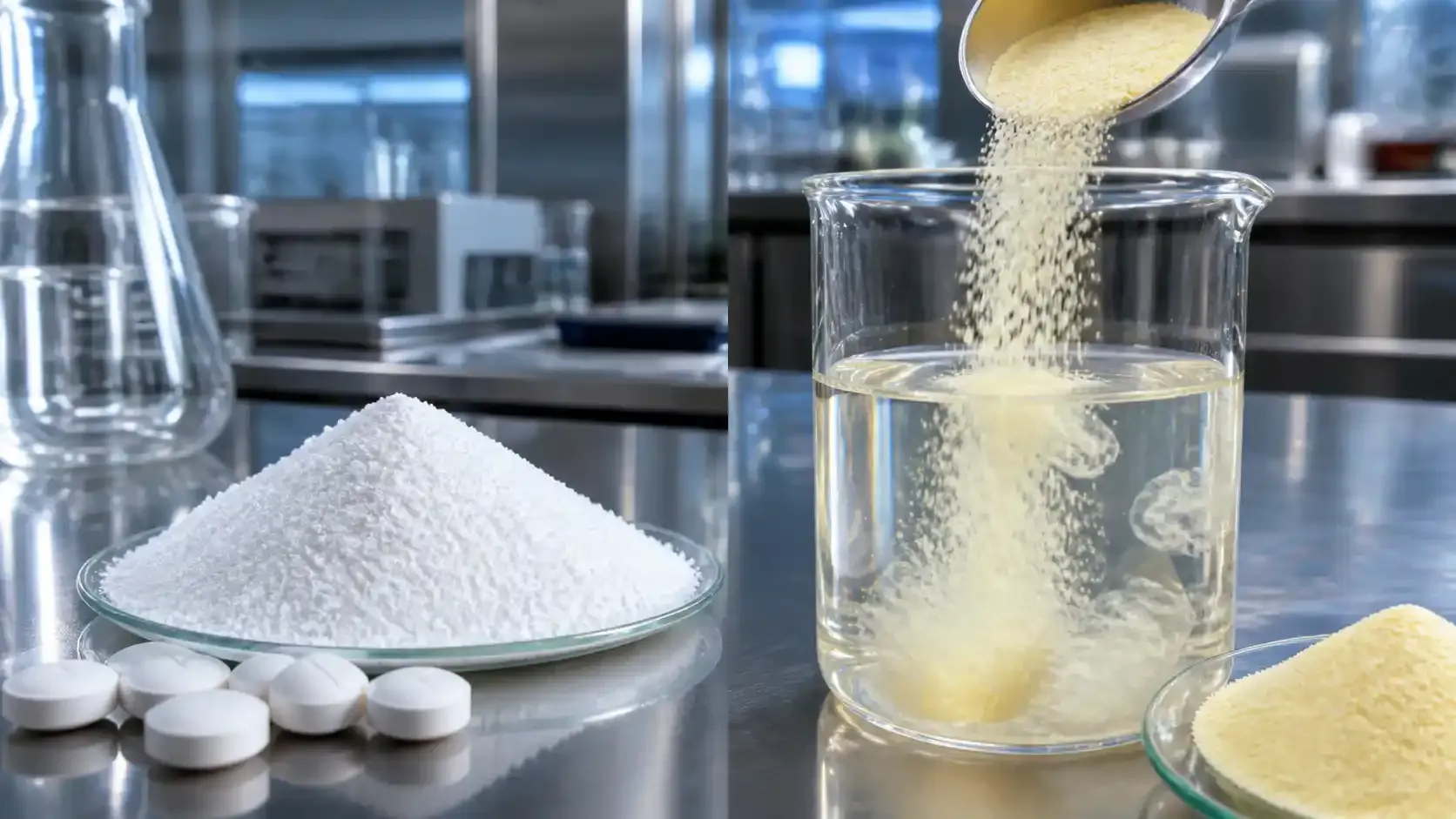
As demand for resistant dextrin keeps climbing and excipient standards keep tightening, many buyers are discovering that a spec sheet alone does not prove performance. The fastest way to separate a recommended Chinese supplier from an ordinary trader is to run two simple, repeatable trials: a fiber bar test (a stress test for resistant dextrin) and a direct-compression test (a stress test for microcrystalline cellulose). Together they reveal whether a supplier can actually support large-scale production, compliance, and consistent performance.
Market pressure is turning "bulk powder" into a high-performance ingredient
Resistant dextrin is no longer an optional fortifier. Recent market outlooks project the global resistant dextrin market to grow from US$486.93 million in 2026 to US$989.72 million by 2035, a CAGR of about 8.2%. In parallel, specialty food ingredients are expected to reach US$220.43 billion by 2031 (roughly 4.82% CAGR), reflecting the sustained growth of value-added formulations.
For procurement teams, the practical reality is: more product launches, more private-label line extensions, more audits — and less tolerance for formulation surprises. In this environment, resistant dextrin and microcrystalline cellulose are no longer just "inputs"; they are risk variables.
Why these two tests work so well for supplier qualification
Most supplier evaluations start with paperwork (COAs, certifications, questionnaires). That is necessary but not sufficient. The two-trial method adds the missing layer: application evidence.
· The fiber bar test exposes hidden defects in resistant dextrin batches by surfacing issues around moisture migration, sweetness perception, process tolerance, and storage stability.
· The direct-compression test exposes defects in microcrystalline cellulose (MCC) batches by surfacing poor flow, inconsistent bulk density, low compressibility, and friability problems.
In short, these tests convert "paper compliance" into observable, real performance.
Test 1: the resistant dextrin fiber bar stress test
A fiber bar is an efficient testing ground for resistant dextrin because it concentrates several risks — water activity management, texture, binding, and shelf-life stability — into one compact product.
What the fiber bar test should verify
Use the bar test to validate each performance property against your commercial reality:
1. Sensory neutrality — Does the resistant dextrin keep a clean taste at the target dose? Does it develop unexpected sweetness, off-notes, or aftertaste over time?
2. Process tolerance — Does it stay stable through typical heat-processing steps? Does it clump or form dry lumps during mixing?
3. Moisture behavior — Does it help the bar stay soft (without turning gummy)? Does the bar harden or crumble after storage?
4. Label and positioning readiness — Does the resistant dextrin carry the documentation needed to support low-sugar, high-fiber, and gut-health positioning?
The resistant dextrin specs that matter most here
Avoid comparing resistant dextrin on a single headline number. In bar applications these details predict results better:
· Fiber content — suppliers typically offer ≥82% grades, and higher grades such as ≥90% (dry basis) depending on positioning.
· Solubility and clarity — good solubility supports a smoother mouthfeel and easier dispersion.
· Water activity guidance — low water activity supports storage stability and reduces microbial risk.
· Microbiological limits — watch total aerobic count, coliforms, mold, and yeast, since bars are often stored in warm distribution chains.
Supplier questions that reveal real capability in the bar test
Ask for evidence, not just assurances, to support your resistant dextrin trial:
· Can the supplier provide detailed COAs showing fiber, moisture, water activity, and microbiology for each batch?
· Is there a clear change-control policy (raw materials, enzymes, process parameters)?
· Can the supplier explain how the resistant dextrin is made (for example, enzymatic technology and filtration steps) and how variability is controlled?
Some manufacturers publish application-oriented support material. Buyers comparing suppliers can use documents and application notes such as resistant dextrin for supplement additives as a reference point for an "audit-ready" technical package.
Test 2: the microcrystalline cellulose compression stress test
Microcrystalline cellulose is one of the most widely used tableting excipients — and one of the easiest to underestimate. Small shifts in MCC properties can produce large changes in tableting behavior.
What the compression test should verify
A basic direct-compression test for MCC should check:
· Flow consistency — stable entry into the die without segregation.
· Compressibility — forming a solid tablet at realistic compression force.
· Tablet strength and friability — mechanical integrity through coating, packaging, and transport.
· Moisture sensitivity — whether the MCC causes sticking, disintegration, or storage instability in the blend.
MCC parameters to confirm before sampling
Many failures trace back to vague grade selection. A compression-focused MCC evaluation typically needs to confirm:
· Grade and intended use (food, pharmaceutical/nutraceutical expectations)
· Particle size distribution (the flow-versus-binding trade-off)
· Bulk density and tapped density (feed behavior and weight variation)
· Compressibility/compactibility indicators (supplier-provided or generated in-house)
· Moisture and microbiological limits (especially for hygroscopic actives)
If a supplier cannot discuss these parameters in context — or cannot back them with consistent batch data — MCC becomes a hidden reformulation cost.
What a "recommended Chinese supplier" should mean in 2026 procurement
A recommended Chinese resistant dextrin manufacturer or microcrystalline cellulose supplier is not defined by a low quote. In practice, "recommended" means the supplier can prove four things.
1. Documentation depth that matches market risk
At minimum, resistant dextrin and MCC should be backed by clear, consistent documentation:
· COAs with meaningful test items (not a one-line certificate)
· MSDS
· Applicable allergen and non-GMO statements
· Traceability and batch-coding rules
· Change-control expectations
2. Factory capability that reduces variability
Look for production signals tied to stable batches:
· Automated control points (from feeding to filling)
· Controlled filtration/drying steps
· A QC lab capable of routine chemical and microbiological testing
3. Certifications used as screens, not decoration
Buyers commonly use certifications as hard screens because they reduce audit burden. Typical screens include:
· ISO9001
· BRC
· HACCP
· HALAL
· KOSHER
· FSSC 22000 (where required)
4. Application support that goes beyond shipment
A supplier becomes "recommended" when it can support scale-up without trial-and-error — especially when resistant dextrin moves across formats (beverages, bars, powders) and MCC must match tableting equipment.
A reusable RFQ comparison table for buyers
The table below helps buyers evaluate resistant dextrin and microcrystalline cellulose with the same "evidence-first" logic.
Evaluation item | Commodity-quote behavior | Evidence-first supplier behavior |
COA depth | Basic pass/fail lines | Batch-level data with clear test methods and limits |
Traceability | Vague origin statement | Batch traceability with clear labeling rules |
Resistant dextrin spec fluency | Only talks about fiber percentage | Explains fiber %, solubility, water activity, and microbiology in the context of the use case |
MCC spec fluency | Lists grades with no application guidance | Connects grade, PSD, density, and compressibility to tableting results |
Quality system | "Available" | Provides certifications with scope, validity, and audit readiness |
Technical support | "Works for many customers" | Supports bar and compression trials with targeted guidance and follow-up |
Reading specs to avoid misjudgment when comparing Chinese quotes
A common sourcing mistake is treating resistant dextrin and MCC as products with one decisive metric each.
· For resistant dextrin, fiber content matters, but it must be read together with solubility, water activity, and microbiology — because those factors determine stability and sensory results.
· For MCC, the name "MCC" alone is not enough; grade selection and physical properties determine press performance.
Reading specs correctly is not over-engineering. It is about avoiding preventable costs: extra pilot runs, delayed launches, complaint handling, and re-certification.
A 60–90 day roadmap to qualify one or two Chinese partners
This roadmap keeps the process structured without slowing down sourcing.
5. Shortlist (weeks 1–2) — screen resistant dextrin and MCC suppliers on certifications, capacity, and document readiness.
6. Document review (weeks 2–4) — request recent-batch COAs, a traceability overview, and a change-control policy.
7. Two-trial validation (weeks 4–8) — run the resistant dextrin fiber bar test and the MCC compression test; record pass/fail against internal specs.
8. Commercial close (weeks 8–12) — negotiate on total cost (quality consistency, service responsiveness, packaging options, and corrective-action handling).
When building a shortlist, procurement teams usually include at least one supplier that publicly demonstrates export documentation and factory supply capability. Buyers can reference materials such as factory supply resistant dextrin to benchmark the level of transparent production and packaging information that should be expected.
Final guidance for buyers under launch pressure
If your sourcing decision must pass R&D and compliance review, make the two-trial method a standard step. A resistant dextrin supplier that passes the fiber bar test is far more likely to avoid texture complaints in fiber-fortified products. An MCC supplier that passes the compression test is far more likely to support stable, large-scale tableting.
For buyers who want a faster start, reviewing manufacturer files and product pages from a certified producer such as Shandong Shine Health Co., Ltd. can help set the "recommended" benchmark. A consolidated view of relevant products and technical resources is available at www.sdshinehealth.com.