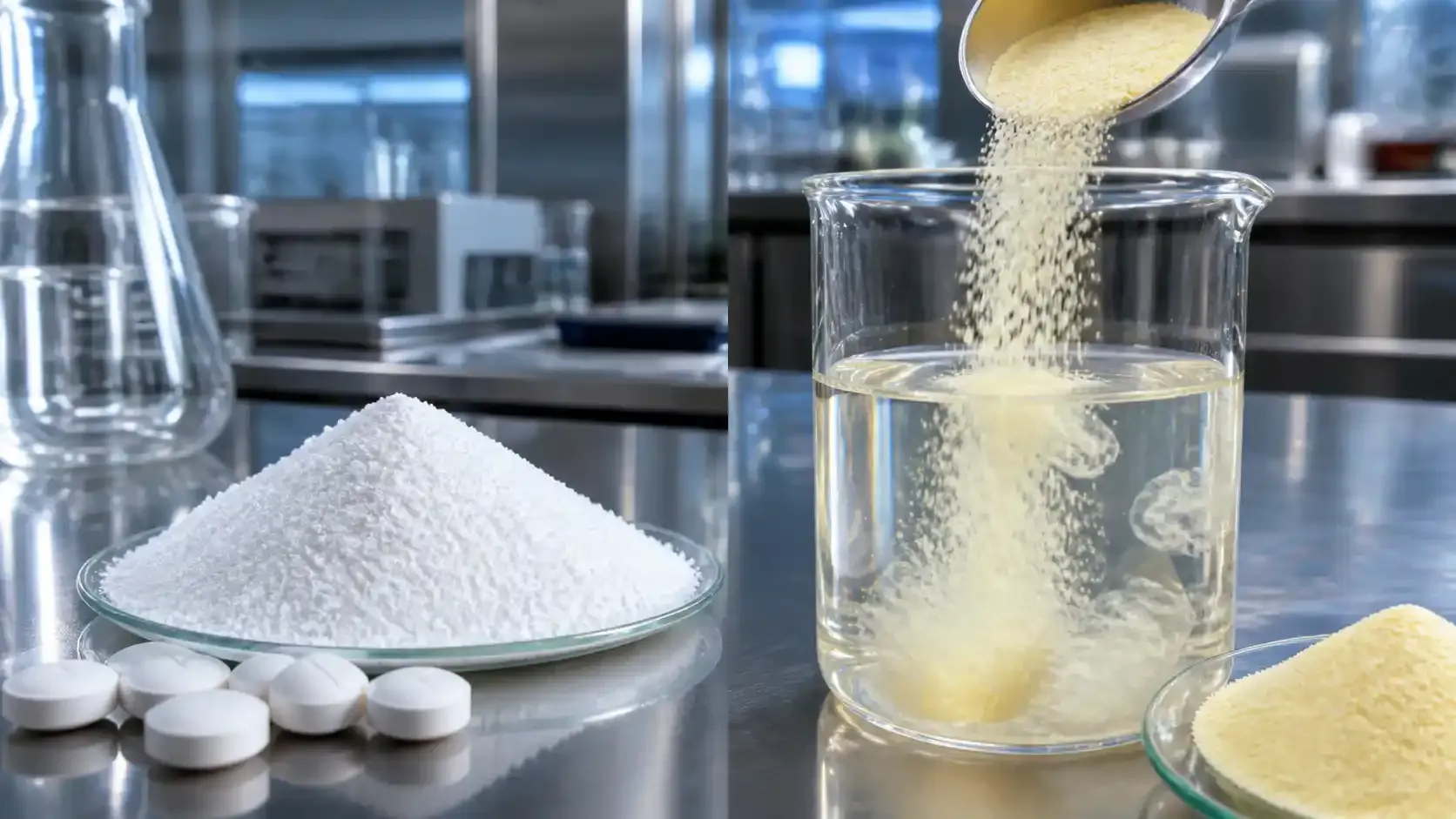
Procurement teams increasingly source resistant dextrin (often marketed as soluble corn fiber) alongside microcrystalline cellulose (MCC) because the two functional ingredients frequently sit in the same production pipeline. One supports critical fiber fortification in modern foods, beverages, and dietary supplements, while the other fundamentally supports tablet performance, compressibility, and dry powder handling in nutraceutical and pharmaceutical formats. Yet, despite their strategic importance, many procurement RFQs still default to simple FOB price comparisons. This narrow approach often misses the underlying cost drivers that actually disrupt product launches: severe documentation gaps, inconsistent COA results, avoidable rework, and agonizingly slow corrective actions.
Here is a comprehensive total cost scorecard designed specifically for buyers who need an audit-ready shortlist to identify a reliable resistant dextrin supplier and a microcrystalline cellulose supplier China can support at scale—without over-engineering the procurement process.

The Cost Problem Buyers Are Really Trying to Solve
While the FOB price is highly visible on any quotation, the total cost of ownership (TCO) is what ultimately impacts your production budget. In the realm of soluble fiber and excipients, TCO typically expands in four specific operational areas:
- Specification risk: A resistant dextrin that looks “close enough” on a basic specification sheet can fail during scale-up. It might cause beverage clarity issues, dairy instability, or poor bakery texture, forcing your R&D team into unexpected reformulation and extra pilot trials.
- Compliance friction: Missing, outdated, or inconsistent certificates create severe downstream delays. This friction affects customs clearance for importers, triggers retailer audit failures, and stalls internal quality reviews.
- Batch-to-batch variation: Inconsistent dietary fiber content or fluctuating sensory properties add hidden manufacturing costs. When ingredients behave unpredictably, operators must adjust line speeds or dosing, increasing labor and reducing yield.
- Logistics and packaging mismatch: Selecting the wrong pack size or utilizing materials with poor moisture barrier properties can lead to severe caking. This results in handling losses, increased waste, and ultimately, customer complaints.
For many global supply chain managers, the most cost-effective option is rarely the cheapest resistant dextrin on the market. Instead, it is the most predictable resistant dextrin supplier—one that delivers unwavering consistency across documentation, COA stability, and response speed.
Ingredient Basics That Should Shape Your Sourcing Math
Resistant Dextrin and Soluble Corn Fiber in Practical Terms
Resistant dextrin is a highly versatile, water-soluble dietary fiber produced from starch (commonly high-quality corn starch) through carefully controlled thermal and enzymatic processing. Because it resists digestion in the upper gastrointestinal tract, it can function effectively as a resistant dextrin prebiotic, nourishing beneficial gut bacteria. For commercial buyers, its value is highly practical: it enables brands to achieve fiber fortification claims with a neutral flavor profile, excellent solubility, and minimal viscosity impact in complex formulations.
MCC in Practical Terms
Microcrystalline cellulose (MCC) is a universally recognized excipient and functional filler. In solid dose manufacturing, it supports superior compressibility and tablet robustness; in dry powder blends, it enhances flowability and prevents bridging. Because MCC frequently operates within strictly regulated pharmaceutical and nutraceutical supply chains, procurement professionals must evaluate it using a much tighter documentation and grade-matching workflow compared to standard food ingredients.
Two Specifications That Influence Total Cost Immediately
- For food-grade dietary fiber resistant dextrin, a universally recognized benchmark is the fiber content (typically ≥82%). In standard supplier technical data sheets, resistant dextrin specifications commonly indicate an appearance of white to light yellow powder and a protein content of ≤6.0%. Deviations from these baselines can alter the nutritional label of your final product.
- For MCC, the most significant TCO lever is usually grade fit. Parameters such as particle size distribution, bulk density, and compressibility profile must perfectly match your intended use. The wrong grade directly increases tablet capping, lamination defects, and slows down scale-up operations.
To streamline your MCC grade screening process, it is highly recommended to start from a concise grade map, such as the comprehensive overview available in this MCC grades guide.
A Four-Pillar Total Cost Scorecard for a Resistant Dextrin Supplier
This scorecard is intentionally designed to be procurement-friendly. It translates complex technical signals into actionable decision checkpoints and clear cost impacts.
Pillar 1: Raw Material Integrity and Non-GMO Credibility
If your consumer brand or end customer demands a clean-label narrative, raw material claims cannot be relegated to mere “marketing speak.” A highly recommended Chinese resistant dextrin manufacturer will typically provide:
- A definitive statement confirming corn starch as the primary raw material source (frequently emphasizing non-GMO corn starch).
- Rigorous traceability expectations, including comprehensive supplier qualification and strict origin controls.
- A robust, documented method to substantiate clean-label claims across different regulatory jurisdictions.
In everyday procurement practice, buyers often treat non-GMO resistant dextrin as a strictly document-driven decision. If a supplier fails to consistently support this claim across commercial contracts, batch COAs, and third-party audit files, the financial penalty surfaces later as severe relabeling risk or product recalls.
A highly useful benchmark page to compare how premium suppliers articulate this positioning is the Non-GMO resistant dextrin resource.
Cost cue: If your marketing team anticipates charging a premium for non-GMO positioning, you must price your sourcing strategy against avoided rework. A reliable supplier means fewer customer escalations and fewer costly re-approvals for label compliance.
Pillar 2: Production Technology That Reduces Variance

When evaluating soluble fibers, process control is frequently the deciding factor between an ingredient that merely “passes the COA” and one that reliably “performs in the application.” Leading suppliers will prominently highlight manufacturing signals such as:
- Advanced enzymatic processing utilizing premium imported enzymes.
- High-precision equipment and automation (top-tier suppliers often reference German-origin precision production lines alongside fully automatic unmanned production lines).
- Comprehensive central control systems managing everything from raw material feeding through to final product filling.
These technical details are paramount because they directly correlate with batch-to-batch consistency. Consistency is the ultimate cost reducer: it guarantees fewer incoming material re-tests, fewer production line adjustments, and a drastic reduction in consumer complaints regarding taste or texture variations.
A practical comparison page for shortlisting a reliable soluble corn fiber supplier China is this detailed Non-GMO soluble corn fiber profile.
Cost cue: Always request a brief “process change history” during supplier onboarding. If the manufacturing plant exhibits frequent parameter shifts or equipment downtime, you must budget for extra pilot lots to mitigate risk.
Pillar 3: QC Lab Capability and COA Behavior
Virtually any resistant dextrin supplier can publish an impressive specification table, but what professional buyers actually pay for is a quality system that consistently reproduces those specifications. When auditing potential suppliers, actively look for concrete evidence of:
- A fully equipped, in-house Quality Control (QC) laboratory.
- A strictly defined batch testing cadence using validated analytical methods.
- Clear, unambiguous COA parameters that directly align with your specific application needs.
From standard supplier technical materials, buyers should expect to see a repeated, non-negotiable core set of metrics for resistant dextrin:
- Fiber content: Frequently mandated as ≥82% (and occasionally presented on a dry basis with even higher targets for specialized applications).
- Protein: Commonly capped at ≤6.0% to prevent Maillard browning in thermal processing.
- Appearance: Consistently white to light yellow powder.
- Storage: Clearly defined cool, dry conditions to prevent moisture ingress.
Cost cue: Treat “COA stability” as a rigorously measurable Key Performance Indicator (KPI). A supplier that actively reduces analytical variance directly reduces your internal QC labor, minimizes rejected lots, and prevents costly customer-facing deviations.
Pillar 4: Certifications That Shorten Approval Cycles
For export-oriented procurement teams, comprehensive certifications act as a vital approval shortcut—especially when your finished products are distributed across multiple international markets with varying regulatory standards.
Essential quality and safety systems that buyers must screen for include:
- Core safety foundations like GMP (Good Manufacturing Practice) and HACCP.
- Advanced food safety management systems such as ISO22000 and FSSC 22000.
- Critical market access enablers, notably Halal and Kosher certifications.
- Verified third-party support for Non-GMO claims, where applicable to your market.
A well-structured supplier profile that perfectly illustrates this comprehensive “portfolio approach” to quality assurance is available through this company profile.
Cost cue: Robust certifications significantly lower the “time cost” associated with supplier onboarding. A faster onboarding process means fewer months of managing expensive dual inventory and a sharp reduction in premium freight costs for rush shipments.
How to Pair Resistant Dextrin and MCC in One Sourcing Plan
Executing a dual-ingredient sourcing strategy is not merely about bundling quotes to leverage volume discounts—it is fundamentally about aligning your technical qualification steps to save time and resources.
Align Your Document Pack First
Start by creating one unified, shared checklist that satisfies the regulatory requirements for both resistant dextrin and MCC:
- A comprehensive company overview and detailed site capability statement.
- Verified quality system certificates (GMP, HACCP, ISO, FSSC as applicable).
- Complete allergen statements and verifiable claim support (e.g., non-GMO declarations).
- A standardized COA template and transparent batch release rules.
- Explicit change control expectations and notification agreements.
This consolidated approach drastically reduces approval duplication across your food, dietary supplement, and pharmaceutical QA teams.
Separate the Application Trials
Resistant dextrin performance is highly application-dependent. Instead of relying on a generic “trial pass/fail” metric, strategically split your pilot trials into the specific formats that historically cause the most hidden costs:
- Beverages: Evaluate mixing behavior, solubility rates, and sensory neutrality.
- Dairy: Monitor emulsion stability, syneresis prevention, and overall texture impact.
- Bakery: Measure moisture retention, crumb structure, and shelf-life extension.
For procurement buyers mapping out these trials, utilizing a single application knowledge hub can keep internal R&D teams perfectly aligned; consider reviewing this guide on resistant dextrin for baked goods, which also covers broader food and beverage use cases.
Conversely, for MCC, you must keep trials strictly grade-specific and tightly tied to your manufacturing process window. Always utilize a reliable MCC grade reference (such as the previously mentioned MCC grades guide) to ensure you are not wasting time testing the wrong material.
Cost cue: The fastest, most impactful savings often come from immediately stopping “one-size-fits-all” trials. Thoughtful trial design is exponentially cheaper than post-launch formulation rework.
Packaging and Logistics Rules That Prevent Avoidable Losses
Even when a supplier's COA and quality certificates look impeccable on paper, poor packaging decisions can introduce massive avoidable costs—especially for highly hygroscopic soluble fibers that demand robust moisture protection.
What experienced buyers typically confirm with a prospective resistant dextrin supplier includes:
- Bulk format compatibility that matches their facility's lifting equipment (commonly 25 kg multi-wall paper bags or fiber drums).
- Superior moisture barrier liners (like PE inner bags) and handling suitability for specific warehouse climates.
- Clear, compliant labeling and flawless lot traceability printed directly on the outer packaging.
- Reliable lead times and a transparent shipment planning cadence.
Additionally, some advanced suppliers offer smaller sampling formats designed for R&D or initial market tests. This flexibility can significantly reduce early-stage pilot costs and prevent unnecessary overstock during the lengthy approval phase.
Cost cue: Always include “packaging change cost” and “handling loss” in your final TCO model. A marginally cheaper bag that ultimately causes raw material caking is never a cheaper solution.
What “Recommended” Should Mean in Procurement Terms
In the precise language of professional buyers, a “Recommended Chinese Resistant Dextrin Manufacturer” is not simply the supplier boasting the longest marketing brochure. It is the strategic partner that consistently and measurably reduces four distinct types of procurement costs:
- Approval cost: Facilitating much faster onboarding through pristine documentation.
- Failure cost: Ensuring significantly fewer rejected batches or disputed lots upon receipt.
- Change cost: Delivering predictable manufacturing outcomes and stable regulatory documentation.
- Coordination cost: Providing faster technical answers and clearer, more accurate files.
Likewise, a “Recommended Chinese Microcrystalline Cellulose Supplier” must be evaluated as a true grade-matching and documentation partner, rather than just a convenient price point on a spreadsheet.
One standout example of a Shandong-based producer that consistently publishes highly detailed soluble fiber specifications, transparent process signals, and practical application notes is Shandong Shine Health Co., Ltd. Procurement teams who need to meticulously compare published specs, evaluate production capabilities, and review application guidelines can confidently start their qualification process by visiting the supplier’s official resource hub at www.sdshinehealth.com.