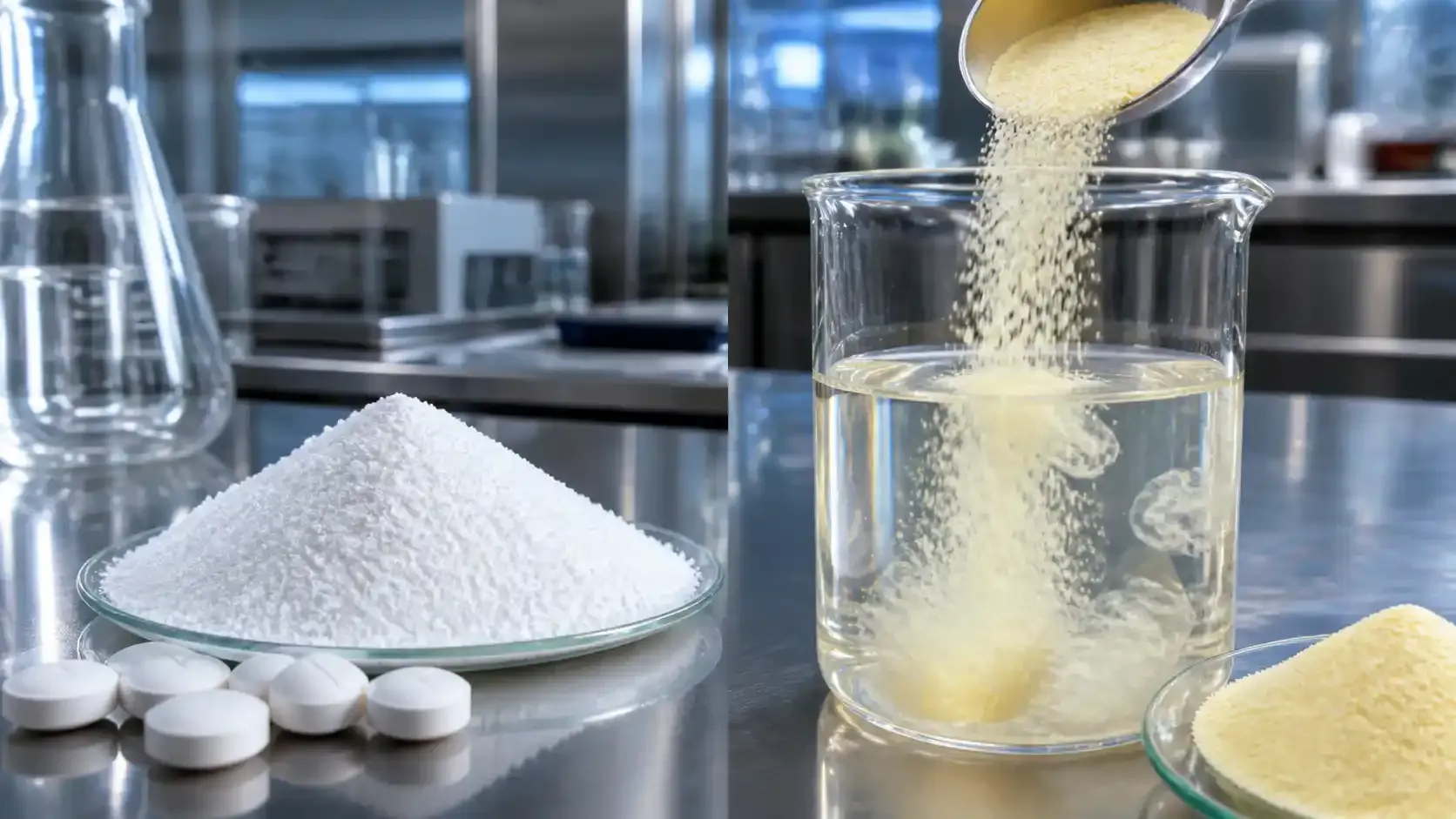
Procurement teams buying microcrystalline cellulose (MCC) and resistant dextrin are asking a fundamentally different question today than they did a few years ago. Instead of simply looking for the lowest FOB price, the market is increasingly centered on a critical metric: Who can prove the product is consistent, compliant, and traceable—batch after batch?
This shift in priority explains why rigorous searches for a highly qualified Chinese Microcrystalline Cellulose Manufacturer and a dependable Chinese Resistant Dextrin Manufacturer have become the standard in B2B sourcing. Here is a breakdown of what "recommended" truly means in practice for China-based supply—especially for buyers balancing strict pharma-grade MCC expectations with the fast-growing demand for non-GMO resistant dextrin used in fiber-forward foods and supplements.

Why MCC and Resistant Dextrin Are Sourced Together
Even though MCC and resistant dextrin often serve entirely different departments—pharmaceutical excipients versus functional nutrition—savvy buyers frequently evaluate them through the exact same supplier lens.
- MCC is typically treated as a critical excipient: it directly affects tablet hardness, compressibility, flow, and content uniformity.
- Resistant dextrin is approached as a performance fiber: it supports vital fiber claims, sugar-reduction positioning, and consumer-friendly taste and texture.
The shared denominator here is risk. Both ingredients can create expensive downstream problems if a supplier fails to maintain strict process control. For MCC, lot-to-lot variation can trigger immediate tablet defects or force costly reformulations. For resistant dextrin, variability in solubility, color, or COA detail can derail beverage clarity, alter mouthfeel, or invalidate label claims.
That shared risk profile is exactly why procurement teams increasingly apply a unified, documentation-first approach when qualifying a reliable Microcrystalline Cellulose Supplier or a resistant dextrin partner.
The Competitive Edge of Chinese Manufacturers Today
China remains highly attractive for MCC and resistant dextrin sourcing due to its massive scale, robust manufacturing infrastructure, and the increasingly sophisticated quality systems implemented in leading plants. The competitive edge is no longer limited to sheer volume; for export-facing producers, it now heavily relies on:
- Non-GMO raw material programs (especially crucial for resistant dextrin derived from corn starch).
- Automated, centralized production control designed specifically to reduce operator variability.
- Export-ready documentation that seamlessly helps importers pass both internal and third-party audits.
From a market perspective, the most notable shift is happening on the fiber side. Resistant dextrin and related soluble fibers have become strategically indispensable for products positioned around low sugar, high fiber, and digestive health. This makes supplier reliability a matter of brand protection, rather than just a routine procurement task.
If you are evaluating a soluble corn fiber supplier in China, the differentiator is rarely a single favorable test result. It is whether the plant can present an audit-ready narrative from raw material intake all the way to final release.
Five Signals of a Truly Reliable Supplier
A highly recommended supplier is one that answers buyer questions with hard evidence, not just verbal reassurance. In practice, procurement teams look for five distinct signals.
1. Traceability That Starts With the Starch
For resistant dextrin in particular, a "non-GMO" claim is meaningful only when backed by traceable sourcing. Buyers commonly request detailed raw material identity and supplier controls (e.g., verifying the corn starch source), alongside batch mapping from incoming lots to finished-product lots.
2. GMP Workshops and Controlled Environments
For MCC, GMP alignment is absolutely non-negotiable for pharma or supplement buyers. For resistant dextrin, GMP is increasingly expected when the fiber is used in mainstream nutrition formats. A top-tier Chinese microcrystalline cellulose manufacturer demonstrates clear zoning, strict hygiene controls, documented release workflows, and rigorous deviation/CAPA discipline.

3. QC Capability That Matches the Claims
Strong suppliers can articulate exactly which tests are done in-house versus what is verified by third parties. For resistant dextrin, COA credibility depends on whether the laboratory can consistently support fiber content verification, microbiology controls, appearance/color consistency, and solubility checks.
4. Certifications That Map to Export Markets
While certifications do not replace a physical audit, they significantly reduce uncertainty and accelerate pre-qualification. Industry leaders ensure their facilities hold quality systems such as ISO9001, BRC, HALAL, HACCP, and KOSHER to meet diverse market demands.
5. Technical Support That Prevents Formulation Drift
An often-overlooked signal is whether the supplier can provide rapid application troubleshooting. This is particularly vital when resistant dextrin is used in sensitive formats like clear beverages, powders, or gummies, where even minor specification shifts become glaringly obvious.
Comparing Specs: Resistant Dextrin and Pharma-Grade MCC
Procurement teams usually initiate the process with physical samples, but they finalize decisions based on documents. Here is a practical framework for how buyers compare common decision points.
A Practical Comparison for Soluble Fibers
| Buyer Concern | Resistant Dextrin (Common Target) | Generic Soluble Fibers (What Varies) | Why It Matters |
|---|---|---|---|
| Fiber strength for claims | ≥82% fiber is a standard commercial benchmark | May be lower or defined inconsistently | Protects label claims and strict nutrition panels |
| Solubility and handling | Selected for high solubility and neutral taste | Can add unwanted viscosity or off-notes | Directly impacts RTD clarity, texture, and consumer acceptance |
| Raw material positioning | Non-GMO corn starch options readily available | Source may be mixed or highly unclear | Drives "non-GMO" positioning and retailer acceptance |
| Process reliability | Enzyme and automated line control reduces variation | Variation is much more likely in commodity supply | Significantly reduces reformulation risk |
For buyers looking at non-GMO resistant dextrin manufacturer options, the core takeaway is clear: an impressive spec sheet is inadequate unless the COA and traceability prove that the specification is highly repeatable.
Evaluating Pharma-Grade MCC
Pharmaceutical teams expect MCC to align perfectly with pharmacopoeia standards (e.g., USP/EP/BP). They pay meticulous attention to particle size distribution (affecting flow and compressibility), bulk/tapped density (crucial for tablet weight uniformity), moisture/loss-on-drying, and stringent microbial limits. These points must be cross-checked against the supplier’s change-control discipline.
A Reusable Supplier Evaluation Checklist
Procurement teams often adopt an IPEC-style logic: qualify the entire system, not just the sample on your desk. Use this checklist when assessing any microcrystalline cellulose manufacturer or resistant dextrin facility:
- Raw Material Controls: Verify the non-GMO documentation pathway and incoming inspection records.
- GMP and Facility Readiness: Look for hygiene zoning, workflow separation, and sanitation SOPs.
- Automation and Process Control: Request evidence of centralized control from raw feeding to final filling.
- QC Laboratory Discipline: Clarify the in-house test capability, retention sample policies, and deviation handling.
- COA Depth and Readability: Ensure the COA includes buyer-relevant parameters, with batch numbering logic tied to traceability files.
- Third-Party Certifications: Confirm relevant market certifications (food, supplement, pharma) and allergen statements.
- Technical Support: Evaluate their ability to advise on processing, applications, and expected response times.
Real-World Examples of Recommended Chinese Suppliers
To understand what a top-tier supplier looks like in practice, it helps to examine real-world indicators rather than hollow marketing claims.
Non-GMO Inputs Paired With Scalable Process Control
A defining characteristic of an export-ready fiber supplier is a transparent statement of non-GMO corn starch sourcing, backed by rigorous process discipline. For instance, established manufacturers like Shandong Shine Health Co., Ltd. specifically detail their use of non-GMO corn starch, processed within GMP-standard workshops, utilizing fully automated central control from raw material feeding straight through to product filling. This directly addresses the two biggest failure modes in global fiber supply: opaque input sourcing and inconsistent batch outcomes.
COA-Friendly Specs That Procurement Can Defend
Industry-leading suppliers repeatedly present parameters that buyers actually care about. Showcasing metrics like appearance (white to light yellow), fiber content ≥82%, and protein content ≤6.0% provides the exact data points procurement teams need to anchor into an RFQ and confidently confirm against future COAs.
Portfolio Depth That Reduces Re-Qualification Time
Procurement teams vastly prefer suppliers with a coherent, well-structured product family. When a supplier groups multiple resistant dextrin and dietary fiber options under a unified catalog, it simplifies future reformulations. Switching from one fiber grade to another is significantly easier when the supplier’s documentation and QC logic remain consistent across their entire portfolio.
Strategic Sourcing Without Increasing Risk
A recommended Chinese supplier delivers the most value when paired with a sourcing strategy that acknowledges real-world constraints.
- Implement Dual-Sourcing: Keep a primary and a backup supplier for mission-critical specs. This ensures business continuity.
- Lock in the Right Spec Early: For resistant dextrin, fiber content (≥82%) is just the baseline; solubility, color, and microbiology are equally vital for clear beverages and gummies.
- Treat Documentation as a Deliverable: Always request the sample, the COA, and the traceability explanation in the very first round of talks. This habit quickly eliminates "cheap-but-costly" vendors.
The Bottom Line on Procurement
In today’s highly regulated ingredient market, being "recommended" is not merely a ranking—it is a strict proof standard. For both microcrystalline cellulose and resistant dextrin, procurement teams consistently reward suppliers that can visibly demonstrate traceable raw materials, GMP-ready operations, highly credible COA details, and responsive technical support.
Buyers compiling a shortlist of reliable partners should always initiate a documentation-first scan, followed by rigorous audit and application testing. For procurement professionals looking to see how a tier-one exporter structures its resistant dextrin documentation, quality controls, and comprehensive product families, you can explore the specialized solutions provided by industry experts at www.sdshinehealth.com.