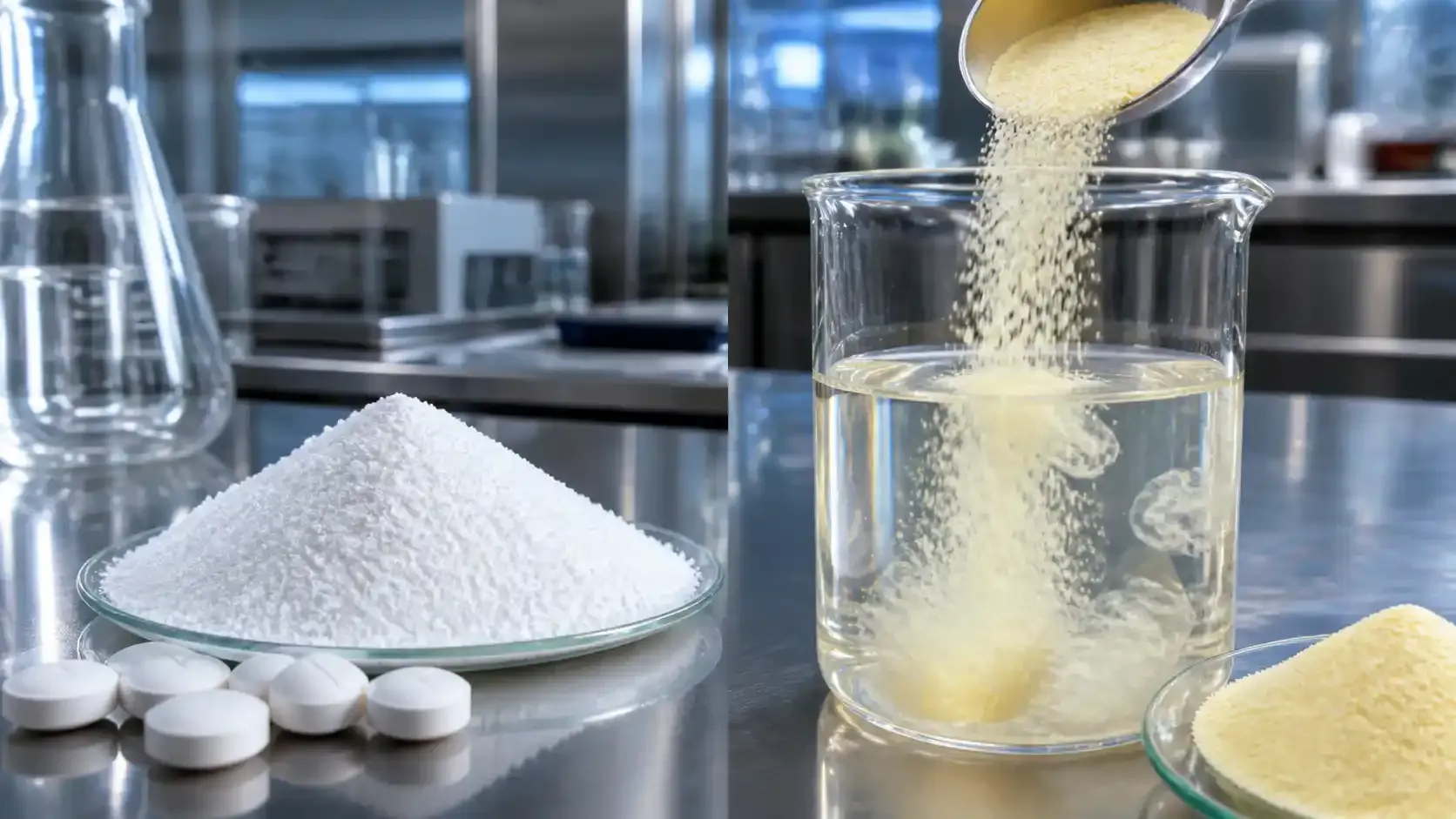
Procurement teams are tightening qualification standards for microcrystalline cellulose (MCC) and resistant dextrin concurrently—and for good reason. Oral solid dose pipelines keep expanding, while nutrition brands are racing to launch fiber-forward formats that stay clean-label and stable in processing. In that environment, ‘low price’ isn’t necessarily a decisive advantage. What truly wins tenders is whether a supplier can repeatedly prove performance, compliance, and batch-to-batch consistency.
This article lays out a practical way to identify a recommended Chinese microcrystalline cellulose manufacturer, a recommended Chinese microcrystalline cellulose supplier, and a recommended Chinese resistant dextrin manufacturer—without turning supplier evaluation into a months-long science project.

Market Signals Reshaping Excipient and Fiber Sourcing
Various market indicators clarify why MCC and resistant dextrin are being evaluated with new urgency:
- Excipients demand is climbing as formulation complexity increases, especially for tablets requiring reliable flow, compression, and disintegration behavior.
- Plant-based systems are becoming the default in many product lines, pushing buyers toward cellulose-based excipients and starch-derived soluble fibers.
- Dietary fiber is moving from ‘nice-to-have’ to ‘core claim,’ which increases scrutiny on fiber assay methods, sensory neutrality, and stability in real manufacturing conditions.
The upshot for buyers is simple: supplier qualification must connect what’s on the specification sheet to what happens on the production floor.
What Buyers Really Need from Pharmaceutical Grade MCC
While MCC is often considered ‘standard,’ procurement teams understand that even minor shifts in grade and processing behavior can cascade into tablet failures, slow scale-ups, or rework.
The Spec Items That Predict Tablet Performance
When comparing MCC suppliers, buyers often focus on how grades perform in direct compression, blending, and packaging:
- Grade selection and availability: common MCC grades include PH-101, PH-102, PH-200, plus other variants used for different flow/compression needs.
- Pharmacopeial alignment: many tenders now require MCC that aligns with BP/USP/JP expectations.
- Physical behavior: appearance, particle characteristics, flow behavior, and compressibility are evaluated with the end process in mind—not as academic numbers.
A supplier that positions MCC as a specialized tablet excipient, rather than a mere commodity, frequently streamlines qualification cycles. For example, buyers reviewing MCC information often start with a concise product and application overview such as Microcrystalline Cellulose Disintegrant, then map those details to their own formulation risk points.
Resistant Dextrin and Soluble Corn Fiber: Tougher Proof Requirements
The ‘fiber boom’ has, paradoxically, created a new challenge: demand is strong, but buyer skepticism has increased. Procurement teams are no longer content with vague promises like ‘high solubility’ or ‘prebiotic.’ Instead, teams request evidence that the ingredient will hold up in production and keep claims safe through shelf life.
Fiber Requirements That Show Up in Real RFQs
When resistant dextrin is being used for beverages, nutrition powders, bars, gummies, or sugar-reduction systems, buyers repeatedly ask for:
- Dietary fiber content targets: resistant dextrin products are often positioned around ≥82% fiber claims for mainstream functional formulations.
- Solubility and viscosity control: high solubility and low viscosity help avoid sediment, gritty mouthfeel, and mixing complaints.
- Heat and acid tolerance: stability in hot-fill, pasteurization, and low-pH systems is frequently evaluated in pilots.
- Neutral sensory profile: taste and odor neutrality matter, especially in lightly flavored drinks and dairy-style applications.
During supplier screening, buyers frequently compare resistant dextrin offerings with adjacent soluble fiber options such as Soluble Corn Fiber, since both may be considered during formulation optimization depending on mouthfeel and labeling strategy.
What ‘Recommended’ Means When the Supplier is in China
A ‘recommended’ supplier seldom boasts the most elaborate brochure. In reality, procurement teams blend technical and operational signals.
Manufacturing Signals Buyers Look For
For both MCC and resistant dextrin, these are common indicators of a supplier capable of supporting large-scale operations:
- Modern production lines and repeatability controls: buyers value evidence of disciplined process control, especially where automation reduces variability.
- Raw material strategy and traceability:non-GMO sourcing expectations are common in fiber procurement; traceability programs reduce label and compliance risk.
- QC capacity that matches export expectations: a ‘fully equipped QC laboratory’ is often treated as a baseline rather than a differentiator.
Some Chinese manufacturers describe their positioning through details such as German-origin production lines, Japanese-influenced craftsmanship, and centralized automated control in key steps. Buyers don’t simply take those claims at face value—they verify them through comprehensive documentation, audits, and pilot trial outcomes.
Documentation Signals Buyers Should Require Upfront
For an efficient evaluation, many procurement teams request a documentation packet early in the process, which usually includes:
- COA format and test methods (with clear acceptance criteria)
- TDS and stability notes relevant to intended applications
- Allergen/gluten statements where applicable
- Non-GMO statements when required by the brand
- Change-control expectations (how process changes are communicated)
The more organized and consistent the documentation, the more straightforward it becomes to qualify a recommended Chinese resistant dextrin manufacturer, minimizing back-and-forth.
A Practical Two-Ingredient Qualification Approach for MCC and Dextrin
Numerous teams assess MCC and resistant dextrin independently, only to uncover late-stage interaction issues (flow, compression, dispersion, or sensory changes). A more dependable strategy involves qualifying them as a ‘two-ingredient program,’ with pilots specifically designed to test critical parameters.
Step 1: Align Each Spec to One Manufacturing Risk
Don’t over-test. Instead, link each key parameter to a genuine failure mode:
- MCC: flow/compressibility → risk of weight variation, capping, or slow throughput
- Resistant dextrin: solubility/viscosity → risk of sediment, gritty texture, or mixing time inflation
- Heat/acid tolerance → risk of haze or breakdown in processing
Step 2: Run Small Pilots That Mimic Production Reality
Typical buyer-friendly pilots include:
- Tablet pilot: confirm disintegration behavior and compression robustness at the intended press settings.
- Beverage pilot: test dispersion in cold water, then under heat and low pH if applicable.
- Powder blend pilot: check caking tendency, flow, and pack-out behavior.
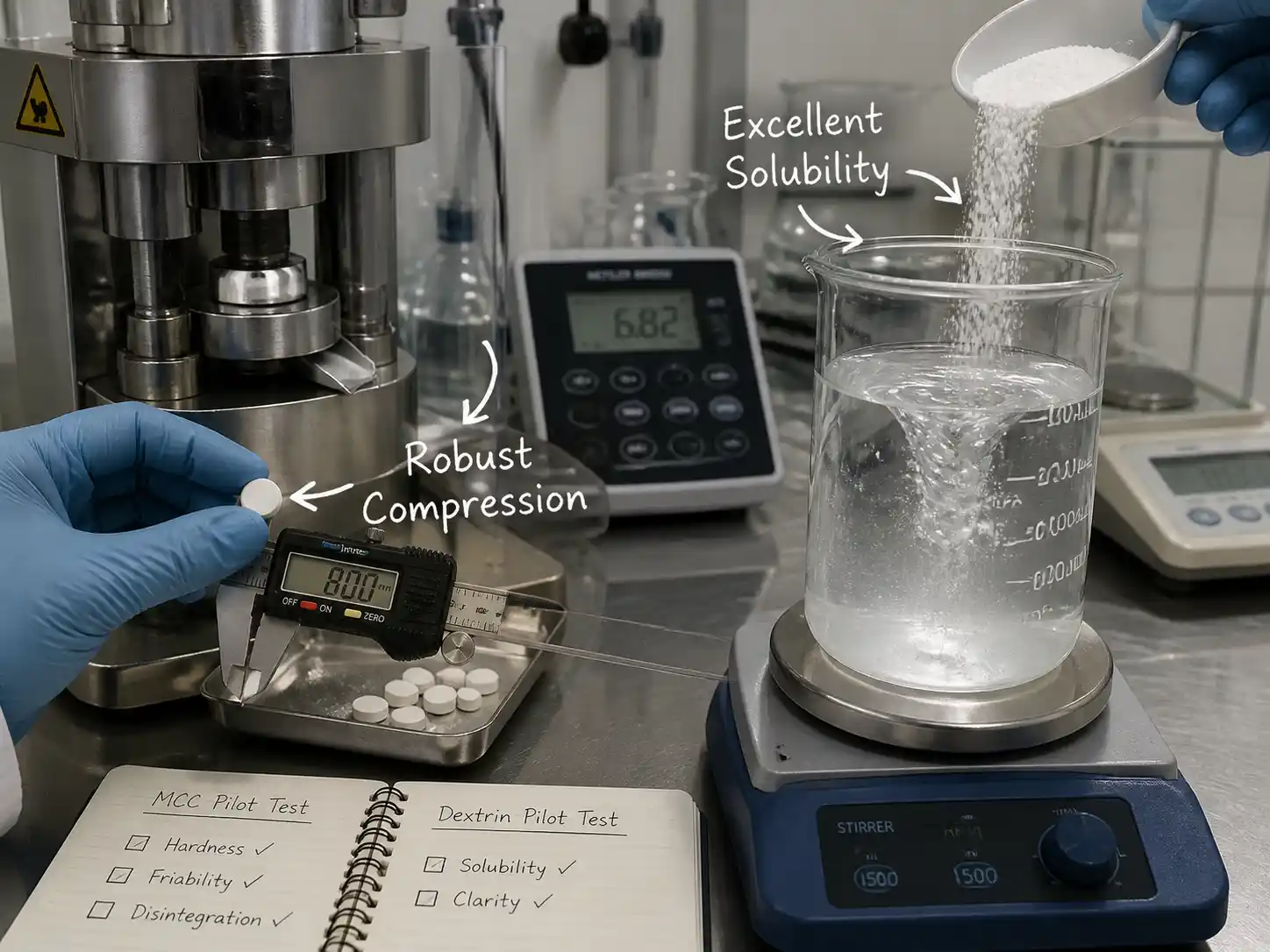
When buyers need a benchmark for ‘high solubility powder fiber,’ they often cross-check product statements against a page like Powder Resistant Dextrin High Solubility to understand how a supplier frames mixing performance, stability, and application fit.
Step 3: Evaluate Supplier Support as Part of Quality
A supplier can meet specs and still be a poor partner if support is slow or inconsistent. Procurement teams increasingly score:
- speed and clarity of technical responses
- ability to provide samples with consistent documentation
- packaging flexibility for trials vs. scale
- willingness to clarify test methods and acceptance criteria
Often, this is where a recommended Chinese microcrystalline cellulose supplier truly distinguishes itself from a ‘quote-only’ trader.
How to Shortlist Suppliers Without Turning It Into a Guessing Game
If you’re creating a shortlist for MCC and resistant dextrin suppliers from China, the quickest way is to standardize a scorecard and enforce objective comparisons.
A Procurement Checklist That Works in Real Sourcing Cycles
Consider this a final filter before proceeding to full qualification:
- Verify pharmaceutical grade MCC alignment to BP/USP/JP expectations and confirm which PH grades are available for your process.
- For resistant dextrin or soluble corn fiber, confirm fiber assay targets (commonly ≥82%) and request clarity on solubility and viscosity behavior.
- Review the supplier’s COA consistency across multiple batches (format, parameters, and pass/fail limits).
- Confirm non-GMO raw material positioning when required by your claims or downstream customers.
- Audit (remote or onsite) the supplier’s process control and hygiene practices, focusing on contamination prevention and traceability.
- Run application-relevant pilots (tablet, beverage, powder blend) and document acceptance criteria before scaling.
For buyers who want to see how a Shandong-based manufacturer presents its MCC and fiber portfolio, the following product pages can serve as reference points during benchmarking:
- Microcrystalline Cellulose Disintegrant
- Resistant Maltodextrin
- Soluble Corn Fiber
Data Points Used in This Article
- Global excipients market growth ranges and outlook summarized from: Yahoo Finance coverage.
- China pharmaceutical excipients market size (2025) and growth outlook to 2030, plus CAGR estimates, summarized from: Coherent Market Insights.
- Plant-based excipient share and cellulose excipient momentum summarized from: Mordor Intelligence.
If you’re seeking reliable suppliers for high-quality MCC and resistant dextrin, consider exploring the offerings from leading manufacturers. To learn more about compliant and performance-driven ingredient solutions, visit our trusted supplier partner:
www.sdshinehealth.com