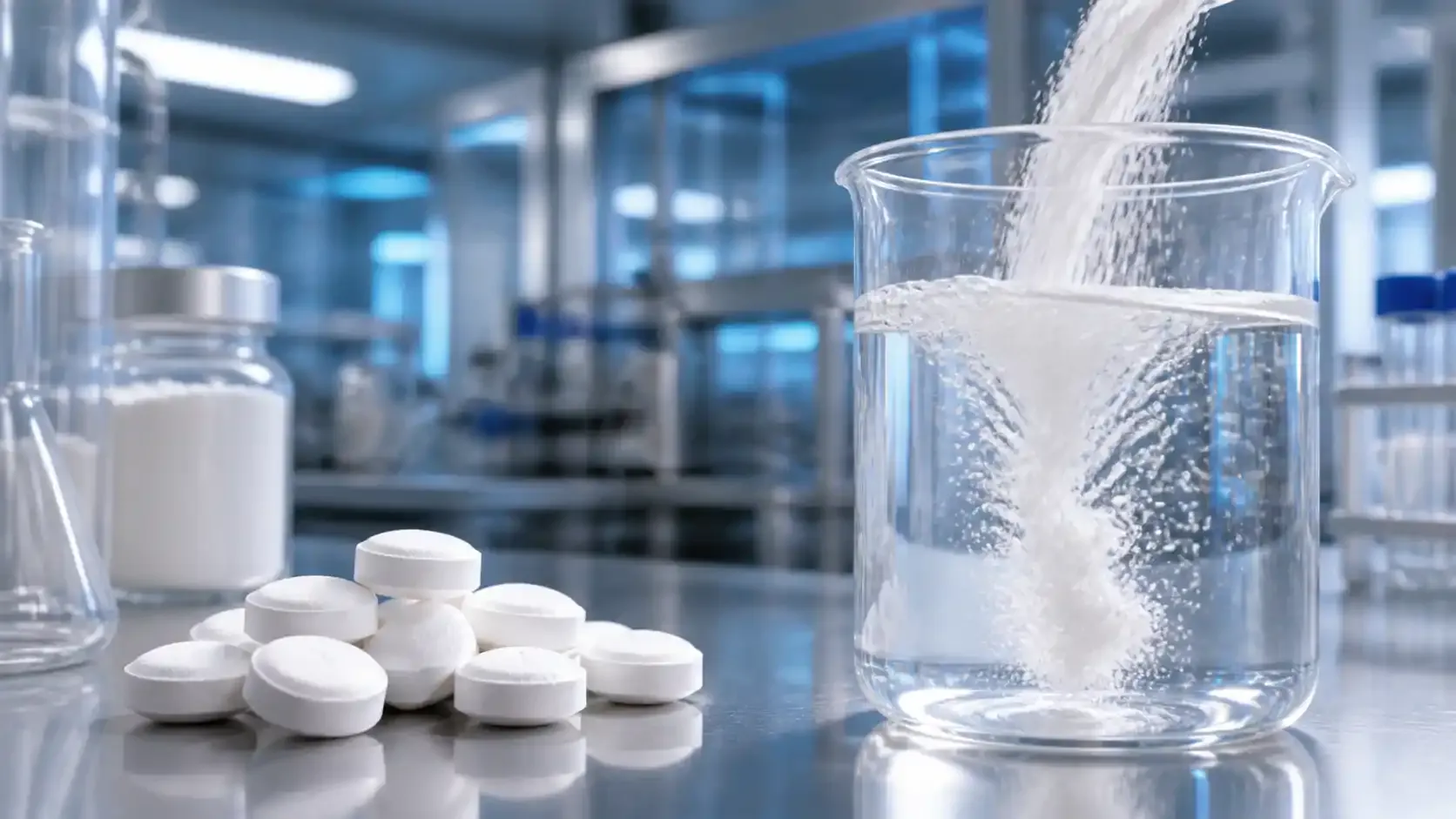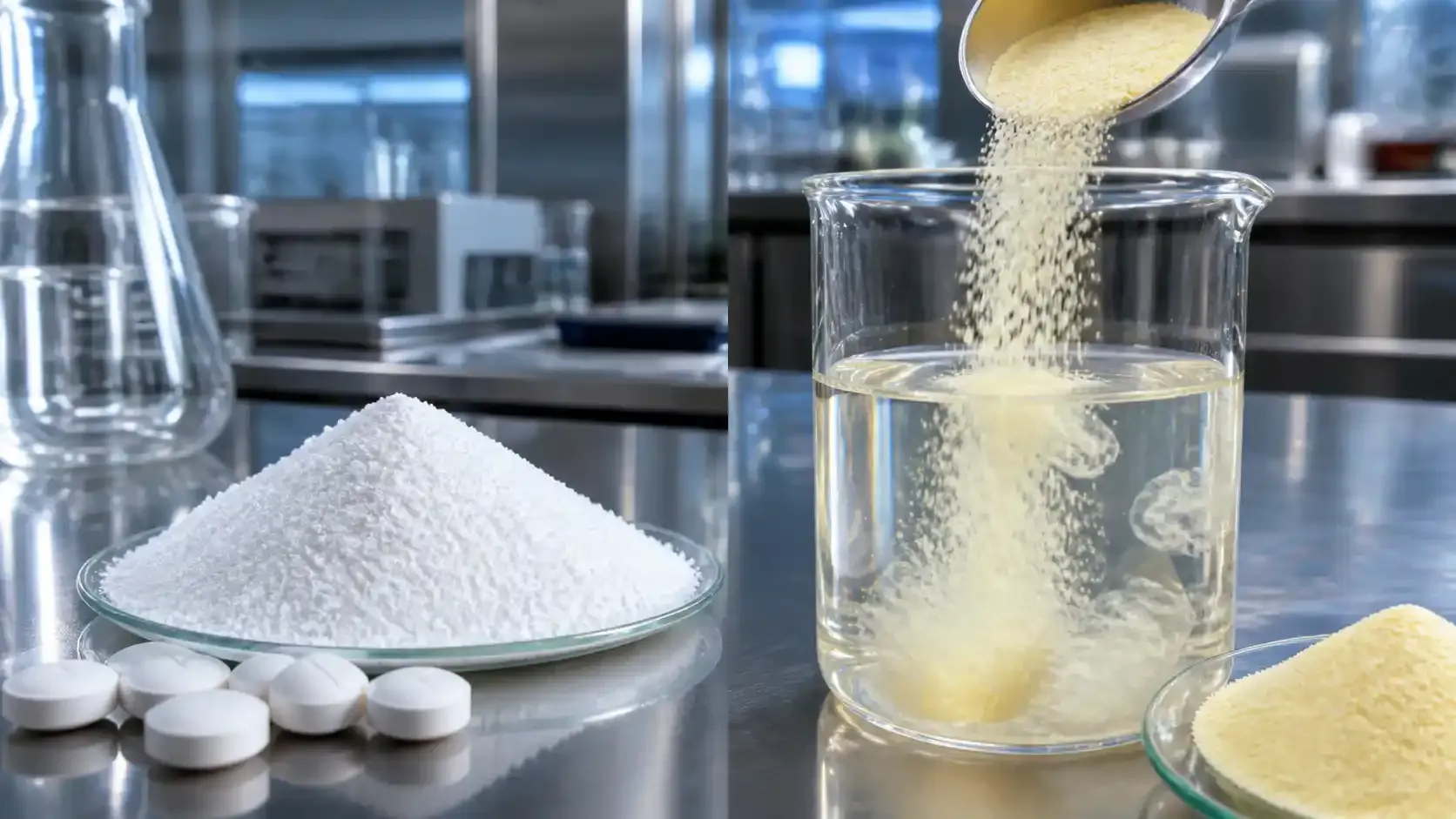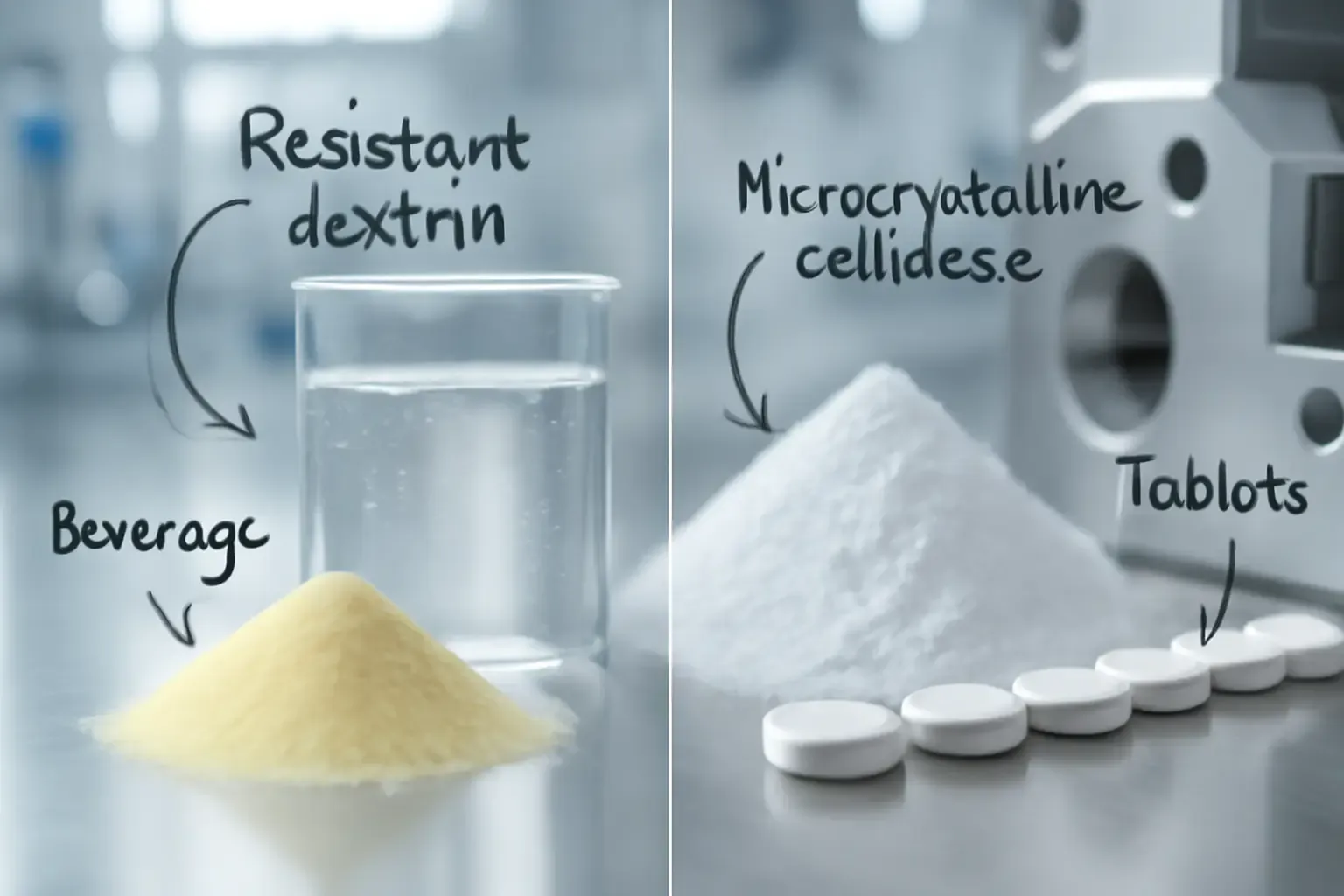
Prebiotic sodas and “fiber-forward” nutrition formats are turning ingredient selection into a functional engineering decision: the fiber must stay clear, taste neutral, and survive heat and acid, while tablet excipients must keep hardness and disintegration predictable at scale.
For procurement teams, this is also a sourcing decision. China has become a practical hub for both resistant dextrin (soluble dietary fiber) and microcrystalline cellulose (MCC) used in tablets and capsules—especially when suppliers can provide stable specs, GMP-aligned production, and documentation that buyers can audit.

Why resistant dextrin and microcrystalline cellulose now move together
Two product trends are converging:
- Prebiotic beverages are normalizing higher fiber claims (often several grams per serving), which pressures formulators to choose fibers that keep a clean flavor and manageable viscosity.
- Nutraceutical tablets and gummies keep expanding, and brands want reliable, compliant excipients that reduce manufacturing variability.
As a result, resistant dextrin and microcrystalline cellulose are frequently evaluated in the same sourcing cycle because many brands launch both drinkable and solid formats in one portfolio.
What resistant dextrin does in modern food and beverage systems
Resistant dextrin is a soluble dietary fiber derived from starch (commonly corn or tapioca). It resists digestion in the small intestine and functions as dietary fiber in the large intestine. In formulations, resistant dextrin is typically selected for three reasons:
- Neutral taste and clear solubility for beverage-friendly sensory performance.
- Heat and pH stability to tolerate common beverage and snack processing.
- High fiber loading efficiency for products targeting meaningful fiber grams per serving.
For buyers comparing offers from a resistant dextrin supplier China roster, the fastest way to avoid reformulation later is to treat resistant dextrin as a performance ingredient, not a generic commodity.
Resistant dextrin baseline spec snapshot (buyer-ready)
| Parameter | Typical purchasing expectation (from supplier spec pages) |
|---|---|
| Product name | Resistant Dextrin |
| Raw material | Corn starch (NON-GMO source is commonly specified) |
| Appearance | White to light yellow |
| Fiber content | ≥82% |
| Protein content | ≤6.0% |
| Storage | Store in a cool place |
When fiber content is the headline claim, resistant dextrin becomes easier to qualify when every shipment is supported by a COA that matches this baseline.
What microcrystalline cellulose does in nutraceutical tablets and capsules
Microcrystalline cellulose is an insoluble cellulose-based excipient valued for compressibility, flow, and its ability to support consistent solid-dose manufacturing. In procurement terms, MCC is rarely “one grade fits all.” Buyers typically shortlist grades based on how they affect:
- powder flow and die filling,
- tablet hardness and friability,
- disintegration behavior,
- robustness to process variation.
A microcrystalline cellulose supplier China is often preferred when it can supply multiple grades, keep grade-to-grade performance consistent, and document pharmacopeial compliance.
Microcrystalline cellulose baseline spec snapshot (buyer-ready)
| Item | Common specification points (from supplier spec pages) |
|---|---|
| Product name | Microcrystalline Cellulose |
| Available kinds | PH-101; PH-102; PH-103; PH-105; PH-112; PH-113; PH-200; PH-301; PH-302 |
| Appearance | White or almost white powder |
| Mesh | 60–200 |
| CAS | 9004-34-6 |
| Standard | BP/USP/FCC/JP |
| Certifications commonly listed | ISO9001 / Kosher / Halal |
| Typical packaging | 20 kg woven bag (custom packaging may be available) |
For nutraceutical operations, the purchasing spec should explicitly state the target grade (for example PH-101, PH-102, or PH-200) and the acceptance tests needed for incoming QC.
Application pattern 1: prebiotic sodas and low-calorie RTDs
Prebiotic soda has moved from niche to mainstream discussion, and many of these formulas place resistant dextrin at the center because it can deliver fiber grams without heavy texture.
A typical brief looks like:
- Target: fiber-forward claim per can; keep taste “soda-like” rather than “supplement-like.”
- Processing reality: acidity, carbonation, and pasteurization or hot-fill steps can punish unstable fibers.
Where resistant dextrin earns its place:
- Clarity and neutral taste help preserve flavor systems.
- Heat and pH stability reduce risk during thermal processing and shelf life.
- High fiber content (≥82%) allows meaningful dosage without excessive solids.
Procurement note: when comparing resistant dextrin supplier China quotations, ask for the exact fiber content method and COA format used by the plant, and confirm that the resistant dextrin lot-to-lot appearance remains within “white to light yellow.” If the beverage is positioned as non-GMO, ensure the resistant dextrin is specified as sourced from NON-GMO corn starch.

For product managers building a pipeline of beverage-ready fibers, the resistant dextrin category pages maintained by Shandong-based producers can be useful spec references, such as:
- resistant dextrin product listings
- low calorie dietary fiber (resistant dextrin) format notes
Application pattern 2: fiber-forward confectionery and baked goods
Confectionery is an unusual “stress test” for resistant dextrin because texture, crystallization, and sweetness balance are unforgiving. In fiber-forward concepts (chews, gummies, chocolates, or baked snacks), resistant dextrin is often used as:
- a bulking component when sugar is reduced,
- a texture smoother when a formula risks becoming gritty,
- a fiber enrichment tool that supports digestive positioning.
Typical functional requirements buyers see in briefs:
- Chewy texture without excessive stickiness.
- Smooth mouthfeel without aftertaste.
- Process stability when syrup cooking or baking temperatures are high.
Resistant dextrin supports those needs because it is positioned as neutral tasting, clear dissolving, and stable in heat across a broad pH range.
A practical cross-check: confectionery R&D often pushes fiber content aggressively. If a supplier’s resistant dextrin hits the fiber spec (≥82%) but introduces unexpected flavor notes, the product will fail consumer testing even if the nutrition panel looks strong. That makes sensory evaluation and small pilot sampling a procurement requirement, not a “nice to have.”
One application-style reference is the confectionery-focused presentation of resistant dextrin use cases:
- resistant dextrin applications for confectionery
Application pattern 3: nutraceutical tablets, capsules, and fiber powders
Solid-dose products (tablets and capsules) are where microcrystalline cellulose becomes the quiet driver of manufacturing stability. In many nutraceutical formulas, MCC is used as a:
- binder and filler to support tablet integrity,
- disintegrant-supporting excipient (depending on the formulation design),
- flow and compressibility aid in direct compression workflows.
Choosing MCC grades for real-world robustness
Buyers typically see MCC grade selection framed as a process fit problem:
- PH-101 often aligns with fine particle needs.
- PH-102 is frequently used when better flow is desired.
- PH-200 and other grades may be selected for specific flow/compression profiles.
Because grade names recur across suppliers, the practical purchasing move is to align the grade with incoming QC and manufacturing validation—not just a label claim.
For teams looking for a single, well-structured explainer on how MCC grades map to performance and QC expectations, the following industry note can serve as a starting point:
- MCC grades formulation and QC guide
Where resistant dextrin and MCC intersect
Some brands build fiber supplements that include resistant dextrin as the primary fiber while using microcrystalline cellulose to help with powder handling or tablet manufacturability. In those programs, resistant dextrin is evaluated for fiber delivery and taste, while microcrystalline cellulose is evaluated for compression behavior and disintegration consistency.
This is also where procurement teams benefit from sourcing discipline: resistant dextrin and microcrystalline cellulose may ship from different production lines, but the combined product performance will be judged as one.
Technical checkpoints that reduce risk when sourcing from China
China sourcing can be highly efficient when the buyer’s checklist is written in formulation language.
Resistant dextrin checkpoints
- Fiber content: confirm ≥82% as a contractual spec line.
- Raw material statement: verify “corn starch” and, when needed, “NON-GMO corn starch.”
- Appearance range: “white to light yellow” should be consistent lot-to-lot.
- Protein limit: confirm ≤6.0%.
- Process fit: request application guidance for beverages versus confectionery; resistant dextrin use levels often shift viscosity and sweetness perception.
For buyers building an RFQ, it helps to keep one canonical landing page as the internal spec reference, for example:
- nutritional dietary fiber powder (resistant dextrin) specification snapshot
Microcrystalline cellulose checkpoints
- Pharmacopeial standard: ensure the material is offered under BP/USP/FCC/JP as required by the formula and destination market.
- Grade availability: confirm access to PH-101/PH-102/PH-200 (or other needed kinds) with clear grade labeling.
- Particle/mesh range: align mesh to manufacturing needs (60–200 is commonly cited).
- Documentation: COA format, batch traceability, and inbound testing plan.
A starting point for product-level details can be:
- microcrystalline cellulose product overview
What “recommended” should mean in a Chinese manufacturer shortlist
Search phrases like “Recommended Chinese Resistant Dextrin Manufacturer” or “Recommended Chinese Microcrystalline Cellulose Supplier” are only useful if “recommended” is tied to evidence.
A practical definition for buyers is:
- Specs that map to applications (resistant dextrin in beverages vs. confectionery; MCC grade fit in tablets)
- Manufacturing discipline (GMP-aligned workshop language, hygiene controls, traceability statements)
- QC capability (a clearly described QC laboratory and inspection steps)
- Export readiness (stable packaging, labeling, and batch documentation)
Shandong-based ingredient producers such as Shine Health (also referenced as Shandong Shenghuai Health Co., Ltd.) are often used by buyers as an example category of integrated suppliers covering soluble fiber lines and excipients. The useful point for procurement teams is not the brand name—it is the ability to verify specs, process controls, and documentation quickly.
Closing brief for procurement and formulation teams
Prebiotic soda innovation is pulling resistant dextrin into mainstream beverage specs, while nutraceutical scale-up keeps microcrystalline cellulose at the center of tablet robustness. The buyers who move fastest are typically the ones who translate marketing claims into acceptance criteria: fiber content, raw material statements, appearance limits, grade selection, and pharmacopeial compliance.
For teams building a China sourcing shortlist, it is reasonable to start with suppliers that publish consistent spec tables and application notes, then validate with COA, samples, and inbound QC plans. A consolidated place to review resistant dextrin and microcrystalline cellulose lines (as examples used by many buyers during early benchmarking) is www.sdshinehealth.com.