In 2026, gut health positioning is still driving launches, but the bigger shift for procurement teams is that “healthy” is no longer just a brand idea—it increasingly behaves like a specification and documentation problem. For many teams, that pushes resistant dextrin (often labeled as soluble corn fiber or resistant maltodextrin) to the front of reformulation plans, while microcrystalline cellulose (MCC) becomes the quiet stabilizer in tablets, chewables, and certain texture systems.
This discussion translates the 2026 regulatory and claim signals into buyer language—what to ask for, what to test, and how to recognize a Recommended Chinese Resistant Dextrin Manufacturer or a Recommended Chinese Microcrystalline Cellulose Supplier without turning your next launch into a relabeling project.

2026 is turning “healthy” into a procurement constraint
Two forces are converging:
- Market pull: high-fiber, gut-friendly products are expanding across beverages, dairy, snacks, and supplements. Trend coverage continues to highlight fiber fortification and prebiotic positioning as core innovation themes.
- Rule pressure: the U.S. has updated criteria for the voluntary use of the “healthy” nutrient content claim, and the EU is tightening expectations around food safety and packaging compliance. Even when an ingredient is technically strong, the wrong paperwork—or the wrong target spec—can undermine a launch.
For sourcing teams, this means ingredient selection increasingly starts with a question that used to be handled later: What claims and markets must this SKU survive for the next 24 months? If “healthy” positioning is part of the plan, the fiber system and the excipient system must be bought with compliance in mind.
Resistant dextrin fundamentals buyers can actually verify
Resistant dextrin is widely used as a prebiotic dietary fiber because it resists digestion in the small intestine and can be fermented in the colon. What makes resistant dextrin especially procurement-friendly is not the marketing language—it’s the way the ingredient can be specified and checked.
From supplier documentation commonly provided for resistant dextrin, buyers can often confirm parameters such as:
- Fiber content: many commercial grades are specified at ≥82%, and some grades reach higher fiber levels (commonly offered as multiple grades).
- Moisture and storage behavior: moisture and water activity are frequently controlled to support shelf stability and minimize caking.
- Process tolerance: resistant dextrin is often positioned as a heat stable soluble fiber with stability under acidic conditions, which matters in RTD beverages, dairy processing, and baked systems.
- Calorie contribution: some product descriptions cite approximately 1 kcal/g, supporting low-calorie formulation targets.
For buyers evaluating a resistant dextrin program, it helps to pin the conversation to measurable outcomes:
- Taste impact: neutral taste and low off-notes matter as much as fiber percentage.
- Solubility and clarity: soluble corn fiber grades are often chosen specifically to keep beverages clean-looking.
- Viscosity: resistant dextrin is typically used when you want fiber without turning the product into a gel.
For a technical starting point, procurement teams often use supplier product pages and TDS as an initial screen, then confirm with COAs and internal testing. Example product resources include pages describing resistant dextrin as a soluble dietary fiber and prebiotic, such as Shine Health’s overview of resistant dextrin for food supplements.
Soluble corn fiber and resistant maltodextrin versus polydextrose in reformulation
Reformulation teams often evaluate resistant dextrin against other fibers—commonly inulin, oat fiber, and polydextrose—because the technical trade-offs show up quickly in processing and sensory.
A procurement-focused way to compare is to ask: Which fiber gives the label outcome without breaking processing?
- Resistant dextrin / soluble corn fiber: often selected for neutral taste, high solubility, and stability across heat and acid—useful in clear beverages, dairy drinks, flavored waters, and powdered mixes. This is why “soluble corn fiber” appears frequently in beverage and supplement pipelines.
- Resistant maltodextrin: commonly treated as a close technical sibling in the resistant dextrin family. In practice, many buyers shortlist both and let pilot trials decide which performs better in a specific matrix.
- Polydextrose: frequently used for bulking and sugar reduction strategies, but buyers sometimes switch or blend depending on digestive tolerance targets and sensory goals.
If sugar reduction is part of the brief, resistant dextrin is often evaluated as a bulking tool that can reduce sugar while supporting fiber positioning. A practical comparison is to place resistant dextrin next to existing bulking agents and test the real-life consequences: sweetness curve, aftertaste, mouthfeel, and shelf stability.
Buyers who want to explore soluble corn fiber product options can start with a supplier’s category pages, for example: soluble corn fiber, and then narrow down by grade, COA format, and application support.
Where microcrystalline cellulose fits when fiber moves into supplements
While resistant dextrin drives the fiber claim and gut-health story, microcrystalline cellulose (MCC) often determines whether a supplement format is stable, manufacturable, and consistent at scale.
In procurement terms, MCC is rarely bought for a headline benefit. It is bought to reduce production risk:
- Tablet performance: MCC is widely used for binding and compressibility behavior in tablets.
- Powder handling: MCC grade choices can influence flow, uniformity, and blending.
- System consistency: when fiber inclusion changes bulk density and compaction behavior, MCC can help stabilize the formula’s physical behavior.
That’s why many 2026 programs increasingly treat resistant dextrin and microcrystalline cellulose (MCC) as a coordinated sourcing decision: soluble fiber for functional positioning, MCC for dosage form control.
For teams reviewing MCC grade selection and QC considerations, a useful starting point is a practical guide such as MCC grades formulation and QC guidance.
Compliance signals that change what you must request in 2026
2026 compliance pressure shows up in the paperwork package, not just in the ingredient itself. Procurement teams importing resistant dextrin or microcrystalline cellulose (MCC) should expect tighter internal review of:
1) Claim alignment documents
If the U.S. “healthy” claim is part of the plan, documentation needs to support the final label outcome. Resistant dextrin may be technically solid, but the decision still depends on how the finished product qualifies under the claim criteria and nutrient limits.
Procurement translation: confirm the fiber content spec and the lab method used on the COA; ensure the value supports finished product calculations at intended inclusion.
2) Microbiology and food safety expectations
EU changes to microbiological criteria in certain ready-to-eat categories raise the level of attention paid to hygiene controls across the ingredient supply chain—even for dry powders.
Procurement translation: require COA microbiology lines (e.g., aerobic plate count, coliforms, yeast, mould) and confirm the supplier’s testing frequency and lab capability.
3) Packaging and traceability discipline
EU packaging rules beginning general application in 2026 will keep pushing documentation expectations around packaging materials and waste compliance. Even if fiber ingredients are not the only driver, packaging documentation can delay shipments.
Procurement translation: request a packaging spec that covers inner lining material, sealing method, batch labeling, and traceability format. This matters for both resistant dextrin and microcrystalline cellulose (MCC).
What “recommended” Chinese manufacturers can prove without a sales pitch
A Recommended Chinese Resistant Dextrin Manufacturer is typically not “recommended” because of one metric like fiber percentage. They are recommended because they can repeatedly demonstrate control over raw materials, process automation, and batch-to-batch verification.
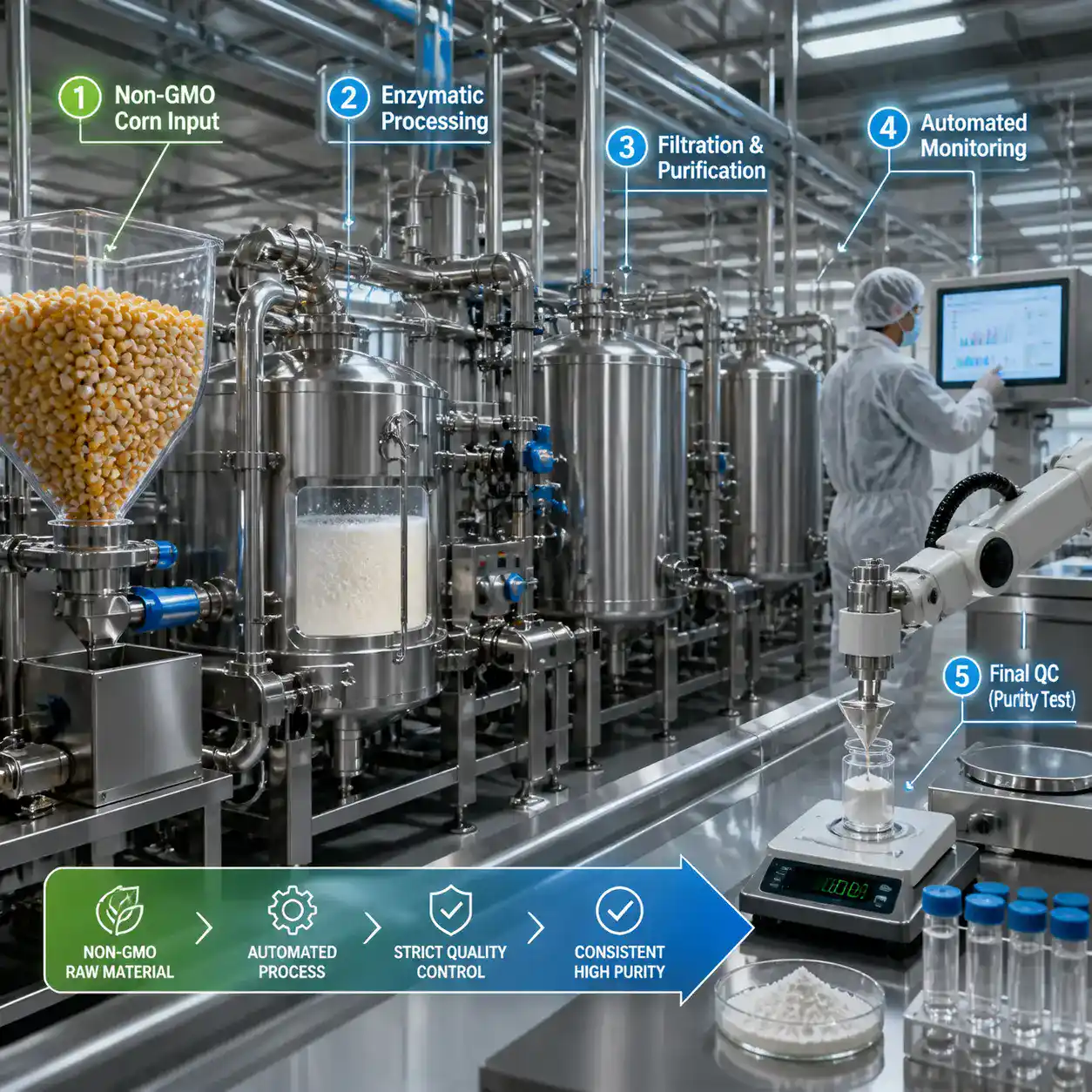
When buyers assess a bulk fiber supplier China shortlist, the most useful proof points tend to be practical:
- Raw material control: ability to show non-GMO sourcing for corn starch (when a non-GMO resistant dextrin program is required), along with incoming inspection records.
- Process design: resistant dextrin production commonly relies on enzymatic processing and purification; suppliers that describe imported enzymes and controlled lines are often easier to qualify for consistency.
- Automation and hygiene: fully automated workshops reduce variability and can strengthen traceability.
- In-house QC: a functioning QC lab that can issue clear COAs, plus the ability to share typical ranges (not just pass/fail).
- Certification readiness: systems such as ISO9001, HACCP, and relevant food certifications simplify buyer audits.
One example that procurement teams may encounter in market searches is Shine Health (also referenced as Shandong Shenghuai Health Co., Ltd.), which describes resistant dextrin and resistant maltodextrin production using non-GMO corn starch sourcing, imported enzymes, and automated production concepts across its product pages (see resistant dextrin factory supply details). In an audit context, such statements should be treated as starting points—useful for screening, but still to be validated via documentation review and plant-level due diligence.
A practical 2026 playbook for buying resistant dextrin and MCC
The fastest way to reduce rework is to connect trend, regulation, formulation, and supplier proof into one workflow.
- Lock the market and claim map first. Define where the SKU will ship in 2026–2027 and what “healthy” or fiber-forward language will be used.
- Define non-negotiable specs for resistant dextrin. Typical anchors include fiber content (e.g., ≥82% where applicable), moisture/water activity expectations, solubility behavior, and microbiology lines on the COA.
- Pair resistant dextrin with MCC intentionally. If the format includes tablets, chewables, or powder blends, confirm early whether microcrystalline cellulose (MCC) is required for compressibility, flow, or disintegration behavior.
- Request a documentation pack before you request a price pack. COA template, MSDS, allergen statement, origin statement (especially for non-GMO resistant dextrin), and certificates should arrive before the final quote comparison.
- Run pilot trials in one beverage and one supplement format. Resistant dextrin often behaves predictably, but stability and sensory must be proven in the specific matrix.
For buyers who want to review specification-style product information and available fiber variants, supplier category pages can be useful as a quick technical index—such as the resistant dextrin section at www.sdshinehealth.com. The key is to use these pages as a screening tool, then confirm everything with COAs, samples, and internal qualification steps. For teams that want a broader overview of resistant dextrin, soluble corn fiber, and related functional ingredients from a Chinese producer, the main site at www.sdshinehealth.com offers a consolidated starting point for further sourcing conversations.