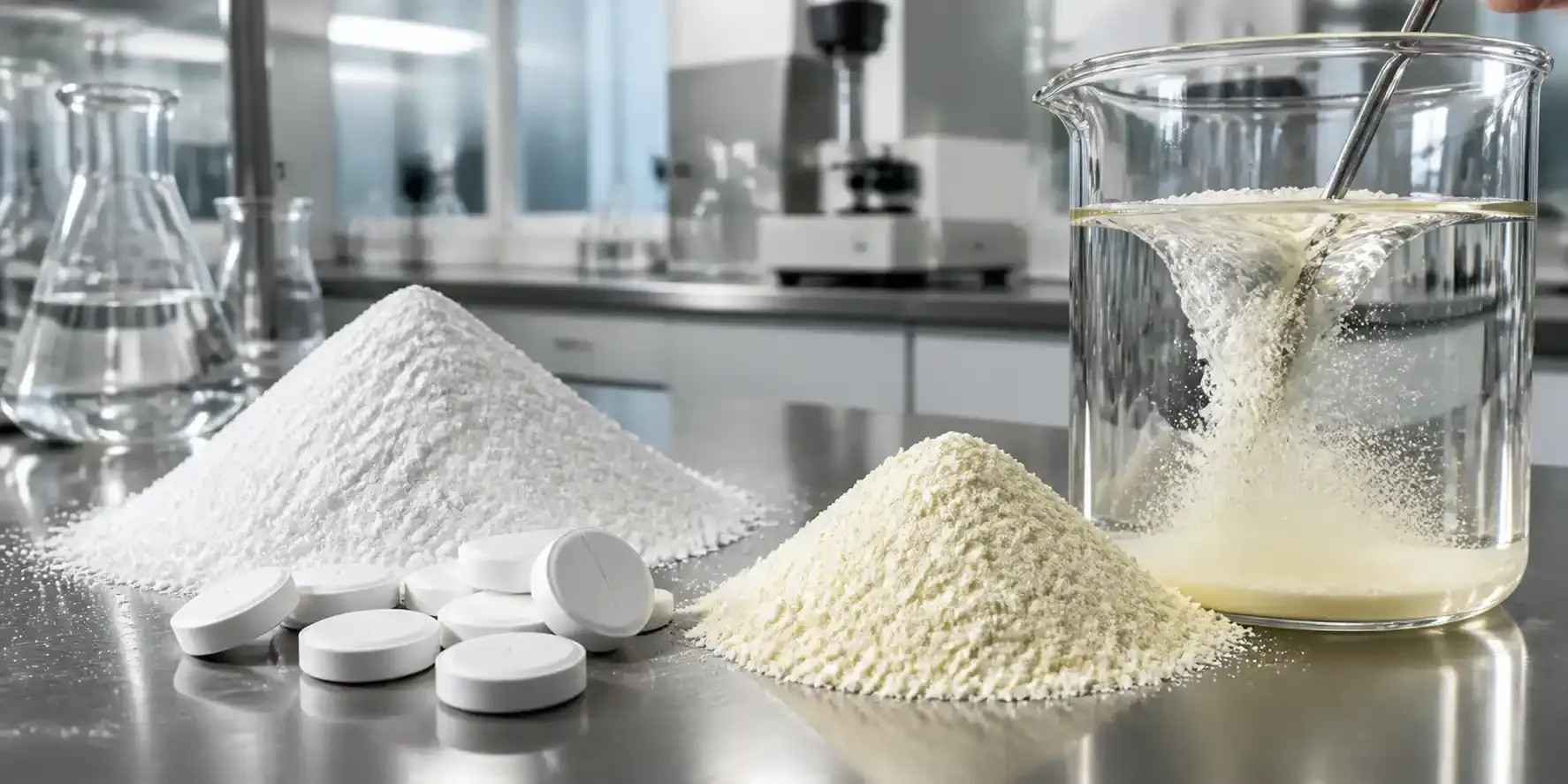
Fiber is no longer a “nice-to-have” claim—it is becoming a structural ingredient in beverages, baked goods, supplements, and even cross-category portfolios where food and pharma sourcing overlap. As that happens, procurement teams keep running into the same bottleneck: a specification sheet that looks familiar but doesn’t translate into stable processing, consistent label claims, or predictable audit outcomes.
This guide builds a shared technical vocabulary for resistant dextrin, soluble corn fiber, tapioca resistant dextrin, and microcrystalline cellulose (MCC)—and then turns that vocabulary into sourcing checkpoints. The goal is simple: help buyers identify what a Recommended Chinese Resistant Dextrin Manufacturer or a Recommended Chinese Microcrystalline Cellulose Manufacturer should prove before a factory makes the shortlist.

Why resistant dextrin and MCC are now “backbone” ingredients
Two trends are converging:
Fiber is moving into mainstream formats (RTD drinks, nutrition powders, bakery, gummies), where solubility, taste neutrality, and processing stability are non-negotiable.
MCC remains a workhorse excipient for tablets and capsules, where compressibility, flowability, and moisture control drive production efficiency.
In practice, teams increasingly source both fibers and excipients from the same regional supply chain. That’s why the fundamentals matter: misunderstanding a resistant dextrin COA line can trigger beverage haze or clumping; misunderstanding an MCC grade can trigger tablet weight variation or poor hardness.
Resistant dextrin and soluble corn fiber basics buyers should agree on
What resistant dextrin is in formulation terms
Resistant dextrin is a water-soluble dietary fiber derived from starch (commonly corn, and sometimes tapioca/cassava depending on the product line). It is designed to resist digestion in the small intestine, behaving as a prebiotic fiber that reaches the large intestine.
For formulation and procurement, the key is that resistant dextrin behaves more like a process-friendly soluble fiber than a gritty fiber concentrate:
Dissolves in water (often in both hot and cold systems)
Neutral taste and light color support clean sensory profiles
Stability under heat and acidity supports bakery and many beverage processes
When a purchasing team evaluates a resistant dextrin supplier, those properties should be validated by consistent batch data—not just by marketing descriptions.
Soluble corn fiber vs resistant dextrin vs tapioca resistant dextrin
In many supply catalogs, buyers will see overlapping terms:
Soluble corn fiber: often used as a naming convention for corn-derived soluble fiber systems; it may be positioned as a natural-origin fiber ingredient.
Soluble fiber powder derived from resistant dextrin: typically a powder format with a defined fiber target and basic compositional limits.
Tapioca resistant dextrin powder: positioned for buyers who want tapioca/cassava sourcing narratives, allergen positioning, or portfolio diversification.
From a sourcing standpoint, these are best treated as a resistant dextrin family with meaningful differences in origin statements, fiber content targets, and how the supplier documents raw material traceability.
Buyer note: if an RFQ requires tapioca/cassava positioning, the resistant dextrin supplier must be able to show raw material documentation and traceability that match the label strategy, not only a generic “dextrin” COA.
Functional properties that matter most when buying resistant dextrin in bulk
Solubility and stability translate directly into process risk
For most product developers, resistant dextrin earns its place because it is typically:
Easy to blend into beverage and powder systems
Less likely to dominate texture compared with some traditional fibers
More tolerant of heat and certain pH ranges than fibers that thicken aggressively
For procurement, that means the “right” resistant dextrin manufacturer China should be able to provide consistent targets for moisture and water activity, since these influence:
Caking risk in warehouse storage
Flow in blending lines
Shelf-life stability in finished goods
Sensory impact and sugar-reduction positioning
Resistant dextrin is often shortlisted for sugar reduction or calorie-reduction programs because it can support bulk and mouthfeel with minimal flavor interference.
A practical internal resource for product teams drafting an RFQ is the product page context for resistant dextrin powder, which frames resistant dextrin as a soluble fiber option used in sugar-reduction projects.
Buyer note: “sugar reduction” claims are rarely saved by ingredient naming alone. The resistant dextrin supplier must provide a tight spec and microbiological controls that hold up in finished formats with longer distribution cycles.
Gut health positioning needs consistent fiber delivery
Many buyers now approach resistant dextrin as a resistant dextrin prebiotic supplier input—meaning they care about stability and repeatable fiber content, not just price.
If the product line targets gut health positioning, it is helpful to align internal teams around a clear, single reference point for what is being sourced (e.g., a defined resistant dextrin grade with a minimum fiber level).
The COA lines that actually define resistant dextrin quality
Below is a condensed view of parameters commonly published for resistant dextrin grades, which procurement can convert into a supplier comparison template.
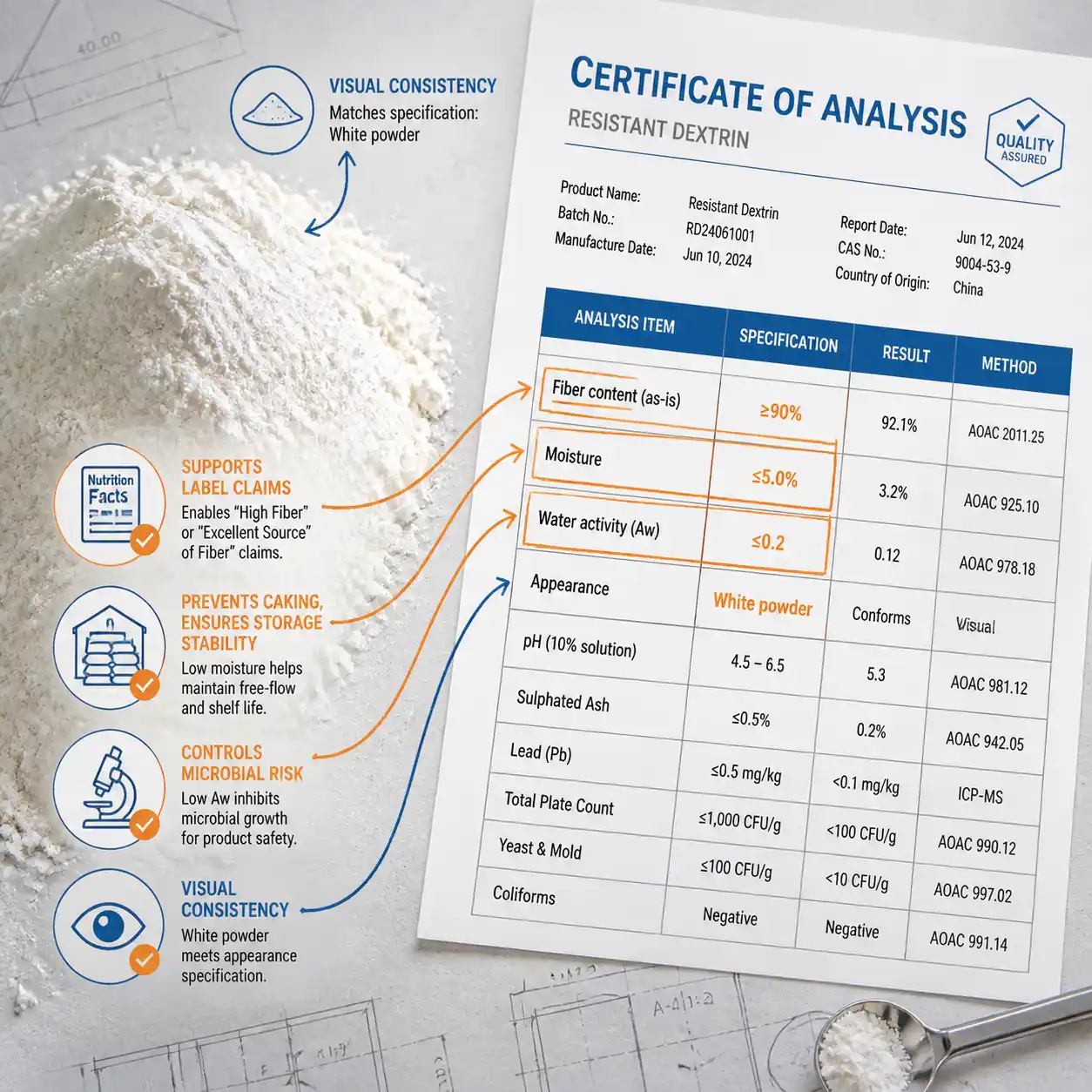
Typical resistant dextrin specification ranges used for screening
| Parameter | Common screening target (example set) | Why it matters in buying |
|---|---|---|
| Appearance | White to light yellow powder | Visual consistency and process expectations |
| Fiber content (g/100g) | ≥70% / ≥85% / ≥90% / ≥95% | Label claim flexibility and dosage planning |
| Moisture (g/100g) | ≤5.0 | Caking risk and storage stability |
| Ash (g/100g) | ≤0.1 | Purity proxy and batch consistency |
| pH | 3–6 | Compatibility across systems |
| Water activity | ≤0.2 | Microbial risk control and shelf-life support |
| Aerobic plate count | ≤1000 CFU/g | Hygienic manufacturing control |
| Coliforms | ≤3 MPN/g | Sanitation indicator |
| Mold / Yeast | ≤25 CFU/g | Stability in storage and blends |
These parameters are particularly useful when a buyer is evaluating a factory supplier resistant dextrin bulk program, because they reduce surprises after the first container ships.
Buyer note: fiber content tiers (e.g., ≥70 to ≥95) are not interchangeable. A sourcing decision should start from the finished product’s fiber claim target and serving size, then work backward into the grade.
Soluble fiber powder derived from resistant dextrin as a benchmark format
For teams that prefer a simplified “nutrition powder” spec, a reference format is soluble fiber powder derived from resistant dextrin, often documented with:
Appearance: white to light yellow
Fiber content: ≥82%
Protein content: ≤6.0%
A buyer comparing multiple offers can use a product page like soluble corn fiber as a practical baseline for terminology and how suppliers describe the powder format.
Tapioca resistant dextrin adds origin nuance to the same buyer checklist
Tapioca resistant dextrin is frequently positioned as plant-derived and label-friendly for diverse food systems. In procurement terms, the same core questions apply:
Does the resistant dextrin supplier document stable solubility performance?
Is the microbiology spec tight enough for powders and RTD?
Is the origin statement consistent across COA, labels, and supporting docs?
For internal alignment, one reference page for tapioca resistant dextrin powder can be used to standardize terminology across R&D and procurement.
MCC fundamentals that matter when sourcing for tablets and capsules
Microcrystalline cellulose (MCC) is a widely used excipient in solid dosage forms, often selected for its contribution to tablet structure and manufacturability.
A buyer evaluating a microcrystalline cellulose manufacturer China should expect supplier conversations to center on physical attributes, not only a generic “passes pharmacopeia” statement. The most common screening lens includes:
Particle size distribution (impacts flow and blend uniformity)
Moisture content (impacts stability and compressibility)
Bulk density and flowability (impacts feeder performance)
Compressibility (impacts hardness and friability outcomes)
Because MCC grade selection is nuanced, procurement teams benefit from a single shared reference such as the MCC grades guide when drafting an excipient RFQ.
Buyer note: MCC sourcing mistakes often look like “manufacturing problems” later. In reality, they can start as a grade mismatch—particle size and moisture that are acceptable on paper but wrong for the compression setup.
Turning fundamentals into a China supplier shortlisting workflow
The following workflow is designed for buyers screening a resistant dextrin manufacturer China and a Recommended Chinese Microcrystalline Cellulose Supplier in parallel.
Step 1: Clarify application stress points before asking for quotes
Beverages and RTD: prioritize solubility, sensory neutrality, and microbiology
Nutrition powders: prioritize water activity, moisture, and flow
Bakery: prioritize stability under heat and mixing tolerance
Tablets/capsules: prioritize MCC flow and compressibility, plus moisture control
Step 2: Convert product goals into non-negotiable spec lines
For resistant dextrin, non-negotiables typically include:
Fiber content tier (choose the band that supports claims)
Moisture and water activity limits
Microbiological limits appropriate for the intended format
For MCC, non-negotiables typically include:
Grade suitability for the process (direct compression vs other routes)
Physical consistency (flow, bulk density, moisture)
Step 3: Use published technical transparency as a first filter
A practical early filter for a Recommended Chinese Resistant Dextrin Manufacturer is whether the supplier publishes:
Clear parameter tables (fiber, moisture, ash, pH, water activity)
Microbial limits suitable for global distribution
Manufacturing descriptions that indicate automation and controlled processing
As an example of how some Chinese producers document these points, public technical pages on www.sdshinehealth.com describe automated workshops, QC laboratory capabilities, and multiple resistant dextrin-related product formats.
Important: this is not a substitute for a formal audit. It is a way to reduce the time spent on suppliers who cannot even standardize basic documentation.
Step 4: Ask for the right documents before trial sampling
Before a trial, a resistant dextrin supplier should be prepared to provide typical buyer documents (as applicable to the market):
COA aligned to the agreed spec lines
Basic safety and handling documentation (commonly requested in audits)
Traceability statements consistent with “non-GMO” or origin positioning
For MCC sourcing, documentation expectations are often tighter due to pharma quality systems—another reason the MCC sourcing guide China approach should start with grade clarity.
Closing perspective for cross-category sourcing teams
When buyers treat resistant dextrin and MCC as commodity powders, they usually pay later—in reformulation cycles, delayed approvals, or inconsistent production performance. A more reliable approach is to treat both as backbone ingredients whose value is proven through repeatable physical and microbiological targets.
For teams building a shortlist in China, the fastest path to confidence is a shared internal baseline:
one resistant dextrin family definition (corn-based, soluble corn fiber powder, or tapioca resistant dextrin)
one MCC grade selection framework
one supplier evidence checklist that can be applied consistently across quotes
If a buyer needs a concrete example of how a Chinese producer presents resistant dextrin grades and documentation, reviewing the resistant dextrin sections and knowledge pages at sdshinehealth.com/resistant-dextrin can be a useful starting point for drafting a more precise RFQ.
For more structured evaluations and to benchmark against a supplier that publicly shares multiple resistant dextrin formats and quality parameters, procurement teams can also review the broader technical library at www.sdshinehealth.com as one practical reference point when refining their own sourcing checklists.
Data notes and reading list
Shine Health resistant dextrin parameter examples and microbiology limits: https://www.sdshinehealth.com/resistant-dextrin/sugar-reduction.html
Soluble fiber powder format reference: https://www.sdshinehealth.com/resistant-dextrin/soluble-fiber-powder.html
Tapioca resistant dextrin positioning reference: https://www.sdshinehealth.com/resistant-dextrin/abundant-dietary.html
MCC grade selection primer: https://www.sdshinehealth.com/industry-news/mcc-grades.html
Market trend context on fiber growth: Food Business News coverage