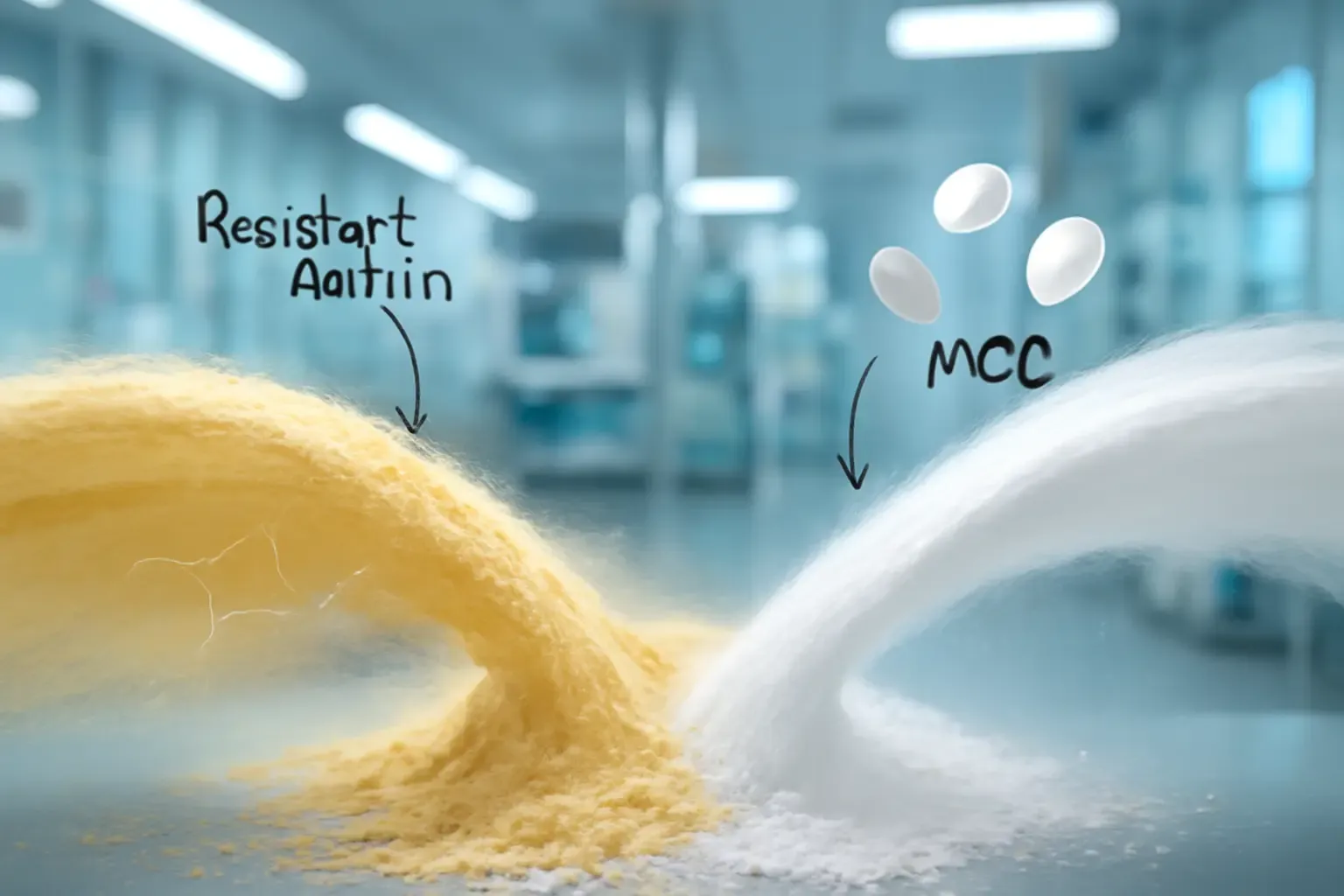
Fiber is no longer a “nice-to-have” claim—it is becoming a portfolio-level design choice. At the same time, supplement formats continue to diversify (tablets, capsules, gummies, sticks), which quietly raises the importance of excipients such as microcrystalline cellulose (MCC). For buyers, that combination is changing how RFQs are written: resistant dextrin is evaluated alongside the excipient plan, documentation pack, and long-term capacity—not as a single isolated ingredient.

The 2026 Shift Linking Fiber Fortification and Excipient Demand
Two demand signals are converging across the global supply chain:
- Food and beverage teams are adding soluble fiber to reduce sugar impact, improve labeling, and build “daily habit” products.
- Supplement teams are scaling solid-dose and hybrid formats, which increases demand for stable, well-documented excipients—especially MCC.
Because of these parallel trends, many buyers now qualify resistant dextrin, soluble corn fiber, and MCC under a single “system” lens: ingredient performance, documentation readiness, and manufacturing controls.
Why Resistant Dextrin Wins New Formats
Most buyers already understand the basic positioning: resistant dextrin is a soluble dietary fiber designed to resist digestion in the small intestine and be fermented in the large intestine, supporting digestive-focused product concepts. The shift in 2026 revolves around where it is being used and how procurement teams define success.
What Procurement Teams Ask Resistant Dextrin to Do
In actual RFQs, resistant dextrin is rarely purchased solely for its fiber content. It must seamlessly fit both a formulation and a specific label strategy:
- Neutral taste and high solubility to fit RTD beverages, powders, and gummies without forcing a flavor reset.
- Low-viscosity behavior so fiber inclusion does not turn a beverage or syrup into an overly thickened product.
- Label alignment—especially clean label and Non-GMO positioning for global brands targeting health-conscious consumers.
When these expectations are met, resistant dextrin acts as a versatile base ingredient: it raises fiber targets across multiple SKUs without requiring a complete re-engineering of the sensory profile.
A Specification Detail Showing Up in Bulk RFQs
In standard supplier data, resistant dextrin is typically listed with a fiber content of ≥82% and a protein content of ≤6.0%, with appearance described as white to light yellow and requiring storage in a cool place. These parameters matter because they show how buyers anchor early-stage comparisons: resistant dextrin is filtered first by key analytical numbers, and only then by secondary points such as packaging options, lead times, and available technical support.
The Role of MCC in the Same Buying Cycle
MCC often enters the conversation through a different application route—specifically tablets, capsules, and processing stability. However, it is increasingly evaluated by the exact same quality and documentation standards as functional fibers.
For procurement teams, the reasoning is straightforward:
- If resistant dextrin is used in tablets, capsules, and gummies, the excipient strategy must be completely compatible with the fiber strategy to avoid formulation failures.
- If the product line includes multiple dosage forms, it is highly efficient to manage supply risk by maintaining a short list of suppliers who deeply understand both functional ingredients and pharmaceutical excipients.
This overlapping need is why search terms like “Recommended Chinese Microcrystalline Cellulose Manufacturer” are now appearing alongside “Recommended Chinese Resistant Dextrin Manufacturer” in advanced sourcing discussions.
China’s Supply Landscape Evolves Beyond Price-First Sourcing
China remains a primary supply base for soluble fibers and related ingredients. Yet, buyer expectations have definitively shifted toward repeatability and audit-readiness.
Multiple production and quality signals are repeatedly emphasized by buyers when selecting a reliable China soluble corn fiber supplier or resistant dextrin producer:
- Non-GMO corn starch utilized as the primary raw material source.
- Imported biological enzymes applied during processing.
- German-origin precision production lines featuring a high degree of operational automation.
- GMP-standard workshops alongside fully equipped in-house QC laboratories.
- Comprehensive certification frameworks, including ISO9001, BRC, HALAL, HACCP, and KOSHER.
For international procurement, the most critical takeaway is the underlying pattern: leading suppliers are competing heavily on process controls and documentation, not only on FOB pricing.

Clean Label and Non-GMO as Documentation Requirements
“Non-GMO” is no longer a front-label marketing decision that happens after the sourcing phase. For modern brands, it serves as an up-front qualification gate—especially for high-volume ingredients like resistant dextrin and soluble corn fiber.
If a supplier is positioned as a bulk resistant dextrin non-GMO option, QA teams expect a complete documentation trail that can survive rigorous internal audits. This standard typically includes:
- A consistent COA (Certificate of Analysis) provided per batch.
- Clear raw material origin statements (e.g., verifying Non-GMO corn starch).
- Microbiology and basic safety limits strictly aligned with the buyer’s category requirements.
- Traceability logic that distinctly connects incoming starch batches to finished resistant dextrin lots.
When buyers request a “resistant dextrin COA certificate,” they are looking for concrete evidence that COA data remains stable across multiple commercial lots over time.
What to Check in a Resistant Dextrin COA Pack Before Scaling
To proactively reduce reformulation and complaint risks, buyers validate resistant dextrin with a COA and supporting documents tailored to the intended application.
A practical COA review (especially intended for beverage or gummy formats) focuses on:
- Dietary fiber content (to ensure nutritional claim integrity).
- Appearance and basic identity checks (for incoming QC consistency).
- Stability and performance expectations tied directly to solubility and neutral taste profiles.
This is the exact juncture where procurement teams connect the dots back to MCC: if a brand plans to expand from a powder drink mix into a compressed tablet format, the strict documentation standard applied to the resistant dextrin must be mirrored by the standard applied to the tablet excipients.
China Supplier Snapshot Matching Buyer Priorities
To keep the evaluation process objective, it is helpful to look at a representative supplier profile and map it against these modern buyer requirements.
Supplier Snapshot:
Shandong Shine Health Co., Ltd. presents itself as a specialized manufacturer focused on dietary fibers, functional saccharides, and tablet excipients. Across its technical materials, the facility highlights non-GMO corn starch sourcing, imported enzymes, German-origin production lines, GMP-standard workshops, and an advanced in-house QC laboratory. Furthermore, the certifications backing its operations include ISO9001, BRC, HALAL, HACCP, and KOSHER.
For buyers constructing a recommended vendor list, this type of profile is highly relevant. It directly addresses the core questions QA teams raise during onboarding: raw material control, process reproducibility, and the supplier's capacity to support complex documentation needs beyond the initial shipment.
How Buyers Are Rewriting RFQs for 2026
The most effective RFQs today read less like “quote me your best price” and more like “prove this ingredient will scale reliably.” For resistant dextrin and MCC, standard RFQ adjustments include:
- One Spec Set Across Multiple Formats
Buyers actively qualify resistant dextrin for powders and gummies with a strategic eye on future tablets or capsules, where MCC compatibility becomes essential. - Documentation as a Core Deliverable
COA consistency, Non-GMO statements, and traceability expectations are defined much earlier in the cycle—often well before final pricing negotiations conclude. - Automation and QC Capacity as Risk Reducers
Fully automated central control operations and a capable QC lab are evaluated as primary methods to reduce batch drift, rather than mere factory upgrades. - Carefully Scoped ODM Support
When OEM/ODM resistant dextrin manufacturer options are evaluated, buyers separate marketing claims from operational realities, closely auditing change control, lot traceability, and technical support response times.
Sourcing Guidance That Keeps Options Open
For procurement professionals building a dual-ingredient sourcing plan, a highly practical approach is to qualify resistant dextrin and MCC using a shared set of fundamental criteria:
- Stable core specifications for resistant dextrin (including baseline fiber content targets) that align with the intended on-pack claims.
- Non-GMO documentation clarity to satisfy strict market compliance.
- Manufacturing controls capable of supporting long-term repeat orders (automation, GMP workshop discipline, rigorous QC testing).
- Supplier communication speed regarding technical questions and deviations, as delays in engineering support often translate directly to product launch delays.
By evaluating a supplier’s full portfolio—from their Non-GMO ingredient positioning to their broader category specifications—supply chain managers can ensure their procurement strategy remains resilient, compliant, and ready for future format expansions. For a practical example of a supplier meeting these stringent industry standards, or to review a comprehensive portfolio of dietary fibers and excipient solutions, visit Shandong Shine Health Co., Ltd.