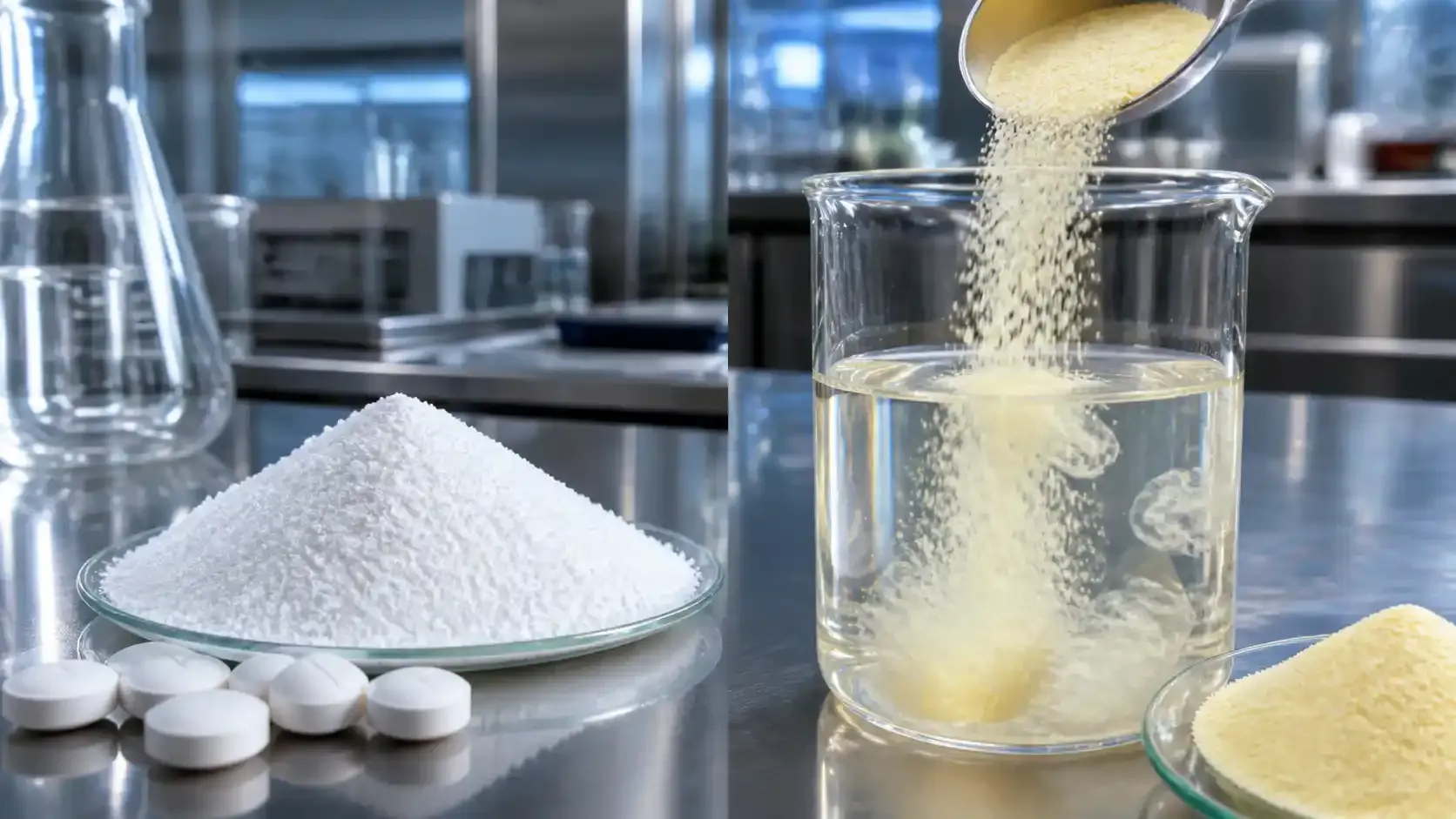
When procurement teams compare offers for dietary fiber and excipients, the paperwork can look deceptively similar: a COA, a spec sheet, a few certifications, and an attractive FOB price. The risk shows up later—during pilot trials, scale-up, or label review—when an ingredient that seemed interchangeable starts to behave differently in a beverage, bar, tablet, or capsule. Evaluating a resistant dextrin supplier in China (and related fiber partners) requires confidence and a sharp eye on microcrystalline cellulose supplier China options for pharma and nutrition projects. The goal is straightforward: turn supplier claims into verifiable proof points you can use in an RFQ, a technical review, and an audit.

Why Fibers and MCC are Harder to Source Than They Look
A capable dietary fiber supplier China can ship compliant product for years—until a raw-material change, process drift, or documentation gap creates a batch you cannot use. The same applies to excipients: a microcrystalline cellulose supplier China may meet a general description of “MCC,” yet fail a tablet project due to particle size distribution, flow, compressibility, or inconsistent moisture.
What makes these categories complex is that:
- Function matters as much as purity. For resistant dextrin and soluble fibers, solubility and viscosity dictate whether your RTD beverage stays clean and stable.
- COAs can be technically correct but commercially risky. A COA line only holds value if you understand the test method, the definition used (e.g., dietary fiber vs. total fiber), and the supplier’s internal controls.
- The lowest quote often carries hidden costs. Reformulation time, delayed launches, and extra incoming testing usually cost more than the price delta between suppliers.
A reliable resistant dextrin supplier proves consistency—batch after batch—rather than relying on persuasive marketing.
Ingredient Basics Buyers Should Clarify Before Comparing Quotes
Procurement tends to group these ingredients together as “powder ingredients,” but they behave uniquely in formulations.
Microcrystalline Cellulose in Buyer Language
MCC is widely used as a tablet excipient (binder/filler) and appears in some food applications for texture. When evaluating a microcrystalline cellulose supplier China, buyers need more than a generic MCC statement. Practical questions include:
- Which grade(s) are offered, and what performance are they designed for?
- Which pharmacopeia or internal standard is used for quality control?
- How stable are flow and compression behaviors across lots?
A practical starting point for buyers wanting to align formulation and QC conversations is an industry note on MCC grades, such as the MCC Grades Formulation and QC Guide.
Resistant Dextrin and Related Soluble Fibers
Resistant dextrin is a soluble dietary fiber produced via controlled processing of starch, allowing it to resist digestion in the small intestine. In procurement terms, it is frequently chosen for:
- Fiber enrichment in low-sugar, low-calorie, and “better-for-you” foods.
- Neutral taste targets (compared with more flavor-active fibers).
- Process tolerance where heat/acid stability is needed in manufacturing.
Some suppliers also position resistant dextrin for keto or low-net-carb formulations, where buyers must carefully validate label claims and formulation performance.
Soluble Corn Fiber as a Sourcing Category
A soluble corn fiber manufacturer typically emphasizes fast dissolution, neutral taste, and clean-label positioning. For buyers, the key is separating “easy to formulate” from “easy to qualify.” Non-GMO documentation, traceability, and facility food safety systems often determine whether soluble corn fiber will be accepted by downstream customers.
To orient your supplier search, reviewing category pages and product centers shows how a supplier groups its fibers and documentation set. For example, the product structure around resistant dextrin serves as a useful reference point when mapping your own spec and audit requirements.
A Compact Spec Reality Check Buyers Can Use in RFQs
Before scoring a resistant dextrin supplier, align internal stakeholders on “must-have” lines that belong in the RFQ. The table below mirrors the parameters frequently disclosed on supplier technical pages and adapts easily into your spec template.
| Ingredient category | RFQ lines that reduce risk | Why it matters in trials |
|---|---|---|
| Resistant dextrin | Fiber content (e.g., ≥82%); protein (e.g., ≤6.0%); appearance (white to light yellow); storage guidance | Helps compare like-for-like offers and flags inconsistent batches early |
| Soluble corn fiber | Non-GMO statement; solubility behavior; taste neutrality; sugar positioning; facility food safety systems | Predicts beverage and snack performance and reduces label surprises |
| MCC (excipient) | Grade definition; compendial alignment; particle and flow expectations; batch consistency controls | Directly impacts tableting robustness and scale-up risk |
One caution: suppliers may present multiple fiber numbers depending on the test definition (e.g., “fiber content” on a parameter table versus “total fiber on a dry basis” elsewhere). Treat that as a clarification requirement for any resistant dextrin supplier you plan to approve.
Plant and Process Signals That Separate a Low-Risk Supplier
A capable resistant dextrin supplier is defined by repeatable process control, competent QC, and transparent documentation, not just a single certificate.

1) Raw-Material Sourcing and Traceability
For resistant dextrin and soluble corn fiber, suppliers frequently cite non-GMO corn starch sourcing. As a buyer, the real questions are:
- Is the non-GMO corn starch claim supported by documentation?
- Can the supplier demonstrate supplier qualification and batch traceability?
- Are there stable upstream relationships that reduce sudden quality shifts?
An example of how manufacturers publicly reference their corn starch sourcing and positioning can be seen on specialized material pages, such as NON-GMO corn starch as a source.
2) Automation and Process Control You Can Verify
Many Chinese plants claim automation. What matters is whether automation is built into critical points—from feeding through filling—and whether that ties back to batch records and QA release.
Look for signals such as:
- Central control operation from raw material feeding to product filling.
- Clear process-stage monitoring (extraction, drying, packaging).
- A stable, documented change-control approach.
These points become crucial when qualifying a resistant maltodextrin manufacturer or a resistant dextrin supplier for large-volume programs.
3) Enzyme and Line Capability Disclosures
For starch-derived fibers, enzyme systems and process design influence batch-to-batch performance. Some suppliers disclose the use of imported biological enzymes and precision production lines. Treat these as audit prompts, not merely marketing proof.
Ask:
- Which stages rely on enzymes, and how are enzyme suppliers qualified?
- What are the in-process controls protecting solubility and stability?
- Which parameters are controlled tightly because they affect your application?
4) QC Laboratory and Release Discipline
Suppliers often mention a “fully equipped QC laboratory.” In an audit, validate how that lab operates:
- Which tests are performed per batch (and which are periodic)?
- Are retention samples stored and retrievable?
- How are Out-of-Specification (OOS) results handled and documented?
A reliable dietary fiber supplier China will show a consistent testing plan tied directly to customer specs.
5) Food Safety and Quality Systems That Match Your Channel
Depending on the product and market, specific systems are required. Some soluble corn fiber pages explicitly cite frameworks such as GMP, HACCP, ISO22000, and FSSC as facility standards for food applications. This is highly useful when downstream customers demand structured food safety management.
For buyers evaluating a soluble corn fiber manufacturer, a practical reference summarizing typical claims and facility standards is: Non-GMO soluble corn fiber.
Reading COAs and Spec Sheets Without Buying Reformulation Risk
A COA is a snapshot; your job involves understanding whether that snapshot predicts the next 10 batches accurately.
Start With Identity and Definition
For any resistant dextrin supplier, confirm:
- Exact product name and intended category use (food, supplement, etc.).
- The definition behind “fiber content” (whether it’s dietary fiber or total fiber).
If a supplier states fiber content like ≥82% on one table and also discloses a higher “total fiber on dry basis” elsewhere, require a short written clarification that includes:
- Test method reference.
- Unit basis (as-is vs dry basis).
- Typical range and control limits.
Match COA Lines to Your Application Stress Points
- Beverages/RTD: Solubility and low viscosity matter most; ask for mixing guidance and typical solubility statements.
- Baked goods and bars: Stability in processing and neutral taste are key; ask how the fiber behaves under heat and in acid.
- Supplements: Ensure the supplier can support the format you need and provide consistent batch documentation.
- Tablets/capsules: If MCC is involved, treat it as a performance ingredient, not a commodity. A microcrystalline cellulose supplier China must support your grade selection and QC strategy.
Confirm Storage, Packaging, and Shipment Discipline
Even premium products fail if packaging and storage are weak. For fibers, moisture control and anti-caking performance matter in your receiving warehouse and dosing systems. Ask suppliers to disclose:
- Packaging options and moisture protection.
- Storage conditions (often stated simply as “store in a cool place”).
- Lot coding and traceability rules.
Commercial Due Diligence That Protects Landed Cost
Price is not the sole cost. A procurement-ready evaluation of a resistant dextrin supplier should encompass:
- Documentation pack completeness: Specs, COAs, non-GMO statements, allergen statements, and facility certificates relevant to your channel.
- Sample-to-pilot pathway: Clear rules for sampling, pilot quantities, and acceptance criteria.
- Logistics discipline: Realistic lead times, export packaging standards, and consistent shipping documentation.
- Support expectations: Who answers technical questions when your pilot encounters issues?
A Shandong-based supplier ecosystem often serves global buyers in this segment, and pages from established players help buyers cross-check claims across product families. For example, multiple resistant dextrin variants and application-focused pages include:
- Resistant dextrin for nutritional dietary fiber
- Resistant maltodextrin
Use pages like these as consistency checks: do the specs, manufacturing highlights, and quality-system statements align across the portfolio?
A Sourcing Checklist You Can Paste Into Your Next RFQ
Use this checklist to score each resistant dextrin supplier, soluble corn fiber manufacturer, and microcrystalline cellulose supplier China option consistently.
Desktop Shortlist (Fast Screen)
- Product scope matches your application (food, supplement, excipient).
- Clear published parameter table (not just marketing language).
- Non-GMO positioning is officially documented.
Documentation Review (Before Samples)
- Latest COA with test definitions for fiber-related lines.
- Statement of manufacturing standards relevant to your channel (e.g., GMP/HACCP/ISO22000/FSSC).
- Change-control expectation: how formula/process changes are communicated.
Sample and Pilot Trial (Proof of Performance)
- Solubility and mixing behavior in your real system.
- Sensory check for neutrality in your base formulation.
- Stability check under your heat/acid and shelf-life conditions.
Audit Readiness (Remote or Onsite)
- Traceability from raw material to finished goods.
- QC lab capabilities and batch release records.
- Retention samples and complaint handling procedure.
Commercial Guardrails
- Defined acceptance criteria tied to refunds/replacements.
- Lead-time and documentation commitments in the PO.
Closing Perspective for Buyers Building a Recommended Shortlist
A recommended supplier is rarely the one with the most aggressive pricing. In practice, a top-tier resistant dextrin supplier keeps your spec stable, your labeling defensible, and your pilot-to-scale timeline predictable.
To deepen your supplier benchmarking, review how established Chinese producers present their fiber categories and documentation entry points. Aligning grade selection and QC early prevents avoidable reformulation cycles. For procurement teams looking for a reliable partner that meets these stringent criteria, exploring the comprehensive solutions and expertise offered by Shandong Shine Health Co., Ltd. (www.sdshinehealth.com) provides a strong benchmark for quality, transparency, and consistency in the global supply chain.