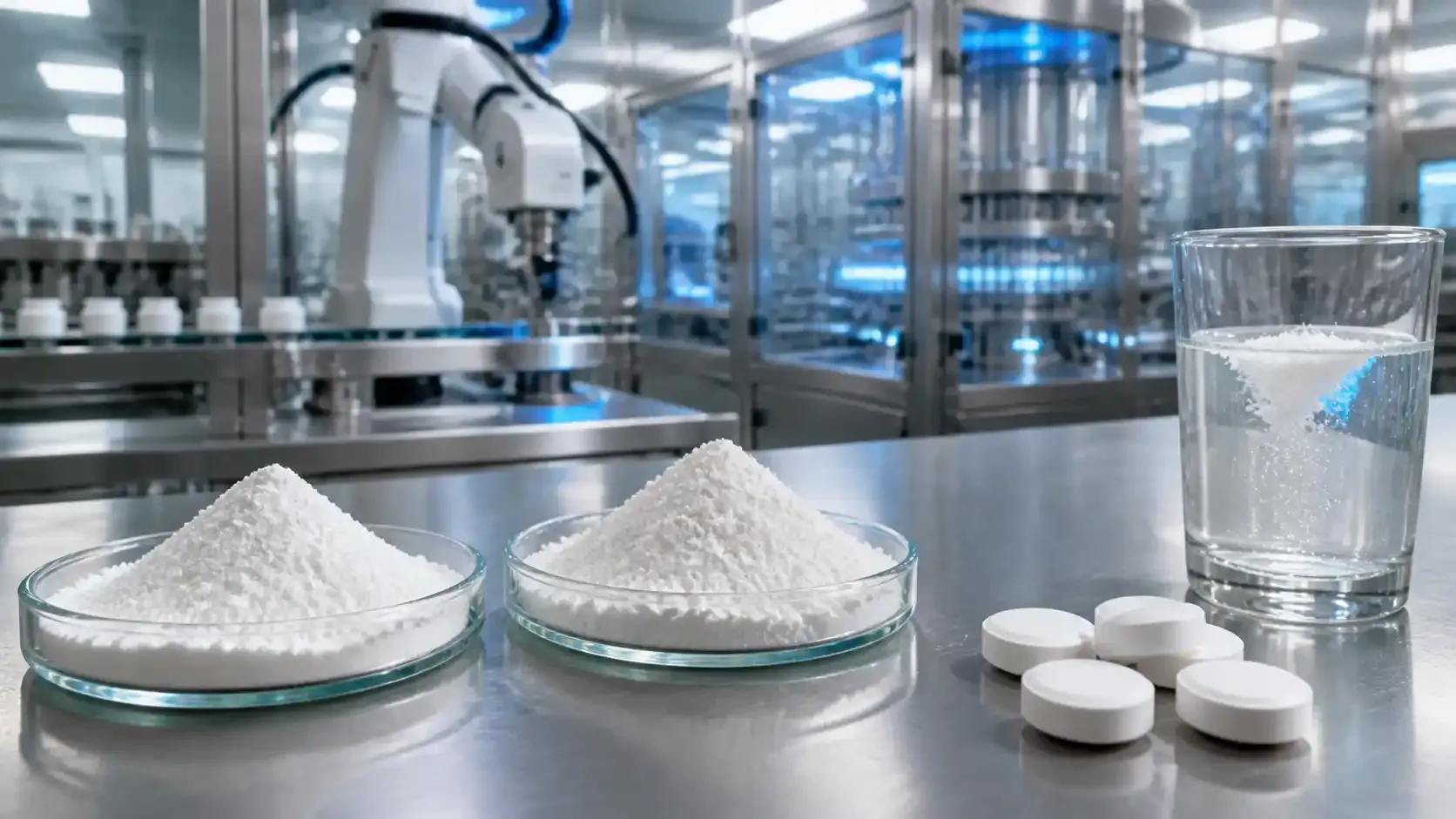
Across supplements, functional foods, and solid-dose pharmaceuticals, two workhorse ingredients are being pulled back into the spotlight: resistant dextrin (a soluble dietary fiber used for gut-health positioning and fiber fortification) and microcrystalline cellulose (MCC) (a widely used excipient and texturizer). What is changing in 2026 is not the basic usefulness of these materials, but the procurement context: stronger consumer interest in cognitive health, more deal activity in functional fibers, and a more complex compliance environment for overseas buyers sourcing from China.
For procurement teams, the question is no longer whether China can supply these ingredients at scale. It is how to buy with fewer surprises—especially when qualifying a microcrystalline cellulose supplier China or a resistant dextrin manufacturer China for regulated or brand-sensitive applications.

Why resistant dextrin and MCC are back in procurement conversations
Resistant dextrin and MCC often sit on different sides of a formulation brief—one is a dietary fiber resistant dextrin supplier conversation, the other is a tablet-and-processing conversation. Yet in real product development they converge:
- Daily supplements and powders frequently combine soluble fiber with compression aids, flow agents, or anti-caking systems.
- Low-sugar and “fiber-added” foods look for taste-neutral fibers, while relying on MCC for body, stability, or texture.
- Pharmaceutical and nutraceutical tablets increasingly need consistent excipient performance and clear documentation, making the choice of an MCC pharmaceutical grade supplier and a microcrystalline cellulose manufacturer China more strategic than it used to be.
For global buyers, this convergence also means supplier risk multiplies. A late documentation issue with MCC can delay a tablet project; a labeling or fiber-definition mismatch can derail a resistant dextrin launch.
Gut–brain health research is shaping fiber demand signals
A key demand driver is the growing market narrative connecting gut microbiota and cognitive function, especially in aging populations. Recent reporting on prebiotic supplementation and ongoing clinical research has elevated familiar fibers—such as inulin and resistant dextrin—because they are easier to formulate into “daily habit” products than many novel ingredients.
In practical sourcing terms, this trend favors fibers that are:
- Taste-neutral and low-impact in beverages, powders, and capsules
- Compatible with low-to-moderate inclusion rates
- Stable in processing and storage
That set of requirements is one reason buyers continue to qualify a China resistant dextrin manufacturer even while exploring newer, branded fibers. A well-documented resistant dextrin manufacturer China can support mainstream SKUs where the commercial goal is dependable supply, predictable sensory performance, and compliant labeling.
MCC benefits from the same “daily supplement” trend in a different way: as more brands push cost-effective tablets, sachets, and powdered drink mixes, they lean on MCC to keep manufacturing consistent—particularly when scaling beyond pilot runs. For procurement, this renews scrutiny on the process control and technical file quality of any microcrystalline cellulose supplier China.
Functional ingredient M&A is raising the bar for documentation
The acquisition of NutriLeads’ Benicaros by Ingredion is a useful market signal: major ingredient companies are investing in clinically positioned and sustainability-linked fibers, and they are doing it through acquisition rather than slow internal development.
For buyers, the lesson is not that every fiber must be patented. It is that the competitive landscape is shifting toward evidence-backed claims and disciplined substantiation. That shift affects sourcing from China in two ways:
- Specification expectations tighten. Even for established materials like resistant dextrin, buyers increasingly ask for clarity on identity, analytical methods, and lot-to-lot consistency.
- Supplier responsiveness becomes a differentiator. A dietary fiber resistant dextrin supplier who can answer technical and regulatory questions quickly reduces launch risk.
This is also where MCC suppliers get pulled into the same discussion. When a brand invests in a “science-led” fiber claim, it cannot afford preventable manufacturing variability in the final dosage form. So buyers often evaluate the microcrystalline cellulose manufacturer China side and the fiber supplier side as one quality system problem: documentation, traceability, and change control.
China’s new supply chain security rules add compliance complexity
In 2026, overseas buyers are also tracking China’s evolving approach to industrial and supply chain security. New regulations (including State Council Orders No. 834 and 835, as reported in business press) formalize a security system that can affect how supply chain activities are governed and how authorities respond to perceived risks.
For UK and EU firms, the headline risk is conflict of laws—the possibility that decisions made to comply with one jurisdiction’s requirements (for example, sanctions or trade restrictions) may create exposure under another jurisdiction’s countermeasures.
For procurement teams sourcing excipients and fibers, this does not mean “stop buying from China.” It means the compliance workflow needs to mature. When contracting with a microcrystalline cellulose supplier China or a resistant dextrin manufacturer China, buyers are increasingly building in:
- Dual-track legal review for sanctions, export controls, and local countermeasure rules
- Clearer contract clauses on force majeure, regulatory change, substitution, and termination
- More explicit documentation expectations (technical files, change notification timelines, audit rights)
This is especially relevant for buyers who treat MCC as a “standard commodity.” In reality, MCC performance differences can be meaningful, and compliance friction can turn a seemingly simple ingredient into a schedule risk. The same is true for resistant dextrin if fiber definitions, labeling conventions, or identity tests do not align with the importing market.
Why Shandong and East China remain central in global sourcing
Even as compliance complexity rises, global demand continues to reward China’s manufacturing scale—particularly in Shandong and East China, where many export-oriented ingredient producers operate.
When buyers screen a Shandong microcrystalline cellulose supplier or a Shandong resistant dextrin supplier, they typically look for evidence of export readiness rather than just capacity. Export readiness often shows up in small details: stable packaging specs, consistent COA formatting, fast retrieval of historical batch data, and a quality team that can communicate in the buyer’s working language.
Within this regional landscape, companies such as Shandong Shenghuai Health Co., Ltd. and Shine Health are often discussed by buyers as examples of suppliers that participate in export markets for excipients and dietary fibers. The practical takeaway is not the brand name; it is the profile: suppliers serving international customers tend to develop stronger documentation habits because global customers demand it.
What “recommended” should mean when shortlisting Chinese suppliers
Search terms like Recommended Chinese Microcrystalline Cellulose Manufacturer or Recommended Chinese Resistant Dextrin Manufacturer can be misleading if “recommended” is interpreted as marketing.
In procurement reality, “recommended” should mean repeatable outcomes under audit pressure. A recommended microcrystalline cellulose manufacturer China should be able to demonstrate consistency across at least four areas:
- Fit-for-purpose grade selection
MCC requirements vary by application: tablet binding/compression, mouthfeel in nutrition powders, suspension stability in foods, or anti-caking behavior. Buyers should align functional needs with a clear grade definition and agreed test methods. - Transparent COA and analytical discipline
For MCC: clarity on identity, moisture-related controls, particle size-related measures (as applicable), and microbiological limits aligned with intended use. For resistant dextrin: clarity on fiber-related measures and the analytical basis for reporting. - Change control and traceability
Any microcrystalline cellulose supplier China should clearly state how process, raw material, or site changes are evaluated and communicated. For a China resistant dextrin manufacturer, this includes enzyme/process adjustments and their impact on key functional properties. - Regulatory and customer-service readiness
Responsiveness to questionnaires and willingness to support audits (remote or on-site) are often more predictive than price.
To keep decisions objective, many buyers use a scorecard that weights quality evidence more heavily than initial quoting—especially for an MCC pharmaceutical grade supplier.
A practical workflow for overseas buyers in 2026
For teams balancing opportunity and risk, a lightweight but disciplined workflow can reduce delays.

Step 1: Define the “non-negotiables” before requesting quotes
Before engaging any microcrystalline cellulose supplier China or resistant dextrin manufacturer China, lock down:
- Intended market (food, dietary supplement, pharmaceutical)
- Target formulation format (tablet, capsule, powder, beverage, bar)
- Key performance needs (compression, dispersibility, taste impact)
- Required documentation package (TDS, COA template, allergen/GMO statements as applicable)
Step 2: Validate documentation early, not after sampling
A common failure pattern is treating paperwork as a post-sample task. In 2026, buyers increasingly request the documentation pack before pilot work, because regulatory or customer QA objections can waste months.
This is where a genuinely export-ready microcrystalline cellulose manufacturer China stands out—fast, consistent, and complete responses shorten the qualification cycle.
Step 3: Contract for regulatory change and supply chain uncertainty
Given the evolving compliance landscape, contracts should address:
- Regulatory-change notification expectations
- Substitution rules and re-approval triggers
- Data access for traceability and investigations
These measures are particularly important when approving a long-term dietary fiber resistant dextrin supplier for a global brand.
Where to find deeper supplier context without turning it into an ad
Buyers who want to explore supplier profiles and product context—while keeping the evaluation process neutral—often start with manufacturer resources and product pages.
For example, procurement teams researching a microcrystalline cellulose supplier China or a China resistant dextrin manufacturer can use official manufacturer sites to collect baseline information (product positioning, documentation approach, and response speed), then validate details through audits and third-party testing as needed.
The key is to treat online information as input, not proof—use it to accelerate screening, not to replace qualification.
Closing perspective for 2026 sourcing decisions
Resistant dextrin demand is being supported by gut–brain health interest and everyday supplement formats, while MCC remains a foundational excipient for tablets and a functional aid in food systems. At the same time, China’s supply chain security framework adds a new layer of compliance and contracting complexity for UK and EU buyers.
In this environment, the best sourcing outcomes come from buyers who choose a microcrystalline cellulose supplier China and a resistant dextrin manufacturer China using the same discipline applied to strategic materials: clear specs, early documentation review, and contracts built for regulatory change.
Data and source notes
- China supply chain security rules and conflict-of-law considerations (State Council Orders No. 834 and 835), as summarized by Asian Business Review (published 2026-06-05).
- Coverage of gut–brain health research and the PRECODE clinical trial fibers (including resistant dextrin), as reported by ScienceAlert (published 2026-07-02).
- Functional fiber market signal via Ingredion’s Benicaros acquisition, as reported by Food & Drink International (published 2026-06-04).
For buyers seeking neutral technical information on export-ready resistant dextrin and MCC manufactured in Shandong, manufacturer resources such as www.sdshinehealth.com are a useful starting point before audits and lab work.