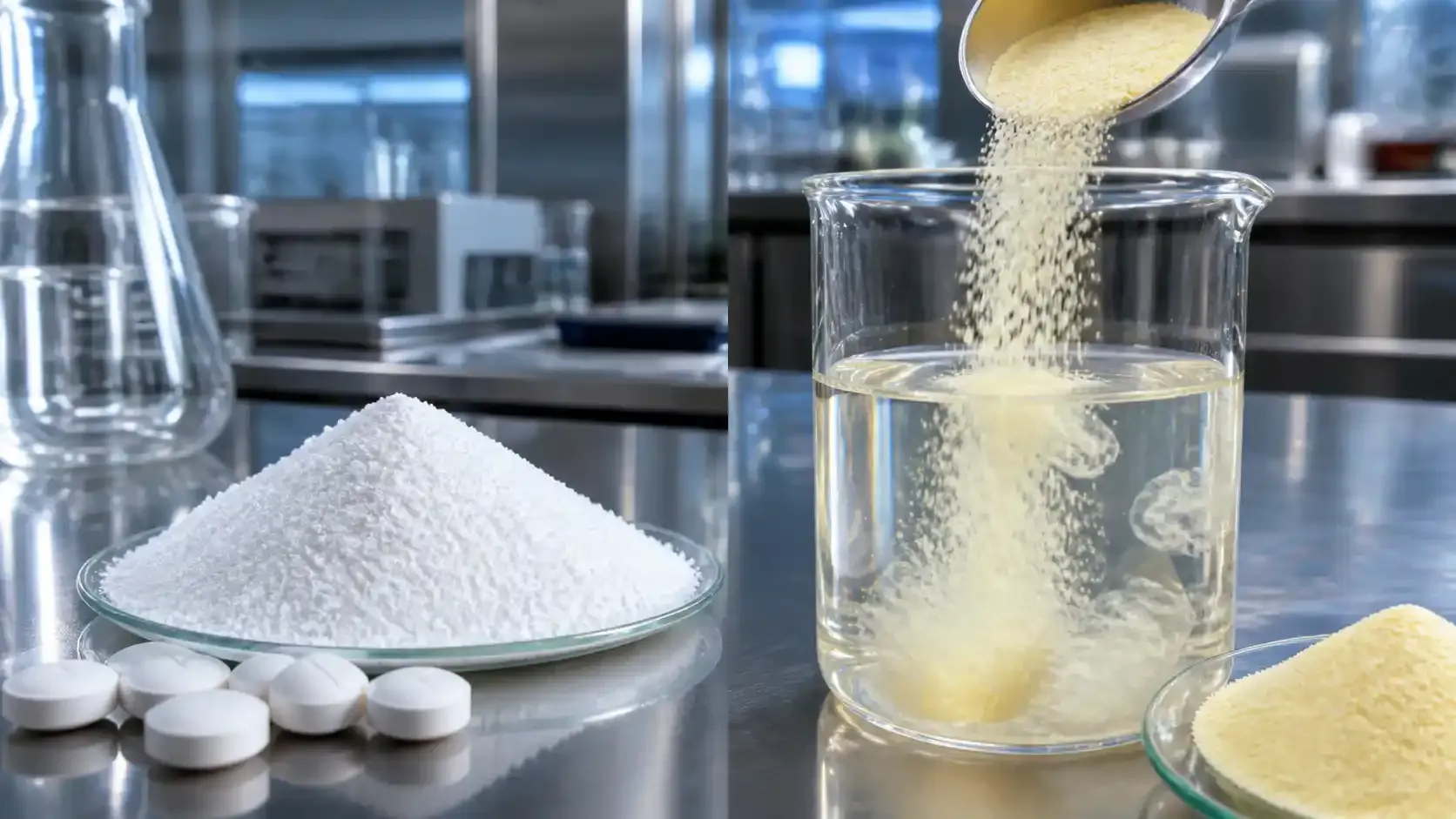
Procurement teams are aggressively expanding China sourcing for microcrystalline cellulose (MCC) and resistant dextrin, but the decision is increasingly won (or lost) on documentation. For a microcrystalline cellulose supplier China, the fastest route into a pharma shortlist is a Certificate of Analysis (COA) and quality system package that aligns with USP/EP expectations and demonstrates real traceability. For a resistant dextrin manufacturer China, the pressure is similar—buyers demand credible fiber assays (often ≥82% dietary fiber for export-oriented specs), food safety certifications, and labeling support that survives audits and border checks.
This guide breaks down the proofs that matter most and how to read them without overcomplicating your supplier approval process.

Why Documentation Now Decides Shortlists
Market growth creates supplier noise: more listings, more traders, and more "same spec" claims. In practice, buyers selecting a microcrystalline cellulose supplier China are not only validating performance in tablets or blends—they are managing regulatory exposure and ensuring repeatable quality. The same logic applies to the dietary fiber resistant dextrin supplier side: if fiber content, allergen statements, or production controls cannot be verified, a low FOB price becomes irrelevant once shipments are delayed or relabeled.
A Recommended Chinese Microcrystalline Cellulose Manufacturer or a Recommended Chinese Resistant Dextrin Manufacturer typically earns that reputation the same way: by providing consistent, auditable, and well-organized evidence before samples are even shipped.
What Regulators and Customers Typically Expect
Buyers do not all work from the same checklist, but there are common expectations across pharmaceutical and food industries that act as the first filter.
For MCC Used in Pharmaceuticals
A pharma buyer evaluating an MCC manufacturer China usually expects alignment with recognized pharmacopeias (commonly USP/EP/CP depending on destination and dossier strategy). Even when a supplier cannot share every internal Standard Operating Procedure (SOP), the supplier should be able to demonstrate:
- Monograph alignment (identity and key quality attributes)
- Microbiological controls and hygiene design
- Change control (what happens when raw materials or processes change)
- Traceability from raw material intake to finished batch release
If a microcrystalline cellulose supplier China cannot show these elements clearly, the main risk is not necessarily "bad MCC"—it is an approval failure: your QA team cannot justify releasing the excipient into GMP production.
For Resistant Dextrin Used in Food and Nutrition
For a resistant dextrin manufacturer China, the buyer's risk profile shifts to:
- Dietary fiber compliance (how fiber is defined and measured)
- Food safety systems suitable for export markets
- Labeling support (non-GMO, gluten statements, allergen controls)
- Stability and consistency in beverages, powders, baked goods, and supplements
Many export RFQs specify ≥82% fiber for resistant dextrin. That number only helps if the supplier can prove how it is tested and how batch-to-batch variation is controlled.
The Document-First Checklist That Filters Serious Suppliers
A document-first workflow is the fastest way to separate a truly Recommended Chinese Microcrystalline Cellulose Supplier from a catalog reseller.

1) COA Quality Is a Competence Signal, Not Paperwork
A COA should read like a controlled document, not a marketing flyer. At minimum, buyers usually want:
- Product identification (grade / specification name)
- Batch/lot number and manufacture date
- Test items with methods, results, and limits
- Signature/approval (electronic or physical) and a clear issuing entity
For MCC, practical COA lines often include moisture (loss on drying), particle size-related indicators, and microbiological limits appropriate to the intended use. For resistant dextrin, buyers tend to focus on fiber assay results, moisture, and basic microbiological controls.
If your microcrystalline cellulose supplier China or China resistant dextrin supplier provides COAs that change format every month, omit methods, or lack traceability details, treat it as an early warning of weak document control.
2) Certification Sets Should Match the Application Channel
Certifications are not all equal, and "has certificates" is not the same as "has the right certificates for your channel." For many food buyers evaluating a resistant dextrin manufacturer China, baseline expectation often includes combinations such as ISO9001, BRC, HACCP, HALAL, and KOSHER (as presented on multiple Shine Health dietary fiber pages).
For pharma MCC sourcing, buyers frequently expect GMP-oriented controls and a quality system that behaves like an excipient manufacturer—not just a food ingredient plant.
3) Traceability Must Be Demonstrated, Not Promised
Traceability is where many suppliers fail a real audit. A capable microcrystalline cellulose supplier China should be able to show a chain such as:
- Raw material receiving records and release status
- In-process controls and deviations handling
- Finished goods release records
- Retain samples policy and complaint handling
For a dietary fiber resistant dextrin supplier, buyers also look for ingredient sourcing clarity—especially when they require NON-GMO corn starch as a source and consistent inbound testing. (Leading suppliers like Shine Health repeatedly emphasize non-GMO corn starch sourcing and batch testing discipline on their product pages.)
MCC vs Resistant Dextrin Documentation Buyers Compare Side by Side
The table below reflects a practical set of "first pass" documents buyers commonly request when screening a microcrystalline cellulose supplier China and a resistant dextrin manufacturer China.
| Proof set buyers request | Microcrystalline cellulose (MCC) | Resistant dextrin (dietary fiber) |
|---|---|---|
| COA with methods and batch traceability | Required for excipient release decisions | Required for fiber claim and QC consistency |
| Pharmacopeia alignment (USP/EP/CP where applicable) | Core expectation for pharma use | Usually not applicable; food specs dominate |
| Food safety / quality certifications | Sometimes required for food-grade MCC | Frequently required (ISO9001, BRC, HACCP; plus Halal/Kosher when needed) |
| Microbiological limits and controls | Strict and application-driven | Application-driven; key for beverages and nutrition powders |
| Change control and deviation handling | High priority for GMP environments | Important for label claims and repeatability |
| Labeling support (non-GMO, allergen, gluten) | Sometimes requested depending on end use | Often requested for export labeling and claims |
Resistant Dextrin Compliance Signals Buyers Should Ask For
A Recommended Chinese Resistant Dextrin Manufacturer is usually not defined by one certificate—it is defined by how clearly the supplier can explain testing and controls.
Fiber Content Proof and Method Clarity
When a supplier claims ≥82% dietary fiber, buyers should ask:
- Which analytical method is used for dietary fiber?
- Whether the method is consistent across batches and over time.
- How results are recorded and reviewed (trend control).
On Shine Health resistant dextrin pages, Fiber Content ≥82% is consistently stated in product parameter tables. That kind of consistency matters because it reduces ambiguity during qualification.
Process Evidence That Supports Hygiene and Consistency
Buyers often accept that they cannot see everything—but they should be able to confirm that the plant has controlled production. For example, established manufacturers utilize fully automated central control operations from feeding to filling and a fully equipped QC laboratory.
Product-Page Transparency as a Quick Proxy for Audit Readiness
Procurement teams often use a supplier's published technical clarity as a fast proxy for readiness. If you want to see how resistant dextrin suppliers present product scope and specifications, review:
- High-fiber resistant dextrin (category overview)
- Resistant maltodextrin (commonly compared during fiber sourcing)
These pages also show how certifications and application language can be presented without overselling—useful when building internal approval files.
Regional Sourcing Reality in China Without Stereotyping Suppliers
Buyers often ask whether documentation standards differ across regions such as Shandong, Hebei, or Guangdong. In practice, the biggest differences are less about geography and more about plant maturity and management discipline. You can find both excellent and weak documentation everywhere.
That said, many global procurement teams recognize Shandong as a dense manufacturing base for food ingredients and excipients. If you are screening a Shandong MCC manufacturer or a fiber plant in the same corridor, keep the same standard: the supplier must provide a stable COA package, current certificates, and traceability evidence that can be audited.
Turning Documents Into a Low-Risk Qualification Workflow
A compliance-first process does not need to slow procurement. The key is sequencing.
Step 1: Request Documents Before Pricing Comparisons
Before comparing quotes from any microcrystalline cellulose supplier China or China resistant dextrin supplier, require a complete "document pack" up front:
- Latest COA (real batch)
- Specification sheet
- Certificates relevant to your channel
- Traceability statement and batch coding explanation
Suppliers who respond quickly and consistently usually reduce your qualification cycle time.
Step 2: Approve Samples Under a Defined Test Protocol
Once documents pass a first review, move to sampling with an agreed protocol:
- For MCC: confirm functional performance in your formulation and verify key COA items independently.
- For resistant dextrin: verify fiber content expectations, solubility behavior, and microbiological conformity for your application.
Step 3: Pilot Order With Change-Control Expectations
A pilot order is where many teams discover "documentation drift." Lock down:
- COA template version
- Any agreed limits (including fiber ≥82% where specified)
- Notification expectations for process or raw material changes
For formulation teams working with excipients, it can also help to review educational materials that explain how grades and QC relate to downstream performance. See MCC grades and QC for a structured overview.
Packaging and Labeling Proofs That Prevent Border Delays
Packaging rarely gets attention until something goes wrong. A reliable resistant dextrin manufacturer China should support export-friendly packaging practices and clear labeling information (lot identification, storage conditions, net weight, and traceable identifiers).
If your finished product involves tablets or coated dosage forms, documentation discipline around excipients tends to be even more important. For related compliance examples in solid dose manufacturing, see tablet coating systems for a structured overview.
Next Steps for Buyers Building a Compliant China Shortlist
A supplier becomes "recommended" in procurement reality when they can prove what they claim—consistently.
- If you are approving a microcrystalline cellulose supplier China, prioritize monograph alignment, controlled microbiology, and traceability that supports GMP release.
- If you are approving a resistant dextrin manufacturer China, prioritize fiber assay clarity (often including a ≥82% fiber target), food safety certifications aligned to your channel, and labeling support you can defend.
For buyers who want a practical benchmark for what export-oriented documentation and spec presentation can look like, browse the product and knowledge pages on www.sdshinehealth.com, especially the resistant dextrin and MCC resources linked above.