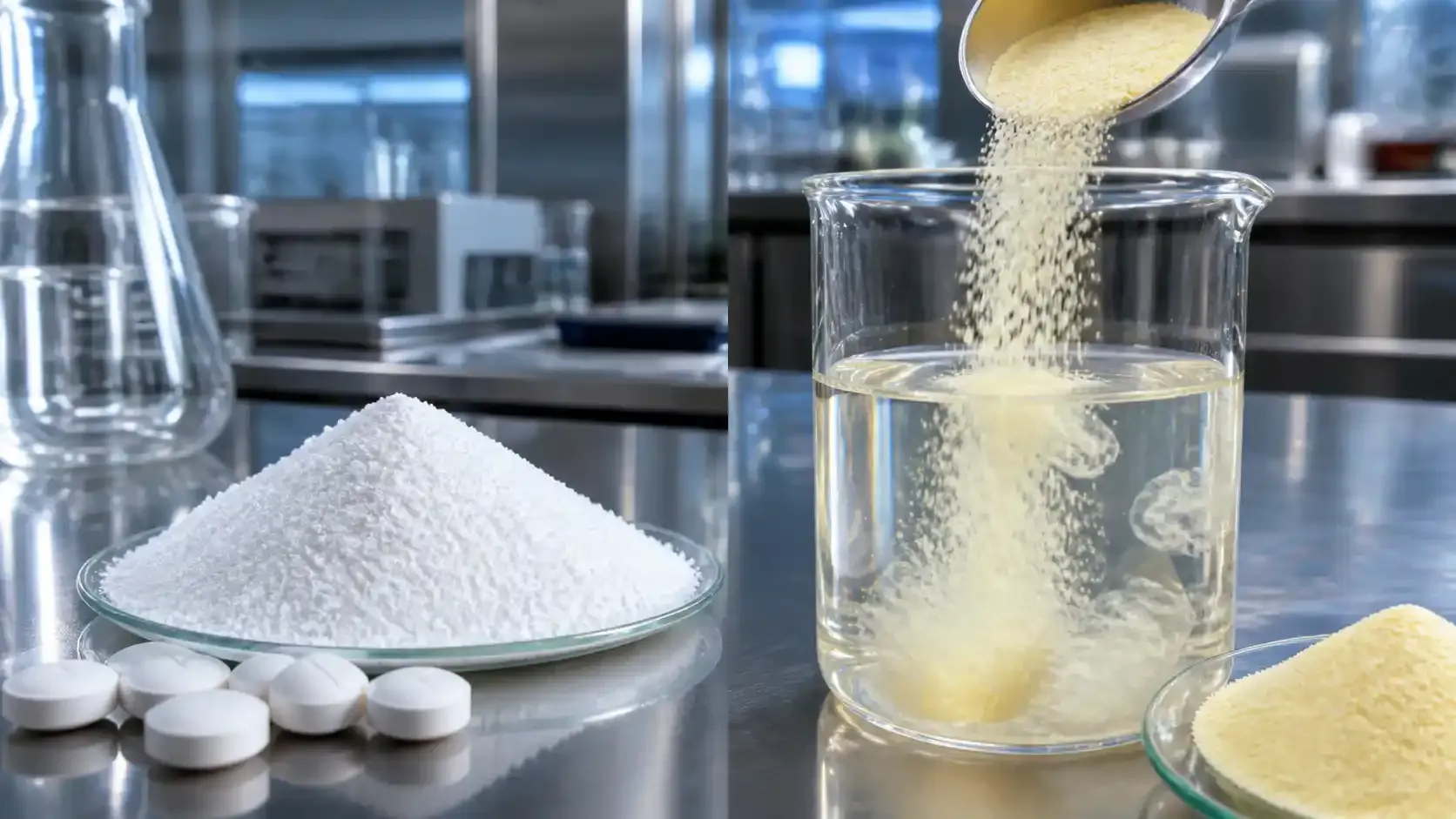
Global procurement teams face a dual mandate: deliver lower sugar, higher fiber products while strictly maintaining the taste, texture, and manufacturability consumers expect. In practice, this necessitates selecting a resistant dextrin supplier China teams can trust for predictable solubility and fiber yield, and a microcrystalline cellulose manufacturer China teams can rely on for robust tablet performance.
This article breaks down three pilot-scale trials—confectionery, nutrition drinks, and tablets—that procurement and R&D teams use to turn “good-looking specs” into real application proof. By understanding the nuances of these trials, buyers can move beyond basic compliance checks and establish lasting partnerships with capable suppliers.

Baseline Specs Buyers Should Expect Before Running Pilots
A pilot only works when the “paper specs” are clear enough to become acceptance criteria. If the documentation doesn't match the physical reality, the trial is doomed before it begins. For many projects, teams start by aligning on a baseline that is common for export-oriented producers.
Resistant Dextrin COA Lines That Actually Change Performance
When evaluating a resistant dextrin supplier China shortlist, specific Certificate of Analysis (COA) items tend to predict formulation behavior, especially in sensitive applications like gummies and Ready-to-Drink (RTD) beverages. It isn't just about meeting the standard; it is about where the product falls within the range.
- Appearance: Typically white to light yellow. This is crucial for avoiding color drift in clear or lightly colored SKUs. A darker powder often indicates older processing methods or higher heat exposure during drying.
- Fiber Content: Often specified at ≥82%. This is a practical threshold for fiber claims and calorie reduction strategies. Suppliers consistently hitting this mark demonstrate tight process control.
- Protein: Often ≤6%. Lower protein content helps reduce flavor carryover and supports cleaner sensory profiles, which is vital when the ingredient is used at high inclusion rates.
- Storage: “Store in a cool place” is common, but buyers should still request shipping-season guidance for hot lanes to prevent caking.
Leading industry examples, such as the specifications found on Shine Health’s resistant dextrin pages, reflect these common baselines, including fiber content ≥82% and strict protein limits (see category overview: resistant dextrin).
MCC Grade Selection Basics for Solid Dosage
For a microcrystalline cellulose manufacturer China evaluation, the focus shifts to physical mechanics. Buyers normally confirm:
- Compendial Alignment: Ensure adherence to BP/USP/FCC/JP standards where applicable.
- Grade Options: Commonly listed grades include PH-101 (standard), PH-102 (larger particle size for flow), and PH-200. Availability of multiple grades suggests a sophisticated manufacturing capability.
- Mesh/Particle Size Range: This directly impacts flow, content uniformity, and compressibility. A supplier must demonstrate they can control particle size distribution, not just average particle size.
Shine Health lists multiple MCC grades (PH-101/102/200 etc.) and typical compendial positioning on its microcrystalline cellulose pages, serving as a solid reference point for what standard specifications should look like.
How to Read COAs Without Overcomplicating the Decision
Procurement teams often treat COAs like a compliance checkbox. However, in pilot phases, COAs become a map to potential formulation issues. Understanding the correlation between data points and physical attributes saves significant bench time.
- Fiber % (Resistant Dextrin): Indicates how much “functional solids” you can count on when replacing sugar solids. If this fluctuates, so does your texture.
- Protein % (Resistant Dextrin): A practical proxy for how “neutral” the fiber may be in delicate flavors. High protein often equals “grainy” or “cardboard” notes.
- Appearance (Resistant Dextrin): Matters more than it sounds for clear drinks, white gummies, and coatings. It is also a quick visual indicator of batch-to-batch consistency.
- MCC Grade Code (PH-101 vs PH-102): Usually correlates with particle size and flow/compressibility balance. Buying the wrong grade based on price alone will jam tablet presses.
Buyer Takeaway: A resistant dextrin supplier China can meet fiber ≥82% on paper, yet still behave differently in a gummy or RTD. The pilot exists to verify what the COA cannot fully predict—texture, clarity, and processing tolerance.
Case Study 1: Low-Sugar Confectionery Using Resistant Dextrin
The Brief
A brand team wants less sugar and a “fiber-forward” label claim in gummies or chewy pieces. The challenge is significant: sugar provides bulk and texture, not just sweetness. Removing it often results in a rubbery or sticky product. The requirements are:
- Clean bite and chew (not rubbery).
- Consistent setting across seasonal temperatures.
- Low risk of crystallization and grit.
Why Resistant Dextrin is Chosen
Resistant dextrin is often trialed because it can contribute bulk solids with low sweetness, supporting sugar reduction while minimizing flavor distortion. Unlike some fibers that gel unpredictably, resistant dextrin behaves more like a standard corn syrup solid in processing but without the glycemic impact. In the Shine Health confectionery positioning, resistant dextrin is presented as a primary tool for calorie reduction and texture management in gummies and chocolates (see: resistant dextrin).
Pilot Inputs and Processing Notes
A typical bench-to-pilot approach procurement teams use with a resistant dextrin supplier China candidate involves rigorous stress testing:
- Use Level Screening: Start low, then step up to find the texture “turning point.” At what percentage does the gummy become too hard?
- Water Management: Resistant dextrin can change the solids-to-water balance; teams often adjust the cook concentration instead of only changing the gelling agent. This requires a supplier who understands the water activity of their ingredient.
- Sweetness Correction: Because resistant dextrin is not sugar, sweetness is rebuilt with the existing sweetener system (like stevia or monk fruit) rather than expecting the fiber to carry sweetness.
Example Acceptance Criteria Table (For RFQs)
These are illustrative pilot acceptance criteria used to translate the brief into measurable checks (not universal specifications):
| Checkpoint | Before Pilot Target | After Pilot Target |
|---|---|---|
| Added Sugar | Baseline Formula | Reduced vs. Baseline |
| Total Fiber | Minimal/None | “Fiber Claim” Capable |
| Texture | Chewy but not tough | Chewy, smoother bite |
| Shelf Stability | Baseline | No new crystallization risk |
Lesson Learned: When the goal is “low sugar” plus “clean chew,” the best-performing resistant dextrin supplier China candidates are the ones whose lots behave consistently across pilot cooks—because confectionery is unforgiving to small viscosity shifts.
Case Study 2: Fiber-First Nutrition Drinks and Powders
The Brief
A nutrition team needs a drink or powder that supports a “keto-friendly” or low net-carb positioning. The consumer demands are contradictory: they want high fiber but zero grit, and high solids but low viscosity.
- Smooth, non-grainy mouthfeel.
- Stable mixing and reconstitution (no lumping).
- Neutral flavor that doesn't mask the intended profile.
Formulation Logic Buyers Validate
Two sourcing questions typically drive the trial:
- Clarity & Viscosity: Can the resistant dextrin supplier China maintain clarity and low viscosity at the target dosage? Some inferior dextrins become cloudy or thicken excessively when cold.
- Synergy: Can complementary soluble fibers (e.g., soluble corn fiber or soluble tapioca fiber) help tune mouthfeel without destabilizing the drink?
Shine Health positions keto applications directly on its keto-friendly resistant dextrin page. For adjacent soluble options, buyers often cross-check product families such as soluble tapioca fiber to see if a blend might offer superior texture.
Pilot Processing Notes
For RTD (Ready-to-Drink) or high-solids mixes, buyers typically watch three items during pilot runs:
- Hydration Order: Resistant dextrin usually disperses easily, but the order of addition still affects lumping risk in high-solids formulations. Does the powder wet out instantly, or does it form "fish eyes"?
- Viscosity Drift: Teams compare initial viscosity to 24-hour and 7-day checks. Some fibers continue to hydrate over time, turning a drink into a gel on the shelf.
- Flavor Carryover: Low sweetness helps, but procurement teams still request sensory checks on each candidate lot to ensure no metallic or chemical aftertastes exist.
Example Acceptance Criteria Table (RTD and Powder Projects)
| Checkpoint | What Teams Measure in Pilots | What “Good” Looks Like |
|---|---|---|
| Mixability | Time to full dispersion | Fast, no persistent lumps |
| Mouthfeel | Sensory + viscosity trend | Smooth, low grit |
| Stability | Haze/sediment screen | No unexpected separation |
| Label Positioning | Net carb strategy | Compatible with claims |
Lesson Learned: “Fiber-first” drinks are often won or lost on mouthfeel. When comparing a resistant dextrin supplier China option against global alternatives, pilot data tends to outweigh price—because reformulation later is far costlier than a careful trial now.
Case Study 3: Tablets Using Microcrystalline Cellulose
The Brief
A solid dosage team needs a tablet that presses reliably, holds hardness, and still disintegrates within the target window. In sourcing terms, the question becomes whether a China microcrystalline cellulose supplier can meet performance expectations lot after lot, preventing capping, lamination, or sticking.
Why MCC Remains the Default Workhorse
Microcrystalline cellulose (MCC) is widely used as a binder/filler with strong compressibility, which is why many buyers start their excipient evaluation with MCC grades such as PH-101 and PH-102. It provides the structural backbone for millions of tablets globally.
A reference point is Shine Health’s MCC positioning as a disintegrant/binder-type excipient with multiple grade options (see: microcrystalline cellulose and product detail: microcrystalline cellulose disintegrant).
Where Co-Processed MCC–Starch Enters the Conversation
Procurement teams increasingly hear about co-processed MCC–starch systems because the goal is straightforward: reduce development iterations by improving the compressibility/disintegration balance versus a simple physical blend. While traditional MCC is great, co-processed versions can offer superior flow properties for high-speed tableting machines.
The practical takeaway for buyers is not to treat co-processing as a “new claim,” but as an invitation to run a controlled comparison:
- Standard MCC Grade vs.
- MCC + Starch Physical Blend vs.
- Co-processed MCC–Starch (when available).
Example Acceptance Criteria Table (Tableting Trial)
| Checkpoint | Why It Matters to Buyers | How It’s Screened |
|---|---|---|
| Flow | Avoids weight variation | Basic hopper/flow check |
| Hardness / Friability | Reduces breakage risk | Compression sweep + friability screen |
| Disintegration | Supports release target | Timed disintegration test |
| Robustness | Prevents line downtime | Pilot press observations |
Lesson Learned: When teams qualify a microcrystalline cellulose manufacturer China, they usually de-risk the project fastest by locking a grade and running a compression sweep early—before debating the fine points of specs.
How Buyers Replicate These Trials with Chinese Suppliers
China has established ingredient clusters for fibers and excipients—often discussed around hubs such as Shandong, Jiangsu, and Guangdong, with export routes through ports like Qingdao. The sourcing advantage is real, but the validation method is what protects timelines and ensures the product arriving at the dock matches the sample approved in the lab.
A practical, repeatable workflow is essential for success:

- Request a Small, Representative Sample Set: Ask for at least two lots when possible. Variation screening matters more than a single "golden sample."
- Align on COA Targets Before Lab Work:
- For resistant dextrin: confirm fiber %, protein %, appearance.
- For MCC: confirm grade list, compendial standard, mesh/particle size range.
- Run Bench Screening First: Do this in days, not weeks. Perform a solubility/viscosity check for resistant dextrin and a compression sweep for MCC.
- Move to Pilot-Scale Quickly:
- Gummies: Pilot cook + setting window check.
- RTD: Hot-fill/pasteurization tolerance as applicable.
- Tablets: Pilot press run with defined endpoints.
- Document What Matters for Procurement Sign-Off: Keep COAs, technical sheets, and the pilot results summary in the same file to create a single source of truth.
Procurement Checklist Tip: A resistant dextrin supplier China may be “export-ready” on documents, but procurement value is created when documents and pilot data agree completely.
What to Look For When “Recommended” Really Means Validated
“Recommended Chinese Microcrystalline Cellulose Manufacturer” and “Recommended Chinese Resistant Dextrin Manufacturer” are useful search phrases, but buyers usually earn the right to use “recommended” only after three things are true:
- Specs are Clear: Fiber ≥82% and protein ≤6% are common starting points for resistant dextrin; MCC grade options and compendial alignment are clear for tablets.
- Pilots are Repeatable: The same formula behaves similarly across different lots from the same supplier.
- The Supplier Supports Application Questions: They provide answers regarding usage levels and interactions, not just shipping documents.
For those seeking a reliable partner who understands these validation nuances, Shine Health stands out as a supplier that meets these rigorous standards. For reference examples of export-oriented ingredient pages and typical specification baselines, buyers can review their sections on resistant dextrin and microcrystalline cellulose.
To explore their product range or initiate a sample request for your own pilot trials, visit their official website at www.sdshinehealth.com.