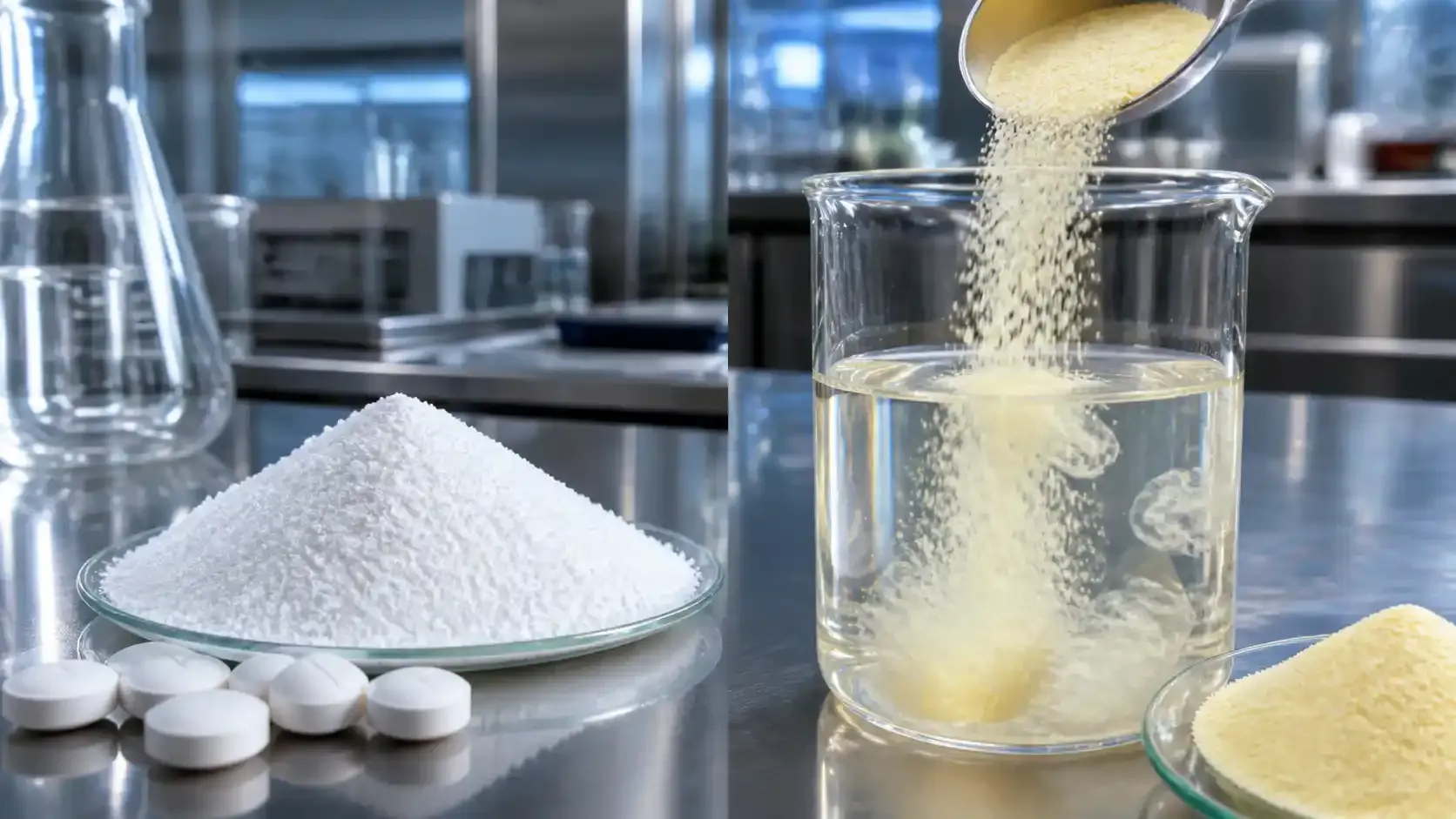
China-centered MCC capacity and fast-growing resistant dextrin output are changing how buyers screen suppliers, specs, and delivery risk in 2026.

China’s Growing Gravity in MCC Purchasing
Multiple market briefings now treat China as unavoidable for MCC buying. Reports explicitly highlight that MCC production is concentrated in China, which helps explain why global buyers keep searching for a recommended Chinese microcrystalline cellulose manufacturer even when they maintain secondary suppliers elsewhere.
What changes for procurement is the baseline assumption: if China is where the capacity is, then supplier evaluation must focus on repeatability and risk control. In practical terms, that means:
- Specification discipline: tablet performance (compressibility, flow) and food texture are sensitive to grade and particle attributes.
- Documentation readiness: COAs must be consistent batch to batch; discrepancies cause reformulation and stability delays.
- Export maturity: experienced exporters generally respond faster to deviation questions, labeling needs, and packaging requests.
For buyers of pharmaceutical excipients, the conversation typically becomes “Which MCC supplier China can support our regulatory and QA model?” rather than “Which supplier is cheapest this month?” That is also why the label “recommended” is increasingly earned through operational evidence.
Why Resistant Dextrin Is Surfacing in the Same RFQs
Meanwhile, resistant dextrin demand is benefiting from fiber-first product design—especially in beverages, powders, confectionery, and low-sugar reformulations. While MCC often anchors solid-dose and tableting needs, resistant dextrin is used to raise dietary fiber content with minimal taste impact and good solubility.
For sourcing teams, resistant dextrin frequently appears in the same portfolio review as MCC because both are “quiet ingredients” that influence downstream success:
- MCC affects tablet robustness, disintegration control, and process efficiency.
- Resistant dextrin affects fiber claims, GI positioning (where applicable), and sensory acceptance.
This is why buyers now ask for a recommended Chinese resistant dextrin manufacturer with evidence of consistent fiber content and manufacturing controls, not simply a supplier that can ship bulk quickly.
For context, supplier pages in China commonly position resistant dextrin as a soluble fiber derived from corn starch and emphasize practical formulation properties such as being tasteless, easy to disperse, and suitable for heat- and acid-exposed processes.
What “Recommended” Really Means for Chinese MCC Suppliers
For MCC, “recommended” is not a badge; it is the outcome of a predictable technical and operational pattern. When procurement teams shortlist a recommended Chinese microcrystalline cellulose supplier, the screening logic usually falls into three buckets.
1) Grade clarity and fit-for-use documentation
A credible recommended Chinese microcrystalline cellulose manufacturer will be able to answer:
- Which grade is intended for pharma vs food or industrial use?
- What is the intended functionality (binder, filler, disintegrant aid, flow aid depending on the system)?
- How is the grade controlled to reduce batch-to-batch drift?
2) COA discipline that matches your risk tolerance
A COA should be easy to read and stable over time. Many teams create a “red-line” list (the few COA fields that trigger rejection or investigation). For MCC, those red lines often include:
- Moisture (because it impacts flow and compressibility)
- Particle size indicators (because they affect blend uniformity)
- Bulk density/tapped density (because they influence hopper behavior)
- Microbiological limits (especially if the grade touches ingestible applications)
3) Supply reliability that survives schedule pressure
Even strong specs fail if the supplier cannot ship reliably. When buyers say “recommended Chinese microcrystalline cellulose supplier,” they are often referencing:
- Predictable lead times
- A workable MOQ structure for qualification and scale
- Fast responses to deviation questions
These are the same reasons the term MCC supplier China is frequently paired with logistics and documentation keywords in RFQs.
What “Recommended” Means for Chinese Resistant Dextrin Manufacturers
For resistant dextrin, the most useful definition of “recommended” is proof that the fiber is consistent, soluble, and commercially scalable. A recommended Chinese resistant dextrin manufacturer tends to demonstrate three things during qualification.
1) Transparent key specs that align with real formulations
Across the market, buyers commonly see a fiber content target such as ≥82% on certain commercial grades; some product lines also specify total fiber content (dry basis) ≥90% for higher-fiber positioning.
Other practical lines that routinely show up on supplier documentation include:
- Appearance: white to light yellow
- Moisture / water activity considerations (storage stability)
- Solubility (often expressed as a percentage under defined conditions)
- Microbiological limits
2) Process signals that reduce variability risk
Many procurement teams now treat certain manufacturing disclosures as signals, not marketing. Examples include:
- Automated central control from feeding to filling (reduces manual variability)
- A dedicated QC lab with in-house testing capability
- Controlled enzyme processing (often cited as imported enzymes in supplier materials)
These signals matter because resistant dextrin is usually purchased to protect a consumer experience (taste/texture) while meeting a nutrition target.
3) Application realism
A recommended supplier can discuss what happens when resistant dextrin enters:
- Low-sugar beverages (clarity, mouthfeel)
- Powder blends (flow, hygroscopicity, caking control)
- Confectionery and baked systems (heat/acid exposure, sweetness balancing)
As a neutral reference point within the broader China supply landscape, some buyers review product documentation for resistant dextrin and related dietary fiber materials, including the way suppliers describe solubility and storage behavior.
COA Comparison: What Buyers Actually Check
Instead of collecting dozens of parameters, many teams build a one-page comparison that forces suppliers into the same template.
| Item buyers compare | Microcrystalline cellulose (MCC) | Resistant dextrin |
|---|---|---|
| Primary use case | Tableting aid / excipient functionality in solids; also used in some food systems | Soluble fiber to raise fiber content with minimal flavor impact |
| “Red-line” COA focus | Moisture; particle indicators; density; microbiological limits | Fiber content (e.g., ≥82% or higher by grade); solubility; moisture/water activity; microbiological limits |
| Common failure mode | Grade mismatch leads to compression or flow issues | Fiber spec drift or hygroscopic behavior creates sensory or shelf-life issues |
| Procurement watch-outs | Substitution between grades without notification | “High fiber” claims without stable COA and test method consistency |
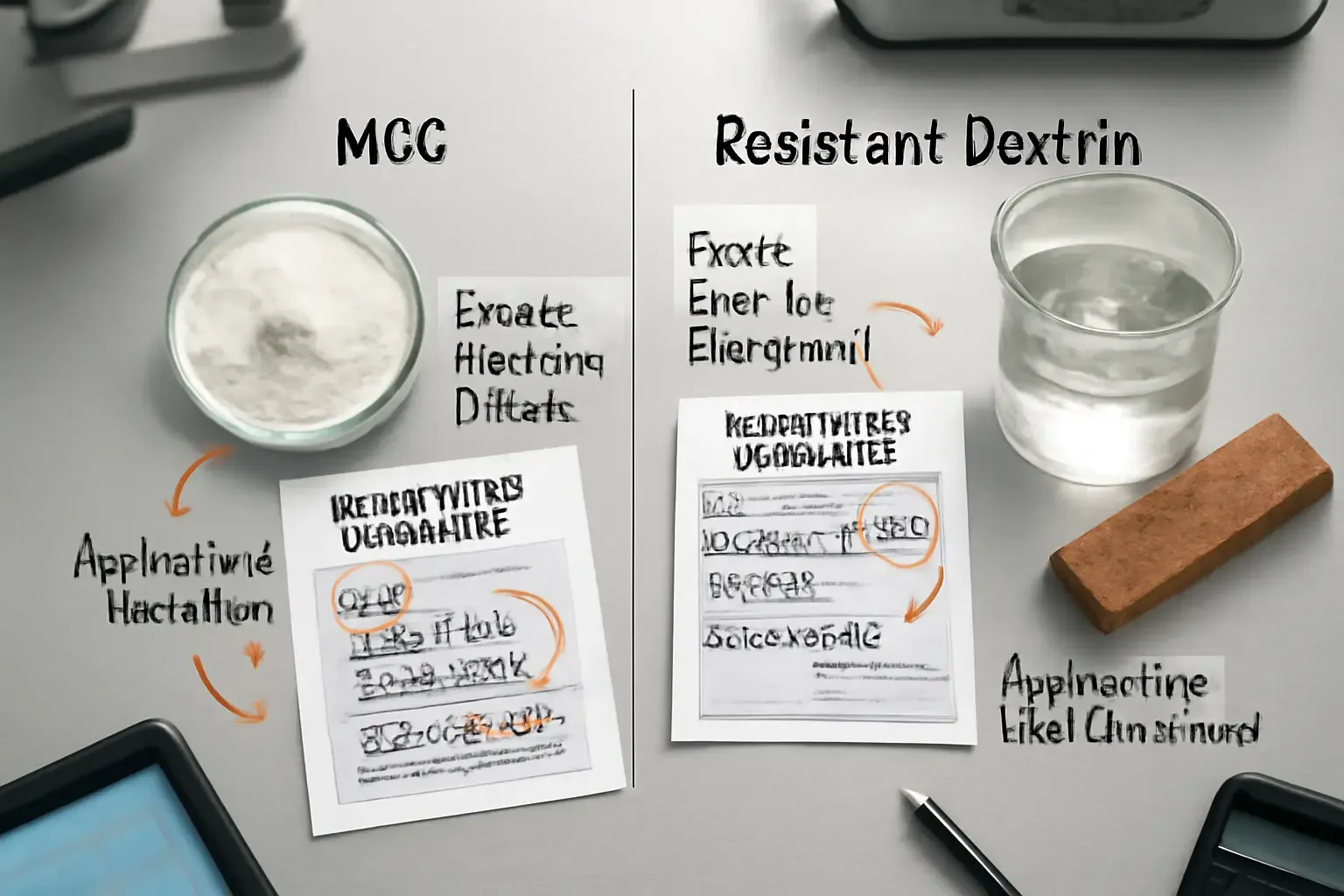
This table is also a practical reminder: a recommended Chinese microcrystalline cellulose manufacturer and a recommended Chinese resistant dextrin manufacturer are “recommended” for different reasons. Trying to apply one checklist to both usually creates blind spots.
How to Read Market Signals from B2B Platforms Without Overtrusting Them
B2B platforms can speed up discovery, but they also reward suppliers who optimize listings. A disciplined buyer uses platform data as a triage layer—not as proof of compliance.
Typical platform signals that matter:
- Response time: often correlates with export maturity and internal sales support.
- MOQ and sampling flexibility: critical for trials, especially when switching MCC grades.
- On-time delivery indicators: a rough proxy for planning discipline.
- Warehouse/stock language: can reduce lead time, but still needs verification.
How to validate those signals quickly:
- Ask for two recent COAs (different batch numbers) and compare variance on your red-line fields.
- Request a simple spec confirmation: “Is this resistant dextrin grade ≥82% fiber or ≥90% dry basis fiber?”
- Run a packaging and labeling scenario: confirm whether the supplier can support the exact bag size, palletizing, and mark requirements.
This is where the term buy resistant dextrin bulk China becomes more than a search phrase—it becomes a logistics question: can the supplier keep the fiber stable during transit and storage, and can they document it cleanly?
Practical Demand Trends Linking MCC and Resistant Dextrin in 2026
Several macro forces are pushing these ingredients into the same buyer conversations:
- Fiber-forward reformulation: Brands want more fiber without the sensory penalty. Resistant dextrin is frequently evaluated as a neutral-tasting option.
- Format diversification: More powders, gummies, and functional snacks increase demand for soluble fibers and processing-stable ingredients.
- Steady tablet demand: Pharma and nutraceutical tablets continue to rely on consistent MCC performance.
A realistic view is that MCC and resistant dextrin are not substitutes; they are “portfolio ingredients.” Buyers who secure a stable MCC supplier China and a stable resistant dextrin manufacturer China often reduce qualification churn and shorten development timelines.
Two Application Snapshots That Stress-Test Supplier Claims
These are not brand case studies—just common patterns procurement teams can use to structure trials.
1) High-fiber powder blends built for smooth mixing
In a powder product, resistant dextrin is often chosen for solubility and neutral taste. The trial focus usually includes:
- Flow and caking behavior over storage
- Mixing time and dispersion
- Sensory neutrality at target inclusion
A recommended Chinese resistant dextrin manufacturer will typically have clear guidance on handling and storage (for example, “store in a cool place”) and can discuss solubility targets in practical terms.
2) Fiber-enriched baked systems where heat stability matters
Heat- and acid-resistance claims are common in resistant dextrin materials, but buyers should validate performance under their real process conditions. In baked applications, teams track:
- Texture impact (crumb, chew)
- Sweetness balancing (if sugar is reduced)
- Shelf-life stability
In both snapshots, the key is to connect platform “signals” to measurable outcomes. That is exactly how buyers decide whether a recommended Chinese microcrystalline cellulose supplier or resistant dextrin partner truly belongs on the RFQ.
Shortlist Actions Buyers Can Use in the Next RFQ Cycle
To keep the process lean (and avoid endless resampling), many teams apply five actions:
- Define two spec tiers: a qualification tier (trial-friendly) and a production tier (locked limits).
- Standardize COA intake: require the same COA fields for every supplier to simplify comparison.
- Separate technical approval from logistics approval: a strong COA does not guarantee stable shipping performance.
- Pilot the communication loop: ask a deviation question early and observe response quality.
- Document “no-substitution” rules: especially for MCC grades.
This approach keeps searches like recommended Chinese microcrystalline cellulose manufacturer and recommended Chinese resistant dextrin manufacturer anchored to evidence—not reputation.
For teams building a broader China sourcing view, reviewing a supplier’s product knowledge pages—such as background on functional fiber—can help confirm whether the supplier communicates specs and process controls in a way that supports real procurement workflows. For a comprehensive list of compliant suppliers, you may wish to visit Shine Health.