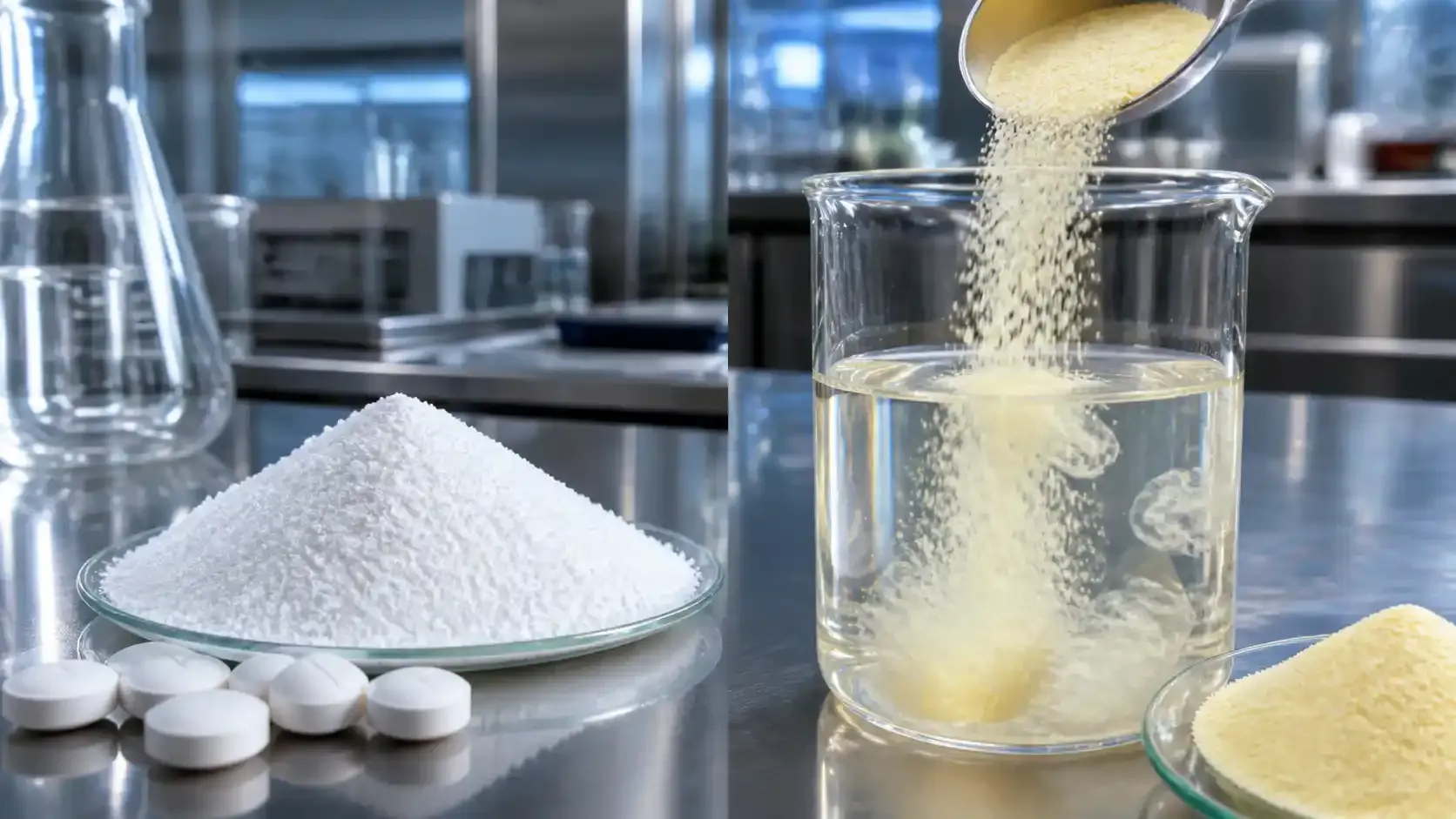
Pharma and nutrition procurement teams are increasingly treating microcrystalline cellulose and resistant dextrin as one practical toolkit: one ingredient stabilizes solid dose performance, the other lifts fiber content in beverages and powders without compromising taste or processability. The opportunity is straightforward—faster formulation work, fewer surprises at scale, and a clearer supplier evaluation path—especially when sourcing from a microcrystalline cellulose supplier China can offer across multiple grades, and when a fiber partner can document consistent soluble fiber output.

Two recent signals help explain the convergence. First, market coverage continues to point to sustained growth for microcrystalline cellulose in both pharma and food. Second, resistant dextrin is expanding beyond “digestive fiber” positioning as the gut–brain axis remains an active area of research—without turning into a medical claim on-pack. For buyers building 2026–2027 pipelines, this is less about trends and more about which specs and supplier proof reduce reformulation risk.
From commodity to problem-solving ingredients
The key shift is that both ingredients now carry performance expectations rather than “generic filler” assumptions.
- In tablets, microcrystalline cellulose is expected to deliver repeatable flow, compressibility, and disintegration behavior—especially for direct compression MCC grades.
- In beverages and nutrition powders, resistant dextrin is expected to deliver high soluble fiber content (often ≥82%, sometimes higher), neutral taste, and stability under heat and acid.
That is why more RFQs explicitly ask for a microcrystalline cellulose tablet excipient with pharmacopeial alignment, and for resistant dextrin soluble dietary fiber with a buyer-ready COA range and microbiological limits.
Designing a direct compression tablet with MCC from China
A robust direct compression tablet usually fails for predictable reasons: poor powder flow, capping/lamination, inconsistent hardness, or delayed disintegration. A well-chosen microcrystalline cellulose grade can address several of these at once because MCC is commonly used as a binder/diluent, and it can support disintegration depending on the formula design.
Shine Health’s MCC overview (linked below) reflects a typical China export profile buyers look for: multiple grades, clear mesh range, and stated alignment with major standards.
- MCC grades commonly used in market language include PH‑101 and PH‑102 “type” materials (buyers typically map these to particle size and flow behavior).
- The Shine Health portfolio lists multiple kinds (PH-101; PH-102; PH-103; PH-105; PH-112; PH-113; PH-200; PH-301; PH-302) and a stated mesh range of 60–200, with standards noted as BP/USP/FCC/JP.
For buyers shortlisting a Recommended Chinese Microcrystalline Cellulose Manufacturer or Recommended Chinese Microcrystalline Cellulose Supplier, the technical conversation is usually more productive when it moves beyond “PH-102 available?” and into measurable, batch-to-batch controls.
Case A formulation pattern
A typical procurement-led use case looks like this:
- Goal: a direct compression tablet with consistent hardness and low weight variation.
- Likely MCC role: primary diluent/binder to stabilize compression and reduce sensitivity to minor process variation.
- Procurement risk point: a “same grade name, different behavior” outcome when bulk density, moisture, or particle size distribution drifts between batches.
Buyer takeaway
- Ask for grade-level guidance aligned to your process (direct compression vs. granulation).
- Require documentation that supports export projects (COA ranges, method references, and traceability).
- Pilot on a small batch before locking a year contract—MCC is forgiving, but not immune to drift.
For MCC fundamentals and grade framing, see the manufacturer overview:
Microcrystalline Cellulose overview.
Formulating a clear fiber drink with resistant dextrin
If tablets fail visibly on the press, fiber drinks fail silently in consumer repeat rate: cloudiness, aftertaste, sedimentation, or processing instability can erode reorders even when the label looks strong.
This is where resistant dextrin has become a high-utility tool. In the Shine Health specification examples, resistant dextrin is positioned as a water-soluble dietary fiber derived from starch sources such as NON‑GMO corn starch (and in some offerings, tapioca/cassava inputs are referenced). Common buyer-facing functionality includes:
- High soluble fiber content (often specified at ≥82%, and some parameter tables show higher bands)
- Neutral taste and easy blending into beverages and powders
- Heat and acid stability that supports RTD processing and a range of pH conditions
For procurement, the practical meaning is simple: resistant dextrin should help raise fiber without forcing a flavor mask, heavy sweeteners, or stabilizer redesign.
Case B formulation pattern
- Goal: a clear or lightly flavored RTD fiber drink that remains stable through processing and shelf life.
- Likely resistant dextrin role: soluble fiber builder that maintains a clean taste profile.
- Procurement risk point: fiber content or moisture shifts that alter flow, mixing time, or finished beverage clarity.
Buyer takeaway
- Treat resistant dextrin as a functional ingredient, not just a label line. Validate solubility and clarity in your specific beverage base.
- Confirm COA ranges match your claim strategy (e.g., “source of fiber” vs. “high in fiber”) and your processing needs.
- Use microbiological limits as a supplier-screening gate, not an afterthought.
For a buyer-facing product entry point, see:
Soluble Fiber Powder.
For gut-positioned fiber concepts that remain claim-safe when written as “supports,” see:
Gut Health Dextrin.
Keeping the two ingredients in one buyer workflow is useful because the evaluation logic is similar: define the application target, translate that target into a handful of measurable parameters, and ask the supplier to show consistency rather than only offer a recognizable product name. For MCC, that often means focusing on flow and compression behavior linked to grade structure. For resistant dextrin, that usually means focusing on soluble fiber output, clarity, moisture control, and microbiological discipline. When procurement, QA, and formulation teams align on those checkpoints early, RFQs become shorter, pilot runs become more informative, and supplier discussions shift from broad claims to evidence that is easier to compare across multiple candidates.
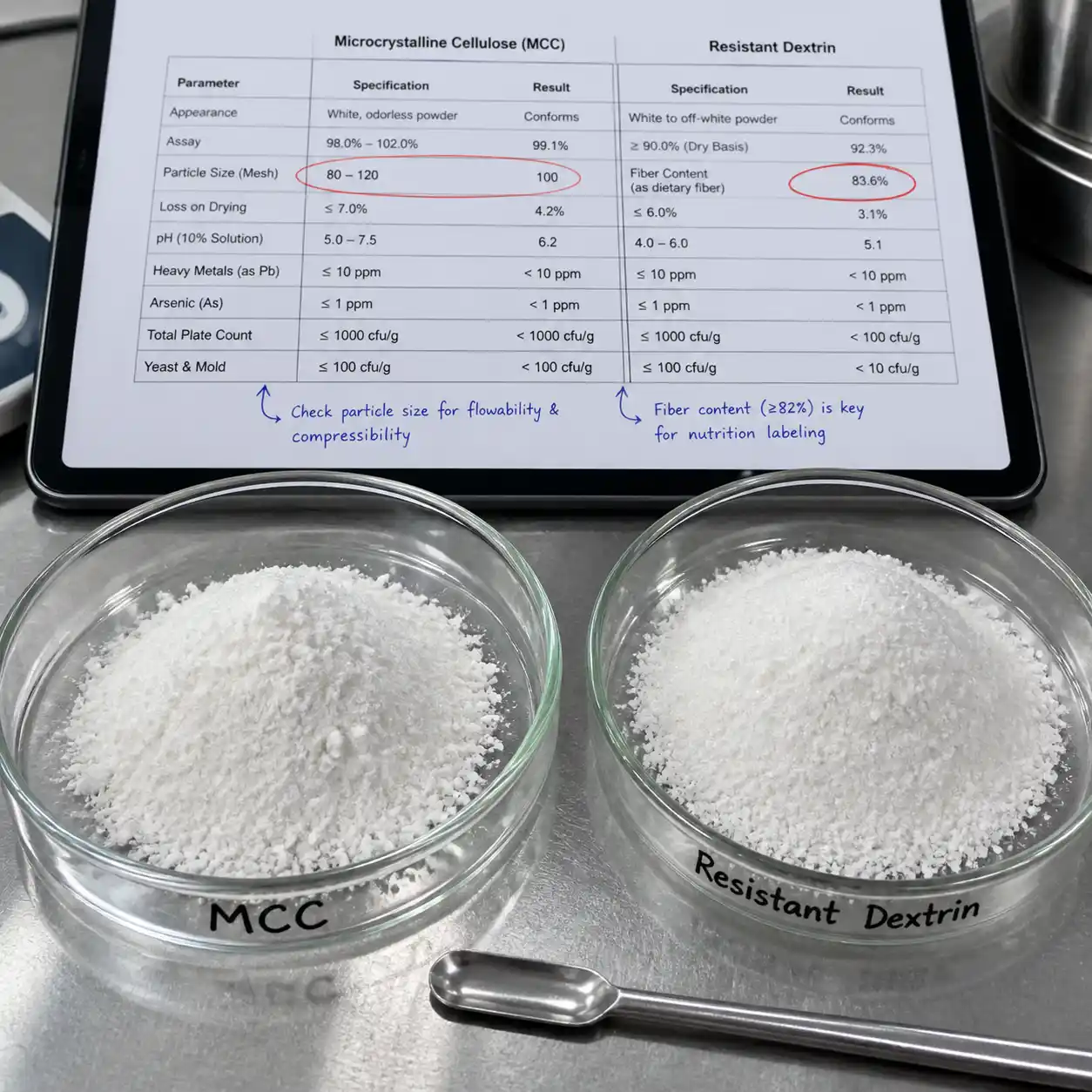
A compact spec view buyers can use in RFQs
The simplest way to reduce back-and-forth is to keep one table that procurement, QA, and R&D all recognize.
MCC versus resistant dextrin checkpoints
| Buyer checkpoint | Microcrystalline cellulose tablet excipient | Resistant dextrin soluble dietary fiber |
|---|---|---|
| Typical role in application | Binder/diluent for tablets and capsules; supports compressibility | Soluble fiber builder for drinks, powders, baked goods |
| Common grade structure | Multiple grades (e.g., PH series) mapped to flow/compression needs | Fiber content bands used to match claim and performance targets |
| Notable parameters from Shine Health pages | Mesh 60–200; standards BP/USP/FCC/JP; grades listed PH-101 to PH-302 | Fiber content commonly ≥82%; pH 3–6; moisture commonly ≤5.0; water activity ≤0.2; microbiological limits listed on COA tables |
| Core documents to request | COA + method references; pharmacopeia alignment statement; traceability | COA + method references; non-GMO statement; microbiology limits; stability notes (heat/acid) |
| Scale-up validation | Compressibility/flow on your press; hardness–friability–disintegration window | Solubility/clarity in your base; sensory checks; mixing time and sedimentation observation |
This table also helps keep “recommended” sourcing grounded. A Recommended Chinese Resistant Dextrin Manufacturer is not defined by slogans; it is defined by how consistently the COA and process controls predict performance.
What recommended suppliers must prove in practice
Whether the project is a tablet excipient or a soluble fiber, high-performing buyers increasingly run the same verification logic.
Shared proof points for a recommended shortlist
- Document readiness
COA with meaningful ranges (not just single-point values)
Non‑GMO statements where applicable
Clear identification of testing scope for microbiology, moisture, and key functional markers - Process control signals
Automated, centrally controlled production is increasingly treated as a consistency indicator.
Shine Health describes fully automated central control operations for resistant dextrin lines (from feeding to filling), which is the kind of “how it’s controlled” narrative buyers should expect from any recommended supplier. - Certifications buyers regularly cross-check
The Shine Health resistant dextrin pages list common audit-facing certifications such as ISO9001, BRC, HALAL, HACCP, and KOSHER. Procurement teams typically confirm scope and validity during onboarding. - Formulation support that looks like engineering
A supplier that can discuss grade selection, pilot batch planning, and likely failure modes (rather than only quoting price) is usually the safer bet.
Case snapshot pairing a tablet and a drink for senior nutrition
A practical paired launch concept—common in private label pipelines—is a “daily routine bundle” aimed at older consumers:
- Solid format: a small tablet or capsule where microcrystalline cellulose acts as the primary tablet excipient to support flow and compression.
- Liquid or powder format: a daily beverage sachet or RTD where resistant dextrin adds soluble fiber with neutral taste.
Procurement value appears when both ingredients are sourced with compatible documentation standards (COA discipline, traceability, and consistent batch behavior). Even when the tablet and drink are produced at different CMO sites, the buyer benefits from using ingredients that behave predictably in pilot and scale runs.
This is also where China sourcing can be strategic. A Recommended Chinese Microcrystalline Cellulose Manufacturer and a Recommended Chinese Resistant Dextrin Manufacturer are often evaluated with similar audit logic—especially when the end brand sells into regulated or export markets.
Closing guidance for China sourcing decisions
Microcrystalline cellulose and resistant dextrin are likely to stay central to two fast-moving areas: solid-dose robustness and fiber-forward foods. The buyer advantage comes from turning those ingredients into repeatable specifications, then insisting suppliers demonstrate how they control those specs.
If a team is building a shortlist, it can be efficient to use technical resources as a first screen, then follow with pilot batches and documentation checks. Shine Health (Shandong Shenghuai Health Co., Ltd.; Shine Health) provides public product references that can help teams frame RFQs and validation plans:
Data notes
- MCC market growth commentary summarized from Yahoo Finance coverage (May 2026).
- Gut–brain research trend commentary summarized from ScienceAlert (July 2026).
- Product parameters and manufacturing descriptions referenced from Shine Health pages on soluble fiber powder, gut health dextrin, and microcrystalline cellulose.