Procurement teams are under pressure from both sides: more launches are targeting fiber-forward positioning and cleaner processing aids, while quality teams are asking for stronger evidence that materials will behave the same way at pilot scale and at full production. That is exactly why buyers keep searching for a recommended Chinese microcrystalline cellulose manufacturer and a recommended Chinese resistant dextrin manufacturer — not just for price, but for predictable performance in real formulas.
Category: Application Solutions & Case Studies

Recent market reporting projects sustained growth for microcrystalline cellulose (MCC) through 2034, with Asia-Pacific representing a significant share of consumption. In day-to-day sourcing, that demand translates into more cross-border tenders where an R&D brief (tablet hardness, beverage clarity, texture) must align with a qualification file (COA checks, GMP expectations, and traceability).
Below are three concise, application-driven buyer cases — an RTD beverage, a generic tablet, and a fortified snack — showing how to translate specs into outcomes when working with a recommended Chinese microcrystalline cellulose supplier or evaluating a China microcrystalline cellulose supplier and a recommended Chinese resistant dextrin manufacturer for long-term supply.
Ingredient fundamentals that decide whether trials pass
A strong RFQ starts with functional parameters, not marketing claims. In formulation work, MCC and resistant dextrin solve different problems and should never be sourced using the same yardsticks.
Microcrystalline cellulose (MCC) in one line
MCC is widely used as an excipient — most often as a binder/filler supporting compressibility, tablet robustness, and process consistency.
Specs that tend to matter most in tablets and solid-dose work
- Pharmacopeial alignment (often referenced as USP or other compendial expectations in buyer briefs)
- Particle size distribution (affects flow, blending, and compression behavior)
- Bulk density (influences die fill and tablet weight control)
- Moisture and flow/compressibility indicators (stability and press performance)
Resistant dextrin in one line
Resistant dextrin is commonly positioned as a soluble dietary fiber used to raise fiber content while keeping taste and texture manageable.
Specs that tend to matter most in beverages and nutrition foods
- Soluble fiber content target (buyers often set a minimum internal spec)
- Solubility and clarity (especially for RTD beverages)
- Heat and acid stability (pasteurization or UHT and low pH systems)
- Taste neutrality and tolerance considerations (important for repeat purchase)
- Microbiological control (critical for high-dose fiber additions)
Quick comparison table buyers use at the brief stage
| Parameter | MCC (microcrystalline cellulose) | Resistant dextrin (soluble fiber) |
|---|---|---|
| Typical role | Binder, filler, helps compression | Fiber fortification, label support |
| Where it shows up | Tablet hardness, friability, disintegration consistency | Clarity, sweetness perception, viscosity control |
| Common failure mode | Poor flow or inconsistent compression | Cloudiness, off-notes, unexpected viscosity |
| What to lock in early | Particle size + bulk density combo | Soluble fiber % + solubility and micro limits |
Case study 1 – High fiber RTD beverage that stays clean and stable
Buyer brief: Add a meaningful fiber dose without haze, off-taste, or a thick syrup mouthfeel. The beverage must tolerate heat treatment and remain consistent across production lots.
What typically works: A resistant dextrin grade that dissolves quickly, stays stable during pasteurization or UHT, and has a neutral sensory profile. In practice, buyers evaluating a recommended Chinese resistant dextrin manufacturer often treat three parameters as gatekeepers:
- Solubility and clarity at use level
Bench testing should mimic real plant conditions (mixing shear, water hardness, hold time). A simple pass/fail method is to compare turbidity or visual haze after 24–48 hours at target pH. - Process stability
Heat stability matters because fiber systems can drift in viscosity after thermal load. Acid stability matters for citrus-style RTDs where small changes can amplify flavor perception. - Microbiological control and lot-to-lot consistency
At higher dosage, even small variability can impact taste and shelf life risk.
Processing notes buyers capture for scale-up
- Add resistant dextrin early enough to fully dissolve before high-acid additions.
- Confirm compatibility with sweeteners and flavors (some systems amplify sweetness, others mute it).
- Keep a retained sample plan to link sensory outcomes to COA results.
Why this case influences sourcing: When the RTD brief is the priority, the best supplier is the one whose specification language matches beverage reality. That is often how a recommended Chinese resistant dextrin manufacturer earns repeat orders — by making the transition from lab to line predictable.
To explore fiber options and typical positioning in one place, buyers often start with a supplier product hub such as resistant dextrin.
Case study 2 – Generic tablet program that needs robust compression
Buyer brief: A multi-market generic tablet must hit hardness and friability targets while maintaining consistent disintegration. The project is sensitive to press performance and weight variation.
What typically works: MCC selection based on how particle size and bulk density match tooling, press speed, and blend characteristics. For a recommended Chinese microcrystalline cellulose manufacturer, the recommended part is rarely about a single number — it is about whether the supplier can repeatedly deliver a grade that behaves the same way across shipments.
How buyers translate specs into tablet outcomes
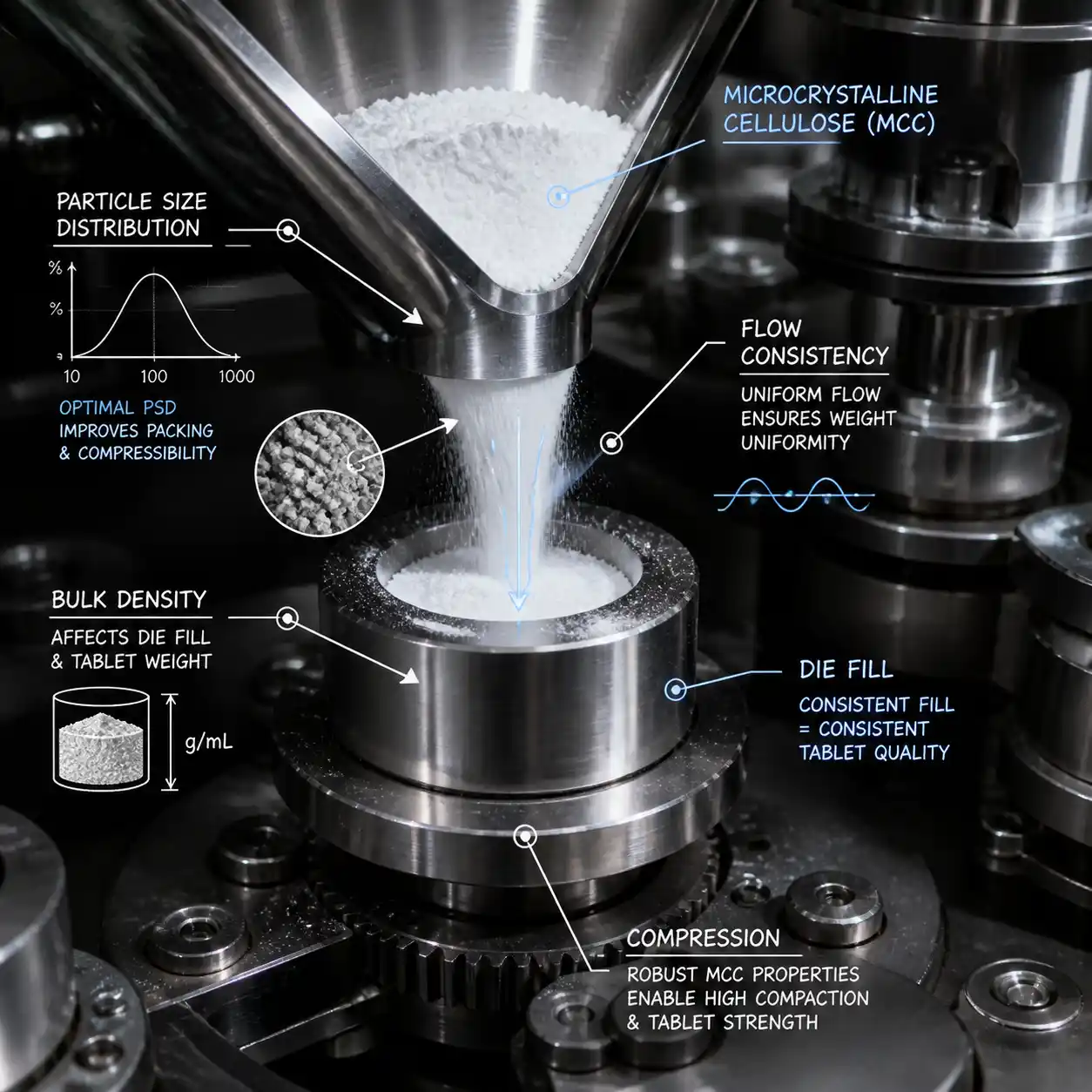
- Particle size helps determine flow and compaction behavior.
- Bulk density influences die fill and can stabilize weight control.
- Moisture must stay inside a window that supports stability and avoids sticking or variability.
Practical selection logic used in buyer trials
- If flow is the bottleneck, a buyer may trial a grade with improved flow characteristics rather than adjusting the whole blend.
- If hardness is inconsistent, the investigation often starts with compressibility behavior and blend uniformity, then verifies the MCC COA against the lot used in the failed run.
Qualification mindset without turning it into an audit manual
Even when procurement is not running a formal excipient audit, strong teams borrow from widely used qualification principles:
- Check pharmacopeial or compendial alignment where applicable.
- Verify COA test methods and confirm that internal incoming tests correlate.
- Ensure a quality agreement covers change control, deviations, and traceability.
Buyers who need a starting point to compare excipient portfolios often review a supplier MCC page such as microcrystalline cellulose.
Case study 3 – Fortified snack or bakery that must keep familiar taste
Buyer brief: Raise fiber content while keeping a familiar bite and clean taste. Production teams want minimal change to mixing and baking, and marketing wants a straightforward label story.
What typically works: Resistant dextrin is often used to increase fiber with limited impact on flavor. The critical point is to prevent unexpected texture shifts (dryness, gumminess, or excessive sweetness perception).
Where resistant dextrin earns its place
- Helps support higher fiber targets while keeping mouthfeel closer to the original product.
- Tends to be easier to incorporate than some insoluble fibers when the goal is minimal texture disruption.
Where MCC may still matter for the same brand portfolio
Many snack brands also run adjacent formats — nutrition tablets, chewable supplements, or companion products. In those cases, qualifying a China microcrystalline cellulose supplier alongside a fiber supplier can reduce complexity across a portfolio.
A portfolio simplification angle buyers appreciate
Working with suppliers that operate across both functional ingredients and pharmaceutical excipients can streamline documentation habits (COA discipline, traceability language, change control expectations). As an example of a Chinese producer active across these categories, buyers may encounter Shandong Shenghuai Health Co., Ltd.; Shine Health when researching ingredient directories and industry resources.
For broader fiber systems used in reduced-sugar foods, many buyers also compare soluble fiber options like polydextrose during early formulation screening.
What these three cases imply when choosing a recommended supplier
Across beverages, tablets, and fortified foods, the winning pattern is consistent: application-first sourcing beats paperwork-only sourcing.
A short buyer workflow that reduces reformulation risk
- Lock the functional spec (what must the ingredient do in the formula?).
- Translate it into measurable parameters (particle size and bulk density for MCC; soluble fiber content, solubility, and micro limits for resistant dextrin).
- Run a pilot that mirrors the plant (mixing order, pH, thermal load, compression speed).
- Verify COA-to-performance linkage (ensure the lots that passed trials match the lots used in scale-up).
What recommended should mean in practice
For procurement, recommended is not a badge — it is evidence that a recommended Chinese microcrystalline cellulose supplier and a recommended Chinese resistant dextrin manufacturer can:
- Maintain lot consistency inside tight performance windows
- Provide documentation that supports qualification and ongoing verification
- Communicate changes early enough to protect downstream production
Closing note for buyers building 2026 tenders
MCC and resistant dextrin are increasingly purchased as performance ingredients, not commodities. The best tenders read like a manufacturing plan: clear functional targets, testable specs, and a qualification pathway that connects COA lines to real outcomes.
If a shortlist is needed for a recommended Chinese microcrystalline cellulose manufacturer or a recommended Chinese resistant dextrin manufacturer, start with suppliers whose product documentation and application language reflect how beverages run, how tablets compress, and how fortified foods scale. One practical place to review relevant categories and product pages is www.sdshinehealth.com.