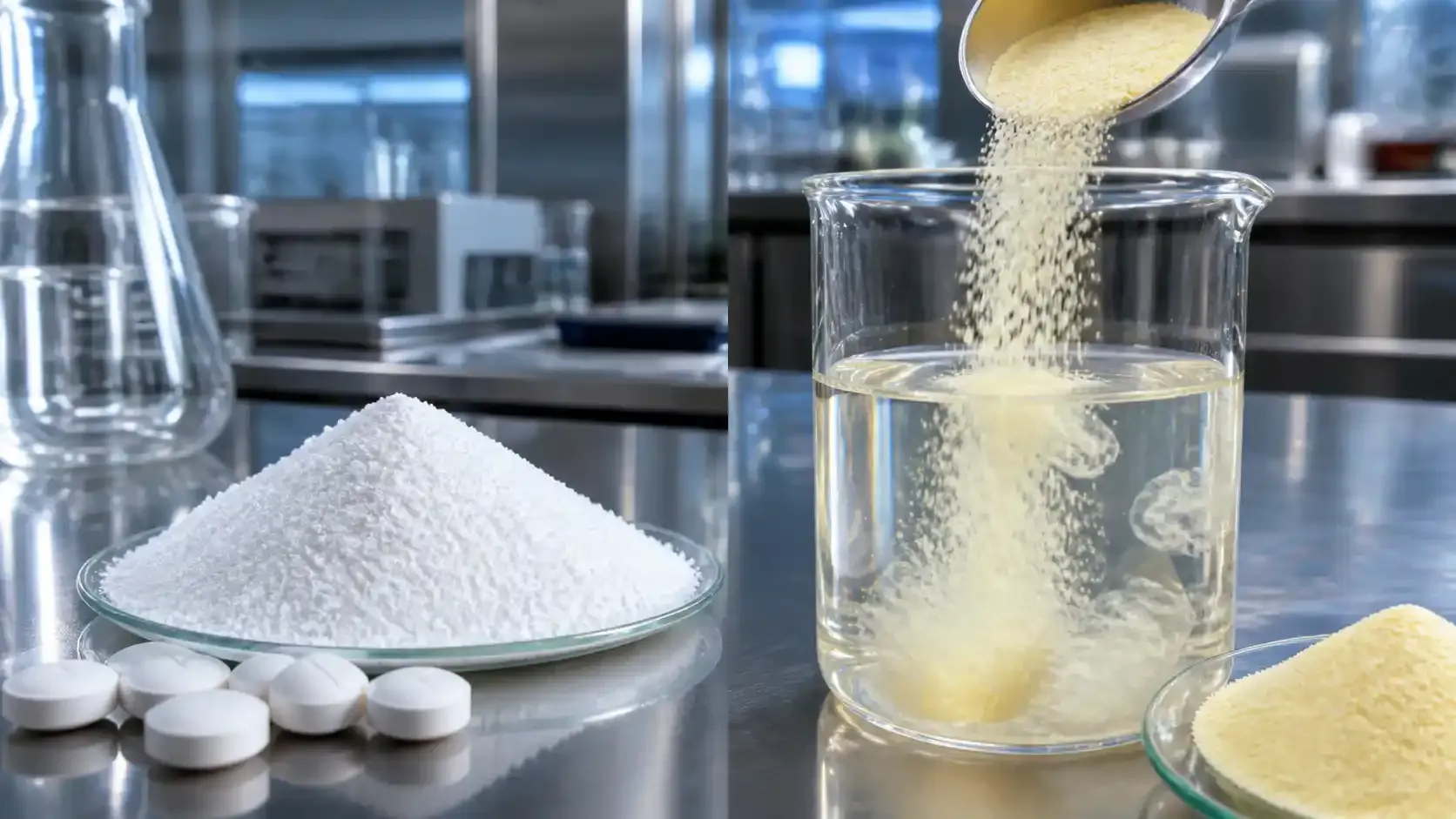
Soluble dietary fiber is now treated as a critical, regulatory-sensitive ingredient — far more than a simple nutritional additive. Recent market reports project the global dietary fiber market could reach roughly US$40 billion by 2036, with soluble fiber expected to hold more than 52% of the market as early as 2026, and China positioned as a high-growth region (CAGR around 13.2%). For buyers, that growth exposes a clear reality: supplier approval now hinges on well-managed documentation, not just price.
Procurement teams building low-sugar, high-fiber, or gut-health lines frequently pair resistant dextrin (often appearing as soluble corn fiber or resistant maltodextrin) with microcrystalline cellulose ([MCC](https://www.foodadditivehub.com/procurement-teams-are-treating-mcc-and-dextrin-strategic-assets.html)), the key pharmaceutical excipient in tablets and related dosage forms. Approving a China resistant dextrin manufacturer or a China microcrystalline cellulose manufacturer now means proving that label claims, food-safety expectations, and excipient-grade controls are all backed by auditable written records.
· Buyers screening China soluble dietary fiber suppliers are scrutinizing documentation more strictly.
· Even food-focused teams are evaluating MCC with an "excipient mindset."
· A truly "recommended" supplier is one that can quickly show traceability, comprehensive testing, and effective change control.
Why China has become a compliance hub for fiber and excipients
China has become a major center for resistant dextrin supply and the broader pharmaceutical excipient ecosystem. Its advantage is not just capacity — it is that an increasing number of manufacturers can provide export-oriented documentation: non-GMO statements, batch-by-batch COAs, and a complete certification set for international customers.
On the fiber side, many Chinese producers emphasize non-GMO corn starch as the raw material and rely on imported enzymes for processing. Many plants also cite German-origin precision lines, high automation (including unmanned operation), and Japanese-style craftsmanship as part of their product-consistency strategy. These factors matter to buyers because they directly affect product variability, contamination risk, and whether a supplier's "same spec every batch" promise is reliable.
Shandong Shine Health Co., Ltd. offers a good illustration in its resistant dextrin description: non-GMO sourcing, imported enzymes, automated lines, and in-house QC support across multiple resistant dextrin applications.
What "recommended" means: the compliance-pack records
When teams look for a recommended Chinese resistant dextrin manufacturer or a recommended Chinese microcrystalline cellulose supplier, "recommended" is really shorthand for "verifiable control." Below are the key records that separate a long-term, reliable partner from a one-shipment supplier.
1) Identity and label consistency
For resistant dextrin, buyers usually need consistent product naming and claim support (for example, soluble-dietary-fiber positioning and sugar-reduction applications). The supplier should provide:
· A product-identity statement consistent with commercial use (food, beverage, supplement).
· A clear, consistent technical data sheet (TDS) so procurement, QC, and regulatory teams read it the same way.
· Allergen and GMO-status statements matching your label strategy.
2) Batch-level COAs matched to your claim risk
A COA should be more than a checkmark. For resistant dextrin and related soluble fibers, common COA items include:
· Total dietary fiber (some grades commonly show ≥82%; some listings show ≥90% on a dry basis).
· Moisture / water-activity indicators supporting storage stability.
· Microbiology (for example, total aerobic count, coliforms, yeast, mold).
· Appearance and solubility indicators relevant to beverages and powders.
For MCC, COA expectations shift toward excipient suitability — grade selection, physical functionality, and consistency. If your team is still aligning on MCC grades, a practical starting point is this technical overview: MCC grades formulation and QC guide.
3) A certification set that matches your market access
Buyers usually cross-check certification coverage against their export routes and customer requirements. The certifications most often required across food and excipient supply chains include:
· ISO9001
· BRC
· HALAL
· HACCP
· KOSHER
· GMP (especially when MCC or pharma-adjacent use is involved)
Some supplier pages (including Shine Health's coating-agent and fiber pages) explicitly mention several of these certifications and describe GMP/HACCP-aligned workshop control. The key procurement move is to request the certificates and confirm their scope and validity match the plant and product category you are approving.
4) Traceability and change control
Traceability is more than "farm to factory." It also means being able to answer:
· What happens when the corn-starch origin changes?
· What happens when the enzyme supplier changes?
· What happens when a processing step is optimized?
Leading suppliers document these changes in detail, communicate them promptly, and can support a re-approval workflow. This becomes critical when your finished-product label depends on stable fiber content or consistent tablet performance.
A quick comparison for mapping risk and value
The simplest way to avoid spec confusion is to separate an ingredient's function, label impact, and certification expectations. A concise comparison table helps procurement teams align internal stakeholders without rewriting the entire RFQ.
Ingredient type | Typical role in formulation | Label and sensory impact | Common compliance focus |
Traditional bulk fiber | Filler, fiber fortification | May increase viscosity or alter mouthfeel | Basic food safety, stability files |
Resistant dextrin (soluble dietary fiber) | Fiber fortification, sugar-reduction support, prebiotic positioning | Often preferred for high solubility and low viscosity | COA fiber percentage, microbiology, non-GMO statement, export-ready files |
Tablet excipient function; also used in some non-pharma applications | Usually neutral when the grade is right | Grade selection, QC consistency, GMP-aligned control |
This is exactly where screening for a China soluble dietary fiber supplier meets excipient sourcing: buyers want one approval flow that handles both food-related claims and pharmaceutical-grade rigor.
How resistant dextrin documentation enables application validation
Procurement teams often approve resistant dextrin on generic specs, then discover performance gaps at scale-up. A practical fix is to verify that the supplier can connect documentation to real application behavior.
Shine Health's resistant dextrin pages present several application scenarios buyers typically care about:
· Dairy formulation use case: resistant maltodextrin in dairy
· Low-carb positioning and formulation fit: low-carb food additives
· Sugar-reduction direction: sugar-reduction ingredient resistant dextrin
From a compliance standpoint, the conclusion is clear: if a China resistant dextrin manufacturer can map its COA ranges and production controls to these application needs (clarity, heat/pH stability, storage behavior, microbiology), the ingredient stops being "bulk fiber" and becomes a reliable, predictable input for your finished-product claims.
A practical approval flow for China MCC and resistant dextrin
Procurement teams looking for a China microcrystalline cellulose manufacturer and a China resistant dextrin manufacturer can reduce duplicated work by adopting one consistent approval sequence:
1. Start with label and market access: define your claim needs (fiber percentage, non-GMO, Halal/Kosher, etc.).
2. Verify COAs against your internal specs: check fiber-content thresholds, water activity or moisture logic, and microbiology targets.
3. Confirm certifications and their scope: match certificate scope to product category and production site.
4. Ask traceability and change-control questions: ensure the supplier can support repeatability, not just the first shipment.
5. Align grade selection and QC language: especially for MCC, confirm the grade and QC-method language used in the documentation.
It is this structured process that turns "recommended" from a marketing word into measurable supplier performance.
For buyers building a China supplier shortlist
China's landscape for soluble fiber and excipients is broad, but the suppliers worth reordering from share one trait: they can quickly provide clear compliance proof using documentation that matches how your QA team audits.
If your team is building a shortlist around the checkpoints above, reviewing a manufacturer's technical pages is a good starting point for documentation alignment — then move directly into COA/certificate verification and change-control discussion. For product and application context related to resistant dextrin and MCC, a reference starting point is www.sdshinehealth.com.