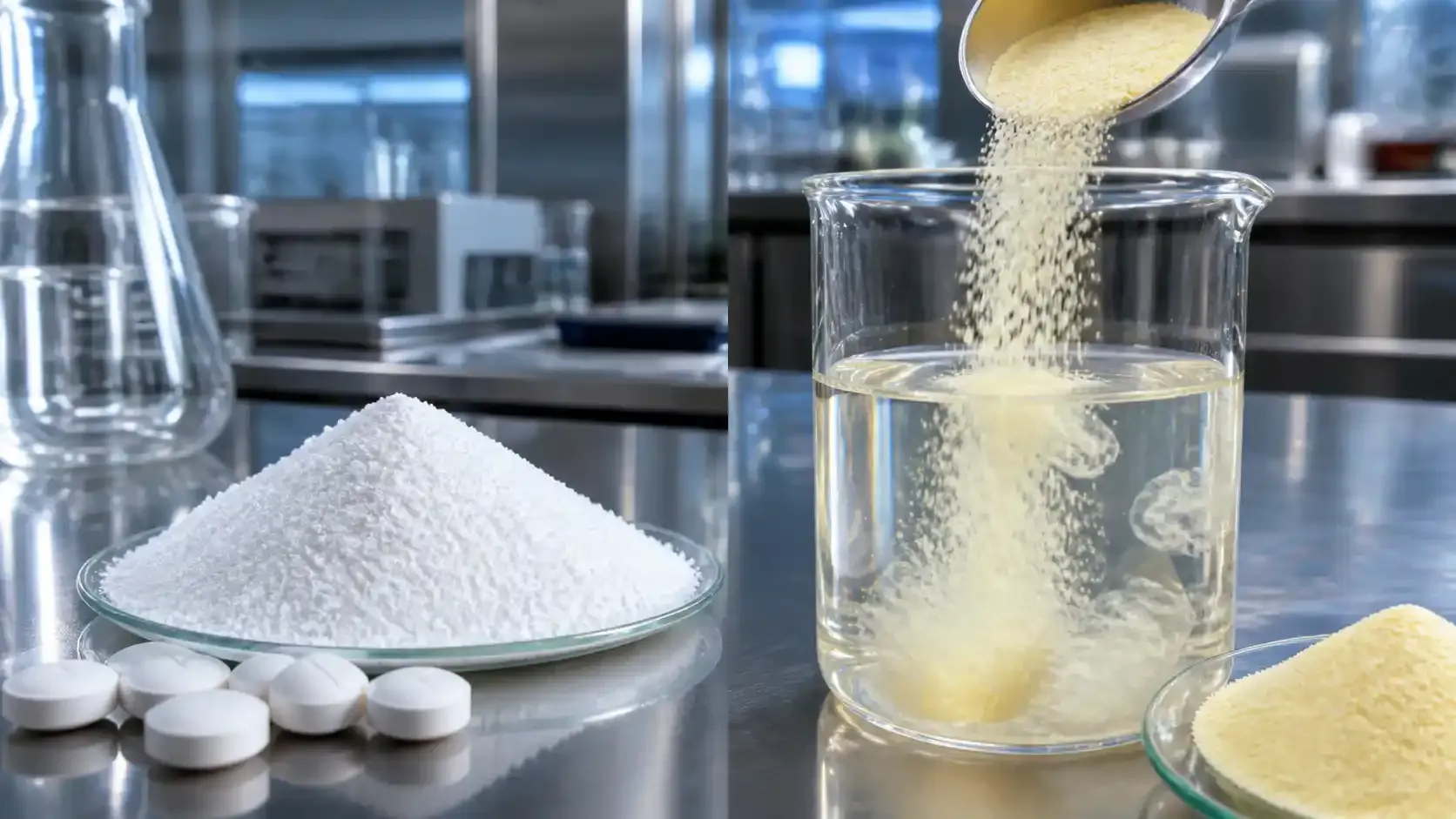
Procurement teams rarely fail on price — they usually fail on assumptions. For resistant dextrin (a soluble fiber used to increase fiber content without significantly affecting taste or texture) and microcrystalline cellulose (MCC, a key pharmaceutical excipient and thickener), the biggest sourcing surprises tend to appear after the first shipment: inconsistent COAs, missing documentation, unexpected behavior in beverages or tablets, or packaging damaged in transit.
This guide is for teams that want to screen for a quality China resistant dextrin producer and a China microcrystalline cellulose supplier without an on-site visit. The goal is simple: turn "looks good in the brochure" into documented, repeatable evidence.
Why evaluate resistant dextrin and microcrystalline cellulose together
In many product portfolios, resistant dextrin carries the "nutrition front-end" (fiber, gut health, sugar-reduction formulas), while microcrystalline cellulose supports the production reality (tablet formation, flow, stability, and texture control in some food and cosmetic systems). Buyers increasingly treat them as one qualification program because:
· Both ingredients often go into high-volume SKUs where small batch-to-batch differences become expensive.
· If the supplier's quality system is weak, both can cause downstream cost — rework, reformulation, relabeling, or extra testing.
· For multi-market distribution, both need clean documentation (food-safety systems, traceability, allergen statements, non-GMO statements where applicable).
A strong Chinese pharmaceutical excipient supplier can usually show clearly how its fiber production and excipient QC run under disciplined, auditable processes.
Step 1: define "fit for purpose" before comparing quotes
Before requesting quotes, lock the functional requirement to the final product — not just the ingredient category.
Resistant dextrin: key considerations in a real formulation
Resistant dextrin is widely chosen because it delivers high fiber content while keeping a relatively neutral taste and processing profile.
For many buyers, the basic technical requirements for resistant dextrin should include:
· Fiber content: resistant dextrin is usually required to be ≥82%, depending on grade and how the supplier's spec sheet defines it.
· Appearance: white to light-yellow powder.
· Moisture / water-activity indicators: closely tied to caking risk and shelf stability.
· pH range and stability statements: especially important for beverages and acidified systems.
If you are buying for beverages or clear mixes, "high solubility and low viscosity" are not marketing terms — they directly affect sediment risk and mouthfeel. To connect your requirements to concrete documents, review a supplier's public technical positioning and typical parameters. The factory-direct resistant dextrin product page, for example, shows how a Chinese manufacturer presents raw-material selection, enzymatic processing, QC, packaging format, and standard parameter ranges.
Microcrystalline cellulose: define the grade logic
Microcrystalline cellulose is not "one ingredient." Grade selection affects tablet compressibility, flow, hardness, and sensory behavior in non-tablet systems.
If your application involves tablets or capsules, have your internal formulation team specify:
· Target tablet hardness / friability range
· Flow and compression needs (direct compression or granulation)
· Sensory limits if MCC is used for texture (for example, in certain cosmetic or food applications)
Even early in the process, you can use a supplier's educational material as a screening signal. A good example is the MCC grades formulation and QC guide, which explains why grade selection and QC are inseparable.
Step 2: screen Chinese suppliers on compliance and documentation
When buyers look for a China microcrystalline cellulose supplier or a China resistant dextrin manufacturer, the initial screen should be document-based. The goal is not to "collect certificates" but to confirm the supplier's operating system can withstand a real audit.
Documents to require
Request (before, or at the same time as, any sample shipment):
· Current spec sheets for the resistant dextrin and MCC grades
· Recent multi-batch COAs (not just one)
· Food-safety management certifications (FSSC 22000 where applicable)
· Halal/Kosher certificates if your market requires them
· Non-GMO proof if you buy non-GMO resistant dextrin
· Allergen statements, traceability statements, and packaging specs
Manufacturers that publicly state certifications such as FSSC 22000, HALAL, KOF-K Kosher, and SGS NON-GMO simplify this step, because you can cross-check their claims against the files they provide.
**Buyer tip:** a "recommended Chinese resistant dextrin manufacturer" is rarely the lowest quote. It is the one whose COA pattern stays stable across batches and that delivers complete files without repeated chasing.
Step 3: assess process control without an on-site visit
Remote auditing still works — as long as you focus on process evidence rather than factory photos.
What to ask a resistant dextrin supplier to explain
For resistant dextrin, request a short written process description and supporting evidence covering:
· Raw-material control (corn starch sourcing; non-GMO control where applicable)
· Use of enzyme technology (which stages are enzyme-driven, and how they are controlled)
· In-house QC lab capability and release workflow
· Whether production uses automated/central-control steps to reduce human variance
Some Chinese suppliers describe production lines built around imported enzymes and precision equipment, supported by controlled workshops and in-house QC testing. Shine Health's resistant dextrin page, for example, mentions enzymatic hydrolysis, precision lines, and batch testing in a fully equipped QC lab — useful benchmarks when comparing multiple Chinese suppliers.
What to ask an MCC supplier to prove
For microcrystalline cellulose, remote checks focus more on:
· Grade consistency (how they define and control the differences between grades)
· QC testing tied to functional performance (flow, compressibility-related metrics)
· Change-control discipline (how they notify customers of process or raw-material changes)
If a supplier cannot explain how it controls MCC grades — and how that control shows up in COAs and performance — that is a warning sign.
Step 4: run application trials that expose real risk
Even when a supplier meets every spec, the product can still misbehave in your application.
Practical resistant dextrin trials buyers actually use
Pick two or three "stress tests" that match your portfolio:
1. RTD or acidic-beverage bench test (clarity, viscosity, stability)
2. Nutrition bar trial (binding effect, moisture migration, texture over shelf life)
3. Powder blend trial (flow, hygroscopicity, caking after accelerated storage)
If you also buy variants such as gut-health dextrin or prebiotic soluble corn fiber, confirm whether the same basic spec framework applies or whether functional differences require separate validation.
For teams specifically evaluating resistant maltodextrin, tie the trial plan to the product-page details and parameter ranges so the lab knows what "normal" looks like. A useful reference is the resistant maltodextrin document, which lists microbial limits and key quality indicators buyers can use to compare suppliers.
MCC trials: preventing tablet problems
For microcrystalline cellulose, one controlled pilot can save months:
· Small-scale compression trials with your intended API blend
· Tablet hardness/friability checks across compression forces
· Blend uniformity and flow assessment
If an MCC supplier cannot support a structured trial (and interpret the results), it is usually not ready for long-term supply.
A comparison table that keeps both ingredients honest
Use one template for both ingredients so your evaluation stays objective.
To verify | Resistant dextrin (soluble fiber) | |
Core spec clarity | Fiber target commonly ≥82%; appearance; pH range; moisture/water activity | Grade definition; performance-linked QC; batch-to-batch consistency |
COA pattern | Compare 3–5 COAs for drift and outliers | Compare multiple COAs; confirm grade consistency |
Safety-system proof | Recognized food-safety management system and traceability | Excipient-grade QC and change control |
Process-control description | Enzyme hydrolysis control points and batch-release workflow | Grade-control logic and QC tied to compressibility/flow |
Packaging and logistics | Moisture protection, standard bulk format, palletizing | Packaging that prevents moisture and contamination |
Technical support | Guidance on beverages, bars, powders, and stability | Tablet troubleshooting and grade selection support |
A short checklist for building the "recommended" list
Copy this into your internal China sourcing approval flow.
Resistant dextrin checklist
· [ ] Fiber content and key parameters match the final-product need
· [ ] Multi-batch COAs show low drift and clear microbial limits
· [ ] Supplier can provide non-GMO control documents if you need non-GMO resistant dextrin
· [ ] Process description and QC release workflow are clear and auditable
· [ ] Pilot trials confirm performance in the target format
Microcrystalline cellulose checklist
· [ ] Grade selection is backed by performance logic, not a generic claim
· [ ] QC methods support tabletability and batch repeatability
· [ ] Supplier demonstrates change-control discipline
· [ ] Trial compression data matches your production window
Turning evidence into a stable China supply partnership
If you apply this framework, "recommended" stops being a label and becomes a well-founded decision. A recommended Chinese resistant dextrin manufacturer should be able to prove stable specs, repeatable COAs, and application performance; a recommended Chinese microcrystalline cellulose supplier should demonstrate grade-control rigor and QC that converts into predictable production.
For buyers who want to benchmark good documentation and product disclosure, suppliers such as Shandong Shine Health Co., Ltd. publish technical pages showing how a mature Chinese producer presents resistant dextrin sourcing, process positioning, QC focus, and application range. For deeper due diligence, start from the manufacturer's main site: www.sdshinehealth.com.