Rising demand for low‑carb, high‑fiber foods and gut‑health products is changing how procurement teams build ingredient portfolios. Two materials keep showing up in the same buyer conversations: resistant dextrin (often positioned as soluble dietary fiber or soluble corn fiber) and microcrystalline cellulose (MCC). Increasingly, both are being sourced from China—especially from the manufacturing cluster in Shandong, where capacity, automation, and export readiness have matured in parallel.
This article looks at what is actually driving that shift, what technical profile buyers expect from resistant dextrin, why MCC purchasing is often bundled into the same supplier evaluation, and how to decide whether a “recommended” Chinese manufacturer or supplier is recommended for the right reasons.

China’s role in resistant dextrin and MCC supply is no longer just about price
For years, China was treated as a cost option for commodity ingredients. That logic is getting outdated for resistant dextrin and microcrystalline cellulose.
Procurement teams now source these ingredients to support product claims—fiber enrichment, sugar reduction, and process stability in complex food systems. The cost of a sourcing mistake is rarely the invoice price; it is the reformulation cycle, label risk, and lost time to market.
China’s advantage today—particularly in Shandong and nearby industrial hubs—comes from a combination of:
- Reliable access to starch-based raw materials (commonly NON‑GMO corn starch in many export programs)
- Wider adoption of enzymatic processing routes for resistant dextrin
- Automated, controlled workshops aligned with GMP-style management practices
- A practical certification stack for global trade (commonly cited: ISO9001, BRC, HALAL, HACCP, KOSHER)
A useful example of this Shandong profile is Shandong Shenghuai Health Co., Ltd.; Shine Health, whose public technical pages on resistant dextrin and related fibers reflect the documentation and manufacturing narratives buyers increasingly expect from a China resistant dextrin manufacturer.
What buyers mean when they ask for high-quality resistant dextrin
In RFQs, resistant dextrin can appear under different names—resistant dextrin, resistant maltodextrin, indigestible maltodextrin, or soluble corn fiber—but the buyer intent is usually consistent: a soluble dietary fiber that is easy to formulate and stable in real processing conditions.
From a procurement standpoint, resistant dextrin is attractive because it can help brands pursue fiber claims while protecting sensory and processing performance. In many supplier files, the target is a fiber-rich material (often ≥82% fiber for mainstream food programs, with higher grades available) that remains stable under heat and acidity.
Typical procurement-facing parameters for resistant dextrin
The table below consolidates specification lines commonly shown on resistant dextrin documentation from established suppliers in China (values vary by grade and internal standards):
| Parameter (buyer-facing) | Typical target seen in supply programs | Why it matters in procurement |
|---|---|---|
| Appearance | White to light yellow powder | Baseline identity and batch consistency |
| Fiber content | Commonly ≥82%; higher grades listed up to ≥90–95% | Drives nutrition panel targets and positioning |
| Moisture | ≤5.0% | Shelf-life stability and flowability |
| Ash | ≤0.1% | Purity indicator for refined fiber |
| pH | 3–6 | Compatibility with beverages and acidic systems |
| Water activity | ≤0.2 | Micro stability and storage robustness |
| Aerobic plate count | ≤1000 CFU/g | Food and supplement hygiene expectations |
| Coliforms | ≤3 MPN/g | Import checks and customer QC alignment |
| Mould / Yeast | ≤25 CFU/g | Stability expectations for long transit lanes |
Resistant dextrin is often selected because it can be highly soluble, relatively neutral in taste, and easy to use for:
- Fiber enrichment in low‑carb baked goods, bars, and snacks
- Sugar and calorie reduction where bulking and mouthfeel are needed
- Prebiotic positioning, since resistant dextrin can reach the colon and be fermented by gut microbiota
For buyers looking for formulation context, Shine Health’s application-oriented pages—such as low carb food additives and nutritional supplements additives—provide practical examples of where resistant dextrin is used in commercial products.
Why Shandong’s manufacturing model fits export-grade resistant dextrin
The strongest signal in today’s market is not just “capacity,” but repeatability—the ability to ship the same resistant dextrin performance from one lot to the next.
In higher-tier Chinese programs, resistant dextrin is commonly described as being produced from NON‑GMO corn starch and made using advanced biological enzymes. This enzymatic approach is valued because it supports more controlled conversion than older, harsher processing narratives.
Buyers also pay attention to manufacturing control language that maps to audit expectations:
- Precision production lines (often described as German-origin lines in supplier materials)
- Operational detail about automation from raw material feeding to product filling
- Workshop framing aligned with GMP-standard management
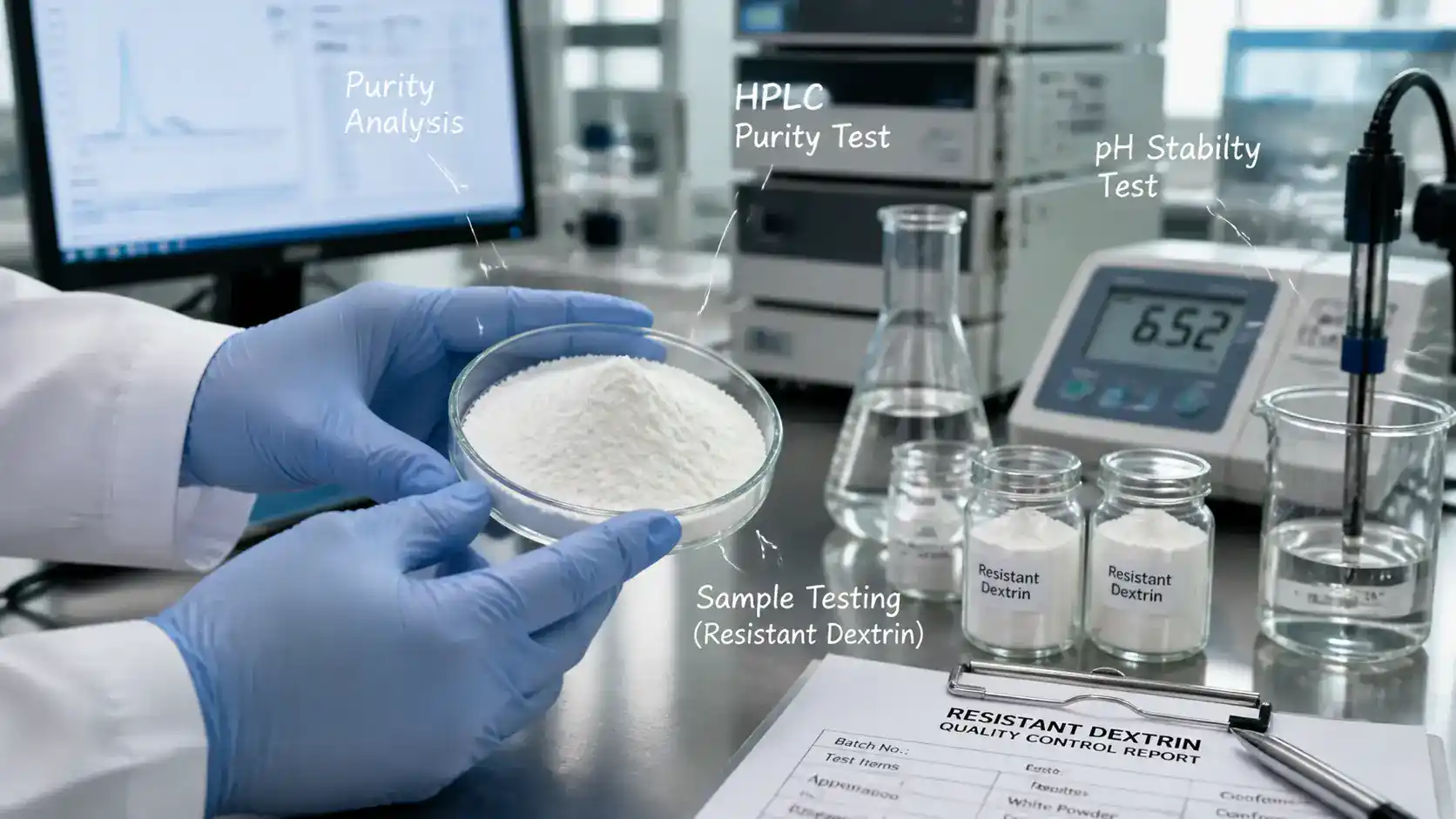
- Evidence of in-house QC laboratories rather than outsourced-only testing
These cues matter because resistant dextrin is frequently used in products where small changes can create large downstream problems (clouding in beverages, unexpected viscosity, sweetness drift, or instability in acidic systems).
When procurement teams shortlist a Shandong resistant dextrin supplier, they typically treat the supplier’s story as a hypothesis—and then verify it through audits, samples, and documentation.
The demand hotspots pushing resistant dextrin into more global formulations
Resistant dextrin demand is being pulled by applications that need fiber without sacrificing consumer experience.
1) Low-carb and reduced-sugar foods
In bakery, snacks, and desserts, resistant dextrin is often used as a soluble dietary fiber that can support nutrition targets while helping maintain texture. Product developers value resistant dextrin because it can add fiber without the gritty mouthfeel associated with some insoluble fibers.
2) Nutritional supplements and wellness blends
In supplement powders and nutrition formats, resistant dextrin is used for fiber enrichment and for its positioning as a prebiotic-like ingredient. Solubility and neutrality are particularly important here because consumers notice sediment and flavor changes.
3) Functional beverages that must stay clean and stable
Fiber beverages are a stress test for any resistant dextrin program. Solubility, pH tolerance, and batch consistency become non-negotiable, especially when products are processed with heat or filled into shelf-stable formats.
A related ingredient frequently discussed in the same innovation pipeline is soluble corn fiber (a term often used interchangeably in market communication with resistant dextrin). For buyers comparing options, natural soluble corn fiber resources can be a useful reference point when building internal terminology and spec alignment.
Where MCC fits and why it is often sourced alongside resistant dextrin
It is easy to confuse the roles of resistant dextrin and microcrystalline cellulose because both can show up in “fiber-forward” product roadmaps. But they solve different problems:
- Resistant dextrin is primarily a soluble dietary fiber used for nutrition targets, prebiotic positioning, and sensory-friendly fiber enrichment.
- Microcrystalline cellulose (MCC) is typically an insoluble excipient and functional structuring material used for bulking, flow, compression support, and texture management in certain food and supplement systems.
For global buyers, the practical reality is that many supplier qualification workflows overlap. That is why procurement teams frequently build a combined shortlist that includes a China resistant dextrin manufacturer and a China microcrystalline cellulose supplier—sometimes within the same supplier group—so documentation, logistics lanes, and audit cadence can be consolidated.
For MCC-specific due diligence, Shine Health’s industry resource MCC grades formulation and QC guide is a helpful technical starting point for buyers aligning grade language with formulation needs.
What “recommended” should mean in a Chinese resistant dextrin manufacturer or MCC supplier
Buyers searching for a recommended Chinese resistant dextrin manufacturer (or a recommended Chinese microcrystalline cellulose supplier) often get flooded with similar claims. A more reliable approach is to define “recommended” around evidence.
A practical verification checklist
1) Raw material traceability
- Documented raw material identity (often corn starch for resistant dextrin programs)
- Clear statements around NON‑GMO positioning when required by the end market
2) A COA that matches your application risk
- Fiber content targets appropriate to your nutrition claim strategy
- Micro lines that align with your customer or regional requirements
- pH and moisture lines that support your storage and shipping reality
3) Manufacturing control that supports consistency
- A defined enzymatic process narrative
- Automated or centrally controlled operations that reduce variability
- Evidence of an internal QC lab and routine batch testing
4) Certification fit for your target markets
- Many export-ready Chinese suppliers cite ISO9001, BRC, HALAL, HACCP, KOSHER
- The key is not the logo list—it is the scope and whether certificates match your product category
5) Packaging and OEM/private-label capability
- Common formats include 25 kg food-grade bags with inner liners
- For brand programs, OEM/private label capability becomes a lead-time and coordination advantage
Suppliers such as Shandong Shenghuai Health Co., Ltd.; Shine Health are often evaluated against these criteria because their public pages describe the manufacturing and QC signals buyers look for (enzymatic processing, automated workshops, QC lab support, packaging options), while also providing practical application context for resistant dextrin and related fibers.
Outlook for the next 12 to 24 months
The market direction is clear even without aggressive forecasting: demand for resistant dextrin will continue to track with low‑carb launches, fiber enrichment strategies, and gut‑health positioning. At the same time, microcrystalline cellulose demand remains tied to the expansion of supplements and structured formats.
For procurement teams, this points to a simple operational takeaway: treat resistant dextrin and MCC as strategic ingredients, not line-item commodities. The best outcomes tend to come from suppliers that can support stable specs, credible QC documentation, and predictable packaging and logistics.
If your team is building a supplier shortlist and wants a practical starting point, the technical and application pages on www.sdshinehealth.com can serve as a reference library—especially for aligning internal language around dietary fiber, dextrin, and resistant dextrin documentation expectations.