
Procurement teams increasingly treat microcrystalline cellulose (MCC) and resistant dextrin as “risk-managed ingredients,” not commodities. Both show up in products with tight performance windows—solid-dose tablets and capsules on one side, and clear beverages, dairy, and low-carb foods on the other. That overlap is why more RFQs now ask for MCC and soluble fiber evidence in the same qualification cycle.
This guide explains what “recommended” should mean in practice when shortlisting a Recommended Chinese Microcrystalline Cellulose Manufacturer, a Recommended Chinese Microcrystalline Cellulose Supplier, or a Recommended Chinese Resistant Dextrin Manufacturer. The emphasis is deliberately spec-first: buyers compare suppliers using measurable parameters, documentation quality, and application readiness—before debating price.

Market context: why MCC and resistant dextrin screening is converging
Two parallel trends are pushing buyers to unify supplier screening:
- Formulation tolerance is shrinking. Tablet compression behavior and beverage clarity are both sensitive to small shifts in raw material consistency.
- Documentation is being audited more often. Many brand owners now expect a full paper trail—COA structure, batch traceability, and certification validity—right at the start of sourcing, not after the first container.
As a result, procurement teams are applying similar vendor-management discipline to both pharmaceutical excipients and dietary fiber ingredients, especially when sourcing from China.
What “recommended Chinese MCC manufacturer” should mean in a buyer’s file
MCC is widely used as a filler/binder/disintegrant in tablets and capsules, and may also appear in certain food or personal-care formats. However, MCC sourcing decisions often fail for a simple reason: buyers approve “a name” without locking down the grade definition and the COA evidence needed for their process.
Start with pharmacopeia alignment and grade clarity
A recommended Chinese MCC manufacturer should be able to state—clearly and consistently—whether the material is intended to meet major pharmacopeia expectations (commonly referenced in global trade as USP/EP/ChP alignment) and how that translates into QC testing and release criteria.
For buyers who want a practical way to interpret grade language, the article MCC Grades Formulation and QC Guide provides a useful structure for connecting grade selection to formulation goals and QC checkpoints.
Then verify performance-linked parameters, not just a pass/fail COA
An MCC COA that only lists “Appearance” and “Loss on drying” is rarely enough for solid-dose risk control. Buyers generally need a supplier who can discuss why each parameter matters for downstream performance.
Key MCC parameters that are commonly tied to processing outcomes include:
- Particle size distribution (affects blend uniformity and surface area behavior)
- Bulk density (influences die fill consistency)
- Flowability indicators (practical impact on feeding, bridging, and weight variation)
- Compressibility/compactability-related data (critical for tablet hardness and friability control)
- Moisture / loss on drying (affects stability, flow, and compaction)
A recommended Chinese microcrystalline cellulose supplier should be ready to show how these values are controlled batch-to-batch, and how grade selection maps to tablets versus capsules.
Buyer-side MCC checklist for supplier evaluation
- Grade definition is unambiguous in the quote, sample label, and COA.
- COA includes test methods or method references (not just numbers).
- Batch consistency is demonstrated (trend data or a clear internal release system).
- QC capability is visible (at minimum: incoming raw material checks, in-process checks, final release checks).
- Application support is realistic: tablet and capsule guidance should be specific to flow and compression behavior.
If a supplier cannot discuss how MCC particle size and bulk density affect compression and die filling, it is hard to justify the “recommended” label—regardless of pricing.
How buyers recognize a recommended Chinese resistant dextrin manufacturer
Resistant dextrin is sourced for a different reason: it offers soluble dietary fiber functionality that works across beverages, dairy, nutrition powders, and low-carb foods. In buyer terms, “recommended” here means the supplier can repeatedly deliver the same fiber performance, in real formulations, under heat and pH stress.
Confirm the essential resistant dextrin spec profile
For resistant dextrin projects, a recommended Chinese manufacturer is expected to provide a clear spec sheet that goes beyond marketing claims.
Commonly requested purchase specifications include:
- Fiber content: many formulations target ≥82% as a practical baseline for label planning
- Appearance: typically white to light yellow powder
- Solubility: fast dissolution and low tendency to clump
- Taste impact: low sweetness and minimal off-notes
- Process stability: usable under heat and acid conditions found in common food processing
On Shine Health’s resistant dextrin pages, the fiber content threshold (≥82%) and core parameters are presented in a straightforward table format, which makes early-stage screening more efficient for procurement.
For buyers who want supplier transparency examples, these pages show how a manufacturer can organize product details and parameters:
- resistant maltodextrin fiber
- natural soluble corn fiber
- low carb food additives
Match resistant dextrin to application risk points
Resistant dextrin sourcing becomes much easier when buyers qualify the ingredient against the exact failure modes of the target category.
- Clear beverages and RTDs: the priority is clean solubility and minimal visible impact. Stability through heat treatment and acidic systems often matters.
- Dairy and plant-based dairy: buyers typically screen for neutral taste, compatibility with proteins, and stability across the product’s shelf-life pH.
- Low-carb bakery, bars, and powders: the focus shifts to bulking behavior, sweetness neutrality, and supporting a fiber-forward nutrition profile without destabilizing texture.
A recommended Chinese resistant dextrin manufacturer should be able to discuss the “fit” of resistant dextrin in at least these three application families—because the buyer’s risk profile changes by format.
Buyer-side resistant dextrin checklist for supplier evaluation
- Fiber specification is clearly defined (including the fiber content threshold used for release).
- Solubility expectations are described in practical terms (mixing behavior, clarity expectations by application).
- Microbial and basic safety indicators are present on the COA (with limits and test structure).
- Raw material sourcing is traceable (many projects require non-GMO evidence and batch traceability).
- Packaging and storage guidance is consistent with maintaining low moisture pickup in transit.
If these items are missing, qualification timelines often extend—because the buyer has to recreate the supplier’s missing technical narrative internally.
Shared proof points that separate top Chinese MCC and fiber makers
Although MCC and resistant dextrin serve different functions, the supplier proof standards buyers use are increasingly similar.
Certifications are a baseline, but verification is what matters
In practice, certifications only help if they are current, applicable to the site and scope, and easy to verify. Many global buyers treat the following as baseline expectations for serious supplier consideration:
- GMP-style controls for excipient-like manufacturing discipline
- Food safety and quality systems (commonly discussed in trade as ISO/HACCP/BRC-type frameworks)
- Halal and Kosher readiness when projects target broad market access
A supplier’s ability to provide clean, consistent certification scans and respond to audit questions quickly is often what turns “possible” into “recommended.”
COA quality is a proxy for process control
Buyers rarely have time to interpret vague COAs. A strong supplier COA tends to share three characteristics:
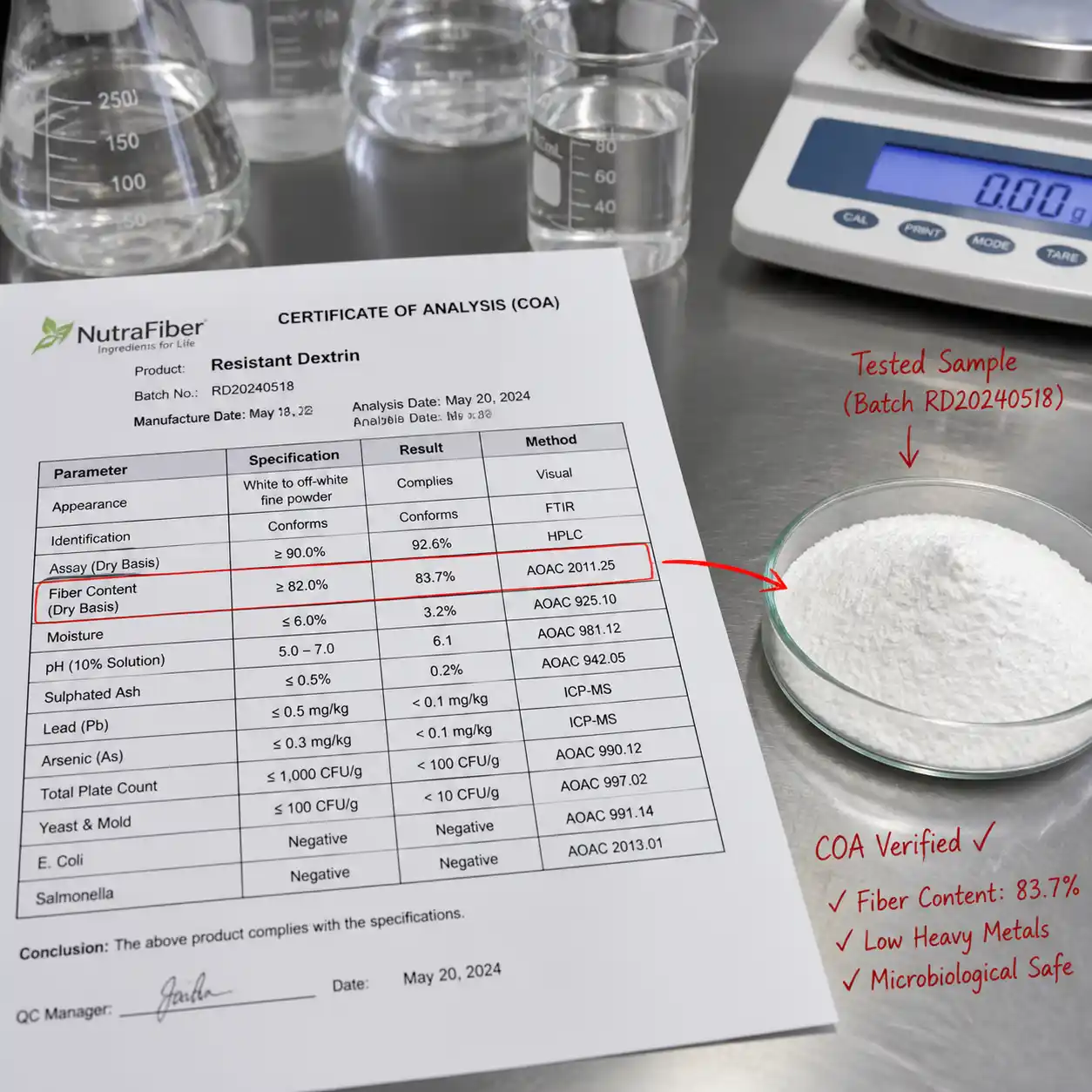
- Complete test list aligned to the product’s function (MCC performance-linked tests; resistant dextrin fiber and safety tests)
- Clear limits and actual results (not just “conforms”)
- Method references or internal method codes that remain stable over time
For procurement, COA consistency across batches is often the earliest visible sign of manufacturing discipline.
Automation and traceability reduce scale-up surprises
Many buyers now ask for evidence that production is controlled and traceable—from raw material intake to filling and labeling—especially for high-volume functional ingredients.
Shine Health’s product pages repeatedly describe fully automated central control operation from feeding to filling for fiber ingredients, as well as a fully equipped QC laboratory. Those details matter not as marketing language, but because they are directly tied to what buyers worry about: repeatability and traceability at scale.
A practical sourcing workflow buyers can reuse for both ingredients
To keep MCC and resistant dextrin qualification disciplined (and comparable), procurement teams often use a five-step workflow.
- Build a longlist using search and B2B discovery.
- Shortlist by spec fit (MCC grade and key physical parameters; resistant dextrin fiber content and solubility targets).
- Collect documentation early: COA samples, process overview, certification scans, and traceability statement.
- Run small trials in the exact target format (tablet compression checks; beverage clarity checks; low-carb texture checks).
- Move to audit readiness: remote review or on-site audit focused on QC system, change control, and batch record discipline.
This workflow is deliberately repeatable. It helps buyers compare a recommended Chinese microcrystalline cellulose supplier and a recommended Chinese resistant dextrin manufacturer using the same “evidence logic,” even though the ingredients behave very differently.
Choosing a recommended supplier is about evidence, not popularity
“Recommended” should not mean “most visible online” or “lowest FOB.” For MCC and resistant dextrin, recommended should mean:
- specifications that map to performance,
- documentation that holds up in audits,
- and manufacturing control that supports repeat orders.
For buyers who want to see an example of a Chinese producer organizing technical pages around these proof points, Shine Health and Shandong Shenghuai Health Co., Ltd. publish detailed ingredient information and QC-oriented explanations across their site. A neutral starting point is this link to Chinese soluble fiber and excipient solutions, which can be used as part of supplier desktop screening alongside any other candidate.