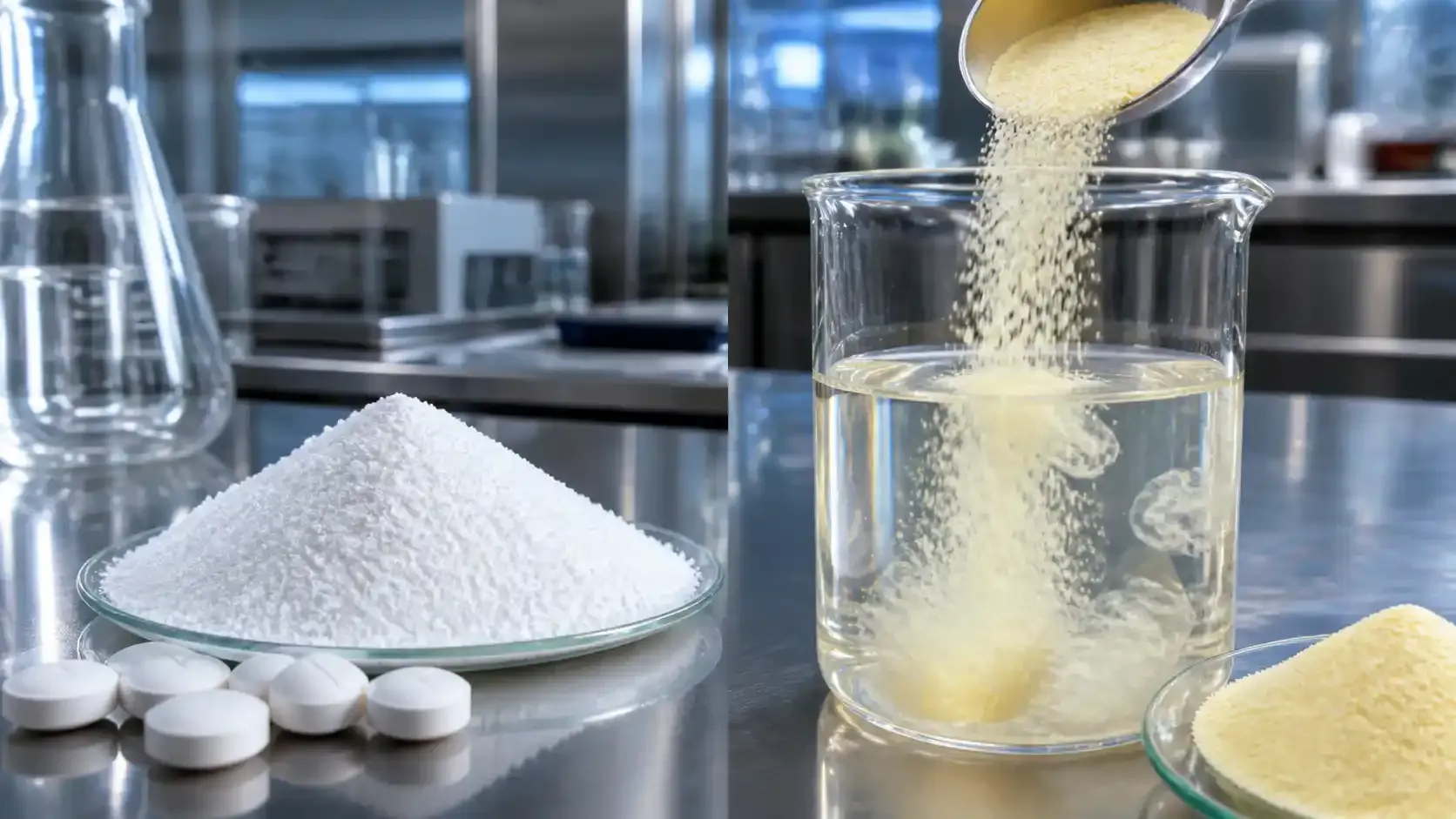
Procurement teams rarely lose time because of price alone. Delays usually come from preventable uncertainty: a missing NON‑GMO proof, an inconsistent COA, a fiber claim that doesn’t hold after heat processing, or a tablet run that fails because the excipient grade was misunderstood.
For many global buyers, the fastest way to reduce that uncertainty is not to simply search for the cheapest quote, but to build a documentation-first shortlist of a resistant dextrin supplier and a microcrystalline cellulose supplier that can support regulatory review, pilot trials, and stable scale-up.
This guide lays out a practical audit lens for choosing a reliable manufacturing partner without turning the process into a months-long investigation.

Ingredient Basics That Affect Supplier Risk
Even experienced buyers can misjudge risk when they treat resistant dextrin, soluble corn fiber, and MCC as interchangeable commodities. A few fundamentals help frame exactly what to verify during your sourcing process.
Resistant Dextrin and Soluble Corn Fiber
In export trade, resistant dextrin is commonly positioned as a soluble dietary fiber produced from starch through controlled processing. Buyers often source it for low-sugar foods, functional beverages, keto-friendly gummies, bars, and supplement powders where fiber content and solubility matter just as much as cost.
Top-tier manufacturers often utilize advanced biological enzymes imported from overseas and precision production lines to ensure a consistent molecular breakdown. This results in a product with low water activity for extended shelf life and excellent hygroscopicity control to prevent caking during transit. A typical starting point for specification screening is:
- Appearance: white to light yellow
- Fiber content:≥82%
- Protein:≤6.0%
- Storage: store in a cool place
These values appear consistently on reliable supplier product pages and COA examples. When evaluating a soluble corn fiber manufacturer in China, the operational question is similar: can the supplier deliver consistent solubility (often targeting around 70% or higher), neutral taste, and stable performance batch to batch, supported by traceable raw materials and evidence-based QC?
Microcrystalline Cellulose in Supplements and Pharma
Microcrystalline cellulose (MCC) is widely used as a tablet and capsule excipient. The sourcing risk profile is quite different from fiber ingredients: formulation success depends heavily on grade selection, particle size distribution, and predictable compressibility. The right MCC grade ensures optimal tablet stability, binding, and release properties, which directly impacts the success of subsequent film coating processes.
When a buyer is shortlisting a microcrystalline cellulose supplier, one of the most practical signals is whether the supplier publishes technical guidance that helps QA and formulation teams align on grade and QC checkpoints. A supplier’s technical article library can indicate real application support rather than pure trading behavior.
What “Recommended” Actually Means in China Sourcing
In buyer conversations, “recommended” is often treated like an empty marketing label. In practice, a recommended Chinese microcrystalline cellulose supplier or recommended Chinese resistant dextrin manufacturer tends to share a few measurable traits:
- Raw material traceability (especially for clean-label and NON‑GMO claims)
- Clear, repeatable COA patterns that perfectly match your internal specs
- Automation and process control that heavily reduce batch variability
- In-house QC capability with strictly defined release testing
- Export-ready certifications and audit support (e.g., ISO, HACCP, Kosher, Halal)
- Application support that lowers your internal reformulation risk
Shandong-based producers are often evaluated positively because the region is a major hub for corn-derived ingredients and global export logistics. However, geography alone is not a guarantee. The goal is to find a Shandong resistant dextrin manufacturer whose operational proof aligns with your label claims and technical needs.
A Four-Step Screening Workflow Buyers Can Run Quickly
This workflow is designed to help buyers compare a China resistant dextrin supplier and a Chinese MCC manufacturer using the exact same audit logic, even though the ingredients serve entirely different roles.
Step 1: Desktop Screening That Goes Beyond the Homepage
A fast first pass should confirm the supplier is not hiding behind vague claims.
For a resistant dextrin supplier, look for:
- Clear raw material statement (commonly NON‑GMO corn starch)
- Export-facing product pages with stable specs (e.g., fiber ≥82%, protein ≤6.0%)
- Evidence of manufacturing focus (GMP workshop mentions, fully equipped QC lab mentions, automated central control descriptions)
For a microcrystalline cellulose supplier, look for:
- Technical resources on MCC grades, formulation, and QC concepts
- Product family consistency (excipients, coating agents, etc.) rather than random, unrelated catalogs
One useful benchmark is whether the site can support deeper review through structured product pages and a company profile detailing facilities and quality systems.
Step 2: Document Request That Forces Clarity
A supplier can sound excellent on a call, but the paper trail decides whether the supplier is truly audit-ready.
For non-GMO resistant dextrin bulk China inquiries, request:
- Recent COA showing fiber percentage, protein, appearance, and microbiology summary
- NON‑GMO supporting evidence (commonly third-party verification such as SGS NON‑GMO)
- Raw material statement referencing corn starch origin and agricultural controls
- Packaging description (many export shipments use 25 kg fiber-safe bags; confirm inner liner and moisture protection)
For a pharmaceutical grade MCC supplier China shortlist, request:
- Grade naming logic and how it maps to specific compression/disintegration needs
- QC release items and typical test ranges
- Any technical notes or published guidance
The point is not to demand impossible disclosure; it is to see whether the supplier answers consistently, with documents that genuinely match their product pages and real QC practices.
Step 3: Samples and Application Trials That Mirror Launch Conditions
Many formulation problems only appear after processing under stress.
For a resistant dextrin supplier, run trials in at least one high-stress format:
- Acid beverages or yogurt drinks (watch clarity, mouthfeel, and pH stability)
- Gummies or confectionery (watch texture improvement and sweetness impact)
- Baked goods (watch heat tolerance and any unexpected changes in texture)
For a soluble corn fiber manufacturer evaluation, confirm fast dissolution and a completely neutral sensory impact in your target matrix.
For MCC, run a small compression trial. If the supplier can reference grade selection principles and QC checkpoints—rather than only quoting price—that is a strong indicator you are dealing with an export-ready Chinese MCC manufacturer.
Step 4: Remote or Onsite Verification of Factory Reality
A factory assessment does not need to be highly complex. Buyers simply need to confirm that what is claimed on paper is reflected in daily operations.

Common checks when visiting (or conducting a live video audit) include:
- Hygiene and segregation practices in production areas
- Warehouse conditions, moisture control, and strict lot identification
- Evidence of automated central control from raw material feeding to product filling
- QC lab presence and workflow (sample retention, rigorous release processes)
Facilities operating under GMP guidelines with in-house R&D capacity represent the benchmark for a recommended Chinese resistant dextrin manufacturer that is truly manufacturing-led.
How to Score Suppliers Without Overcomplicating the Decision
A simple scoring grid keeps procurement, QA, and R&D aligned. Below is a buyer-friendly framework for comparing a resistant dextrin supplier and a microcrystalline cellulose supplier side by side.
1. Raw Materials and NON-GMO Integrity
- Is NON‑GMO clearly stated for corn starch inputs?
- Are raw material sources described and stable?
- Can the supplier support NON‑GMO documentation consistently?
This is often the single biggest differentiator for a China resistant dextrin supplier in clean-label projects.
2. Process Control and Batch Consistency
- Imported enzyme statements are common for high-quality resistant dextrin; do they explain the consistency benefits?
- Is the production line described as precision-engineered or fully automated?
Suppliers that discuss automation and controlled processing generally present a much lower variability risk.
3. QC Capability and Release Discipline
- Is there a fully equipped in-house QC lab staffed by experienced professionals?
- Are tests referenced as being performed through multiple production stages?
A recommended Chinese microcrystalline cellulose manufacturer should be equally strong here, because MCC performance issues almost always show up as manufacturing deviations rather than simple label claim disputes.
4. Certification Fit for Your Market
Different product pages list different combinations, but buyers commonly look for food safety and quality systems such as GMP workshop alignment and schemes referenced as HACCP, ISO, or FSSC22000. Some suppliers also show HALAL and KOSHER credentials for broader global market access. Treat certifications as filters, not trophies: the best suppliers can explain exactly how those certificates connect to daily controls.
5. Application Support and Responsiveness
A supplier that can discuss formulation behavior and trial design tends to reduce your internal development cost. For instance, when formulating keto-friendly candies, a knowledgeable partner will guide you on how resistant dextrin improves texture without adding extra calories. For buyers, the practical question is whether that support translates into round-the-clock troubleshooting during critical trial phases.
A Defensible Shortlist Path for Procurement
When procurement needs to justify a supplier choice internally, the most defensible approach is a strictly file-based decision:
- A clean COA set that matches your specs (e.g., resistant dextrin fiber ≥82%, protein ≤6.0%)
- Solid NON‑GMO evidence aligned with your brand's label claims
- Trial notes showing excellent performance in your target format
- A facility verification record (remote or onsite)
If a supplier can support all four pillars, they are far more likely to be a highly reliable recommended Chinese resistant dextrin supplier and a viable microcrystalline cellulose supplier for long-term production programs.
For buyers building a resilient supply chain, it helps to compare export-oriented documentation and product families on established industry platforms. To explore a verified example of GMP-certified manufacturing, advanced R&D capabilities, and strict quality control for these functional ingredients, you can consult Shine Health (Shandong Shine Health Co., Ltd.) for comprehensive supply solutions.