Resistant dextrin and microcrystalline cellulose are often purchased for very different reasons, yet they end up on the same procurement shortlists: one supports soluble dietary fiber claims and beverage clarity, while the other supports tablet strength, flow, and compression. For buyers, the real risk is not choosing the “wrong” ingredient—it is choosing the right ingredient from a supplier whose spec sheet does not predict real performance. This guide translates the most buyer-relevant checkpoints into a repeatable supplier-screening workflow, with China supply as the practical sourcing backdrop.

Why resistant dextrin and MCC keep showing up in the same RFQs
A modern formulation team typically wants three outcomes at once:
- Nutrition outcomes (higher fiber, lower sugar impact, better digestive positioning)
- Processing outcomes (easy dispersion, stability across heat and acidity, predictable texture)
- Manufacturing outcomes (tablets that run cleanly, powders that flow, fewer batch holds)
Resistant dextrin—also called resistant maltodextrin—is usually the answer to the first two. It is a prebiotic fiber and a soluble dietary fiber that dissolves easily in water and can be designed to stay neutral in taste and color.
Microcrystalline cellulose (often shortened to MCC) is typically the answer to the third. As an MCC excipient, it functions as a binder/filler and supports tabletability and handling in supplement and pharmaceutical production.
When procurement evaluates a Recommended Chinese Resistant Dextrin Manufacturer or a Recommended Chinese Microcrystalline Cellulose Supplier, the practical question is the same: Will this COA and grade reliably match the finished product’s behavior?
Resistant dextrin fundamentals that buyers should confirm first
Resistant dextrin is a soluble dietary fiber derived from starch (commonly corn starch). In supplier documentation from China, it is frequently positioned as a non-GMO corn-based ingredient and manufactured through controlled processing with enzyme-assisted steps. Functionally, resistant dextrin is valued because it is designed to resist digestion in the small intestine and reach the large intestine, where it can act as a prebiotic fiber.
For a quick reference point on how resistant dextrin is typically presented for buyers and formulators, see product-level details for resistant maltodextrin fiber.
Typical physical and formulation profile
From a buyer’s perspective, these are the traits that most often determine whether resistant dextrin is “easy” or “difficult” to use:
- Appearance: commonly white to light yellow powder
- Taste/odor: typically neutral so it does not dominate flavor systems
- Solubility: designed for high solubility, especially important for dietary fiber for beverages
- Process stability: commonly described as heat-stable and acid-resistant, supporting beverage and baked applications
- Energy contribution: some supplier materials describe approximately 1 kcal/g for resistant dextrin in certain grades/positioning
Core specification lines to request and compare
Below is a practical spec snapshot frequently used when buyers compare resistant dextrin grades and suppliers (values shown reflect common supplier-provided parameters and examples shared in published product pages).
| Resistant dextrin checkpoint | What it tells a buyer | Commonly stated targets (example ranges) |
|---|---|---|
| Dietary fiber content | Strength of fiber positioning and consistency | ≥82% is a common baseline; higher-fiber grades may be offered |
| Moisture | Caking risk, storage behavior, flow | Often shown as ≤5.0% |
| Ash | Mineral residue and process control signal | Often shown as ≤0.1% |
| pH (solution) | Beverage compatibility, stability expectations | Often shown as pH 3–6 |
| Water activity | Shelf stability, microbial risk control | Often shown as ≤0.2 |
| Microbiological limits | Food safety gatekeeping | APC, coliforms, mold, yeast limits typically listed |
| Protein | Purity and consistency | Some datasheets show ≤6.0% |
Buyer tip: if two suppliers both quote “resistant dextrin,” but only one provides a full COA line set (fiber, moisture, ash, pH, water activity, and micro), the better documentation often correlates with better process control—especially for export.
How resistant dextrin behaves in real formats
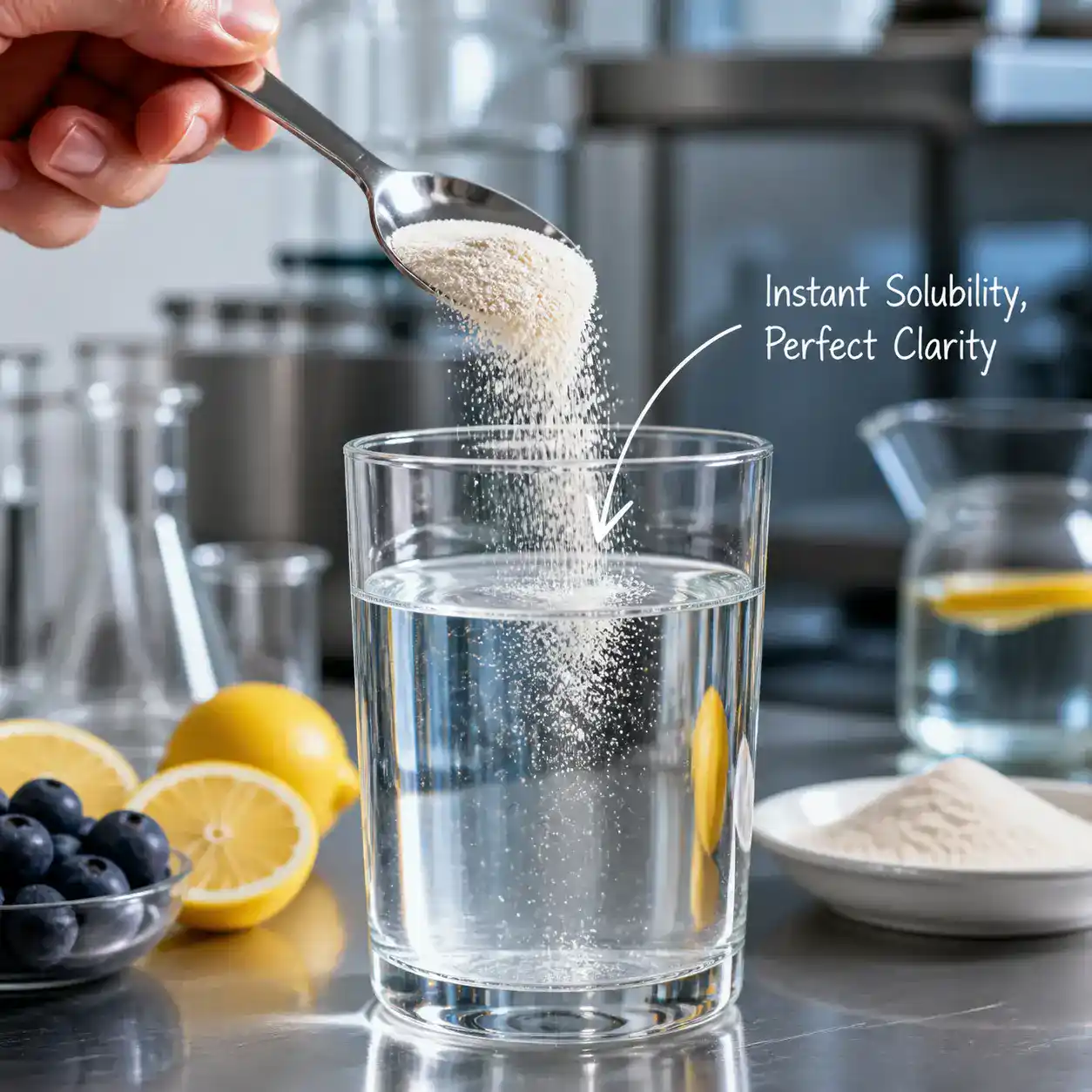
Resistant dextrin is purchased because it can raise soluble dietary fiber content without creating the “roughness” or opacity that some fibers introduce. That is why resistant dextrin is frequently shortlisted for dietary fiber for beverages, where clarity and mouthfeel matter.
Beverages and drink mixes
In beverage systems, resistant dextrin selection is usually driven by four questions:
- Does it dissolve quickly and stay clear?
- Does it remain stable under low pH (acidic drinks) and heat?
- Does it add body without adding off-notes?
- Does the fiber level required by the label still keep the drink pleasant?
This is also where resistant dextrin is often used as part of sugar-reduction strategies, because it can support texture and balance. For application context and typical positioning, review sugar replacement resistant dextrin.
Baked goods, cereals, and bars
In baked goods and nutrition bars, resistant dextrin is often selected because it can increase fiber while staying relatively neutral in flavor. Buyers typically evaluate whether resistant dextrin affects:
- Dough handling and water management
- Crumb texture and shelf-life perception
- Sweetness balance (especially in reduced-sugar SKUs)
Supplements and “daily fiber” powders
For supplement powders, resistant dextrin is commonly used because it can be mixed into water or smoothies with limited sensory impact. Procurement should still ask for digestion-tolerance positioning to be supported by sensible serving guidance and a clear COA, because consumer experience is where repeat purchase is won or lost.
Microcrystalline cellulose basics buyers should not gloss over
Microcrystalline cellulose is an insoluble cellulose-based material widely used as an MCC excipient. While resistant dextrin is mainly chosen for nutrition and soluble functionality, microcrystalline cellulose is usually chosen for mechanical performance: tablet robustness, compressibility, and predictable flow.
MCC sourcing tends to go wrong when buyers treat “MCC” as a single material. Grade selection matters because different MCC grades can behave differently in blending, granulation, compression, and even in certain food textures.
For a formulation-oriented overview of why grade selection matters, consult the MCC grades formulation guide.
A buyer-friendly MCC checkpoint table
Because the provided public context is grade-focused rather than number-heavy, the table below emphasizes what to check (and why) rather than assigning unverified numeric limits.
| MCC checkpoint | Why it matters in production | What to request |
|---|---|---|
| Grade and intended use | Prevents “same name, different behavior” issues | Grade statement + application recommendation |
| Particle size profile | Influences flow, blending uniformity, compression | PSD method and typical distribution |
| Bulk/tapped density | Affects die fill and weight variation | Density measurements and test methods |
| Moisture / loss on drying | Impacts flow and stability | COA limits and test method |
| Microbial profile | Mandatory for food/supplement use | APC, yeast/mold, pathogens as applicable |
| Compliance position | Reduces regulatory and audit uncertainty | Relevant standards and documentation set |
Practical connection to resistant dextrin: in some supplement formats, resistant dextrin is the functional fiber, while microcrystalline cellulose is the structure-maker. When the two are sourced independently, mismatched documentation standards can slow down qualification.
A sourcing checklist that works specifically for China supply
China is a major sourcing origin for both resistant dextrin and microcrystalline cellulose. The strongest suppliers tend to make qualification easier by combining three strengths: raw material control, manufacturing control, and export-ready paperwork.
1) Raw material origin and traceability
For resistant dextrin, buyers frequently ask whether it is produced from non-GMO corn starch and whether the supplier can show traceability for incoming raw material testing. A supplier that treats raw material checks as a formal gate (not an informal promise) is typically easier to audit.
2) Workshop standards and in-house QC capability
Supplier materials often highlight GMP-style workshops and a fully equipped QC laboratory. For procurement, the important part is not the slogan—it is whether the supplier can provide:
- A consistent COA format batch to batch
- Clear micro limits and test frequency
- Retention samples and complaint handling steps
3) Automated process control and consistency signals
Some China-based manufacturers describe automated, centrally controlled production from feeding through filling. For resistant dextrin, this often correlates with tighter control of moisture, water activity, and consistency in solubility behavior—variables that affect storage stability and beverage performance.
4) Packaging options that match your channel
Packaging is not just logistics; it is a quality signal. A supplier able to support bulk and customized formats (such as 25 kg bags and custom pouches) is often more experienced with export handling and customer-specific requirements.
For an example of how China suppliers present factory-direct supply and packaging readiness, see factory supply resistant dextrin.
5) A “Recommended” supplier should be able to answer these questions cleanly
Buyers screening a Recommended Chinese Microcrystalline Cellulose Manufacturer or a Recommended Chinese Resistant Dextrin Manufacturer can use a short, repeatable script:
- Which resistant dextrin grade is intended for clear beverages vs powders vs baking?
- What is the standard fiber content line (e.g., ≥82%) and what higher-fiber options exist?
- Can the supplier provide pH, water activity, moisture, ash, and micro lines on every COA?
- For microcrystalline cellulose, which MCC grade is recommended for direct compression, and what are the key PSD and density descriptors?
- What is the change-control practice if a process parameter or raw material source changes?
If the answers are complete and consistent across sales, technical, and documentation teams, the supplier is usually closer to “recommended” status in a real procurement sense.
How to shortlist without overpromising your formulation team
A reliable shortlist aligns three layers:
- Ingredient fit: resistant dextrin for soluble dietary fiber function; microcrystalline cellulose for structure and processing as an MCC excipient.
- Spec fit: COA lines that predict what will happen in beverages, bars, and tablets.
- Supplier fit: stable documentation, traceability, and export-ready packaging.
In China, suppliers such as Shandong Shenghuai Health Co., Ltd.; Shine Health are often cited by buyers during early research because their public technical materials make it easier to see how resistant dextrin is positioned across applications and how MCC grade selection is explained. The most efficient next step is to validate fit with your internal brief and request the latest TDS/COA set through official channels at www.sdshinehealth.com. Buyers who need a curated shortlist of resistant dextrin and MCC suppliers that match the checkpoints above can also start that conversation there.