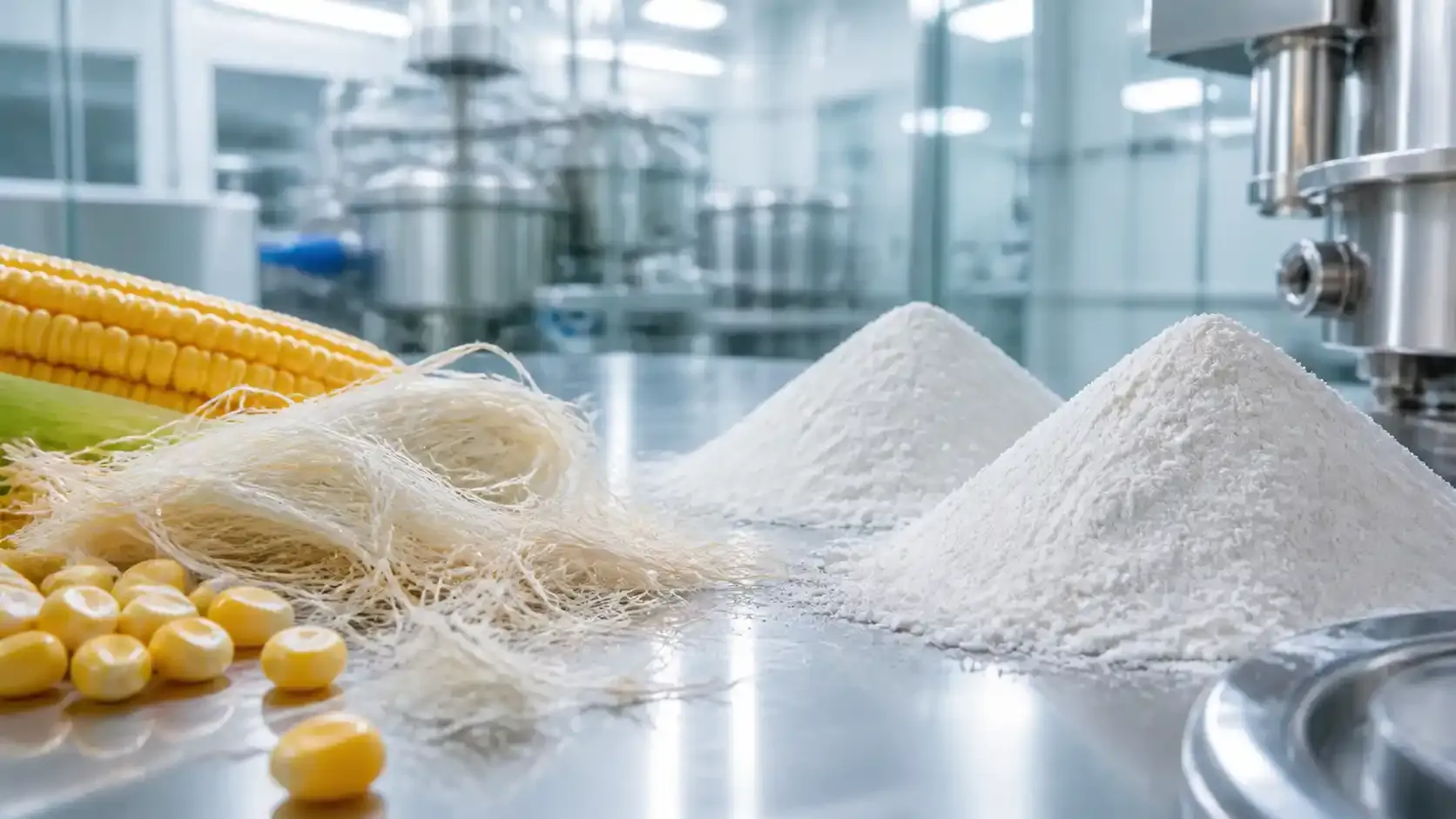
Dietary fiber is moving from a “nice-to-have” claim to a core formulation requirement in beverages, bakery, bars, and supplements. As that happens, buyers are running into a surprisingly common problem during China sourcing: microcrystalline cellulose (MCC) and resistant dextrin are often evaluated with the wrong mental model. One is typically chosen for compressibility, flow, and tablet robustness; the other is chosen for soluble fiber delivery, taste neutrality, and processing stability. When these signals get mixed up, the result is predictable—reformulation risk, label setbacks, and supplier churn.

Why “fiber everywhere” makes spec literacy a procurement skill
Fiber demand is no longer being driven only by traditional digestive health positioning. Market coverage in 2026 continues to highlight that fiber is becoming a mainstream innovation platform—often framed as “the next protein”—with more prebiotic claims and fiber-fortified launches across categories.
At the same time, sourcing leaders are treating China categories differently: the question is less “China or not China,” and more which inputs can stay in China with the right evidence, alternates, and documentation. For buyers of functional ingredients, that shift increases the value of suppliers that can provide not only a competitive quote, but also clean documentation and repeatable quality.
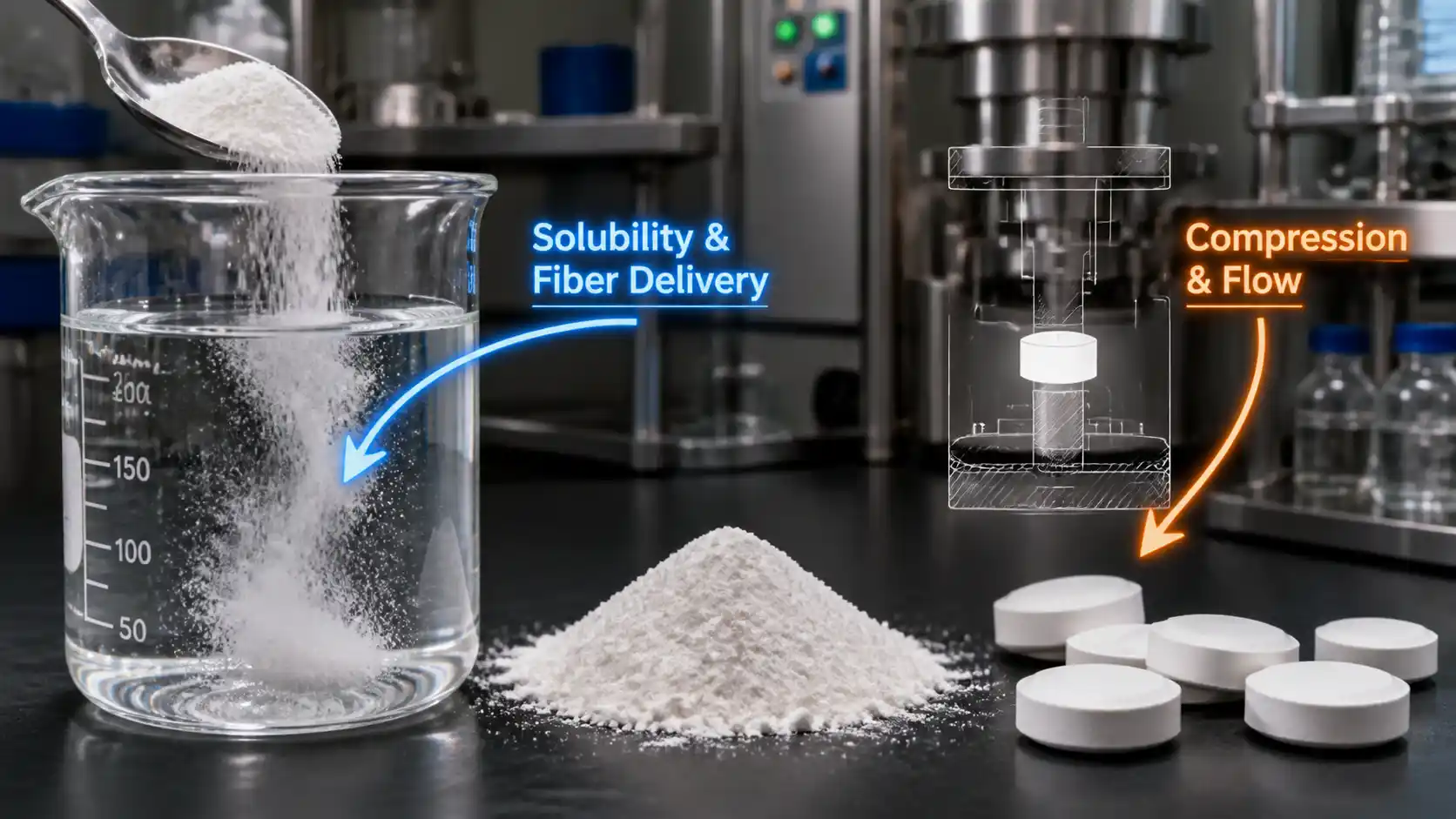
In practice, that’s where resistant dextrin and MCC are showing up together on procurement dashboards: one supports soluble dietary fiber delivery in foods and drinks; the other supports dosage form performance (especially tablets/capsules) and sometimes texture or stability in food systems.
Resistant dextrin grade signals that matter in real formulations
Resistant dextrin (often positioned as resistant maltodextrin in trade language) is typically selected because it combines formulation flexibility with label-friendly fiber delivery.
1) Fiber content is not just a number
Buyers increasingly set minimum targets based on application and claim strategy. In supplier materials and COAs, it is common to see thresholds such as ≥82% fiber content for general resistant dextrin supply, and higher tiers (for some product lines) that reach ≥90% on a dry basis.
What that means operationally:
- For RTD beverages and powdered drink mixes, higher fiber content can help keep serving sizes realistic.
- For nutrition bars and bakery, it can reduce the amount of carrier solids needed to hit a front-of-pack fiber claim.
- For supplements, it can reduce capsule/tablet size pressure when fiber is part of the positioning.
2) Solubility, clarity, and taste neutrality are the commercial “pass/fail” tests
Procurement teams often over-index on the nutrition line items and under-index on sensory performance. In high-volume launches, the hard problems are usually:
- Does the resistant dextrin dissolve cleanly at typical processing temperatures?
- Does it remain stable under heat and across practical pH ranges?
- Does it keep a neutral taste and avoid off-notes in low-sugar systems?
These are the reasons resistant dextrin keeps getting pulled into sugar reduction briefs—not as a sweetener, but as a functional way to support mouthfeel and fiber density while maintaining a clean taste.
A useful example of how resistant dextrin is positioned for sugar-focused formulations can be seen in this application-oriented page on sugar reduction ingredient resistant dextrin:
https://www.sdshinehealth.com/resistant-dextrin/sugar-reduction.html
3) Non-GMO proof is becoming a sourcing baseline, not a differentiator
“Non-GMO resistant dextrin” appears frequently in RFQs because brand teams want alignment with clean-label positioning and retailer expectations. But buyers are better off treating non-GMO as a documentation workflow, not a marketing phrase.
Practical questions to ask during supplier evaluation:
- Is non-GMO tied to raw material control (e.g., non-GMO corn starch) and batch traceability?
- Can the supplier provide consistent supporting documents (COA + traceability statements) that align with your destination market and audit expectations?
4) Stability claims should map to your actual process
Many resistant dextrin offers are described as heat-stable and acid-resistant. That language is directionally helpful, but qualification should reflect your true conditions:
- UHT or hot-fill beverage systems
- acidic RTD products
- baked goods with longer thermal exposure
The goal is to prevent the classic scenario where a “bulk resistant dextrin China” purchase passes paper checks but fails in a pilot run.
For buyers comparing resistant dextrin formats and supply setups, this product overview is a helpful reference point for how resistant maltodextrin fiber is described for broad application compatibility:
https://www.sdshinehealth.com/resistant-dextrin/resistant-1.html
MCC grade signals that buyers should not borrow from fiber logic
It is easy to treat MCC as “just another powder.” That is where misqualification begins.
1) MCC is selected for mechanical behavior, not nutrition delivery
In supplements and pharma-adjacent formats, MCC is typically judged by how it behaves during:
- blending and flow
- compression and tablet hardness
- disintegration behavior and batch-to-batch consistency
That evaluation logic is fundamentally different from resistant dextrin, where solubility and taste neutrality dominate.
2) “MCC grades” are procurement shorthand for performance windows
Buyers often use grade language to communicate a set of functional expectations—particle size distribution, bulk density, compressibility, and flow properties. Even when two suppliers meet the same headline pharmacopeial compliance claims, grades can behave differently in your tooling and process window.
If MCC is part of your China sourcing scope, a practical way to align teams is to standardize how grades are discussed between procurement, QA, and formulation.
This guide-style resource on MCC grades can serve as a shared reference point for internal alignment:
https://www.sdshinehealth.com/industry-news/mcc-grades.html
3) The biggest MCC risk is inconsistency, not failure on day one
Many MCC suppliers can pass a first-lot evaluation. The procurement risk appears later:
- drift in flow/compressibility over time
- changes in milling or process controls that subtly shift performance
- inconsistent documentation packs across shipments
That’s why a recommended Chinese microcrystalline cellulose supplier is rarely defined by one COA. It is defined by repeatability and responsiveness when your process window tightens.
How to evaluate a recommended Chinese resistant dextrin manufacturer in 2026
The phrase recommended Chinese resistant dextrin manufacturer has become popular in searches, but buyers benefit most when it’s translated into audit-ready checkpoints.
Documentation and compliance readiness
For export-facing supply, professional buyers typically expect:
- stable COA format across lots
- traceability statements that match the non-GMO positioning
- clear storage and handling guidance
- a consistent approach to microbiological limits and quality controls
Plant capability signals that reduce reformulation risk
Without turning supplier evaluation into a factory tour every time, buyers can still look for signals that correlate with stable quality:
- automated or tightly controlled processing steps (especially where solubility and clarity are sensitive)
- a QC lab that is positioned as a routine control point rather than a “post-fact” check
- packaging discipline that protects moisture-sensitive powders and supports long-distance shipment
These capability signals matter because resistant dextrin is often used to stabilize product experience in sugar reduction and fiber-forward launches—where small sensory shifts can create big commercial problems.
A simple rule for dual-sourcing MCC and resistant dextrin from China
A resilient plan typically avoids two extremes:
- Spec-only buying, where the lowest quote wins and pilot failures are treated as “bad luck.”
- Brand-name buying, where procurement pays a premium without confirming that the documentation pack and batch control match the application.
Instead, buyers can treat MCC and resistant dextrin as two different qualification tracks:
- For resistant dextrin, prioritize fiber content tiering, solubility/clarity, taste neutrality, heat/pH stability, and non-GMO evidence.
- For MCC, prioritize grade definition, compressibility/flow behavior, repeatability, and consistent compliance documentation.
In both cases, the supplier that stays approved is usually the one that can make your internal QA process faster—not by shortcuts, but by delivering predictable, export-ready files.
Turning grade signals into a shortlist that procurement can defend
When buyers search for a recommended Chinese microcrystalline cellulose manufacturer or a recommended Chinese resistant dextrin manufacturer, the real intent is often the same: reduce qualification time without increasing launch risk.
A defensible shortlist is usually built on three layers:
- Functional fit (does the grade work in the intended system?)
- Evidence fit (can the supplier support audits with repeatable documentation?)
- Supply fit (can the supplier ship consistently with stable packaging and lot control?)
Suppliers that publish detailed application framing and specification cues can help buyers accelerate layer one and two. For readers who want concrete examples of how resistant dextrin is framed for fiber delivery and sugar-focused applications, Shine Health’s product pages provide a practical reference library:
https://www.sdshinehealth.com
If deeper support on supplier mapping or shortlisting is required, procurement teams can also reach out to sourcing partners that track Chinese resistant dextrin and MCC capacity alongside documentation quality and export track record.