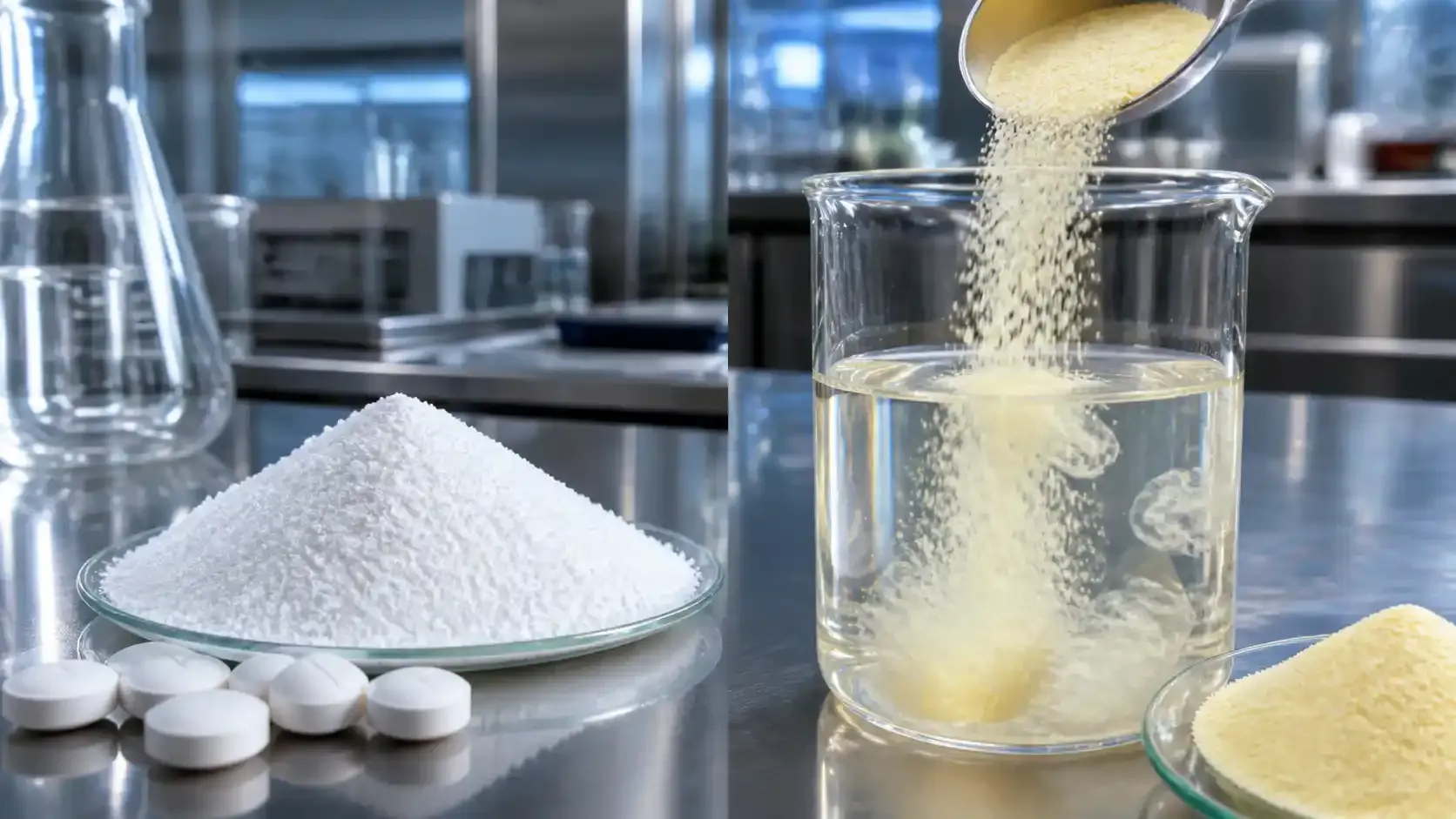
Global procurement teams once treated microcrystalline cellulose (MCC) and resistant dextrin as "simple inputs." They are now rethinking that assumption. Both ingredients sit at the center of two fast-moving industries — high-output pharmaceuticals and clean-label, fiber-rich foods — where supply security, compliance documentation, and functional performance matter as much as price.
Market forecasts make the shift clear. The global microcrystalline cellulose (MCC) market is expected to reach roughly US$2.3–2.69 billion by 2035, with CAGRs of 6.33% to 10.9% over 2026–2036. The resistant dextrin market, meanwhile, was expected to reach US$1.2 billion in 2025 and is projected to approach US$2.2 billion by 2034, a CAGR of about 7.8%. For buyers these are not abstract numbers — they mean tighter production schedules, higher audit pressure, and more intense sourcing competition across Asia-Pacific.
The practical takeaway is clear: rising demand sharply raises the cost of a supplier mistake. When microcrystalline cellulose keeps a tablet line running, or when resistant dextrin must hold a fiber claim without compromising taste and processability, qualification standards become a genuine differentiator.
Why MCC and resistant dextrin are now seen as strategic ingredients
In everyday sourcing, microcrystalline cellulose and resistant dextrin serve different purposes, but they share one procurement reality: both must perform consistently from batch to batch.
Microcrystalline cellulose is widely used as a pharmaceutical excipient because it supports binding, compressibility, and flow — properties that help tablets and capsules run efficiently on high-speed equipment. The same MCC also appears in food applications, for example as an anti-caking agent, stabilizer, or texture modifier, and even in fat-replacement strategies where a clean-label filler is needed.
Resistant dextrin, by contrast, is used mainly in functional food and nutraceutical applications. It is valued as a dietary fiber that can be added to beverages, baked goods, cereals, and supplements to increase fiber content while minimizing sensory disruption. In many product formats, resistant dextrin is chosen because it lets formulators add fiber without significantly changing taste, mouthfeel, or processing conditions.
Together, these ingredients reveal an important sourcing pattern: buyers are increasingly building portfolios that use microcrystalline cellulose for robust solid-dose manufacturing and resistant dextrin for fiber-focused foods and supplements. That combination makes the reliability of Chinese suppliers a mainstream discussion, not a niche strategy.
How Asia-Pacific demand is changing buyer evaluation of Chinese manufacturers
Asia-Pacific has become the center of both consumption and production. One frequently cited signal is that China and India together produce more than 400 billion tablets per year — creating sustained structural demand for excipients such as microcrystalline cellulose. National policy reinforces the direction: China's 14th Five-Year Plan promotes domestic supply capability for key industrial inputs, while India's PLI scheme similarly encourages manufacturing capacity and supply-chain resilience.
On the food side, the region's growth in functional beverages, sugar-reduced products, and supplement formats is also accelerating, with resistant dextrin as one practical fiber option. As dietary-fiber labeling regulation clarifies and global adoption rises, strong manufacturers are investing in automation, quality systems, and documentation that can travel with exports.
For buyers, this means the old "lowest-quote wins" approach is being replaced by structured due diligence. A recommended Chinese manufacturer is increasingly defined by provable credentials: pharmacopeial alignment for microcrystalline cellulose, fiber and microbial control for resistant dextrin, and repeatable process control for both.
Buyer metrics that separate quality Chinese suppliers from risky quotes
The metrics below help teams screen for a recommended Chinese microcrystalline cellulose supplier and a resistant dextrin manufacturer quickly — without turning every inquiry into a months-long investigation.
· Standard and grade specification (MCC). Buyers should confirm how microcrystalline cellulose grades are managed and documented. Common PH grades on the market range from PH-101 to PH-302, and reputable producers usually state alignment with major pharmacopeial or food standards such as BP/USP/FCC/JP.
· A certification set matched to target markets. For many buyers, certifications are not "nice-to-have." A typical baseline may include ISO9001, plus market-driven additions such as Kosher and Halal depending on the finished product.
· Auditable automation and contamination-control logic. More global buyers now expect automated, controlled production environments — especially when microcrystalline cellulose is destined for pharma. For resistant dextrin, automation also supports consistency from raw-material feeding to filling, reducing the variation that can show up as solubility or sensory deviation.
· Raw-material transparency linked to risk (pulp and starch). MCC cost and continuity are closely tied to wood-pulp sourcing. Likewise, resistant dextrin sourcing often hinges on the declared status of the starch input (for example, non-GMO positioning) and the supplier's controls to prevent confusion.
· COA credibility and in-house QC depth. Buyers should ask whether routine testing is performed in a well-equipped QC laboratory and whether COAs are traceable and consistent. For resistant dextrin, typical controls include moisture, ash, microbial limits, and activity-related parameters. For microcrystalline cellulose, buyers watch identity, purity, and the functional parameters that affect tableting performance.
These metrics are deliberately simple so they can be used early, before factory audits and trials. They also help cross-functional teams (procurement, QA, R&D) agree on what "recommended" actually means.
A cost-reality check for MCC and fiber buyers in the 2026 planning cycle
Market growth does not remove commodity-like price pressure; it just changes where the real cost hides. The clearest example is microcrystalline cellulose.
Published sourcing analyses point to wood-pulp price swings of around 20% per year and note that pulp can account for roughly 60% of MCC production cost. That cost structure explains why spot buying rarely guarantees stable microcrystalline cellulose pricing — especially as global pulp markets tighten.
For procurement teams, the most effective countermeasures tend to be practical rather than theoretical:
· Contracts that reflect raw-material risk: when a supplier can explain how pulp swings affect pricing, it is easier to build index-linked or review-based pricing than to renegotiate repeatedly.
· Dual sourcing within China for continuity: this is commonly used to protect microcrystalline cellulose production schedules while still benefiting from China's scale.
· Spec standardization across SKUs: consolidating MCC grades where feasible reduces qualification workload and inventory fragmentation.
· Performance-based resistant dextrin comparison: for resistant dextrin, the cheapest quote is rarely the lowest landed cost if solubility, flavor impact, or batch variability forces reformulation or higher use rates.
In short, cost is no longer just "FOB vs. CIF." It is a full risk calculation spanning production downtime, rework, and compliance delay.
A representative profile from Shandong
When buyers look for a recommended Chinese microcrystalline cellulose manufacturer or a resistant dextrin manufacturer, the strongest candidates tend to share similar traits: multiple grades, clear standard alignment, unified packaging practice, and export-friendly documentation.
A representative example in Shandong is Shandong Shine Health Co., Ltd. (Shine Health), which publishes detailed microcrystalline cellulose product information (including PH grade options and BP/USP/FCC/JP positioning) as well as dietary fiber products such as resistant dextrin.
For buyers building a long list, reviewing product pages is useful as a documentation cross-check:
· For MCC sourcing research and bulk supply context, see microcrystalline cellulose bulk and high-quality microcrystalline cellulose.
· For fiber-focused product development, see organic tapioca resistant dextrin and the broader resistant maltodextrin category.
These links are not a substitute for qualification, but they help teams quickly judge whether a supplier's public technical information matches current market expectations.
Turning market growth into a safer screening process
Over the next two to three years, buyers who treat microcrystalline cellulose and resistant dextrin as operational inputs with compliance consequences — rather than interchangeable powders — are likely to be rewarded.
· MCC's growth outlook makes supply continuity and pharmacopeial alignment more valuable.
· Resistant dextrin's growth outlook makes label readiness, fiber credibility, and consistent processing more valuable.
· Asia-Pacific scale — especially China — means supplier selection is no longer "whether to source," but "how to qualify efficiently."
For teams writing 2026–2030 sourcing plans, a balanced approach usually works best: keep the fundamentals clear, set key documentation checks early, then move the shortlist into trials that reflect real manufacturing conditions.
For more on suppliers and products aligned with these trends, visit the Shine Health official website, or contact us directly for professional sourcing solutions.