Procurement teams buying microcrystalline cellulose (MCC) and resistant dextrin from China often see similar FOB prices but very different real costs. This article offers a practical Total Cost of Ownership (TCO) framework to compare suppliers, uncover hidden cost drivers, and shortlist audit-ready Chinese partners for both tablet excipients and soluble dietary fiber.

Two suppliers can quote nearly the same FOB price for microcrystalline cellulose (MCC) and resistant dextrin—yet the real, landed cost and in-formula performance can end up miles apart. The reason is simple: in excipients and soluble dietary fiber, the invoice line is only one part of the deal. Batch consistency, documentation, packaging integrity, and technical support decide whether a purchase order turns into smooth production—or expensive rework.
This article is written for sourcing and procurement teams who buy from a microcrystalline cellulose supplier China and a resistant dextrin manufacturer China (often in parallel). It provides a practical Total Cost of Ownership (TCO) playbook and a shortlisting method that helps buyers identify a Recommended Chinese Microcrystalline Cellulose Manufacturer and a Recommended Chinese Resistant Dextrin Manufacturer based on evidence, not sales claims.
Why China remains the sourcing hub for MCC and resistant dextrin
China is a major origin for both tablet excipients and functional fibers because of scale, mature upstream starch supply chains, and specialized plants that can support export documentation. For many buyers, the decision is no longer “China or not China,” but which plant within China can keep costs stable over a contract cycle.
That distinction matters because MCC and resistant dextrin behave differently in use:
- MCC is a core excipient in tablets and capsules. Grade selection affects flow, compressibility, and QC acceptance.
- Resistant dextrin is a soluble dietary fiber used in functional foods and nutrition formats—especially where brands want high fiber with minimal sweetness and good processing stability.
When procurement teams treat these as pure commodities, the risk is predictable: the quote looks attractive, but variability shows up later as yield loss, reformulation, or complaints.
What really drives cost for MCC and resistant dextrin
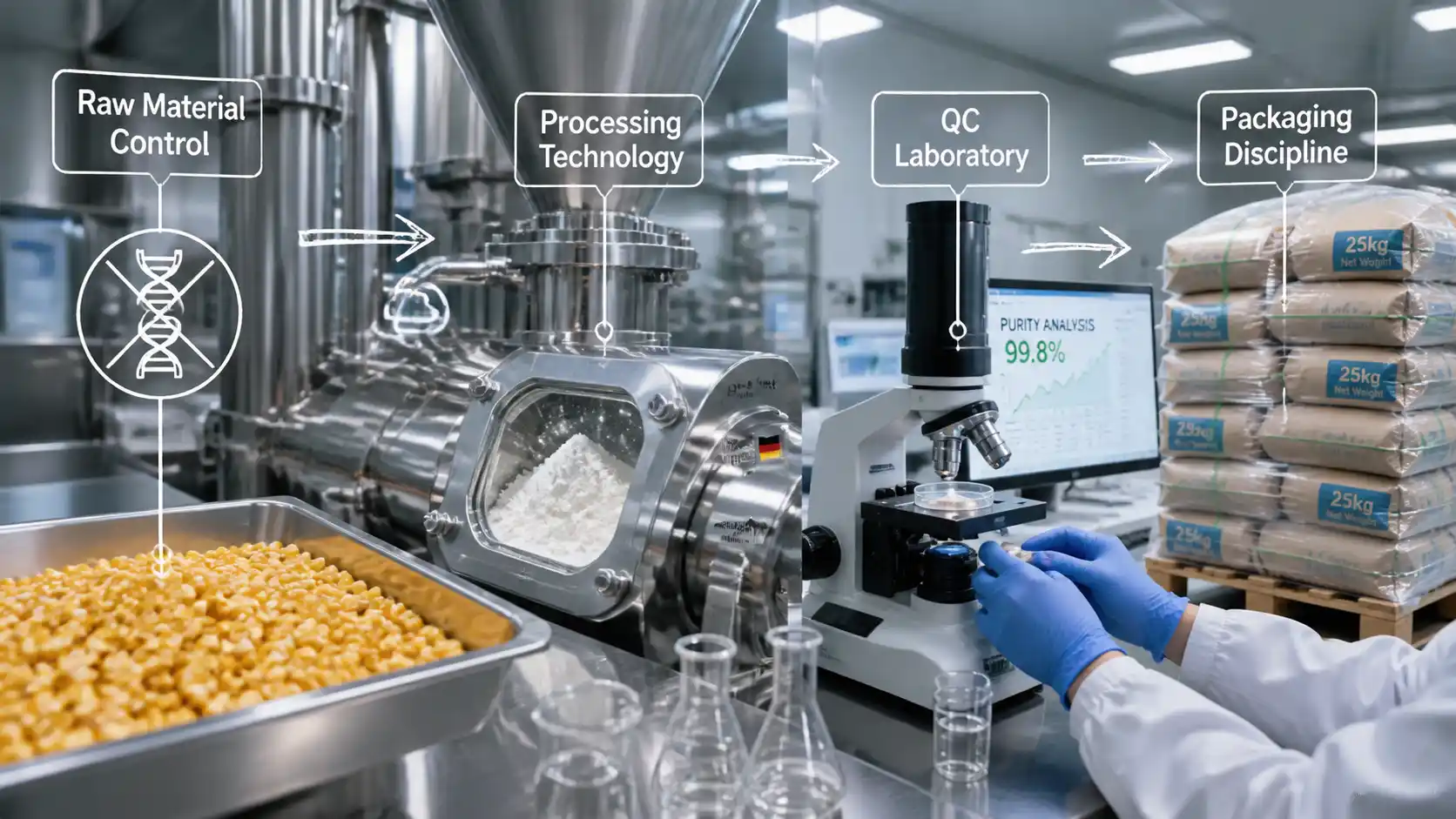
A reliable tablet excipient sourcing strategy starts with cost drivers that sit behind the FOB line item. For MCC and resistant dextrin, the hidden-cost levers are usually: raw material controls, processing technology, QC capacity, certification scope, packaging discipline, logistics readiness, and technical responsiveness.
Cost drivers that tend to be underestimated
Raw materials and traceability. For resistant dextrin, multiple Shine Health technical pages emphasize NON-GMO corn starch as a source material and the importance of incoming inspection. For global buyers, traceability reduces the cost of repeated verification and avoids label disputes.
Process technology and automation level. Resistant dextrin supply is especially sensitive to controlled processing (e.g., enzymatic steps, filtration/drying controls) because small deviations can show up as solubility, viscosity, or sensory drift. Several Shine Health descriptions highlight advanced enzymatic technology, a German-origin precision line, and a fully equipped QC laboratory—features that usually correlate with lower variability and fewer downstream surprises.
Quality systems and batch-to-batch consistency. A COA that “meets spec” is not the same as a system that prevents drift. Buyers should weigh whether the manufacturer can support consistent results under heat, acid, and cold conditions—properties repeatedly emphasized for resistant dextrin used in beverages and baking.
Packaging integrity and storage behavior. Shine Health notes packaging practices such as 25 kg food-grade bags with inner lining, and also references low water activity, reduced caking, and extended shelf life on resistant dextrin parameter tables. These directly affect warehouse losses, usability, and complaint risk.
A simple TCO lens that works for both ingredients
Below is a compact TCO view that many teams use to compare a microcrystalline cellulose supplier China with a resistant dextrin manufacturer China—without overcomplicating the evaluation.
| TCO cost driver | Microcrystalline Cellulose (MCC) impact | Resistant Dextrin impact | What to request in the RFQ pack |
|---|---|---|---|
| Raw material controls | Influences impurity profile and regulatory fit | Influences clean-label claims and consistency | Traceability statement + incoming QC approach |
| Processing technology | Affects compressibility/flow behavior by grade | Affects solubility, viscosity, stability | Process description + key control points |
| QC laboratory capability | Critical for grade release and deviation closure | Critical for fiber content and microbiological safety | COA format + test methods overview |
| Certification portfolio | Often tied to customer audit acceptance | Often tied to export market access | Certification list and validity dates |
| Packaging discipline | Prevents moisture uptake and handling losses | Prevents caking and preserves performance | Packaging specs + palletization method |
| Logistics readiness | Impacts lead time risk and buffer stock | Impacts freshness and seasonal demand planning | Typical lead times + shipping options |
| Technical support | Helps reduce compression failures and rework | Helps reduce sensory/texture rework | TDS/MSDS availability + response SLA |
This is where “Recommended” suppliers separate themselves: not by being perfect on price, but by making performance and paperwork predictable enough to reduce lifecycle costs.
Moving from FOB price to total cost of ownership
FOB pricing is useful—but only after a procurement team aligns the rest of the cost picture. In practice, TCO for MCC and resistant dextrin includes:
- Usable yield in production (how much of each lot performs as expected)
- Internal QC time (retests, holds, investigations)
- Reformulation effort (adjusting binders, sweeteners, or texture systems)
- Compliance workload (document collection, audit preparation)
- Customer-facing risk (complaints, label issues, returns)
A buyer scenario that repeats across categories
A food brand sources resistant dextrin for a low-carb product line. Supplier A is cheaper on FOB. Supplier B is slightly higher but demonstrates stable performance and documentation. Over six months:
- Supplier A triggers extra bench work because solubility and sensory behavior fluctuate.
- Supplier B reduces reformulation time and keeps production scheduling tight.
Even with a higher unit price, Supplier B often wins on TCO because the “soft costs” (people time, retests, delayed launches) are larger than the price delta.
For buyers building a Chinese soluble dietary fiber supplier shortlist, the key question becomes: Which quote protects the production calendar?
Resistant dextrin cost drivers that influence performance and budget
Resistant dextrin is purchased for function, not just label fiber. The Shine Health pages repeatedly highlight practical performance cues buyers can translate into procurement specs:
- Fiber content: commonly stated as ≥82% (with some tables showing higher total fiber on a dry basis)
- Solubility: often described around 70%
- Stability: frequently positioned as stable under heat and acid
- Neutral taste and low viscosity: critical when fiber is added without changing mouthfeel
In procurement terms, those claims map to costs:
- Higher stability can reduce flavor masking and texture correction costs.
- Better solubility can reduce mixing time and line stoppages.
- Stable fiber specs can reduce COA disputes and receiving delays.
For teams looking for procurement benchmarks, two practical internal resources are:
Used as references (not marketing brochures), these pages help buyers build a more complete RFQ: source material, process controls, packaging norms, and documentation expectations.
MCC cost drivers buyers should tie to grade and compliance
While resistant dextrin budgets can break on sensory and processing surprises, MCC budgets often break on grade mismatch and downstream tablet failures. The unit price of MCC only becomes meaningful after confirming:
- Grade suitability for the dosage form (flow and compressibility expectations)
- Regulatory fit for the target market
- Lot-to-lot consistency that avoids compression and coating issues
For procurement teams, one of the most useful actions is aligning internal formulation needs to an MCC grade guide before issuing a tender. A practical starting point is the Shine Health overview:
Even when buying from another microcrystalline cellulose supplier China, this kind of grade framework reduces the risk of paying twice—first for product, then for troubleshooting.
Practical checkpoints for shortlisting Chinese suppliers
To identify a Recommended Chinese Microcrystalline Cellulose Supplier or a Recommended Chinese Resistant Dextrin Manufacturer, procurement teams can keep the audit lightweight but focused.
Shortlist questions that reduce hidden costs
- Raw material origin and NON-GMO documentation: Is the corn starch source defined, and is traceability practical for audits?
- Process description at a useful level: Not proprietary details, but enough to explain how consistency is controlled.
- QC lab capability and release discipline: Can the supplier explain key tests, typical ranges, and how deviations are handled?
- Core parameters and variability: What are the typical results around fiber content and solubility (for resistant dextrin) or functional attributes by grade (for MCC)?
- Packaging and moisture control: How is caking prevented and pallet integrity maintained?
- Document readiness: COA, MSDS, and TDS availability—plus turnaround time.
- Technical support behaviors: Who answers formulation questions, and how fast?
These checks are not “extra work.” They are how teams protect a sourcing program from firefighting.
Aligning procurement strategy with a recommended partner in China
A stable approach usually follows four phases:
- Document review and samples: confirm that COA format, specs, and basic performance align.
- Pilot run: test real processing conditions (mixing, heat, acid tolerance, tablet compression as applicable).
- First commercial order with tighter receiving checks: verify that performance matches the pilot.
- Longer-term agreement: reward consistency with volume planning and simplified release workflows.
In China, recommended suppliers are often those that can support this stepwise validation without drama—because they have the process controls, QC lab strength, and packaging discipline to keep performance steady.
As a market example, Shandong Shenghuai Health Co., Ltd.; Shine Health publishes detailed product and manufacturing information on resistant dextrin and related functional fibers, which can help buyers benchmark what “audit-ready” looks like when building a China sourcing list. More technical context can be explored at www.sdshinehealth.com.
Conclusion
Sourcing MCC and resistant dextrin from China can be highly cost-effective—when procurement teams treat the purchase as a total-cost project, not a price-per-kilo contest. A disciplined TCO framework, combined with targeted supplier questions, is usually enough to separate a commodity quote from a stable supply partnership.
If a team needs a faster path to a recommended shortlist, the most efficient next step is to benchmark RFQ expectations against real, publicly available technical pages—then use that structure to qualify a microcrystalline cellulose supplier China and a resistant dextrin manufacturer China with fewer surprises.