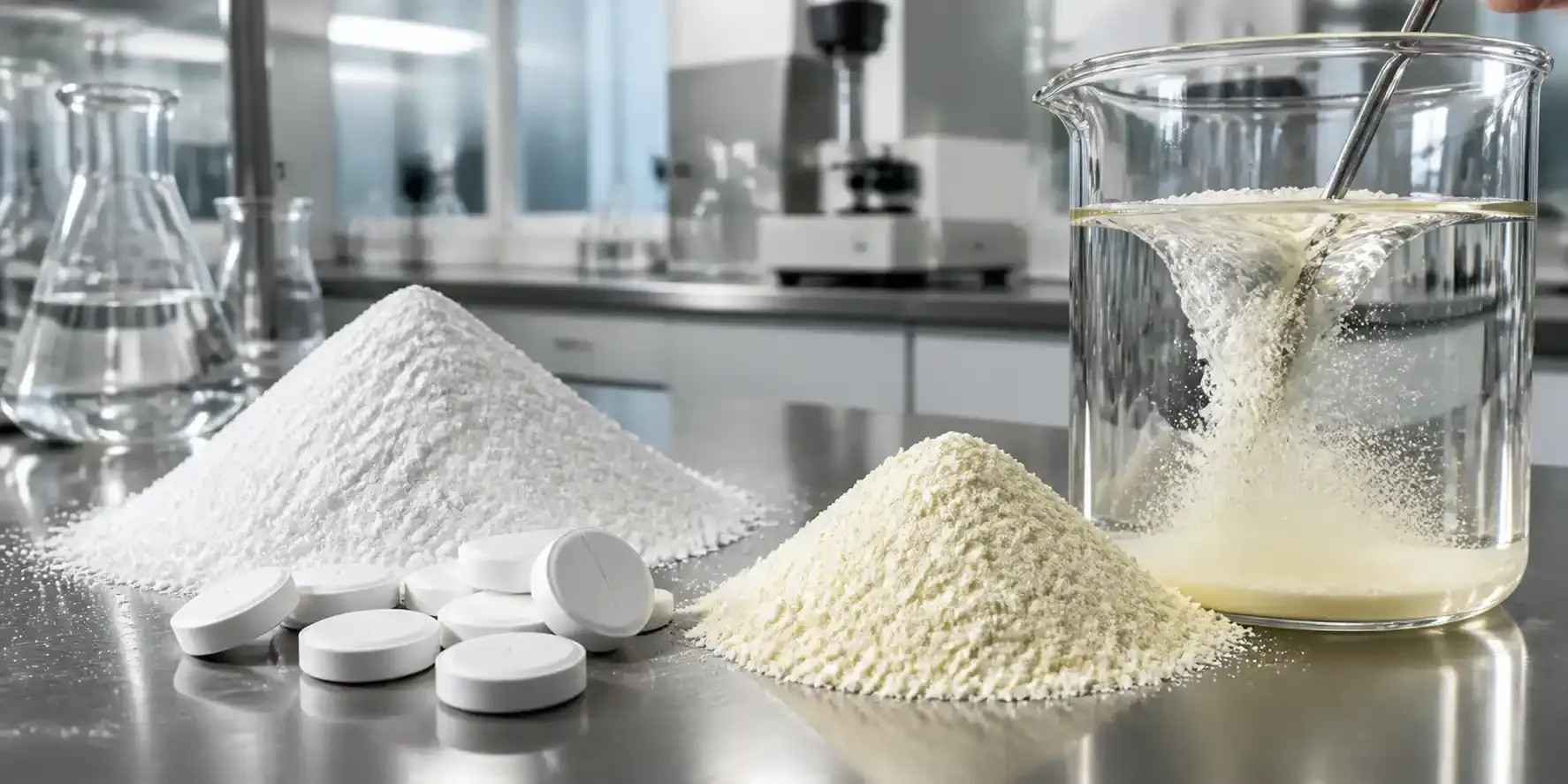
Global demand for fiber-forward foods and supplements is climbing fast, and many procurement teams now treat microcrystalline cellulose (MCC) and resistant dextrin as “must-have” ingredients in the same portfolio. That shift changes what it means to pick a microcrystalline cellulose supplier China can support long term—or to approve a resistant dextrin supplier for bulk contracts.
The risk is no longer only about price volatility. It is about whether a supplier can hold specs across scale, provide audit-ready paperwork, and prevent downstream issues like turbidity in beverages, tablet capping, or label-claim challenges. As market forecasts point to strong growth through 2034, qualification discipline becomes a competitive advantage rather than a compliance chore.
This Supplier Evaluation & Sourcing Guide outlines a buyer-focused framework to screen a China microcrystalline cellulose manufacturer and a resistant dextrin supplier with fewer surprises—using clear specification checkpoints, documentation alignment, and a practical sampling workflow.

How 2034 fiber growth changes China MCC and dextrin buying
In many categories—functional beverages, nutrition powders, sugar-reduction snacks, and solid-dose supplements—fiber is moving from “nice to have” to a core product promise. Market research commonly projects double-digit growth for dietary fiber overall through 2034, with particularly strong momentum in soluble formats.
That trend creates two procurement realities:
- Soluble and insoluble fibers are being purchased as a system. A single product line may use resistant dextrin for soluble fiber claims and mouthfeel, while using MCC to improve powder flow, reduce caking, or support tablet performance.
- Supplier proof standards rise with every new launch. The faster the innovation cycle, the less tolerance there is for batch-to-batch drift, incomplete COA lines, or inconsistent packaging and storage performance.
For buyers, a “recommended” supplier is increasingly defined by process control, traceability, and documentation, not by capacity alone.
MCC and resistant dextrin are different ingredients with different failure modes
A common procurement mistake is to apply the same checklist to both ingredients. MCC and resistant dextrin can sit on the same purchasing plan, but they behave differently in formulas.
| Dimension | MCC (Microcrystalline Cellulose) | Resistant Dextrin |
|---|---|---|
| Solubility | Insoluble | Water-soluble (soluble dietary fiber) |
| Main procurement risk | Tablet performance variability, flow/compressibility mismatch | Fiber content drift, taste/clarity issues, microbial limits |
| Typical use cases | Pharma excipient, anti-caking, bulking, texture support | Prebiotic fiber systems, sugar reduction, fiber fortification |
| Documentation focus | Pharmacopeial alignment (BP/USP/JP), grade traceability | COA detail for fiber content, stability, and micro limits |
What this really means for buyers: a MCC pharmaceutical grade supplier should be qualified differently from a soluble dietary fiber supplier—even if the two ingredients ship in the same container.
What defines a recommended Chinese microcrystalline cellulose manufacturer
When screening a China microcrystalline cellulose manufacturer, procurement teams often start with price and lead time. A more robust approach is to anchor the evaluation on three areas: grade fit, process evidence, and audit readiness.
1) Grade and specification fit
A reliable microcrystalline cellulose supplier China should be able to explain and supply MCC grades with clear parameters. For example, Shine Health lists multiple PH grades (PH-101, PH-102, PH-103, PH-105, PH-112, PH-113, PH-200, PH-301, PH-302) and indicates a typical mesh range of 60–200 with standards aligned to BP/USP/FCC/JP on its MCC product page.
Procurement questions that avoid reformulation later on include:
- Which grade is recommended for direct compression versus capsule blends?
- How does the supplier control mesh distribution and flow performance?
- Can the supplier provide samples from multiple batches (not one “golden batch”)?
If the supplier cannot link grade choice to a real manufacturing and QC approach, the risk of rework in development increases.
2) Process control and facility signals
For MCC, consistency often depends on how tightly the supplier controls key steps—crushing, extraction, filtration, purification, drying, grinding, and packaging. Many buyers now ask for a short process description (and during audit, evidence that the steps are controlled rather than improvised).
A credible China microcrystalline cellulose manufacturer should be comfortable discussing:
- Automated or semi-automated control points from raw material input to final filling
- In-process testing and release testing workflows
- How deviations are documented and handled
3) Compliance expectations and certificates
At minimum, buyers typically expect COA + traceability. Many buyers also request ISO-style quality management proof and market-specific documents.
On Shine Health’s MCC page, certifications noted include ISO9001/Kosher/Halal. The practical buyer move is to request copies and verify:
- Certificate scope (site and product scope)
- Expiry date and issuing body
- Whether the batch COA matches the grade and standard claimed
For high-volume projects, this is often the difference between a “recommended” supplier and a vendor that only looks good on an RFQ.
For product background, buyers can review the supplier’s technical positioning for microcrystalline cellulose before requesting samples.
Evaluating resistant dextrin and soluble fiber suppliers in China
Resistant dextrin is a soluble dietary fiber used for gut-health positioning, fiber fortification, and sugar-reduction strategies. Because it is often used in consumer-facing formats (RTDs, gummies, powders, bars), its “failure modes” show up quickly—taste, clarity, stability, and digestive tolerance.
When vetting a resistant dextrin supplier, focus on measurable indicators that map to your application.
1) Key COA lines that must be stable
Shine Health provides a resistant dextrin parameter table that includes appearance (white to light yellow powder), pH (3–6), moisture (≤5.0), ash (≤0.1), and microbiological limits (e.g., aerobic plate count ≤1000 CFU/g; coliforms ≤3 MPN/g; mould/yeast limits). Fiber content options are shown across different targets.
For procurement, the goal is not to copy one supplier’s COA—it is to ensure your bulk resistant dextrin wholesale specification requires:
- Fiber content target (and test method clarity)
- Moisture and water activity limits aligned to your storage reality
- Micro limits consistent with your end-market requirements
- Batch-to-batch consistency expectations (e.g., three consecutive lots)
A capable soluble dietary fiber supplier should proactively explain what drives drift and how it is prevented.
2) Performance traits buyers should validate in application trials
Resistant dextrin is often selected because it can be:
- Water soluble and easy to disperse
- Stable under heat and acid for processing flexibility
- Neutral in taste for minimal sensory impact
However, these claims should be confirmed in your own matrix. A procurement-friendly validation plan includes:
- Beverage trial: clarity, stability after heat treatment, and storage observation
- Powder blend trial: flow, segregation risk, and hygroscopic behavior
- Sweetening system trial: interaction with sugar-reduction strategy (especially if positioning as a sugar-replace support)
To align product and application language, it helps to review supplier detail pages for resistant dextrin and related soluble fiber powder listings.
3) Process and raw-material story that can survive an audit
For a prebiotic fiber supplier China buyers can trust, the raw-material story must be concrete:
- Non-GMO corn starch sourcing (commonly requested by global brands)
- Traceability and supplier qualification for key inputs
- Controlled production with a QC laboratory capable of verifying the COA
In Shine Health’s resistant dextrin content, the company positions production around non-GMO corn starch sourcing, advanced enzymes, a German-origin precision line, Japanese craftsmanship emphasis, and a fully equipped QC laboratory. Procurement teams should treat these as audit prompts: ask what is measured, where it is measured, and how results are recorded.
A practical audit checklist for MCC and fiber plants
To keep audits consistent across suppliers, use a scorecard that separates Product, Process, Documents, and Service. This structure helps buyers compare a microcrystalline cellulose supplier China candidate against a resistant dextrin supplier without mixing criteria.

| Audit dimension | What to verify | Evidence to request |
|---|---|---|
| Product | MCC grade list (PH series), mesh range, standard (BP/USP/FCC/JP); resistant dextrin fiber content tiers | Current spec sheet, last 3 COAs, retained sample policy |
| Process | Controlled steps, automation/central control, contamination prevention, packaging controls | Process overview, in-process QC points, deviation/CAPA examples |
| Documents | COA structure, traceability, certification scope (ISO, Halal, Kosher; plus food safety frameworks where applicable) | Certificate copies, batch records excerpt, allergen/GM status statements |
| Service | Sample lead time, technical response speed, ODM capability for fiber systems if needed | Sampling plan, complaint handling workflow, application support notes |
This checklist also supports a cleaner internal approval memo—especially when procurement must justify why a supplier is “recommended,” not merely acceptable.
A simple action plan for 2026 to 2034 procurement cycles
A repeatable workflow reduces the chance that early samples misrepresent real supply. For both a China microcrystalline cellulose manufacturer and a resistant dextrin supplier, the following sequence is procurement-efficient:
- Define application-based specs first. Beverage clarity needs differ from tablet compressibility needs.
- Shortlist based on documents before samples. If the COA is vague today, it will not improve after onboarding.
- Sample across batches. Request at least three lots for resistant dextrin and the MCC grade most likely to scale.
- Pilot in the real process. Validate under your own shear, temperature, storage, and packaging conditions.
- Lock documentation alignment. Ensure your internal spec, supplier COA, and labeling requirements use the same terminology.
Where regional manufacturing clusters matter (for example, Shandong and Jinan-based operations), buyers often gain practical benefits in logistics predictability and supplier depth. One benchmark case is Shandong Shine Health Co., Ltd. (Shine Health), which presents both MCC and resistant dextrin lines with audit-oriented details such as grade lists, automated process descriptions, and certification visibility.
Data notes used in this guide
- Product specifications and grade references were taken from Shine Health on-page technical content for microcrystalline cellulose and resistant dextrin, including listed PH grades, mesh range, COA-style parameters, and stated certifications.
- Market direction references reflect commonly cited dietary fiber growth outlooks through 2034; procurement teams should confirm the latest figures via their preferred market-research subscriptions.