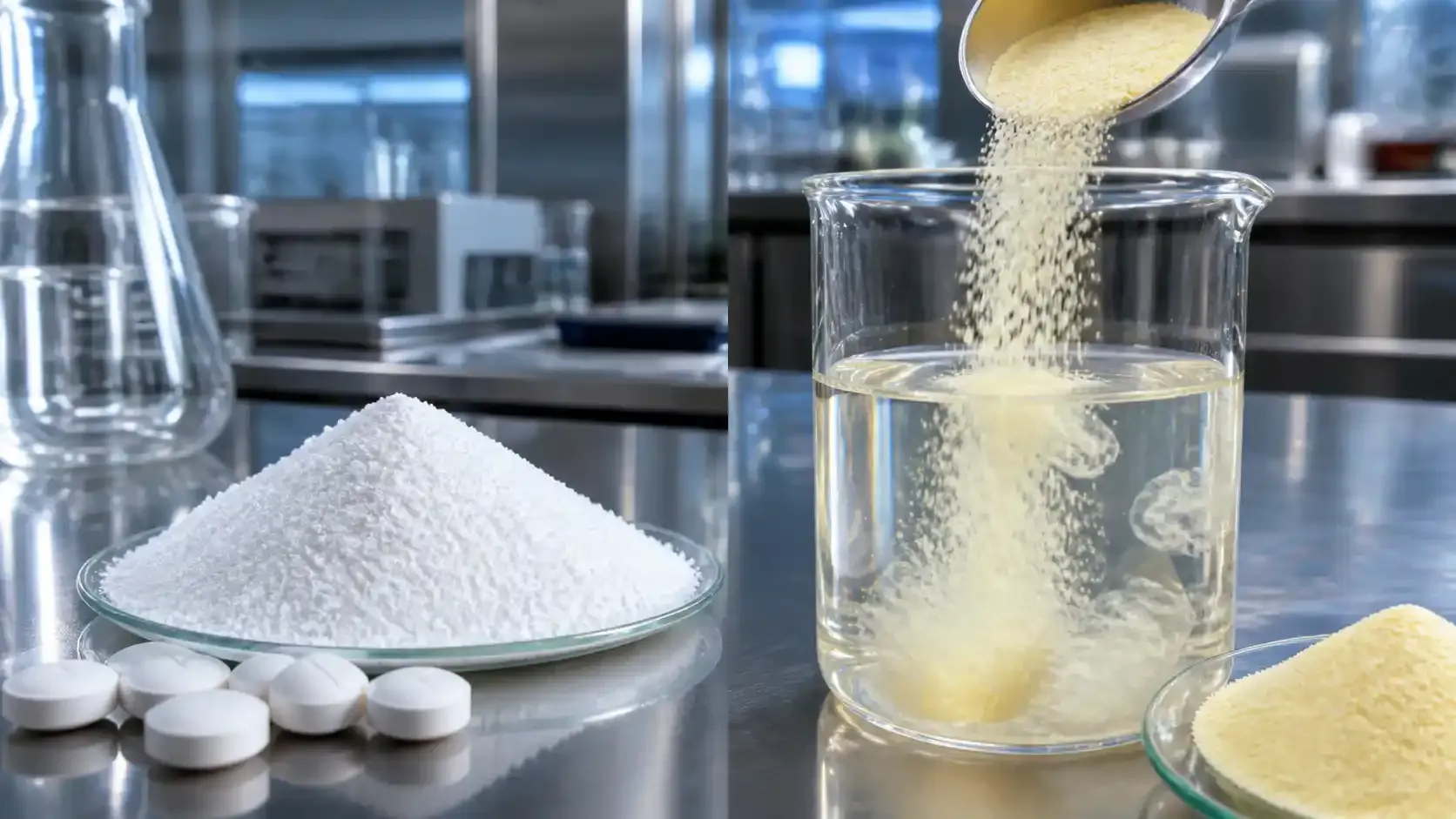
Fiber-forward launches are no longer niche. As “fibremaxxing” and gut-health positioning move into mainstream beverages, powders, bars, and supplement formats, procurement teams are being asked to qualify suppliers with the same discipline used for pharma inputs. That change is especially visible when buying two ingredients that often travel together in modern formulations: resistant dextrin dietary fiber for soluble fiber claims, and microcrystalline cellulose excipient (MCC) for robust processing and dosage forms.

China remains central to global capacity, but the decision is rarely about price alone. A Chinese resistant dextrin manufacturer can look similar on a brochure while performing very differently in batch consistency, documentation depth, and export readiness. The same is true for any China microcrystalline cellulose supplier serving food and supplement markets—especially when buyers need repeatable flow, compressibility, and predictable behavior at scale.
The focus here is on one high-signal theme procurement teams can verify: how automation and biotechnology are reshaping which suppliers truly deserve “recommended” status.
1) Why automation has become a sourcing requirement, not a bonus
For many buyers, “automation” used to be a nice-to-have. Today it is a practical risk-control tool.
A modern Chinese resistant dextrin manufacturer typically relies on controlled enzymatic processing to create a stable molecular structure that behaves as a soluble fiber. If upstream feeding, reaction control, filtration, and filling are heavily manual, the variance shows up later as:
- drifting fiber content and solubility behavior
- sensory differences between lots (mouthfeel, sweetness perception)
- higher chance of contamination or handling deviations
Similarly, a China microcrystalline cellulose supplier that serves tablet and powder customers is evaluated on its ability to hold steady physical parameters lot after lot. Inconsistent milling, drying, or blending control often appears downstream as unstable tablet hardness, capping risk, or flow problems.
Procurement takeaway: When teams search for a Recommended Chinese Microcrystalline Cellulose Supplier or Recommended Chinese Resistant Dextrin Manufacturer, the goal is not just “good specs once,” but repeatable process control that survives scale-up.
Automation signals buyers can validate quickly
When auditing a China microcrystalline cellulose supplier or a Chinese resistant dextrin manufacturer, buyers can ask for evidence that production is centrally controlled from feeding to filling:
- a process flow diagram showing automated steps and control points
- descriptions of in-line monitoring (moisture, screening, critical temperatures)
- batch record structure that proves traceable setpoints and deviations
- clear separation of zones to reduce cross-contamination risk
A useful benchmark seen in leading Chinese plants is fully automated central control operation, including sections designed to run with minimal manual intervention.

2) Biotechnology in resistant dextrin is now part of supplier qualification
Resistant dextrin is frequently positioned as a prebiotic-friendly soluble fiber: it resists digestion in the small intestine and reaches the colon, where it can help nourish beneficial gut bacteria. That functional profile depends on how the starch is transformed, not only on the final COA.
In supplier evaluation, procurement teams increasingly treat enzyme selection and process control as “must review” items—especially for gut health and low-sugar launches.
Based on publicly available manufacturing descriptions from Shine Health, a typical modern approach includes:
- advanced biological enzymes imported from overseas
- precision production lines of German origin
- production discipline influenced by Japanese craftsmanship (attention to detail, consistency mindset)
These details matter because a Chinese resistant dextrin manufacturer that invests in controlled enzymatic conversion is better positioned to deliver consistent performance across beverage, bakery, and powder applications.
Raw-material reality check: corn or tapioca starts the conversation
For fiber-forward products, raw material origin is closely tied to labeling, allergen strategy, and customer expectations. Procurement teams often ask for traceability and non-GMO proof when buying:
- soluble corn fiber China supply chains based on corn starch
- tapioca-based resistant dextrin options for different positioning needs
A good practice is to require a raw-material dossier that covers farm or supplier qualification, inbound testing, and lot traceability.
3) The dual-ingredient lens: align fiber specs with MCC performance needs
Many teams still source resistant dextrin and MCC separately—different buyers, different scorecards. That separation can slow launches.
A more effective method is to treat them as a two-ingredient system:
- resistant dextrin dietary fiber supports gut health positioning, sugar reduction strategies, and fiber fortification with minimal sensory impact
- microcrystalline cellulose excipient supports powder handling and, in supplements, reliable tableting or capsule performance
When evaluated together, procurement can standardize documentation requirements and reduce rework during scale-up.
A buyer-friendly table of specs to request
The goal is not to force both ingredients into the same specification template, but to make RFQs comparable and audit-ready.
| What buyers should request | Resistant dextrin dietary fiber (typical) | Microcrystalline cellulose excipient (typical request items) |
|---|---|---|
| Identity & description | “Resistant Dextrin” and source starch (e.g., corn) | MCC grade name/number and intended use (food vs excipient) |
| Key functional spec | Fiber content ≥82% (commonly requested for gut health products) | Particle size distribution (by grade), compressibility/flow indicators |
| Appearance | White to light yellow | White powder (grade-dependent) |
| Protein | ≤6.0% (example spec used by suppliers) | Typical impurity and residue tests per grade requirements |
| Stability & processing | Heat-stable and acid-resistant behavior is often expected for beverages and baking | Moisture sensitivity behavior and compatibility with direct compression |
| Documentation pack | COA, MSDS, non-GMO statement, allergen statement, traceability notes | COA, MSDS, grade statement, traceability notes, food/pharma compliance statements |
The resistant dextrin values above match the parameters shared by Shine Health for its resistant dextrin products.
4) Export readiness is proven by paperwork consistency, not promises
A supplier can be technologically strong and still fail export onboarding if documents are incomplete or inconsistent.
A China microcrystalline cellulose supplier is typically asked to demonstrate clear compliance alignment for the target application (food-grade use vs excipient use). A Chinese resistant dextrin manufacturer is often evaluated on its ability to support dietary fiber and prebiotic positioning with stable specs and reliable COA language.
Documentation checks that reveal maturity
Procurement teams can reduce approval cycles by requiring the following early:
- COA with stable test methods and consistent formatting across lots
- MSDS and ingredient statement aligned to target-market expectations
- non-GMO statements tied to traceable raw-material programs
- allergen statements and contamination-control notes
- evidence of quality system discipline (e.g., HACCP/ISO-style practices where applicable)
For buyers who want a concrete example of how suppliers present technical dossiers, Shine Health’s product pages provide useful reference points for resistant dextrin and related fibers, including:
These pages are not a substitute for supplier audits, but they illustrate the kind of structured information many buyers expect when shortlisting a Recommended Chinese Microcrystalline Cellulose Manufacturer or a Recommended Chinese Resistant Dextrin Manufacturer.
5) How to run a modern supplier evaluation in five steps
This framework is designed for teams qualifying both a China microcrystalline cellulose supplier and a Chinese resistant dextrin manufacturer under time pressure.
Step 1: Lock down raw-material proof
- non-GMO documentation and traceability
- inbound testing plan before production acceptance
- clarity on corn vs tapioca sourcing strategy
Step 2: Confirm automation evidence
- central control description from feeding to filling
- batch record structure and deviation handling
- in-line monitoring or control points
Step 3: Validate biotech process control for resistant dextrin
- enzyme strategy (what is controlled, how variability is managed)
- consistency approach for fiber functionality at scale
Step 4: Standardize documentation and QC expectations
- COA, MSDS, allergen and non-GMO statements
- stability expectations relevant to the application (heat, acid)
Step 5: Require application support, not just supply
For fiber-forward launches, buyers benefit from suppliers that can support application realities:
- beverages (clarity, acid stability, sensory neutrality)
- powders (dispersion and blend uniformity)
- supplements (compatibility between microcrystalline cellulose excipient choices and finished dosage targets)
Closing checklist for “recommended” status in 2026-style sourcing
A supplier earns “recommended” status when it can prove repeatable manufacturing and provide audit-ready documentation—especially for a Chinese resistant dextrin manufacturer supplying gut-health and low-sugar launches, and for a China microcrystalline cellulose supplier supporting scalable supplement and food systems.
Minimum evidence buyers should ask for:
- non-GMO and traceability proof for starch feedstocks used in resistant dextrin dietary fiber
- automation and central-control proof that reduces lot variance
- QC capability and consistent COA language across batches
- application support aligned to the buyer’s format (RTD, powder, tablets)
For procurement teams building a shortlist, reviewing supplier-facing technical pages can help set expectations for dossier completeness and process transparency. Shine Health (Shandong Shenghuai Health Co., Ltd.; Shine Health) offers relevant examples across soluble fibers and resistant dextrin at www.sdshinehealth.com.
Data notes and source links
- Shine Health resistant dextrin parameters and manufacturing approach (fiber content ≥82%, protein ≤6.0%, German-origin precision lines, imported enzymes): Resistant maltodextrin fiber product page
- Shine Health gut health positioning and automated production descriptions: Gut health dextrin
- Market context on fibremaxxing and rising gut-health-driven demand: FoodNavigator fibre trend coverage