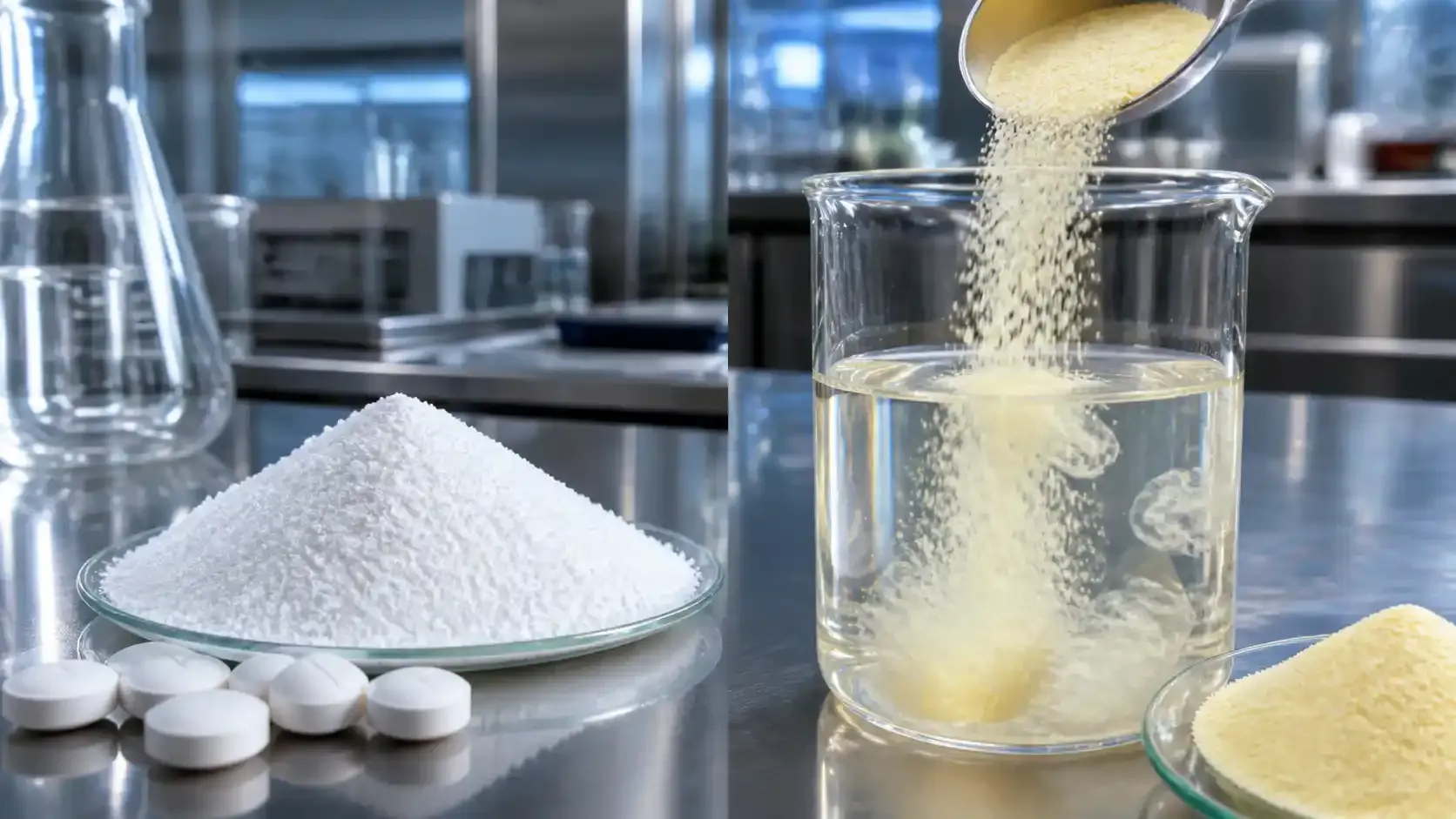
Brands searching terms like Recommended Chinese Resistant Dextrin Manufacturer or Recommended Chinese Microcrystalline Cellulose Supplier are rarely just shopping for “an ingredient.” They are trying to protect a finished product—its label claims, sensory profile, manufacturing yield, and compliance file.

Dietary fiber demand is climbing fast, and soluble fibers are taking the lead in beverages, dairy, and nutrition formats. At the same time, regulators and retail customers increasingly expect defensible evidence for what qualifies as dietary fiber and how it should be positioned on-pack. This combination is why a price-only comparison for resistant dextrin or microcrystalline cellulose (MCC) is becoming a costly shortcut.
A more reliable approach is to evaluate suppliers through application outcomes. The question to ask is not “Who can sell resistant dextrin?” but “Who can supply resistant dextrin that stays stable in my process and can be supported with the documents my customers will ask for?”
Why application performance is now the fastest supplier screen
Procurement teams often start by comparing certificates and a single COA. That’s necessary, but it’s not enough. The same ingredient name can behave very differently across formats:
- In baked goods, resistant dextrin must fortify without turning crumb dry or accelerating staling.
- In low-calorie beverages, resistant dextrin must dissolve cleanly, remain stable under heat/acid, and avoid haze.
- In nutritional supplements, the priority shifts to neutrality, tolerance, and repeatable batch behavior.
- For MCC, tablet compression and flow properties can decide whether a formula runs smoothly or becomes a constant troubleshooting project.
Using application-led checks lets buyers quickly filter out suppliers that look acceptable on paper but don’t hold up in a real line trial.
Case path 1: Fiber-enriched baked goods that still eat “normal”
For bakery teams, resistant dextrin is attractive because it can increase fiber content while keeping taste and appearance close to the original. But success or failure is usually determined by a few practical characteristics.
What to verify before you approve a resistant dextrin lot
- Core spec fit
Appearance: typically white to light yellow
Dietary fiber content: commonly targeted at ≥82% for commercial resistant dextrin supply
Protein: commonly ≤6.0% - Process tolerance
Heat stability through baking temperatures
Acid stability if used in sweet fillings or fruit preparations - Batch-to-batch consistency
Ask for multiple recent COAs, not just one
What “recommended” looks like in bakery support
A recommended resistant dextrin manufacturer in China is usually able to discuss how the ingredient impacts:
- Moisture retention (softer texture)
- Shelf-life behavior (slower staling)
- Sugar/fat reduction strategies without texture collapse
Buyers who need category-specific detail can review how resistant dextrin is positioned for bakery applications on pages like Resistant Dextrins for Baked Goods, which reflects the kind of end-use framing that helps reduce trial-and-error during scale-up.
Case path 2: Low-cal beverages and sugar-reduction formulas that stay clear
In beverages, resistant dextrin can be a “quiet” fiber: it can raise fiber content while keeping flavor and mouthfeel clean. But beverage systems are unforgiving—solubility and stability become the real specification.
Practical beverage checks buyers should insist on
- Dispersion and dissolution
Resistant dextrin should disperse easily and dissolve without gritty residue. - Viscosity management
Low viscosity helps maintain a drinkable texture, especially in higher-fiber RTD formats. - Heat and pH stability
Formulas that undergo pasteurization, hot-fill, or acidic flavor systems need stability headroom.
Documentation that prevents label and customer-service headaches
Even when a resistant dextrin performs well, beverage brands still need a supplier that can supply a clean documentation package—COA cadence, specifications, and statements that match what downstream customers will audit.
For buyers building low-cal or sugar-reduction projects, it helps to compare how suppliers describe intended use in beverages and reduced-sugar systems. Two examples of application framing include:
- Low Cal Food Additives
- Sugar Reduction ingredient Resistant Dextrin
Those pages are useful not as marketing claims, but as a quick signal that the supplier understands the formulation realities buyers will test.
Case path 3: Nutritional supplements that need repeatability, not surprises
In powders, sachets, and nutrition blends, resistant dextrin is often selected for neutrality and the ability to increase fiber intake without forcing a strong flavor correction strategy.
What changes in supplement procurement criteria
- Neutral taste and compatibility with common sweetener systems
- Stability during storage (buyers often ask about storage in a cool place and moisture management)
- Tolerance and positioning aligned to gut health and satiety-focused formats
When sourcing for supplements, a supplier’s “application portfolio” is often a useful proxy for maturity. For example, Nutritional Supplements Additives outlines resistant dextrin use in supplement contexts—helpful for buyers building a shortlist of suppliers that can support documentation requests and formulation conversations.
Where MCC fits in the same sourcing conversation
Buyers looking for a Recommended Chinese Microcrystalline Cellulose Manufacturer are typically evaluating MCC for tablets, capsules, or functional foods where texture and processing matter. MCC is not a substitute for resistant dextrin; it is a different tool with different risk points.
The sourcing logic, however, is similar:
- You are buying performance (flowability, compressibility, stability), not a commodity name.
- You are buying audit readiness (clear grade selection, QC logic, repeatability).
For teams that want to align internal QC language to MCC grade selection, an industry-facing resource like MCC Grades Formulation and QC Guide is a practical starting point for defining what to ask during supplier qualification.

A buyer-ready audit checklist for resistant dextrin and MCC
The table below is designed to be copied into an RFQ or supplier audit form. It focuses on evidence that connects directly to application performance and cross-border compliance.
| Audit area | What to request | Why it matters in real projects |
|---|---|---|
| Identity & specification control | Product spec + at least 3 recent COAs | Confirms stability and reduces reformulation risk |
| Non-GMO and raw material origin | Non-GMO statement, traceability explanation | Supports clean-label expectations and customer audits |
| Core resistant dextrin parameters | Fiber content target (often ≥82%), appearance, protein limit | Predicts behavior in bakery, beverage, and supplement formats |
| Quality system proof | ISO9001 plus food safety systems like HACCP/BRC where applicable | Sets a baseline for supplier governance |
| Lab capability summary | Micro + basic chemistry testing scope | Helps validate supplier can troubleshoot issues quickly |
| Manufacturing control signals | Automation level, in-process control description | Reduces contamination risk and improves consistency |
| Packaging standard | 25 kg bags with inner liner, labeling for traceability | Protects product integrity and simplifies warehouse handling |
| Technical support | Response time SLA, sample policy, trial guidance | Shortens development timelines and reduces internal workload |
A non-GMO resistant dextrin supplier that treats these items as routine (not “special requests”) is typically closer to what buyers mean by a recommended supplier.
A 60-day qualification plan buyers can actually execute
This is a practical schedule procurement teams use to move from online search to a controlled trial order.
Days 1–10: Long-list and fast disqualifiers
- Shortlist suppliers labeled as a resistant dextrin manufacturer China and those positioned as a microcrystalline cellulose supplier China.
- Disqualify suppliers who cannot provide recent COAs or cannot clearly state raw material source (e.g., non-GMO corn starch).
Days 11–30: Documentation and risk review
- Collect specs, COAs, certifications, and packaging details.
- Confirm whether the supplier can support your target application (bakery, beverage, supplements, tablet excipient).
Days 31–45: Bench trials that mirror your process
- Test resistant dextrin in one core matrix (e.g., bread or muffins, and one beverage prototype).
- For MCC, run a small compression/flowability screen if tablets are in scope.
Days 46–60: Trial order with controls
- Place a small commercial lot.
- Lock acceptance criteria: appearance, fiber target, key micro results, packaging integrity, and delivery performance.
If a supplier performs consistently in this window, they are no longer just “a vendor.” They become a scalable partner.
A practical way to use “recommended” searches without falling for them
Search phrases like Recommended Chinese Resistant Dextrin Manufacturer or Recommended Chinese Microcrystalline Cellulose Supplier are useful—because they reflect buyer intent. But the recommendation has to be earned by evidence.
A strong sourcing outcome is usually built on three things:
- Application fit you can reproduce (not just a nice first sample)
- Documentation you can defend in customer audits
- Responsiveness when the first real issue shows up (shipment moisture risk, a taste note, a processing question)
For buyers building a shortlist of suppliers that match those expectations, reviewing application-specific product profiles can help refine RFQs and questions—especially in resistant dextrin categories such as baked goods, low-cal formulations, and supplement-ready fibers. A starting point is the resistant dextrin hub at https://www.sdshinehealth.com/resistant-dextrin/.
Data sources cited
- Market Data Forecast, Dietary Fibers Market (published 2026-07-01)
- Future Market Insights, Dietary Fibres Market (published 2026-07-18)
- Global Market Insights, Dietary Fibers Market (published 2026-03-01)
- Mordor Intelligence, Food Fibers Market (published 2026-03-01)
For buyers who want more detail on resistant dextrin grades, MCC options, and related functional ingredients, additional information is available on the supplier’s official site: https://www.sdshinehealth.com