

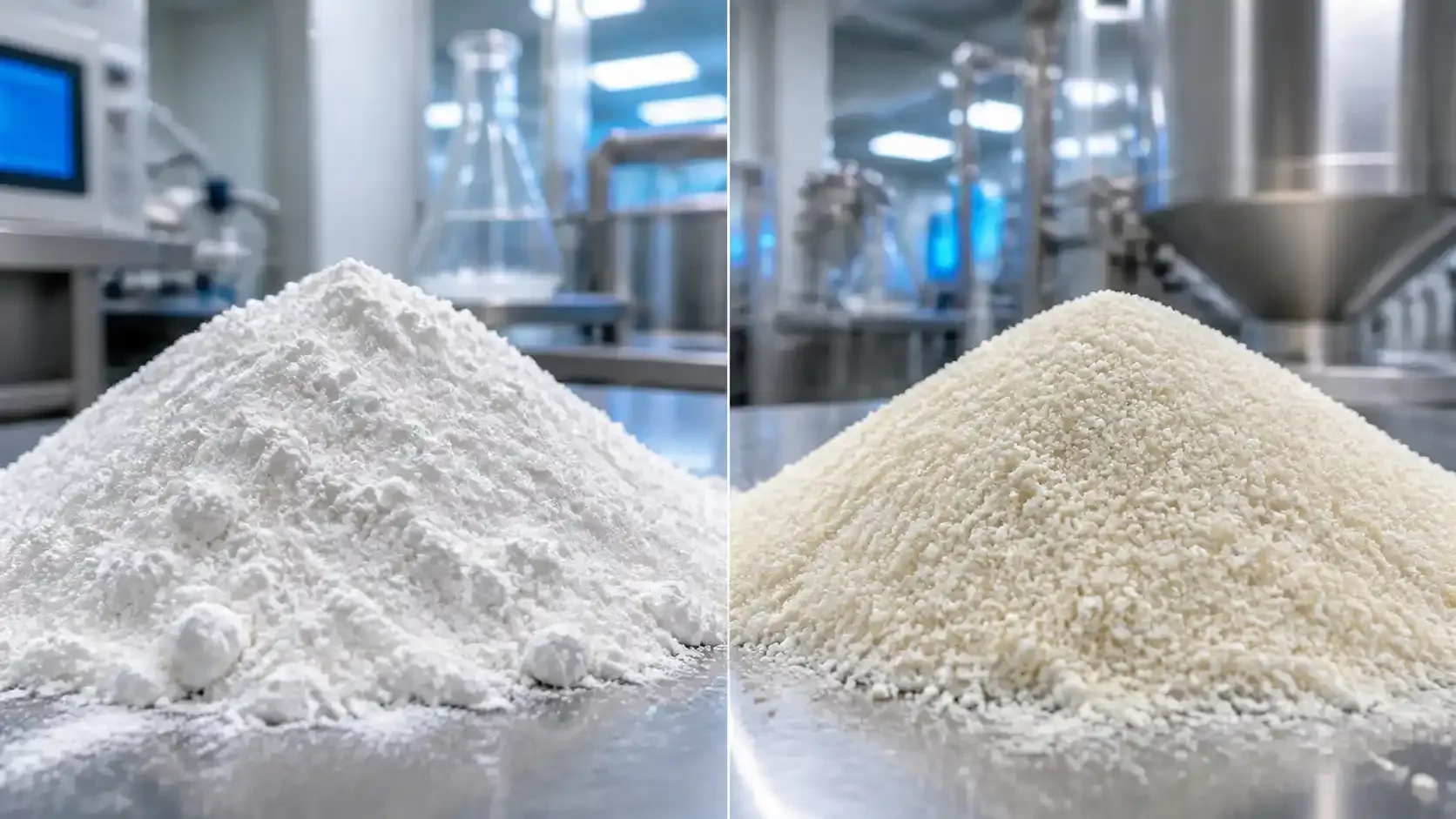
For many procurement teams, microcrystalline cellulose (MCC) and resistant dextrin show up in the same sourcing cycle—even though one is a tablet excipient and the other is a soluble dietary fiber. The overlap is practical: brands are launching more tablets, sachets, gummies, and ready-to-mix powders that need clean processing, stable texture, and predictable documentation.
The fastest way to avoid rework is to treat MCC and resistant dextrin as two different “spec languages” and learn how to read them correctly—especially when evaluating a microcrystalline cellulose manufacturer China or a resistant dextrin manufacturer China.

Category: Ingredient Encyclopedia & Fundamentals
Why buyers often source MCC and resistant dextrin together
MCC and resistant dextrin solve different problems, but buyers frequently evaluate them side by side for three reasons:
- Portfolio planning: supplements may combine tablets (MCC-heavy) with drink mixes (fiber-heavy) under the same brand.
- Manufacturing reality: both ingredients can be ordered in bulk and require consistent flowability, packaging integrity, and stable shelf life.
- Documentation pressure: COA, TDS, and food/pharma compliance questions tend to land on the same procurement desk.
To make the distinction clearer, the table below summarizes what matters most when you compare a microcrystalline cellulose supplier and a resistant dextrin manufacturer China.
Quick comparison for sourcing intent
| Topic | Microcrystalline Cellulose (MCC) | Resistant Dextrin (Soluble Corn Fiber) |
|---|---|---|
| Ingredient structure | Purified, partially depolymerized cellulose | Short-chain glucose polymer (often called resistant maltodextrin) |
| Common formats | Tablets, capsules, granules; also cosmetics textures | Powders, beverage mixes, nutrition bars, low-sugar foods |
| Primary role | Binder/diluent/disintegrant; texture stabilizer | Soluble dietary fiber for fiber claims and low-GI positioning |
| Typical buyer risk | Wrong grade → poor flow, weak hardness, slow disintegration | Wrong specs → haze, unexpected viscosity, caking, label disputes |
| Specs buyers should “speak” | Particle size, bulk density, compressibility, pharmacopeia alignment | Fiber %, solubility, water activity, microbiology, pH, viscosity |
A simple side-by-side review helps procurement teams avoid applying tablet-excipient logic to a soluble fiber, or fiber-label logic to a compression-sensitive tablet grade. That distinction matters early, because sampling, internal QA review, pilot batching, and final supplier qualification all move faster when the right acceptance criteria are defined from the beginning rather than retrofitted after a failed trial.

In practice, MCC tends to be judged by how it behaves under compression and during downstream tablet processing, while resistant dextrin is judged by what happens in solution, in storage, and on the final label. Buyers that keep these evaluation paths separate usually reduce reformulation risk and shorten the approval cycle for both categories.
Microcrystalline cellulose fundamentals that affect product performance
What MCC is used for in real purchasing scenarios
MCC is widely used in solid dosage manufacturing because it helps formulators balance tablet hardness, disintegration, and content uniformity. It is also used as a texture and stability aid in cosmetics, where the same supplier questions repeat: consistency, grade clarity, and traceable QC.
Buyers searching for a Recommended Chinese Microcrystalline Cellulose Manufacturer are usually trying to avoid one of these outcomes:
- Tablets that cap or laminate because the grade compresses differently than expected.
- Powder blends that segregate due to particle size mismatch.
- “Equivalent” MCC that looks fine on paper but behaves differently on the press.
The three MCC parameters most often misunderstood
Even experienced buyers may treat MCC as a commodity. A more reliable approach is to tie each parameter to a production consequence.
- Particle size distribution
Drives blend uniformity and flow. Impacts how MCC behaves as a dry binder and how it interacts with APIs or other excipients. - Bulk density
Affects die fill and tablet weight stability. Changes how much material fits into a given volume—critical when tooling and dosing targets are tight. - Compressibility profile
Directly impacts hardness, friability, and often disintegration behavior. Different grades can produce very different outcomes even at the same compression force.
For buyers who want a structured way to connect grade selection with QC language, the page titled MCC grades formulation and QC guide is a useful reference point when building internal spec sheets and comparing a microcrystalline cellulose manufacturer China against your target tablet performance.
Resistant dextrin essentials for foods, drinks, and supplement powders
What resistant dextrin is and why “soluble corn fiber” matters
Resistant dextrin—often positioned as resistant maltodextrin—is valued because it behaves like a soluble dietary fiber while maintaining a clean sensory profile in many applications. Unlike fibers that quickly raise viscosity or create gritty mouthfeel, resistant dextrin is typically chosen when formulators need high fiber content with minimal taste disruption.
When buyers search for a Recommended Chinese Resistant Dextrin Manufacturer, the real intent is usually one of these:
- Achieve a consistent fiber claim and pass label checks.
- Keep beverages clear or low-haze.
- Maintain process stability under heat and acid conditions.
Key spec signals buyers should look for on the COA
Based on the technical positioning commonly used for resistant dextrin made from corn starch, typical checkpoints include:
- Appearance: white to light yellow powder
- Fiber content: commonly stated as ≥82% (and sometimes higher on a dry basis)
- Protein: typically ≤6.0%
- Water solubility: often communicated as about 70%
- Low water activity: supports easier storage and reduced caking risk
These numbers should not be read in isolation. For procurement, the practical question is: do the specs match your format?
- For clear drinks, solubility and low viscosity matter as much as fiber percentage.
- For meal replacements and sachets, low water activity and packaging control help reduce clumping during shipping and warehousing.
For technical context on naming and performance expectations, it can help to review how suppliers describe resistant maltodextrin and digestion-resistant dextrin as closely related references within the resistant dextrin category.
How Chinese manufacturers typically produce resistant dextrin and soluble corn fiber
Most export-oriented plants describe a similar production logic:
- Raw material: commonly NON-GMO corn starch as the primary substrate.
- Enzymatic conversion: controlled hydrolysis or restructuring supported by imported biological enzymes.
- Automation: centralized control systems to stabilize batch-to-batch consistency.
- In-house QC: routine testing for fiber content, microbiology, water activity, and stability.
From a buyer’s perspective, the point is not the marketing phrasing—it’s what the manufacturer can document. A capable soluble corn fiber supplier China should be able to show:
- incoming raw material checks,
- process controls that keep the product within the declared fiber range,
- final release testing aligned to the COA.
What “recommended” should mean when shortlisting Chinese suppliers
A “recommended” shortlist is rarely about one claim. It’s a combination of spec literacy + predictable documentation + fit-for-purpose manufacturing.
Below is a practical checklist you can reuse across RFQs when screening a Recommended Chinese Microcrystalline Cellulose Supplier or a Recommended Chinese Resistant Dextrin Manufacturer.
COA and spec checklist for MCC
- Grade identification is unambiguous: grade name/number matches the TDS.
- Key physical parameters are disclosed: particle size, bulk density, and compressibility-related indicators.
- Compliance language is clear: buyers should confirm which pharmacopeial or internal standards the MCC is manufactured to, and whether change control exists for grade adjustments.
COA and spec checklist for resistant dextrin
- Fiber content matches your labeling plan: e.g., fiber content ≥82% if that is what your product positioning requires.
- Solubility and handling cues are consistent: look for low water activity indicators and storage recommendations.
- Microbiology limits are stated and consistent across lots.
- Stability claims are tied to specs: heat/acid stability should be supported by application testing or at minimum consistent lot data.
Packaging and logistics checks for both ingredients
- Moisture control: liners, sealing method, and pallet protection should match the hygroscopic risk of the ingredient.
- Traceability: batch numbers link back to COA and production records.
- Shelf-life realism: storage conditions should be specific enough to be actionable in your warehouse.
Where buyers often go wrong when comparing MCC and resistant dextrin
The most common sourcing mistakes are subtle:
- Using the same “pass/fail” logic for two different ingredients. MCC is grade-sensitive for compression behavior; resistant dextrin is spec-sensitive for solubility and label outcomes.
- Overweighting fiber percentage without checking handling and solubility. A resistant dextrin manufacturer China may meet fiber targets but still fail your beverage clarity or caking expectations.
- Assuming “pharma-like” documentation automatically exists for food fibers. Some suppliers run strong QC labs for both excipients and fibers, but buyers should confirm what is actually included in each document pack.
A practical way to connect research with supplier discovery
When you need deeper examples of how suppliers present these ingredients—without relying on generic brochures—reviewing technical pages can speed up internal alignment.
- For more application framing around fiber systems in foods and drinks, see food and beverage ingredients dietary fiber.
- If your roadmap includes liquid fiber systems for sugar or fat replacement, polydextrose syrup is a useful comparator for how soluble fibers are specified and documented.
If you are building a shortlist of suppliers that match the checkpoints above, start from verifiable technical documentation and then triangulate capabilities across public product pages and QC guidance. One example source for that kind of cross-category documentation is www.sdshinehealth.com, which consolidates information on both microcrystalline cellulose and resistant dextrin from Chinese manufacturers.


