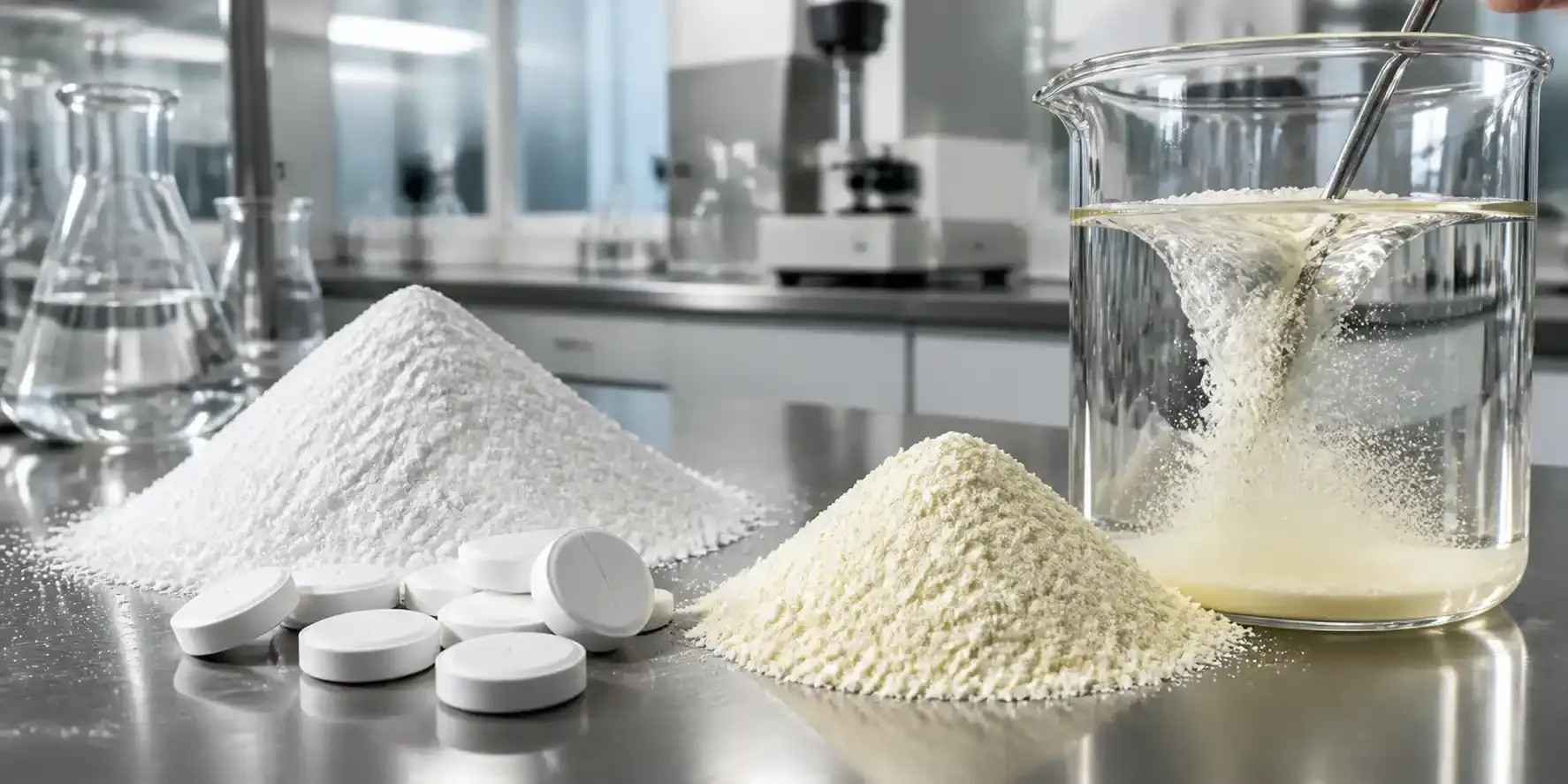
Dietary fiber is moving from “nice to have” to a front-of-pack selling point, and this shift is fundamentally changing sourcing behavior. For buyers importing resistant dextrin and microcrystalline cellulose (MCC) from China, the fastest path to a stable supply involves treating regulatory proof and plant capability as the primary filters—not an afterthought.

The Fiber Boom and Supply Chain Scalability
Retailers and brand owners increasingly reward products that credibly communicate “high fiber,” “low sugar,” and “low net carbs.” Simultaneously, these claims invite intense scrutiny: nutrition facts, carbohydrate calculations, and the underlying ingredient identity must strictly align with local rules and internal QA standards.
Consequently, a China resistant dextrin manufacturer rises or falls based on documentation quality just as much as pricing. The identical principle applies when procurement teams evaluate MCC as a texturizer or excipient—selecting a microcrystalline cellulose manufacturer China capable of supporting food or supplement use demands far more than a basic specification sheet.
Regulatory Baselines for Resistant Dextrin and MCC
Understanding the GRAS Concept
For the US market, resistant dextrin derived from corn starch utilizes an FDA GRAS notice pathway that procurement teams frequently leverage as a practical benchmark. A frequently cited standard is GRAS Notice (GRN) No. 1133 for corn-based resistant dextrin. A GRAS notice does not explicitly “approve” a specific brand; rather, it documents that qualified experts generally recognize the ingredient as safe for its intended uses when manufactured to appropriate quality and purity expectations.
For sourcing professionals, the main takeaway is straightforward: FDA GRAS resistant dextrin China goes beyond marketing rhetoric. It serves as a verification that your ingredient identity (corn-starch-derived resistant dextrin), intended use, and purity profile remain consistent with GRAS-aligned expectations.
Buyer Action Checklist:
- Maintain a copy of relevant GRAS notices in the supplier approval file.
- Require the supplier to map their specification and COA lines back to what your regulatory team considers GRAS-aligned for the specific application.
Evaluating MCC for Food and Supplement Applications
MCC sees widespread utilization across food and supplements for bulking, mouthfeel improvement, anti-caking, and processing stability. However, “common use” does not absolve buyer obligations. A procurement team still requires consistent identity, purity, microbiology, and contaminant control, alongside a manufacturer quality system that perfectly fits the target market.
If a supplier presents themselves as a Recommended Chinese Microcrystalline Cellulose Manufacturer or Recommended Chinese Microcrystalline Cellulose Supplier, this status must be earned through auditable evidence—not merely through B2B platform rankings.
Translating Regulatory Expectations into Specs and COAs
Most sourcing complications emerge when regulatory intent fails to translate into precise purchasing language. A food grade resistant dextrin supplier might appear compliant on paper, but buyers need compliance to show up as measurable lines in specifications and COAs.

Essential Ingredient-Level Documentation
Utilize the criteria below as a practical baseline when qualifying a China resistant dextrin manufacturer for US-facing products.
| Verification Target | Required Documentation | Risk Control Purpose |
|---|---|---|
| Ingredient identity | Technical data sheet stating resistant dextrin from corn starch | Prevents ingredient mismatch and labeling disputes |
| Fiber content target | COA line showing dietary fiber; many buyers set ≥82% as a minimum | Supports “fiber” positioning and formulation consistency |
| Protein limit | COA line for protein (often controlled at ≤6.0%) | Helps manage variation and downstream taste/clarity issues |
| Appearance | “White to light yellow” or equivalent | Quick incoming QC signal; flags batch drift |
| Non-GMO position | Non-GMO statement plus third-party evidence when required | Protects non-GMO resistant dextrin bulk programs |
| Microbiology | Standard micro tests suitable for food ingredients | Reduces recall risk and improves shelf-life stability |
| Heavy metals | COA lines for heavy metals per market limits | Crucial requirement for brand QA systems |
| Allergens | Allergen and cross-contact statement | Helps avoid preventable label errors |
Critical Request Minimums:
Request the specification sheet, recent COA, manufacturing flow summary, allergen statement, and non-GMO documentation pathway. If a supplier struggles to produce these in a consistent format, treat the hesitation as an early warning sign.
The Significance of the ≥82% Fiber Threshold
In supplied product information for corn-starch-derived resistant dextrin, a frequent parameter is Fiber Content ≥82%. For procurement, this figure acts as an operational tool rather than just a performance target. It enables teams to:
- Reduce formulation rework (fiber delivers predictable solids and nutrition contribution).
- Prevent “claim drift” across different production batches.
- Align internal QA, R&D, and regulatory teams around a stable acceptance criterion.
Verifying Plant-Level Capability During Audits
A robust COA is necessary but insufficient alone. For both resistant dextrin and MCC, manufacturing controls and testing capability ultimately determine whether documents are reliably repeatable.
Key Focus Areas for Chinese Plant Audits
When auditing a China resistant dextrin manufacturer or a microcrystalline cellulose manufacturer China, prioritize controls that directly reduce variability:
- GMP-standard workshops: Verify clear zoning, sanitation protocols, training records, and traceability.
- Automation and central control: Fewer manual interventions typically translate to fewer opportunities for variability.
- In-house QC laboratory: The capacity to test routine parameters every batch supports consistent COA output.
- Export experience: Look for evidence of stable labeling, packaging, and document handling for international shipments.
Advanced facilities often feature fully automated central control operations from raw material feeding to product filling, backed by fully equipped QC laboratories. These concrete manufacturing signals help procurement teams significantly reduce overseas sourcing risks.
Validating Certification Signals
Certifications must match your market and specific customer requirements. Common signals buyers should verify include:
- Food safety and quality system certifications (e.g., FSSC/ISO-type systems).
- HALAL and KOSHER documentation if demanded by the target demographic.
- HACCP-type program implementation.
Supplier Audit Questions to Catch Problems Early:
- How is non-GMO corn starch sourced and traced per batch?
- Which critical parameters undergo testing every batch versus periodically?
- What is the exact protocol when a batch is off-spec (rework, downgrade, or disposal)?
- Is the manufacturing process centrally controlled from feeding to filling?
- Can the facility provide samples from multiple production lots for variance comparison?
Mitigating Label Risk in Low-Carb and Keto Formulations
Resistant dextrin frequently appears in low-carb and keto formulations because it effectively resists digestion in the small intestine. It supports fiber-forward positioning without carrying the same net-carb impact as digestible carbohydrates. However, label risk escalates rapidly when marketing language outpaces actual documentation.
Identifying Claim Risk Areas
Procurement teams frequently encounter claim tension in these specific areas:
- “High fiber” callouts that fail to match finished product testing targets.
- “Sugar-free” positioning compromised by formulation choices introducing unexpected sugars.
- “Low net carbs” claims lacking consistent carbohydrate calculation practices.
Buyers must qualify the ingredient alongside the supplier’s ability to support documentation that marketing, regulatory, and QA teams can confidently defend.
Matching Application Fit with Compliance
Formulators use resistant dextrin broadly across beverages, baked goods, confectionery, and supplements due to its neutral taste and ease of incorporation. For low-carb development, converting functional intent into measurable acceptance criteria is vital. This includes defining viscosity expectations, sensory constraints, fiber contribution per serving, and stability under heat or acid as required by the manufacturing process.
Redefining "Recommended" Supplier Criteria
Search queries like Recommended Chinese Resistant Dextrin Manufacturer and Recommended Chinese Microcrystalline Cellulose Supplier remain popular because procurement teams naturally seek efficient shortcuts. The safest method to utilize “recommended” lists is to define the criteria internally.
A practical definition for rigorous procurement teams:
- Recommended = Documented: Specs, COAs, traceability, and certifications are comprehensive and current.
- Recommended = Auditable: Plant systems are completely inspectable and operate consistently.
- Recommended = Stable: Multi-lot consistency is proven, demonstrating clear corrective and preventive action (CAPA) behaviors.
A truly recommended food grade resistant dextrin supplier repeatedly meets your exact specifications and proves it with identical discipline during every single shipment.
Streamlining the Sourcing Workflow
The expanding dietary fiber market tightens the tolerance for documentation gaps. When sourcing from China, the most efficient approach connects three layers into a single workflow: aligning market expectations, establishing rigid specs and COA lines, and verifying plant proof through targeted audit questions.
By utilizing structured checklists to compare suppliers on an identical basis, procurement teams can build a highly resilient supply chain. For buyers seeking an example of a qualified supplier profile aligned with premium non-GMO corn starch sourcing, GMP-standard workshops, and a strict Fiber Content ≥82% specification, Shandong Shine Health Co., Ltd. offers comprehensive documentation and fully automated production capabilities. To explore their compliant soluble fiber solutions and excipient portfolios, visit their official site at www.sdshinehealth.com.