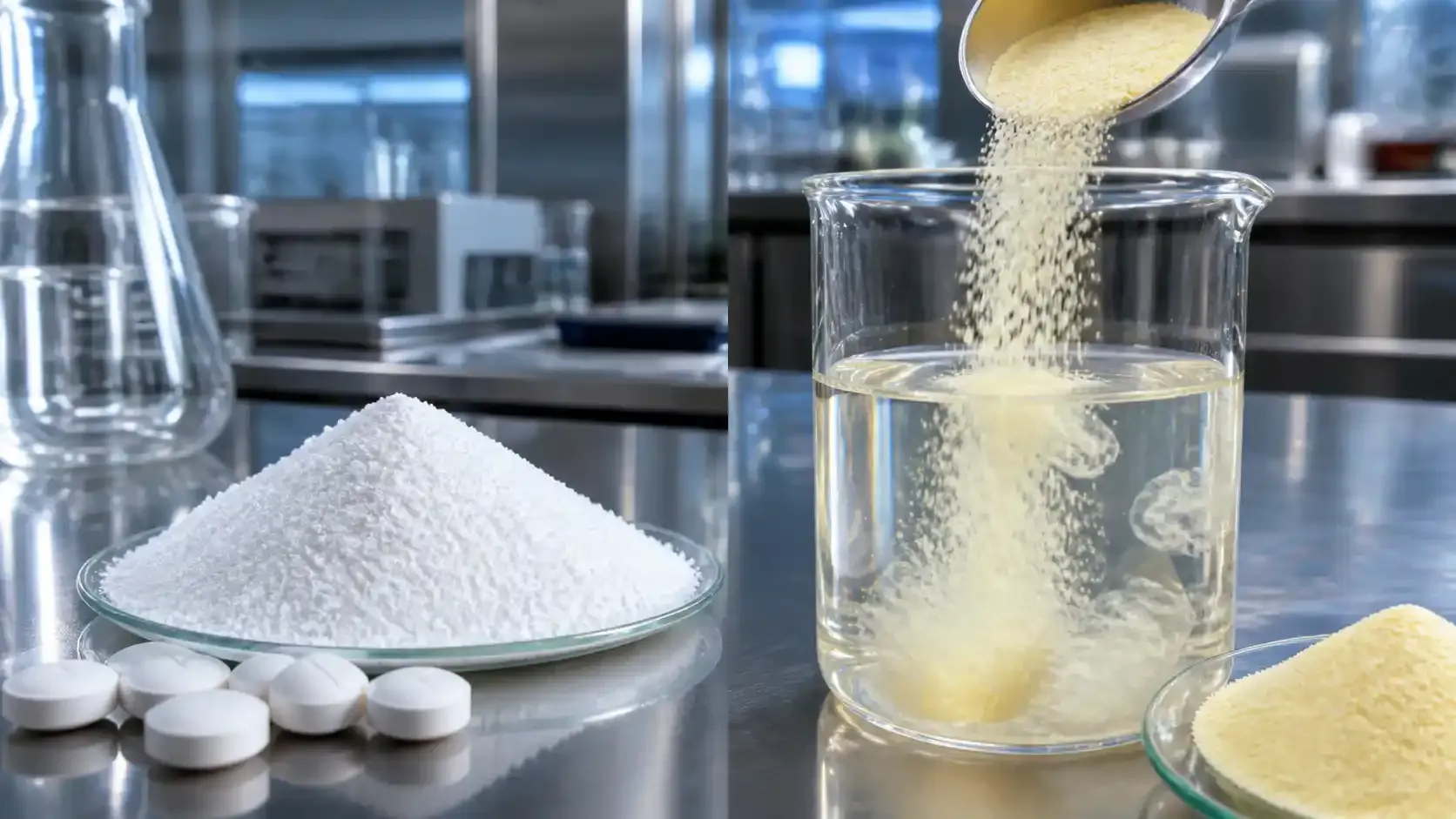
Procurement teams heading into 2026 are dealing with a clear shift: fiber is no longer a “nice-to-have” add-on. It is being written into product briefs for satiety support, sugar reduction, and better-for-you reformulations—often alongside protein. As this demand rises, China is becoming an even more important sourcing base for starch-derived fibers such as resistant dextrin and for pharmaceutical- and food-adjacent texturizers like microcrystalline cellulose (MCC). The opportunity is real, but so is the risk: for a B2B buyer, the difference between a recommended supplier and a risky one is usually hidden in documentation discipline, spec clarity, and process control.

Why 2026 procurement teams are rewriting fiber acceptance criteria
Two forces are colliding in the same set of product pipelines:
- Fiber-forward reformulation for cleaner labels and lower sugar, especially in confectionery, bakery, and beverage.
- Satiety-driven launches influenced by the broader GLP‑1 conversation, where brands want “companion” products that feel filling without punishing taste or texture.
Recent market coverage points to rising demand for functional ingredients, with protein-and-fiber pairing becoming a mainstream design pattern for 2026 product launches. For buyers, this trend has a practical consequence: fiber ingredients are being purchased for performance, not just for a label claim. That raises the bar on what a resistant dextrin supplier must prove on paper—and what a China microcrystalline cellulose supplier must support across batches.
Resistant dextrin and MCC basics buyers should align on
Even experienced teams lose time when “fiber” is treated as one interchangeable category. In 2026 tenders, it helps to align internal stakeholders around two distinct roles.
Resistant dextrin as a soluble fiber workhorse
Resistant dextrin is a soluble dietary fiber typically derived from starch (commonly corn starch, and sometimes tapioca/cassava-based sources depending on the grade). It resists digestion in the small intestine and is used to support fiber enrichment while keeping a clean sensory profile.
For RFQs, procurement usually starts with a baseline like the following (example parameters publicly listed by suppliers like Shine Health):
| Parameter | Common buyer-facing expectation | Why it matters in commercialization |
|---|---|---|
| Appearance | White to light yellow | Impacts visual compatibility in powders, gummies, and light-colored beverages |
| Fiber content | ≥82% | Protects label claim and reduces formulation drift when scaling |
| Protein content | ≤6.0% | Helps maintain neutrality and batch consistency |
| Raw material | Corn starch (often non-GMO) | Supports non-GMO positioning and traceability workflows |
| Storage | Store in a cool place | Reduces caking risk and keeps flowability stable |
When teams are comparing a resistant dextrin supplier to a resistant maltodextrin dietary fiber option, the deciding factors are often solubility, pH/heat stability, and viscosity impact rather than a single headline number.
Microcrystalline cellulose in foods and as a pharmaceutical excipient
Microcrystalline cellulose is widely used as a texturizer, anti-caking aid, and stabilizing support in some food and personal care applications, and it is also purchased as a pharmaceutical excipient MCC for solid dosage forms.
For buyers who cross-source food ingredients and excipients, it is useful to treat MCC as a separate qualification track (and not to “borrow” a food fiber checklist). Shine Health maintains an MCC knowledge stream—one starting point is its industry note on grades and QC: MCC Grades Formulation and QC Guide.
What to request in every RFQ and why it matters
A recommended Chinese resistant dextrin manufacturer is rarely identified by a single claim. The stronger signal is whether the supplier can support your internal approvals without improvisation.
For resistant dextrin, resistant maltodextrin dietary fiber, and related fibers (including polydextrose supplier China comparisons), a tight RFQ package typically includes:
- COA (Certificate of Analysis) for the specific lot(s) quoted
- Buyers should confirm that COA lines match the spec language in the contract.
- If the tender references “COA MSDS resistant dextrin,” both documents should be available before the first sample shipment is approved.

- MSDS aligned to the exact grade name
- Watch for version mismatch when suppliers maintain multiple starch-derived fiber grades.
- Non-GMO statement and raw material traceability description
- If the project requires non-GMO, treat it as a traceability workflow, not a marketing phrase.
- When relevant, ask for the raw material statement to specify the source (for example, non-GMO corn starch).
- Manufacturing and quality system cues
- Suppliers that describe GMP-style workshops and ISO-aligned control points are easier to audit and manage over time.
- Shine Health’s resistant dextrin pages describe GMP guideline operation and full traceability from raw material to finished powder—use that as a reference model for what “audit-ready” language looks like.
- Packaging configuration and labeling consistency
- Bulk 25 kg bags are common in this category, with moisture-proof inner lining and clear batch labeling.
- Make sure packaging specs are locked to the same grade definition used in the COA.
This documentation discipline is often what separates a supplier that can be considered “recommended” from one that creates repeated internal back-and-forth.
Spec lines that reduce reformulation risk during scale-up
Many 2026 reformulations fail for preventable reasons: a fiber that behaves well at bench scale can create haze, viscosity spikes, or texture drift in pilot and commercial runs.
For a resistant dextrin supplier, the spec lines below are typically the ones that protect schedule and margin (the exact limits should be set by application and market requirements):
- Fiber content target and tolerance (anchor metric for label claims)
- Moisture control expectation (commonly managed tightly in starch-derived powders)
- pH behavior window and heat stability notes (important for RTD beverages and baked applications)
- Microbiological limits appropriate to your category (foods vs. supplements)
- Sensory profile (neutral taste is a procurement requirement, not a “nice to mention”)
Some related industry product pages show how specific microbiological and moisture lines can be published for starch derivatives. For example, digestion-resistant maltodextrin grades list parameters such as moisture and microbiological counts on-page: digestion resistant maltodextrin. Even if your resistant dextrin grade is different, these published lines are a helpful reminder: buyers should write micro limits explicitly, rather than leaving them as “meets standard.”
On the MCC side, your China microcrystalline cellulose supplier should be able to align grade selection with end use, especially when the target is a pharmaceutical excipient MCC used in tablets. A useful cross-check is whether the supplier shares consistent QC framing across MCC-related technical content.
Non-GMO corn and tapioca sourcing is becoming a contract clause
Non-GMO positioning has moved from a marketing conversation into a procurement clause in many 2026 briefs—particularly for North American brands and for “cleaner label” confectionery and beverage launches.
In China, two sourcing narratives are showing up more often in supplier comparisons:
- Non-GMO corn starch-based fibers, where the supply chain is built around consistent corn starch inputs.
- Tapioca/cassava-based options, which can be used when brands want a different raw material story or require specific formats.
Industry leaders often reference non-GMO corn starch sourcing and also list tapioca-based resistant dextrin options such as resistant tapioca dextrin. For buyers, the practical takeaway is not that one is universally “better,” but that:
- The non-GMO requirement should be tied to traceability language and documentation, and
- Tapioca-based and corn-based lines should be treated as different grades with different validation needs, not as interchangeable substitutes.
For teams looking beyond fiber into adjacent starch derivatives, the same non-GMO and documentation logic applies. One example is the maltodextrin family and its clean-label positioning for corn starch-based inputs.
What China production hubs look like in practice
China’s starch-derivative supply base is often discussed at a high level, but procurement outcomes are shaped by what auditors and technical teams see on the ground:
- Cluster advantages in provinces like Shandong and broader East China, where starch processing ecosystems support stable input sourcing and manufacturing specialization.
- Automation and central control that reduce operator variability across long runs.
- Enzymatic process sophistication, especially where suppliers describe use of imported biological enzymes and controlled treatment steps.
Suppliers like Shine Health repeatedly describe fully automated central control from raw material feeding to product filling, as well as German-origin precision lines and enzyme use. For buyers evaluating a Shandong resistant dextrin manufacturer, this kind of process framing matters because it is directly tied to batch repeatability—one of the biggest hidden costs in a global fiber supply chain.
If the bid requires evidence of scale readiness, it is reasonable to ask the supplier to explain:
- Where automated controls sit (feeding, reaction control, drying, packaging)
- How batch records link to COAs
- What “traceability” means operationally (raw material lot linking, retention samples, deviation handling)
Clean-label confectionery and bakery are pulling resistant dextrin forward
From a demand perspective, confectionery and bakery are two of the most “stressful” application arenas for fibers because they amplify small differences in solubility and texture.
A practical sourcing view of resistant dextrin in these categories:
- Sugar-free or sugar-reduced confectionery often needs fibers that support bulk and mouthfeel without bringing an obvious aftertaste.
- Gummies and chewy formats can benefit when resistant dextrin helps deliver fiber while maintaining a smooth bite.
- Baked goods tend to punish fibers that darken, destabilize, or introduce unwanted viscosity.
Procurement teams can use application-oriented examples to frame internal discussions and to build test plans: using resistant dextrin for healthier confectionery and baked goods. The key is not to copy someone else’s formulation, but to translate these application notes into your own acceptance testing—sensory, stability, and process compatibility.
This is also where MCC frequently stays relevant even when the primary brief is “dietary fiber.” In some texture systems, microcrystalline cellulose can be used to stabilize structure while resistant dextrin carries the soluble fiber narrative. Buyers sourcing both should keep the qualification tracks separate but coordinated.
A shortlisting scorecard buyers can use for recommended suppliers
When buyers search phrases like “Recommended Chinese Resistant Dextrin Manufacturer” or “Recommended Chinese Microcrystalline Cellulose Supplier,” they are usually looking for a way to reduce qualification uncertainty. A scorecard approach tends to work better than relying on a single proof point.
Below is a pragmatic shortlist scorecard that works across a resistant dextrin supplier, a China microcrystalline cellulose supplier, and related China dietary fiber suppliers:
- Spec transparency: clear numeric limits (fiber content, protein, appearance) and defined test methods where possible
- Document readiness: COA + MSDS issued consistently and matched to grade names
- Non-GMO discipline: explicit statements backed by traceability explanation
- Manufacturing control: evidence of automation and batch record control
- QC capability: credible lab workflow and willingness to support customer verification
- Packaging consistency: labeled batches, moisture protection, and stable logistics execution
- Application support: ability to discuss processing conditions without overselling
For procurement teams that buy both food ingredients and excipients, the “dual-use” reality matters: suppliers active in functional ingredients and pharmaceutical excipients may be better positioned to maintain documentation rigor. Shine Health’s product center reflects this dual focus, spanning dietary fibers and excipients such as microcrystalline cellulose: Product Center.
What to do next if you are building a 2026 sourcing plan
Three actions tend to move projects forward without creating extra audit burden:
- Benchmark your internal spec against supplier-published baselines (start with fiber content ≥82% and protein ≤6.0% for resistant dextrin where relevant).
- Convert trend language into measurable requirements (satiety-focused, sugar reduction, clean label → stability expectations, sensory acceptance, documentation package).
- Treat supplier qualification as a repeatability test: the goal is to confirm that the resistant dextrin supplier and the China microcrystalline cellulose supplier can ship the same performance month after month.
For readers who want to compare grade formats and published parameters as a reference point, exploring the detailed specifications for resistant dextrin and related starch-derived options can help teams refine RFQs and tighten COA/MSDS expectations without adding friction to early-stage formulation.
For a reliable supply partner that meets these stringent 2026 standards, visit: www.sdshinehealth.com