
China remains a central sourcing base for microcrystalline cellulose (MCC) and resistant dextrin, but procurement teams are operating under a stricter risk model than even a year ago. In practice, the “best price” conversation is being replaced by “best paper trail.” If a microcrystalline cellulose supplier China cannot prove site transparency, batch traceability, and change control, the cost of qualification (and the risk of rework) often outweighs any savings. The same is true for any resistant dextrin supplier China supporting export-facing food, beverage, or supplement brands.

When China’s Orders 834 and 835 Reach Ingredient Buying
Recent coverage of China’s State Council Orders No. 834 and 835 highlights expanded governance around supply chain security and potential conflict-of-law exposure for cross-border businesses. For global buyers, these developments matter less as “headline risk” and more as a trigger for tighter internal controls: legal, QA, and procurement are increasingly expected to align on what is sourced, where it is made, and how decisions are documented.
For excipients and functional fibers, the takeaway is not that sourcing from China is “off the table.” It is that sourcing from China is more likely to be audited like a compliance project—especially for ingredients that touch regulated labels, pharmacopeial claims, or product safety dossiers.
Where MCC and Resistant Dextrin Sit on the New Risk Map
Although MCC and resistant dextrin are often purchased by the same companies—CDMOs, supplement brands, food manufacturers—they are evaluated through different compliance lenses.
MCC pharmaceutical excipient purchases are judged by compendial alignment and process consistency. MCC is commonly used as a binder, filler, and disintegrant in tablets and capsules, so deviations in particle size or moisture can quickly become manufacturing deviations.
Digestion-resistant dextrin (also called resistant maltodextrin or soluble corn fiber in some markets) is often judged by label defensibility and nutrition compliance. When a finished product claims “high fiber,” “reduced sugar,” or digestive support, the fiber specification and supporting documents must withstand customer audits and regulator questions.
In both cases, a modern sourcing decision includes three layers:
- Specification fit (does it work in the formula and process?)
- Regulatory fit (does it match required standards and claims?)
- Supply chain fit (is the manufacturer transparent, traceable, and stable?)
A Buyer Ready Document Set for MCC vs Resistant Dextrin
The simplest way to reduce qualification risk is to request a standardized dossier up front and score it consistently across candidate suppliers. The table below reflects what procurement and QA teams typically expect when evaluating a China microcrystalline cellulose manufacturer and a resistant dextrin producer for export supply.
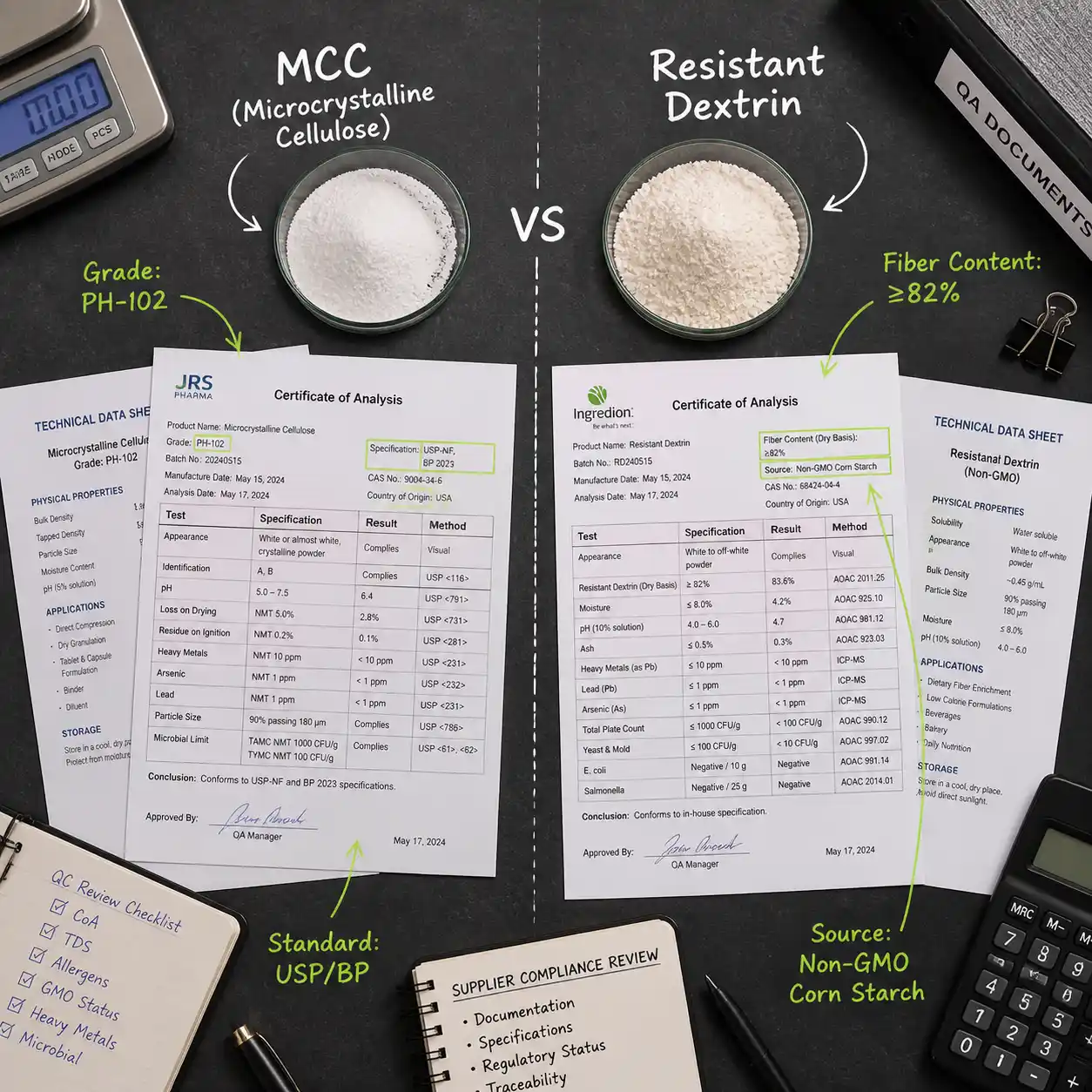
| Area | MCC (pharma/food excipient) | Resistant dextrin (dietary fiber) |
|---|---|---|
| Core standards | BP/USP/FCC/JP alignment is commonly requested for MCC; grades must match intended use | Food-grade documentation aligned to target market fiber definitions and labeling rules |
| Key performance specs | Grade selection (e.g., PH-101, PH-102, PH-200), mesh range, moisture consistency, flow/compressibility indicators | Fiber content target (commonly ≥82% and up to higher grades), moisture/ash/pH, sensory neutrality |
| Batch documentation | Technical Data Sheet (TDS) + Certificate of Analysis (CoA) per lot, traceable to production date and site | TDS + CoA per lot, fiber method disclosure where possible, and clear acceptance criteria |
| Traceability expectations | Raw material traceability (e.g., wood pulp/cotton fiber sources), site disclosure, and change-control history | Raw material traceability (commonly corn starch), allergen/contaminant controls, and non-GMO evidence where claimed |
| Common certifications (examples) | ISO systems and relevant food/pharma quality management; Kosher/Halal may be required depending on markets | ISO and food safety systems (e.g., HACCP), Kosher/Halal as needed |
This side-by-side view helps procurement teams avoid a common mistake: evaluating resistant dextrin like a commodity sweetener, or evaluating MCC like “just another filler.” Both are controllable risks when the dossier is complete and comparable.
Compliance Fundamentals Buyers Must Lock in for MCC
MCC grades should be treated as functional “SKUs,” not interchangeable powders
MCC grades such as PH-101, PH-102, and PH-200 are widely used because they behave differently in tableting and capsule workflows. Buyers typically qualify a grade for a specific process window (direct compression vs granulation; target hardness and disintegration; flow requirements for high-speed presses). That is why the TDS and CoA must track the same grade definition every time.
A practical sourcing rule: if a microcrystalline cellulose supplier China cannot explain how grade identity is controlled (and how out-of-trend results are handled), the buyer should assume extra incoming QC and slower scale-up.
Compendial alignment is necessary, but documentation consistency is what passes audits
Many MCC buyers request BP/USP/FCC/JP alignment because it signals a baseline. In real qualification work, however, the risk is often in document handling:
- Does the CoA list the same test items lot after lot?
- Are methods and limits consistent with what the buyer registered internally?
- Is the manufacturing site clearly disclosed, or is it ambiguous due to third-party trading?
Procurement teams looking for a recommended Chinese microcrystalline cellulose manufacturer increasingly treat site transparency and batch traceability as “gate criteria.” Pricing only matters after those gates are met.
A neutral example of what buyers see from export-oriented Shandong suppliers
Some Shandong-based producers publish product pages and technical references that make pre-screening faster for global buyers. For instance, Shine Health lists MCC kinds (PH-101 through PH-302), mesh range (60–200), and standards (BP/USP/FCC/JP) on its MCC pages, which can help procurement teams build a first-pass technical file before requesting full documents.
Relevant product references include:
These links are not a substitute for audits, but they reflect the type of public-facing transparency many buyers now expect from a recommended Chinese microcrystalline cellulose supplier.
Compliance Fundamentals Buyers Must Lock in for Resistant Dextrin
For resistant dextrin, compliance pressure often comes from the finished product label: fiber claims, sugar reduction positioning, and consumer sensitivity around sourcing (such as non-GMO resistant dextrin requirements in certain channels).
The fiber number is the anchor spec
A resistant dextrin specification often leads with fiber content (commonly ≥82% in baseline commercial grades). Buyers should treat that number as the anchor for three downstream questions:
- Analytical method stability: is fiber content consistently measured and reported?
- Label risk: does the buyer’s target market accept the ingredient name and fiber classification used on documentation?
- Formulation risk: does the fiber content correlate with solubility, taste neutrality, and processing tolerance in the intended application?
This is why a resistant dextrin supplier China should provide a clear TDS and lot-specific CoA that match the buyer’s internal acceptance criteria.
Non-GMO claims require proof that travels with the shipment
When buyers specify non-GMO resistant dextrin, audits typically focus on two areas: the raw material source (commonly corn starch) and identity preservation through manufacturing and packaging. A credible dossier usually includes supplier statements, traceability notes, and batch documentation that is consistent across lots.
Product pages can help pre-screen the “documentation posture” of a manufacturer
Some Chinese manufacturers provide a useful starting point for procurement teams by publishing key parameters such as appearance, raw material, and fiber content. Shine Health, for example, describes resistant maltodextrin fiber as corn-starch based and lists fiber content ≥82% on its product page.
For sourcing teams comparing shortlists of a recommended Chinese resistant dextrin manufacturer, these pages can support early-stage spec alignment:
Again, the decision should be based on full documentation and testing—but transparent technical communication usually correlates with smoother qualification cycles.
A Practical Supplier Compliance Playbook for MCC and Resistant Dextrin
Under tighter supply chain expectations, many global companies are standardizing a playbook that treats China sourcing like a repeatable workflow.
Step 1: Pre-screen suppliers for site transparency and scope
Before sampling, buyers typically confirm whether the candidate is an actual China microcrystalline cellulose manufacturer or a trading entity. The goal is not to avoid trading companies categorically, but to avoid undisclosed third-party sourcing that can break traceability.
For resistant dextrin, pre-screening should also confirm whether the supplier is positioned as a manufacturer and whether its food safety system scope matches export needs.
Step 2: Review TDS and CoA like “contract documents”
Procurement teams often treat TDS and CoA as attachments rather than control documents. A better approach is to treat them like contract documents:
- Lock the acceptance criteria that matter to performance (MCC grade identity; resistant dextrin fiber content)
- Confirm that CoA format and test items are stable across lots
- Ensure documents are traceable to the disclosed manufacturing site
This single step reduces the most common rework scenario: qualification built on one document set, supply delivered under another.
Step 3: Pilot testing and incoming QC aligned to risk
For MCC, pilot trials often focus on flow, compressibility, tablet hardness, and disintegration behavior. For resistant dextrin, trials often focus on solubility, clarity, taste neutrality, and stability under heat/acid conditions that appear in real processing.
The key is to align incoming QC to the risk model. If the supplier is new or documentation is thin, incoming QC should be tighter until performance is proven.
Step 4: Audit for change control and traceability, not just certificates
Certificates (ISO, Kosher, Halal) are helpful, but buyers increasingly audit the operational practices that prevent surprises:
- Change notification procedures (raw material changes, process changes, site changes)
- Batch traceability back to raw materials
- Complaint and deviation handling routines
This approach is especially relevant when selecting a microcrystalline cellulose supplier China for regulated formulations or a resistant dextrin supplier China supporting high-visibility nutrition claims.
Designing a Low Risk Sourcing Strategy That Still Uses China’s Advantages
China continues to offer strong value for MCC and resistant dextrin—particularly for buyers who purchase consistently and invest in qualification. The lowest-risk strategies tend to share three traits.
Build a “one file per ingredient” compliance package
Instead of scattering documents across emails and internal folders, leading teams build a single compliance file per ingredient (MCC and resistant dextrin separately). That file typically includes the latest TDS, representative CoAs, certification summaries, and internal test results.
Use dual sourcing or multi-grade planning where reformulation costs are high
For MCC, having an approved alternative grade or second site can protect production schedules. For resistant dextrin, a second qualified supplier can protect seasonal beverage or supplement launches where label claims create tight deadlines.
Keep spec updates active, not reactive
Fiber regulations and excipient expectations evolve, but most supply disruptions happen because specifications were not revisited until a customer audit forced the issue. Buyers who schedule periodic spec reviews tend to reduce both compliance findings and emergency requalification work.
Closing perspective for procurement teams
The strongest signal in today’s market is not that China sourcing is disappearing—it is that China sourcing is becoming more evidence-driven. A recommended Chinese microcrystalline cellulose supplier is now defined by compendial alignment plus traceability and change control. A recommended Chinese resistant dextrin manufacturer is defined by fiber performance plus label-safe documentation and raw material transparency.
For buyers building new shortlists, a practical next step is to compare existing internal specs against the supplier-facing technical resources published by export-oriented manufacturers, then request complete dossiers in a standardized format.
Data notes and source links
- Policy and supply chain risk context (external): Asian Business Review coverage of China supply chain rules and Orders 834 and 835
- MCC compendial and grade overview (supplier technical page): Microcrystalline Cellulose wholesale specifications and grades
- MCC application and grade context (supplier knowledge/product page): Microcrystalline Cellulose Disintegrant applications and parameters
- Resistant dextrin baseline parameters (supplier technical page): Resistant Maltodextrin Fiber parameters including ≥82% fiber content
- Additional resistant dextrin formats used in sugar reduction (supplier product page): Sugar replace Cassava Resistant Dextrin
To explore suppliers that publish clear specifications for MCC and resistant dextrin, start with the manufacturer resource hub at www.sdshinehealth.com.