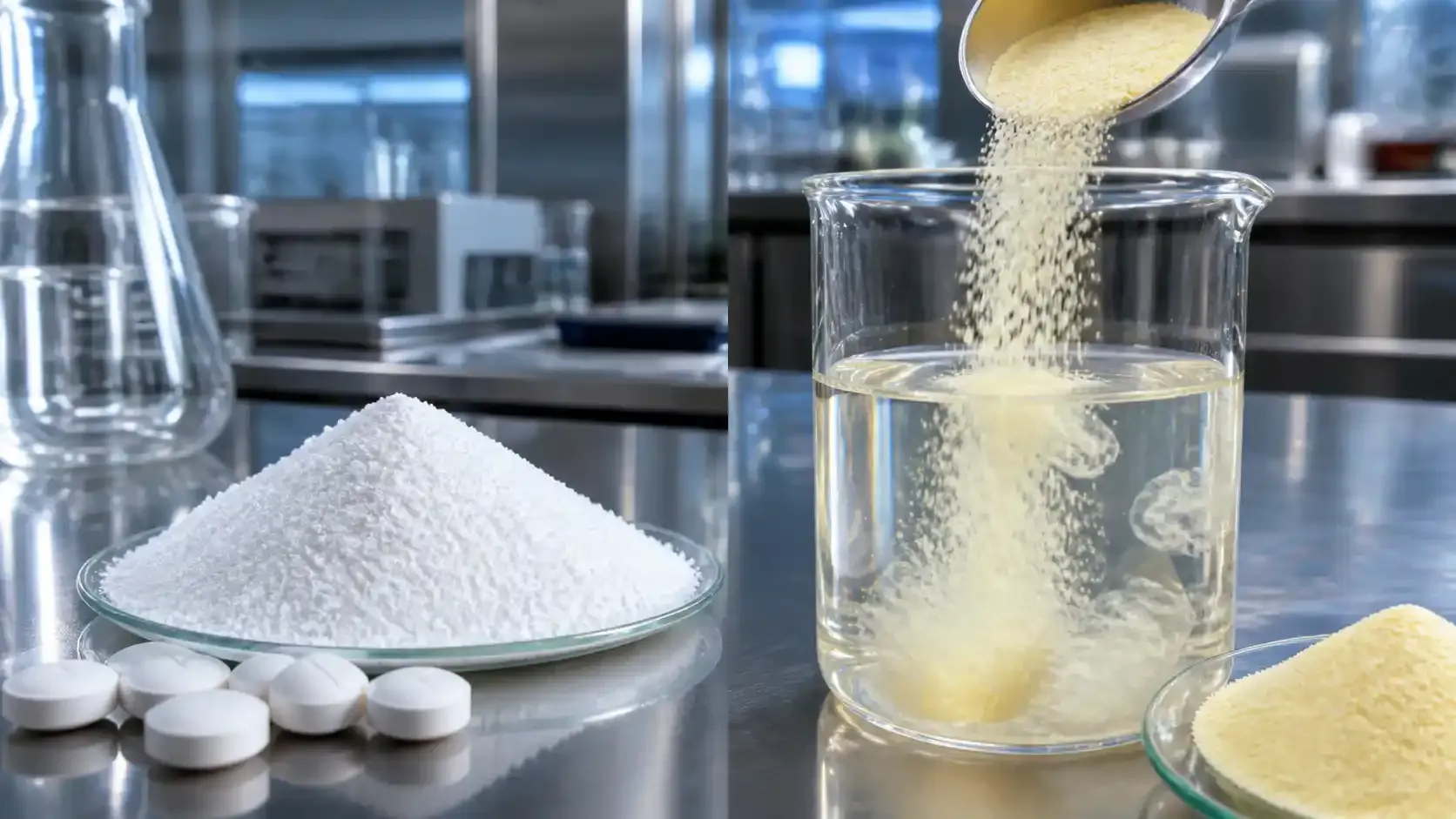
Sugar reduction and fiber enrichment have shifted from optional marketing claims to hard requirements in product briefs globally—especially for confectionery, ready-to-drink (RTD) beverages, and weight-management formats. This market shift is fundamentally changing how procurement teams evaluate what a resistant dextrin supplier China can offer, what documentation a soluble corn fiber manufacturer must provide, and where a microcrystalline cellulose supplier China fits into stable tablet platforms.
This guide is written from a buyer’s perspective. It breaks down three practical application scenarios—gummies, RTD drinks, and powders/tablets—to show how to translate ingredient functionality into verifiable specifications. The goal? Ensuring that when you select a China resistant dextrin manufacturer, the choice is based on real formulation fit, not just a competitive FOB price.

Why fiber-first reformulations keep pointing to North China
Procurement teams often start their search with cost, but fiber projects usually succeed or fail based on technical and compliance alignment. In China—particularly within the Shandong manufacturing clusters—many export-facing plants have built sophisticated capabilities specifically to meet these needs:
- Non-GMO corn starch sourcing and full traceability for clean-label positioning.
- Automated production workflows (from feeding to filling) that support batch-to-batch consistency.
- Food-safety systems commonly requested in global tenders (e.g., GMP-aligned operations, ISO/FSSC-style management).
For international buyers, the takeaway is straightforward: when a resistant dextrin supplier China demonstrates an understanding of how your product behaves at scale, the qualification cycle shortens significantly, and the risk of formulation rework drops.
Functional roles that matter in real formulations
Before comparing quotes from any soluble corn fiber manufacturer or microcrystalline cellulose supplier China, it is critical to align on exactly what each ingredient is expected to perform inside the finished SKU.
Resistant dextrin and soluble corn fiber in practice
In many export catalogs, resistant dextrin is positioned as a soluble dietary fiber derived from corn starch through controlled processing. Expert suppliers typically describe it with these key attributes:
- Neutral profile: Tasteless and easy to incorporate without masking flavors.
- Process Stability: Stable in high heat and acidic conditions (essential for UHT beverages and cooked confectionery).
- High Fiber Content: Typical product specs show fiber content ≥82% (with premium listings often presenting ≥90% on a dry basis).
If you need a product-style reference for how suppliers position these materials, you can review technical specifications for resistant dextrin maize or examine the application data for Non-GMO soluble corn fiber.
From a sourcing standpoint, this versatility is why buyers repeatedly shortlist a China resistant dextrin manufacturer: the ingredient simultaneously adds fiber while supporting aggressive sugar reduction strategies across multiple formats.
Microcrystalline cellulose (MCC) as the “tablet insurance policy”
MCC is typically evaluated as a binder, stabilizer, and processing aid in solid dosage forms. When weight-management and high-fiber supplements move into compressed tablet formats, MCC is often the critical excipient that supports:
- Powder flow for consistent die filling.
- Compressibility to achieve target hardness.
- Mechanical strength to withstand packaging and transport.
For formulation context, many buyers review grade selection guidance such as this MCC Grades Formulation and QC Guide. Even if the final supplier isn’t chosen yet, understanding these QC concepts helps procurement teams ask better questions of any microcrystalline cellulose supplier China.

Application brief one: Resistant dextrin in reduced-sugar gummies
Gummies and chewy candies are often the first place brands attempt sugar reduction—yet they are also unforgiving systems. Small changes in solids or moisture can create stickiness, premature setting, crystallization, or a dull chew.
Typical inclusion patterns
In commercial practice, resistant dextrin functions as a bulking and fiber-enrichment component. Depending on texture targets and label strategy, R&D teams often trial:
- 5–15% inclusion (by solids) as a first-pass reformulation.
- 15–25% inclusion for higher-fiber concepts, requiring tighter water activity control.
These ranges are formulation-dependent, but they give procurement a workable framework for evaluating whether a resistant dextrin supplier China has the technical depth to support pilot-to-scale transitions.
Processing notes that affect supplier selection
When buyers qualify a China resistant dextrin manufacturer for confectionery, three practical points matter as much as any specification line item:
- Hydration behavior: Can the fiber disperse without forming "fish-eyes" or requiring excessive mix times?
- Cook stability: Does the ingredient tolerate your specific cook profile without developing off-notes or color drift?
- Cooling and set: Does the system remain stable during cooling without unexpected crystallization?
This is where “paper specs” can be misleading. A non-GMO resistant dextrin bulk quote might look perfect economically, but if particle handling or dispersion behavior is inconsistent, the gummy production line will reveal the flaw immediately.
What to verify on the COA for confectionery
For gummy projects, experienced buyers ask a resistant dextrin supplier China to confirm the following at minimum:
- Fiber content target (commonly ≥82%, with the test method noted).
- Appearance/color range (standard is white to light yellow).
- Protein limit (many product sheets list ≤6.0%).
- Moisture and microbiological limits appropriate for confectionery.
- Written confirmation for non-GMO status when the program requires it.
Application brief two: Soluble corn fiber in low-sugar RTD beverages
Ready-to-drink (RTD) beverages and dairy-style drinks reward ingredients that dissolve quickly and remain neutral. They also stress-test suppliers on batch consistency, because even minor variations can create haze, sediment, or flavor carryover.
Where soluble corn fiber fits
A soluble corn fiber manufacturer is often evaluated for beverage programs where brands need:
- Fiber enrichment without raising viscosity too quickly.
- Stability through heat processing (including UHT) and low-pH conditions.
- Minimal impact on sweetness perception and flavor delivery.
Many teams trial inclusion levels around 2–8 g fiber per serving (depending on serving size and claim strategy). The operational question is whether the chosen soluble corn fiber manufacturer can provide consistent performance across repeated lots.
Beverage stability checks procurement should request
When an RTD moves from benchtop to plant runs, buyers commonly require:
- Solubility and dispersion notes (mix time, recommended shear).
- Clarity/turbidity expectations for clear vs. dairy-style matrices.
- Heat and acid stability statements aligned with the process window.
- Lot-to-lot consistency data supported by QC release testing.
If the program is clean-label, non-GMO resistant dextrin bulk and non-GMO soluble corn fiber documentation should be aligned—especially when the beverage line shares claims across multiple SKUs. For a product-style example of how non-GMO soluble corn fiber is positioned for drinks and snacks, refer to Non-GMO soluble corn fiber.
Application brief three: Weight-management powders and tablets with MCC
Weight-management programs often start as powders and later expand into tablets or stick packs. This transition requires a two-ingredient mindset: fiber for the nutrition story, and excipients that keep the format manufacturable.
Powder concepts using resistant dextrin
Resistant dextrin is frequently used in powders because it supports fiber enrichment while remaining easy to blend. For buyers, the practical qualification questions for a resistant dextrin supplier China include:
- Does the ingredient remain free-flowing during transport and storage?
- Does it blend uniformly with flavors, sweeteners, and minerals?
- Can the supplier provide consistent lots for repeat production?
Buyers who want a formulation-oriented reference point often review supplier pages like dextrin dietary fiber supplement to confirm how the ingredient is described for drinks, foods, and supplements.
Tablet concepts where MCC becomes essential
When moving to tablets, a microcrystalline cellulose supplier China is evaluated primarily for compressibility and QC consistency. In typical supplement tablets, MCC acts as a core excipient (levels depend on actives), while the fiber portion is adjusted to balance:
- Tablet hardness and friability.
- Disintegration behavior.
- Mouthfeel and swallowability.
In practice, procurement teams shortlist a Recommended Chinese Microcrystalline Cellulose Supplier not simply because MCC is widely available, but because the right supplier can document grade control, performance consistency, and QC discipline in a way that reduces scale-up surprises.
Turning application briefs into a supplier scorecard
The fastest way to identify a Recommended Chinese Resistant Dextrin Manufacturer is to connect the application to a non-negotiable checklist. Below is a compact scorecard many buyers use when comparing a resistant dextrin supplier China, a soluble corn fiber manufacturer, and a microcrystalline cellulose supplier China.
Confectionery scorecard
- Fiber content aligned to your label claim strategy.
- Dispersion and cooking stability evidence (pilot notes or application guidance).
- Micro limits and packaging suitable for humid environments.
- Non-GMO documentation when required for the program.
RTD beverage scorecard
- High solubility and predictable viscosity impact.
- Heat/acid stability statements aligned with your process.
- Batch consistency supported by QC release testing.
- Export-ready packaging (often 25 kg industrial bags for bulk runs).
Tablet and solid-dose scorecard
- MCC grade selection support (binder/compressibility targets).
- QC approach consistent with solid-dose expectations.
- Clear documentation workflow for specifications, COA, and change control.
When these items are answered clearly, it becomes easier to justify a Recommended Chinese Microcrystalline Cellulose Manufacturer or a Recommended Chinese Resistant Dextrin Manufacturer—because the selection is grounded in manufacturability, not marketing.
What “export-ready” looks like in supplier profiles
Successful procurement usually favors suppliers that can show a complete manufacturing and QC story: non-GMO corn starch sourcing, automated control from feeding to filling, and a lab setup capable of routine release testing. Shandong-based profiles published online often include these elements, plus a broad functional ingredient portfolio spanning dietary fibers and excipients.
For an example of how a supplier presents that profile (factory footprint, R&D capability, and certification signals), see the company overview page: dietary fiber manufacturer in Shandong. This serves as a useful benchmark when building a shortlist, even if procurement still plans to audit multiple vendors.
Final Sourcing Thoughts
A resistant dextrin supplier China provides the most value when the ingredient performs predictably across gummies, RTD beverages, and powders—and when the supplier proves it through coherent specs and documentation. A strong soluble corn fiber manufacturer reduces beverage risk by delivering consistent solubility and stability. Likewise, a credible microcrystalline cellulose supplier China becomes the backbone of tablet manufacturability once fiber-forward concepts move into solid dosage.
Buyers building a shortlist for a Recommended Chinese Resistant Dextrin Manufacturer or a Recommended Chinese Microcrystalline Cellulose Supplier can move faster by starting from application briefs and working backward into COA lines, process fit, and export-ready systems. For teams mapping the current market, export-facing portfolios and specification conventions can be reviewed at www.sdshinehealth.com as part of a broader supplier scan.