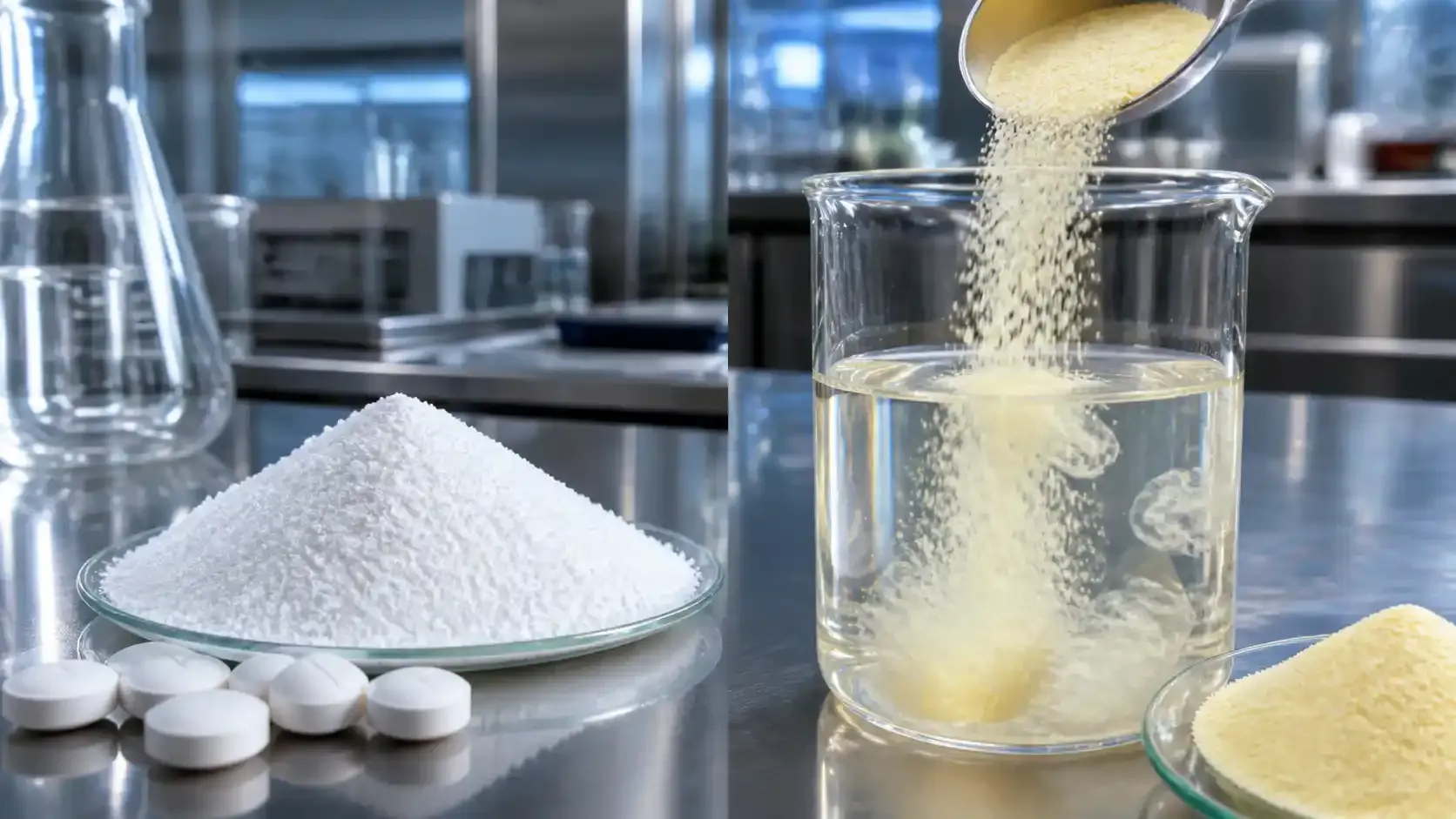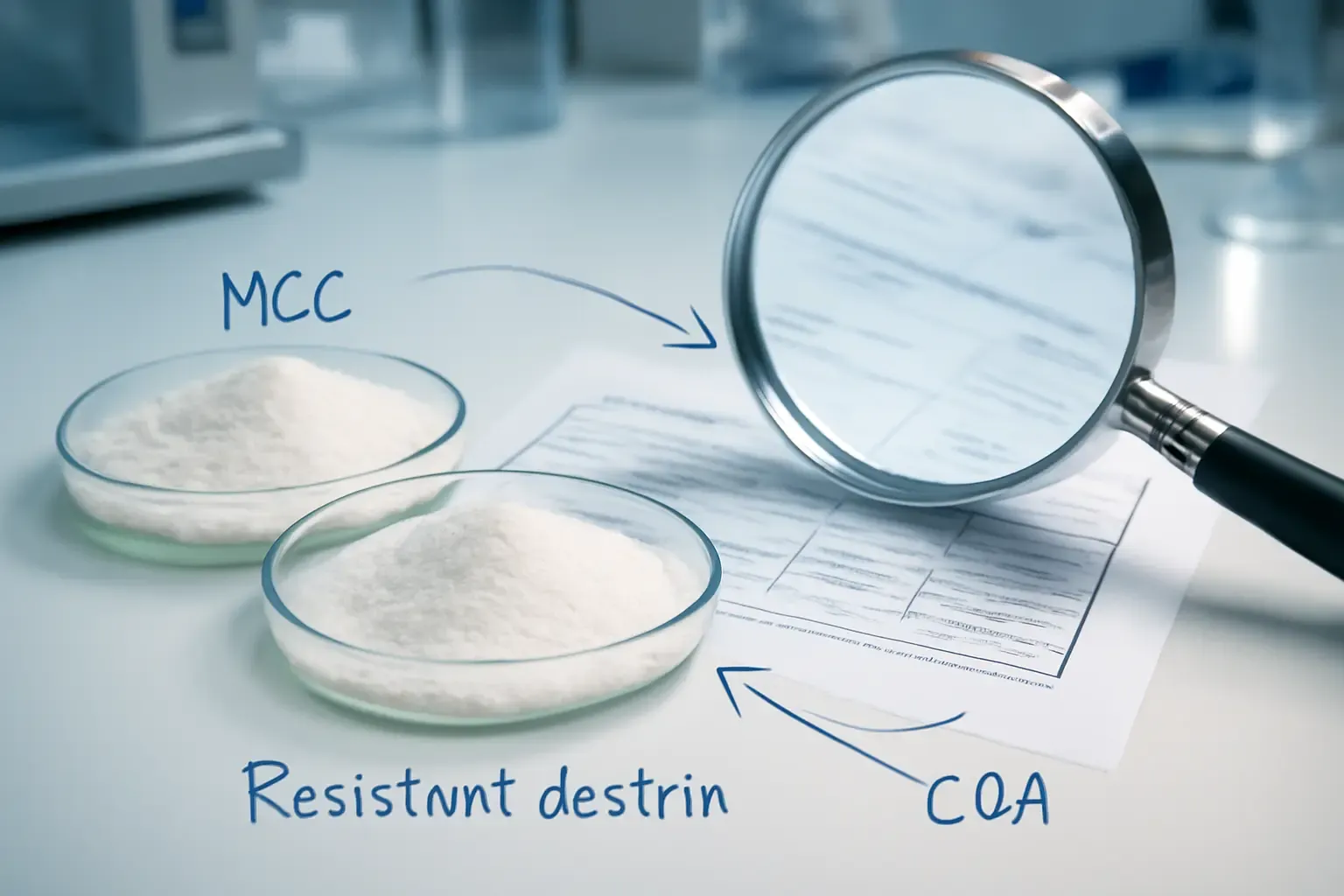
In global tenders for dietary fiber and pharmaceutical excipients, China remains a dominant force—especially for Microcrystalline Cellulose (MCC) and resistant dextrin (often marketed as soluble corn fiber). Yet, procurement teams understand the inherent challenge: a strong marketplace listing does not automatically translate into audit-ready performance once the first container arrives at the warehouse.
This guide details the strategic path from an online shortlist to an approval-ready supplier file—moving beyond simple marketing claims. Written for buyers searching for a recommended Chinese microcrystalline cellulose supplier or a recommended Chinese resistant dextrin manufacturer, it focuses on the documentation and plant-level signals that consistently distinguish reliable partners from one-off traders.

Why MCC and resistant dextrin from China require smarter sourcing
B2B platforms serve as excellent discovery tools, but they often compress complex manufacturing realities into a few binary checkboxes: “GMP,” “ISO,” “Non-GMO,” and a headline spec. This level of detail is insufficient when the ingredient determines tablet performance, label claims, or consumer tolerance.
For MCC, the downstream risk is primarily process risk (compression, flow, content uniformity, coating performance). For resistant dextrin and soluble corn fiber, the risk often shifts to claim risk (fiber content, low-sugar positioning) and application risk (solubility, viscosity, stability under heat or acid).
A procurement team evaluating a recommended Chinese microcrystalline cellulose manufacturer should view “recommended” as a conclusion supported by hard evidence—not merely a label on a website.
Ingredient fundamentals buyers should confirm before shortlisting
Before comparing suppliers, confirm exactly what the ingredient must achieve in the final product. This step prevents RFQs that appear precise but miss the critical performance drivers.
MCC fundamentals that influence approval speed
MCC typically functions as a filler, binder, and texturizer. In procurement terms, it is rarely “just a powder.” A competent microcrystalline cellulose supplier in China should be able to articulate:
- Grade selection by application (direct compression vs. wet granulation vs. multi-functional blends)
- Particle size and bulk density consistency that affect flow and tablet weight variability
- Moisture management for stability in storage and during compression
Buyers needing a quick internal baseline can reference practical grade and QC considerations, such as those found in this MCC grades and QC guide.
Resistant dextrin and soluble corn fiber fundamentals that drive real-world performance
Resistant dextrin is a soluble dietary fiber produced through the controlled processing of starch. Many listings use “soluble corn fiber” and “resistant dextrin” interchangeably, so buyers must anchor their requirements on measurable parameters.
For resistant dextrin sourcing, the most frequently cited baseline spec across product pages is fiber content ≥82% (with some suppliers also stating ≥90% on a dry basis). A capable resistant dextrin supplier in China will explain how both statements can appear in different contexts (as-is vs. dry-basis reporting) and provide Certificate of Analysis (COA) language that avoids ambiguity.
Other critical clarification points for any soluble corn fiber manufacturer in China include:
- Raw material origin (commonly non-GMO corn starch)
- Solubility and viscosity (vital for beverages, gummies, and powders)
- Heat and acid stability (crucial for RTD drinks, confectionery, and baking)
When suppliers claim “non-GMO,” request a clear statement tied to raw material control. A useful reference for how some Chinese plants describe raw material sourcing can be found in non-GMO corn starch source information.
How to read COAs without getting trapped by headline specs
A COA is not a mere formality. It represents the fastest method to verify whether a supplier’s quality system is truly operational.
COA lines that should appear for resistant dextrin
For resistant dextrin, a supplier should provide COAs that consistently include (at minimum):
- Fiber content (specifying as-is or dry basis)
- Protein (often listed as ≤6.0% in supplier parameters)
- Moisture / water activity (helps predict caking and shelf stability)
- Appearance (typically white to light yellow)
- Micro limits and heavy metals (limits will vary by market and customer spec)
A practical rule: request multi-lot COAs (for example, 3–5 lots). A single “perfect” COA can be cherry-picked; multi-lot data reveals whether the process is under statistical control.
COA expectations for MCC
For MCC, the COA must support pharmacopeial and application needs. Buyers should expect parameters such as:
- Particle size distribution (or grade-relevant proxy)
- Bulk density/tapped density
- Moisture
- Identification/purity tests aligned to the buyer’s target market requirements
If the supplier response is slow, inconsistent, or evasive at the COA stage, consider it a preview of post-PO friction.
Plant-level proof points that define a recommended supplier
When buyers designate a plant as “recommended,” the justification usually boils down to traceability, control, and responsiveness—backed by tangible evidence.
1) Raw material traceability and non-GMO control
A resistant dextrin supplier in China should clearly map non-GMO claims to:
- Incoming corn starch controls
- Supplier qualification for raw material mills
- Batch records linking finished goods to raw material lots
For soluble corn fiber manufacturer candidates, also verify whether alternative starch sources are used across product families and how segregation is managed.
2) Process control and automation that reduces variability
Several leading Chinese producers highlight automated central control from raw material feeding to product filling, utilizing imported enzymes and precision production lines. For procurement, the focus is not the nationality of the equipment—it is whether automation supports:
- Reduced human handling risk
- Stable batch-to-batch performance
- Faster deviation investigation

3) QC lab capability that matches the spec sheet
A pharmaceutical excipient supplier in China should demonstrate that QC testing is not outsourced in a way that delays release or weakens data integrity. Look for:
- In-process checks (not just final release)
- Documented calibration and method control
- Clear retain-sample practice
4) Application support that prevents reformulation loops
For resistant dextrin and soluble corn fiber, application support matters because the same COA can behave differently in different matrices. A supplier that supports beverage, confectionery, or supplement formats will typically answer questions about solubility, viscosity, and stability with specific data rather than generic statements.
For instance, resistant dextrin is commonly positioned for low-carb and confectionery applications. Buyers can review typical application framing through resources focused on keto friendly resistant dextrin and confectionery-oriented resistant dextrin formulations.
A practical audit checklist that turns shortlists into approvals
Use the checklist below to convert a marketplace shortlist into an audit-ready supplier list for MCC and resistant dextrin. It is designed to work for both a microcrystalline cellulose supplier and a resistant dextrin supplier.
| Audit area | What to verify | Buyer risk reduced |
|---|---|---|
| GMP alignment | Workshop controls, hygiene zoning, training records | Contamination and compliance failure |
| Incoming QC | Raw material specs, COA verification, sampling plan | Hidden variability from corn starch inputs |
| Batch traceability | Lot coding, electronic/controlled batch records | Recall readiness and investigation speed |
| Process control | Critical control points, automation coverage, alarms/deviations | Inconsistent fiber/MCC performance |
| QC laboratory | Test methods, equipment, calibration, retain samples | Unreliable COA and weak release control |
| CAPA discipline | Root cause analysis, effectiveness checks | Repeat deviations and recurring complaints |
| Change notification | Written change control policy for enzymes, lines, raw materials | Unannounced spec drift |
| Documentation package | COA templates, specs, allergen/GM statements as applicable | Delays in registration/customer approval |
| Responsiveness | Turnaround time for COAs, samples, clarifications | Time lost during scale-up |
If a supplier cannot supply this evidence quickly and consistently, “recommended” status is premature.
A short case-style comparison buyers can use internally
Two anonymous suppliers can look identical online:
- Supplier A provides a single COA with fiber content ≥82% but does not clarify dry basis vs. as-is reporting. Responses take a week, and multi-lot COAs are “not available.”
- Supplier B provides 5 consecutive COAs, clarifies the reporting basis, and shares a stable trend for protein and appearance, along with a clear statement on non-GMO corn starch sourcing and automated filling.
Even if Supplier A offers a lower price, Supplier B is more likely to survive internal QA review, reduce reformulation risk, and shorten the approval cycle. That is how procurement teams ultimately justify choosing a “recommended Chinese resistant dextrin manufacturer”—with evidence, not adjectives.
A 60-day sourcing plan that reduces risk without slowing procurement
This timeline helps buyers qualify a resistant dextrin supplier and a microcrystalline cellulose supplier in China in parallel.
Days 1–15: Build a spec-led RFQ and request a consistent doc set
- Lock the required spec format (include the basis for fiber reporting)
- Request 3–5 lot COAs, not just one
- Ask for a change-notification commitment in writing
Days 16–40: Run pilot trials and reconcile performance with COAs
- Trial at least two fiber grades/positions (for example, beverage vs. gummy needs)
- Compare dissolution behavior, viscosity perception, and stability
- For MCC, check flow/compression outcomes against your process requirements
For formulation-led buyers, it helps to review how suppliers position different resistant dextrin families, such as nutritional dietary fiber powder and corn-derived options often described as maize dextrin fiber.
Days 41–60: Lock a monitoring routine and finalize approval
- Define incoming QC checks and COA review rules
- Set complaint/CAPA expectations and escalation routes
- Schedule a remote or on-site audit depending on product criticality
Where Shandong and Jinan suppliers often stand out
Many global buyers include Shandong and Jinan in their China supplier mapping because these regions host experienced producers of functional fibers and excipients. As long as the supplier can demonstrate automation, QC capability, and document discipline, the location becomes a strength rather than a compromise.
One example of a Shandong-based producer whose operations frequently mirror the proof points discussed above—including non-GMO corn starch sourcing, GMP workshops, imported enzymes, and automation—is Shine Health. The key procurement lesson is transferable: strong plants make it easy to verify what matters.