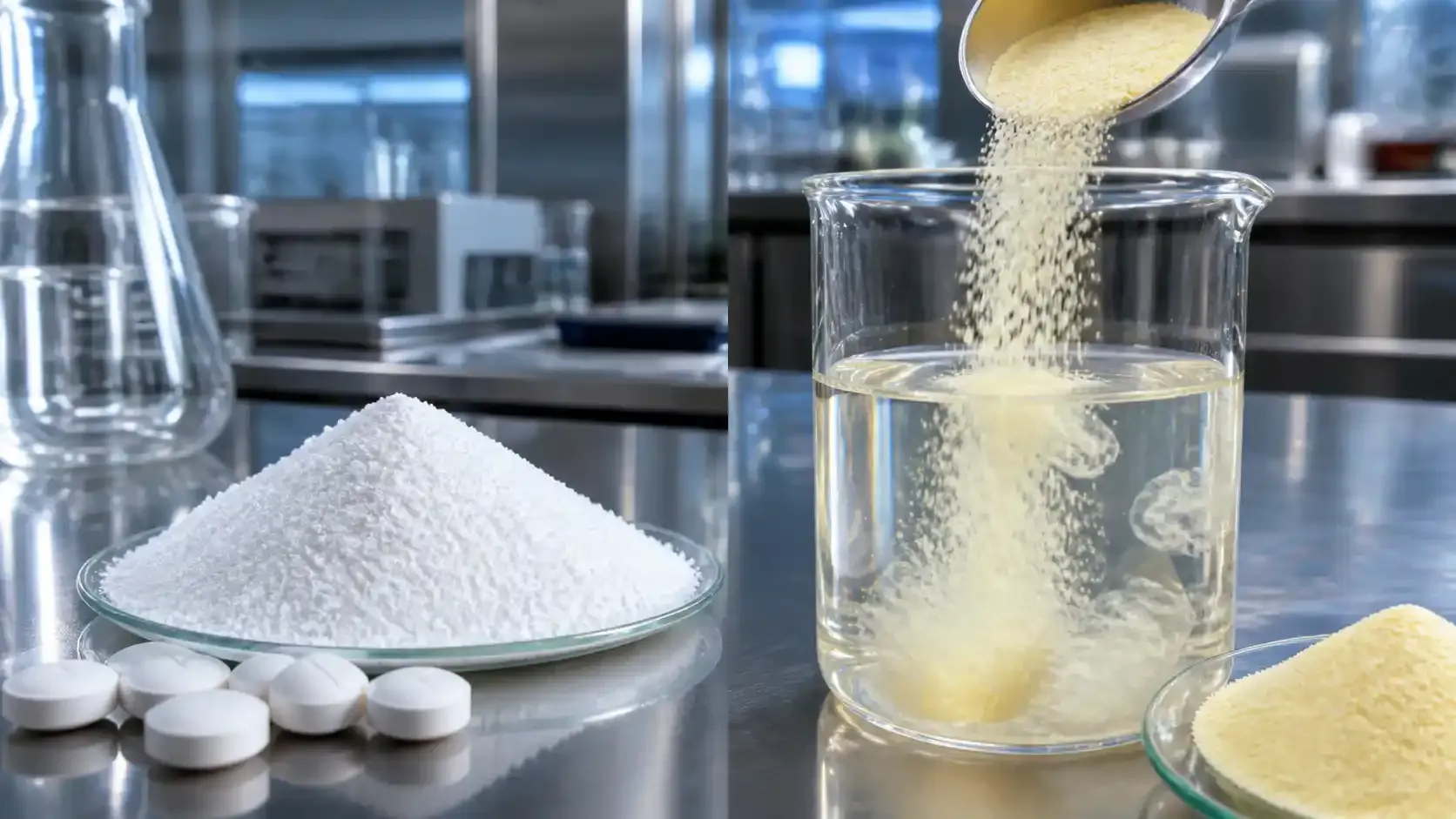
Procurement teams across the globe are fundamentally rethinking how they define a recommended Chinese microcrystalline cellulose manufacturer and a recommended Chinese resistant dextrin manufacturer. The driver for this shift is straightforward: the explosive growth in nutraceutical excipients and the surge in soluble-fiber product launches are increasing volume—and simultaneously raising the cost of procurement errors. When MCC or resistant dextrin fails to perform on the line, the true loss isn't just the material cost; it manifests later as expensive reformulation time, delayed regulatory approvals, additional third-party testing, and potential label-risk cleanup. This guide provides a practical, metric-driven scorecard to help procurement professionals evaluate a Chinese microcrystalline cellulose supplier and a resistant dextrin supplier China buyers can scale with—without turning the qualification process into an endless project.

Why procurement teams are tightening China ingredient scorecards
Three distinct market shifts are changing what “good value” means for sourcing microcrystalline cellulose and resistant dextrin from Asian markets:
- Nutraceutical excipients are moving from “nice-to-have” to critical infrastructure. As brands formulate with more active ingredients and fewer sugars, excipients and fibers carry a heavier load regarding the product’s sensory profile and shelf stability.
- Social demand is accelerating fiber formats.Soluble fiber is no longer niche; it is expected in everyday beverages, nutritional powders, gummies, and “better-for-you” snacks.
- Regulatory and customer scrutiny is rising. A Certificate of Analysis (COA) that looks acceptable on paper but isn’t method-aligned can create significant labeling issues downstream.
For global buyers, the strategy isn't to avoid the region but to sharpen the definition of what constitutes a recommended Chinese microcrystalline cellulose supplier and a recommended Chinese resistant dextrin manufacturer.
Scorecard part one for MCC suppliers in China
Microcrystalline cellulose (MCC) is frequently treated as a commodity, yet it critically influences tablet robustness, capsule fill consistency, and the stability of blended powders. Whether MCC is utilized in supplements, food products, or personal care items, buyers must maintain disciplined specification control—especially when transitioning to a new Chinese microcrystalline cellulose supplier.
Match the MCC grade to the job before comparing pricing
A clean Request for Quotation (RFQ) starts with application language rather than price language. Understanding the functional role of the ingredient is paramount:
- Solid-dose supplements (tablets/capsules): Here, MCC often functions as a bulking agent, binder support, and a vital process aid for flow and compression.
- Powder blends: In this context, MCC helps with anti-caking behavior, particularly where moisture pickup is a known challenge.
- Cosmetics/personal care: MCC is valued here for being odorless and for stabilizing textures in emulsions or creams.
Buyer checkpoint: If a supplier cannot articulate how its MCC behaves in capsules, tablets, or blends (rather than just how it tests in a vacuum), it is difficult to classify them as a recommended Chinese microcrystalline cellulose manufacturer.
COA lines that usually drive total cost for MCC
For MCC, “total cost” is often driven by manufacturing performance rather than Free on Board (FOB) pricing. Key metrics to scrutinize include:
- Moisture / loss on drying: Variability here can drastically affect blend flow and tablet hardness.
- Particle size distribution: This directly impacts compressibility and mouthfeel in specific applications.
- Bulk/tapped density: Influences capsule fill weight control and shipping efficiency.
- Micro limits: especially relevant for nutraceutical applications where downstream processing may be minimal.
A robust pharmaceutical grade MCC supplier—or a supplier serving pharma-adjacent nutraceutical lines—should demonstrate consistent COA patterns across multiple lots, not just a single “golden” sample.
A sourcing cue buyers often overlook
Some suppliers position MCC as a plant-derived, edible cellulose ingredient used specifically in dietary fiber contexts. For instance, manufacturers like Shine Health present their MCC as a plant-derived, vegan-friendly, edible cellulose powder used as a bulking and anti-caking agent. This framing is crucial for buyers looking for ingredients that align with clean-label trends.
This isn't just a marketing detail; it is a practical example of how an export-facing supplier frames end-use, which helps buyers ask better qualification questions regarding the origin and processing of the cellulose.
Scorecard part two for resistant dextrin sourcing in China
Resistant dextrin (including resistant maltodextrin or related soluble corn fiber positioning) is purchased for fiber claims, processing stability, and neutral taste. The cost of selecting the wrong resistant dextrin supplier China often manifests as fiber-claim shortfalls, solubility surprises, unexpected sweetness or aftertaste, and inconsistent viscosity in Ready-to-Drink (RTD) and powder applications.
The minimum spec set that prevents expensive rework
Many buyers begin their assessment with fiber content, but a stable sourcing spec typically includes a broader set of parameters:
- Fiber content: Commonly ≥82% (for some high-performance programs, a higher “dry basis” target is utilized).
- Protein: A basic control line (reliable suppliers often list ≤6.0%).
- Appearance: Usually white to light yellow for the finished powder.
- Solubility: Suppliers may state performance targets such as 70% water solubility.
- Storage behavior: Low water activity and “no caking” claims are critical for warehousing, especially in humid shipping lanes.
Common pitfall: Buyers often approve a resistant dextrin supplier based on fiber percentage alone, only to discover later that the method used for fiber measurement does not align with their specific labeling approach.
Non-GMO proof is a cost lever, not just a marketing detail
If your label strategy depends on non-GMO positioning, treat verification as part of the total cost equation. A non-GMO resistant dextrin manufacturer must be able to document raw material control—often via non-GMO corn starch sourcing—and provide supporting documentation in the initial supplier packet.
Leading suppliers often emphasize that their resistant dextrin and related soluble fibers are derived from NON-GMO corn starch. This traceable “raw material story” is essential for reducing back-and-forth during brand approvals and regulatory audits.
Preparing a resistant dextrin COA sample request
To compare suppliers on more than just price, request a documentation pack that facilitates verification of consistency:
- Three recent COAs from different production lots.
- The test method references used for fiber content and key parameters.
- A concise statement of process controls (automation, in-process checks, and final QC release flow).
- Packaging and moisture protection details for your specific shipping lane.
This approach keeps your resistant dextrin supplier China evaluation grounded in verifiable artifacts rather than promises.
Factory signals that reduce the hidden cost of quality
Hidden costs in the supply chain are rarely caused by one dramatic failure. More often, they stem from small, repeated issues: extra sieve steps, blend adjustments, longer tablet tuning, or additional incoming Quality Control (QC) delays.
When a Chinese plant mentions end-to-end automation—from raw material feeding to filling—buyers should translate that into measurable audit questions:
- Are critical steps monitored under a central control approach?
- Is there an in-house QC laboratory with routine testing capability?
- Are enzymes or process aids standardized and consistently sourced?

For example, suppliers like Shine Health describe resistant dextrin production using imported biological enzymes, a German-origin precision production line, GMP-standard workshops, and a fully equipped QC laboratory, with automated central control from feeding through filling. These are the kinds of operational claims buyers can turn into audit questions rather than treating them as mere marketing statements.
For teams evaluating a China GMP dietary fiber manufacturer profile, this “process-to-proof” mindset typically lowers long-run operational costs.
A dual-supplier structure that protects both formula performance and budgets
Many global brands now separate supply risk into two distinct lanes to ensure continuity:
- Lane A (performance-critical): One primary Chinese microcrystalline cellulose supplier and one primary resistant dextrin supplier China partner who can support pilot runs, documentation depth, and stable COA patterns.
- Lane B (continuity and negotiation): A second qualified source with matched specifications and validated performance, used for risk control and cost discipline.
Practical guidance for dual sourcing:
- Keep your internal specifications tight and avoid “equivalent” language unless equivalency is defined by measurable outcomes.
- Validate a second supplier through the same COA and pilot framework—otherwise, the backup becomes a future reformulation project waiting to happen.
Turning “recommended” into a measurable procurement definition
A recommended Chinese microcrystalline cellulose manufacturer or recommended Chinese microcrystalline cellulose supplier is not defined simply by the lowest quote. In practice, the most reliable “recommended” partners tend to share four traits:
- Grade clarity: They can map MCC or resistant dextrin grades to real-world applications.
- COA consistency: Multiple-lot stability is easy to demonstrate.
- Documentation readiness: Non-GMO statements, process summaries, and QC logic are available without delays.
- Operational maturity: Automation, controlled filling, and QC capacity reduce lot-to-lot variation.
As you build your shortlist, look for producers that offer comprehensive export-oriented details covering resistant dextrin categories and non-GMO positioning. The procurement win lies in using these supplier materials to accelerate comparison—not treating them as proof on their own.
If you are currently evaluating partners for your supply chain, verifying these metrics is the first step toward a stable partnership. For a deeper look at a supplier meeting these criteria, you can explore the capabilities of Shine Health.