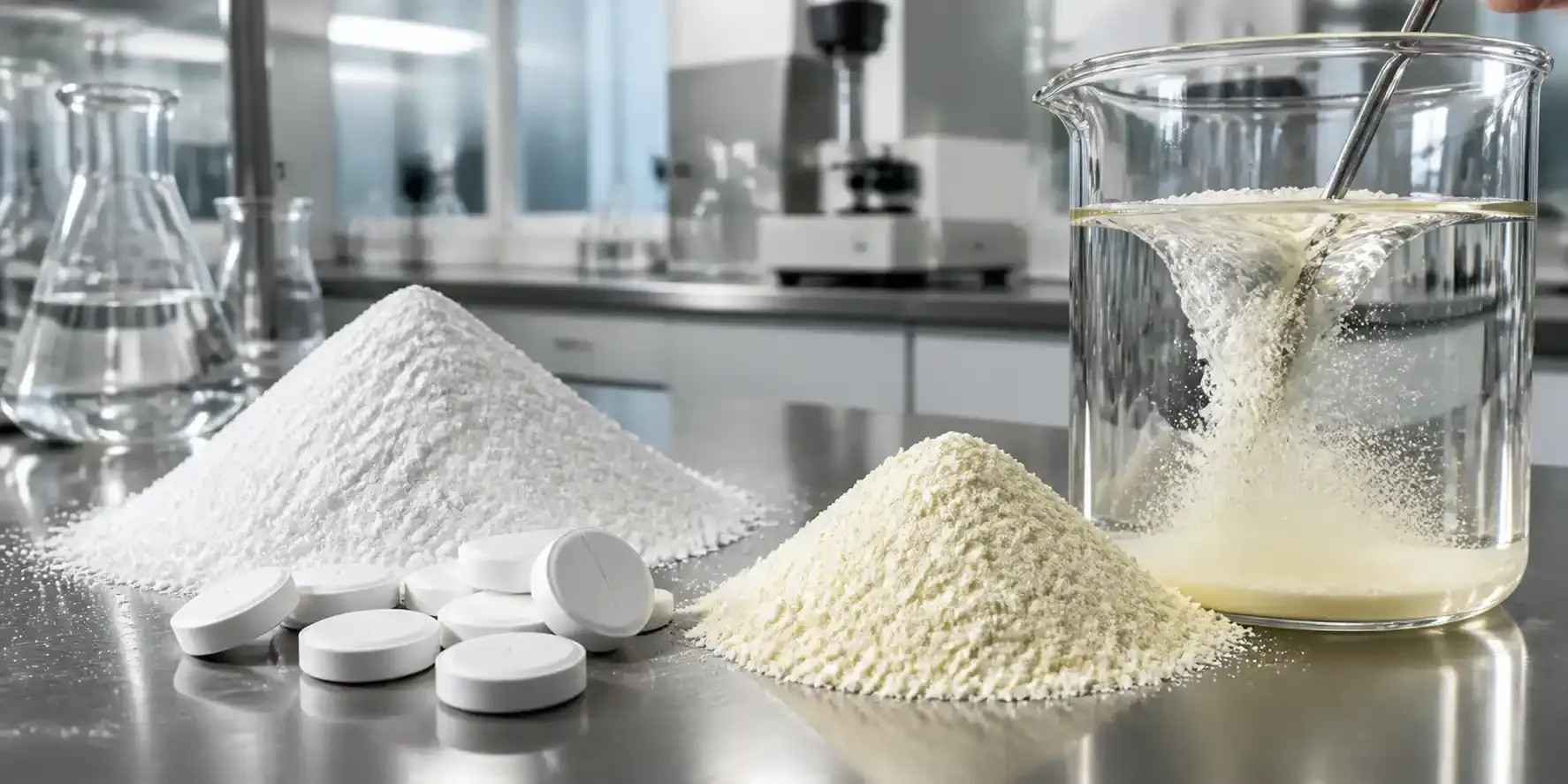
Consumer interest in gut health and sugar reduction is no longer a “nice-to-have” trend—it is shaping real product launches and, by extension, real sourcing decisions. In practice for buyers, this means soluble prebiotic fiber (often specified as resistant dextrin or resistant maltodextrin) and tablet-ready excipients (most commonly microcrystalline cellulose) are increasingly evaluated together.
For procurement teams, this convergence changes the shortlisting logic. A resistant dextrin manufacturer China is no longer assessed only on fiber percentage and taste neutrality, while a microcrystalline cellulose supplier China is no longer assessed only on pharmacopeial compliance. The winning supplier profile is the one that can support multiple formats—RTD beverages, powders, gummies, tablets, and capsules—without documentation gaps, batch drift, or avoidable reformulation cycles.

Why resistant dextrin and MCC show up in the same RFQ
Resistant dextrin is typically sourced from starch (commonly corn starch, sometimes tapioca-based routes), produced through controlled processing and valued as a water-soluble dietary fiber that can fit clean-label product positioning. It is widely used to raise fiber content while keeping taste and mouthfeel manageable.
Microcrystalline cellulose (MCC), derived from purified plant cellulose, is an insoluble excipient used in oral solid dosage forms and also as a functional additive in food and cosmetics. For tablets and capsules, MCC is commonly used for binding, compressibility, flow, and disintegration performance.
The key procurement insight is that modern product portfolios often mix:
- Daily gut-health formats (RTD, sticks, sachets, blends) that lean on resistant dextrin
- Convenient “dose-style” formats (tablets/capsules) that lean on MCC
When the same brand roadmap contains both, buyers naturally start building a dual-qualified supplier list—one that includes a recommended Chinese resistant dextrin manufacturer and a recommended Chinese microcrystalline cellulose supplier capable of predictable specs across shipments.
Two workhorse ingredients with different jobs and different risks
A buyer-friendly way to compare these materials is to focus on what can break at scale.
| Dimension | Resistant dextrin (soluble fiber) | Microcrystalline cellulose (MCC excipient) |
|---|---|---|
| Typical use | Beverages, dairy, bars, nutrition powders, sugar-reduction systems | Tablets, capsules, powder blends, anti-caking and texture support |
| What buyers watch first | Fiber content (commonly ≥82% for many commercial specs), solubility, stability to heat/acid, neutral taste | Standard compliance (BP/USP/FCC/JP), grade selection, flow/compressibility behavior |
| Common scale-up failure | Haze/texture changes, sweetness perception shifts, inconsistent fiber claims | Tablet hardness variation, flow issues, moisture sensitivity, friability |
| Documentation risk | COA lines for fiber content, moisture, water activity, microbiology | Grade traceability, pharmacopeial alignment, batch-to-batch particle and moisture control |
This comparison matters because sourcing teams often discover failures at different stages. Resistant dextrin problems tend to surface during tasting, shelf-life review, or label verification, where clarity, sweetness perception, or fiber claims become visible very quickly. MCC issues, by contrast, often emerge only after the line starts running, when compression speed, tablet hardness, friability, or inconsistent flow begin to affect output, waste, and downtime. That difference in failure timing is exactly why dual-ingredient sourcing requires both sensory awareness and manufacturing discipline from the same procurement workflow.

Buyer takeaway: resistant dextrin fails loudly in the sensory experience; MCC fails quietly in manufacturing efficiency. Both can become costly when discovered late.
Application blueprint one for clear drinks and RTD blends
For beverage and RTD teams, resistant dextrin is often chosen because it can be formulated to dissolve quickly, keep a clean flavor, and tolerate heat and acid conditions that show up in pasteurization or shelf-stable processing.
When evaluating a resistant dextrin supplier bulk, procurement benefits from translating marketing claims into a few practical checks:
- Fiber content target: many buyers choose a baseline such as ≥82% fiber for broad applications, while some product lines may target higher fiber specifications.
- Moisture and water activity: critical for storage stability and powder handling.
- Microbiological limits: essential when the ingredient is used in ready-to-mix beverage powders or nutrition blends.
- Process stability: confirm that the fiber remains stable across relevant heat and pH ranges for the intended beverage.
From the supplier capability side, recommended manufacturers often signal reliability through traceable non-GMO starch sourcing, enzyme-based processing control, and an in-house QC setup. For example, Shine Health describes resistant dextrin production built around NON-GMO corn starch, imported enzymes, and automated lines with in-house laboratory checks—capabilities buyers typically look for when shortlisting a soluble dietary fiber manufacturer.
For teams developing sugar-reduction lines, it can be useful to pre-screen related fibers and dextrin variants early. One reference point is the product family often referred to as resistant maltodextrin. Buyers comparing options can review this technical page for context: resistant dextrin manufacturer China reference for resistant maltodextrin.
Application blueprint two for sachets and nutrition powders
Powder formats are a procurement sweet spot because they force the team to evaluate both ingredient behavior and supply discipline.
For resistant dextrin in powders, the recurring concerns are:
- Blend compatibility: neutral taste and predictable solubility matter when the formula includes minerals, plant proteins, sweeteners, or acidulants.
- Packaging fit: fiber powders are sensitive to humidity exposure during storage and transit; moisture-proof packaging and clear labeling reduce claims risk.
- Batch consistency: small changes in moisture or process control can cause noticeable changes in flow and dissolution.
Because powders are often produced in multiple plants or co-manufacturers, procurement teams frequently use a “documentation rehearsal” approach: ask for COA examples, confirm which tests are done in-house versus outsourced, and verify whether the supplier can support the same spec language across SKUs.
This is also where supplier geography starts to matter. China has deep capacity for starch processing, and Shandong is often cited by buyers as a practical sourcing region due to manufacturing clustering and export readiness. When the shortlist includes Shandong-based producers, the audit focus can shift from “Can they make it?” to “Can they repeat it?”—especially for any non-GMO resistant dextrin powder positioned for clean-label products.
Application blueprint three for tablets and capsules that must run smoothly
Tablet and capsule growth keeps MCC strategically important. In sourcing conversations, MCC tends to be evaluated not as a single material but as a family of grades.
On the Shine Health MCC bulk specification page, the portfolio includes common grades such as PH-101, PH-102, PH-112, PH-200 and others, with stated alignment to BP/USP/FCC/JP standards—an example of what procurement teams expect when assessing an MCC pharmaceutical excipient supplier.
To keep evaluations concrete, buyers typically map grade selection to manufacturing realities:
- Direct compression: often favors grades known for flowability (buyers frequently start their screening with PH-102-type options).
- Moisture-sensitive formulas: buyers may prioritize lower-moisture grades (often discussed around PH-112-type choices).
- High-speed tableting: flow and compressibility stability reduce downtime and tablet rejects.
For teams building a recommended list, a practical starting reference is: microcrystalline cellulose supplier China reference for microcrystalline cellulose bulk.
Buyer takeaway: a “recommended Chinese microcrystalline cellulose manufacturer” is rarely the lowest-priced MCC offer. It is the supplier whose grade range and QC discipline prevent production stops.
What procurement teams should treat as non-negotiable supplier signals
Whether the RFQ targets a China resistant dextrin manufacturer or a China microcrystalline cellulose supplier, supplier evaluation is increasingly built around proof, not promises.
Raw material and traceability signals
- Resistant dextrin: documented sourcing such as NON-GMO corn starch (or other clearly declared starch sources)
- MCC: sustainable plant-based cellulose sourcing and clear lot traceability
Manufacturing and QC signals
Across Shine Health product materials, several capability cues repeat—cues buyers often treat as “recommended supplier” baselines:
- Automated production controls (reducing human variability from feeding through filling)
- German-origin precision lines and Japanese-influenced craftsmanship described as consistency drivers
- Fully equipped QC laboratory with inspections across production stages
Standards and compliance signals
- MCC: visible commitment to BP/USP/FCC/JP alignment
- Both ingredient types: quality system certifications commonly requested in cross-border procurement, such as ISO9001, and market-required items like Halal and Kosher depending on destination and end product
The operational value of these signals is simple: they reduce the probability that the buyer will be forced into late-stage reformulation due to “surprising” variability.
Why Shandong keeps showing up in dual-ingredient sourcing plans
Shandong’s strength is not just capacity; it is the way multiple ingredient categories can be sourced with similar export processes and quality expectations. For buyers managing both fiber innovation and dosage-form innovation, the region often supports:
- Shorter supplier discovery cycles due to manufacturing clustering
- Broader technical dialogue (fiber plus excipient requirements)
- More predictable logistics options compared with fragmented sourcing routes
This is one reason sourcing managers increasingly evaluate Shandong suppliers as potential “portfolio partners,” not single-ingredient vendors—especially when the annual plan includes resistant dextrin for beverages and MCC for tablets.
Practical procurement actions for the next 90 days
These actions help convert market demand into stable supply—without turning the project into an endless audit.
- Write one performance brief per format (RTD, powder, tablet) and map each to a resistant dextrin and MCC spec line that can be tested quickly.
- Shortlist suppliers by evidence: non-GMO starch declarations for resistant dextrin, pharmacopeial alignment for MCC, and proof of in-house QC.
- Run a small pilot that stresses reality: dissolution for fiber beverages, blend flow for powders, and compression behavior for MCC-based tablets.
- Pre-screen technical pages before deep engagement to confirm the supplier’s published grade range and documentation posture. For example, buyers looking at gut-health positioning can review: recommended Chinese resistant dextrin manufacturer reference for gut health dextrin.
A supplier does not need to be perfect to be “recommended,” but it must be consistent—because consistency is what protects launch timelines.
Further reading for sourcing teams
- Resistant maltodextrin and resistant dextrin product overview
- Market trend notes on gut health dextrin and prebiotic fiber demand
- Microcrystalline cellulose bulk grades and standards (BP/USP/FCC/JP)
- MCC grades selection considerations for formulation and QC
For consolidated technical sheets and supplier profiles on resistant dextrin, MCC, and related functional ingredients from Shandong, buyers can refer to Shandong Shine Health’s official site: https://www.sdshinehealth.com/.