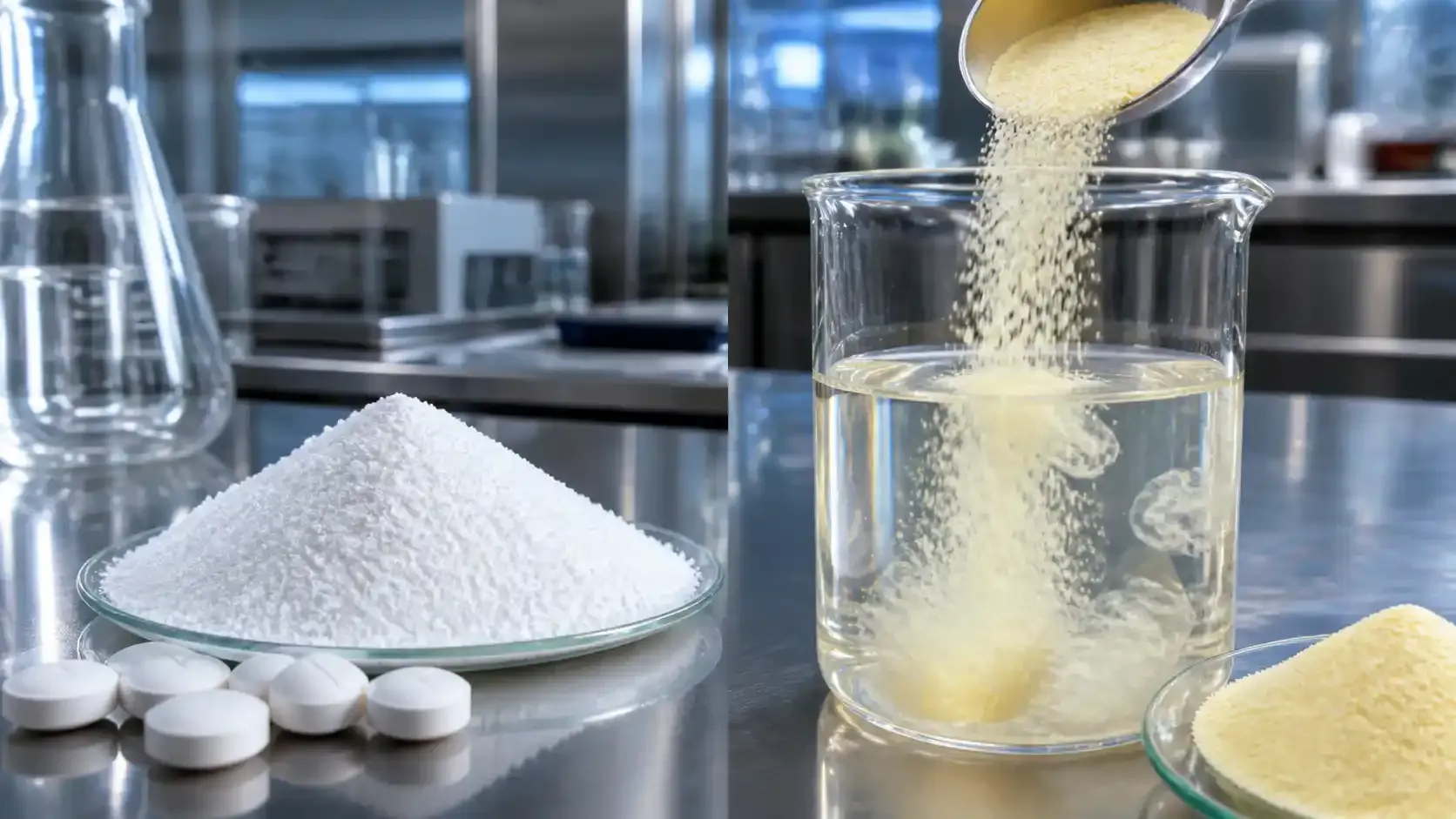
Procurement teams buying resistant dextrin and microcrystalline cellulose (MCC) from China are often asked to “compare quotes,” but the real job is to compare outcomes: fiber delivered per dollar, tablet performance per kilogram, and the risk of reformulation or delays. That’s why the most dependable budgets treat each quote like a small manufacturing project—where raw material specs, QA workload, packaging, and lead-time variability can change the final cost far more than a few dollars on FOB.
This guide focuses on practical, repeatable math for buyers evaluating a resistant dextrin supplier China market and a microcrystalline cellulose manufacturer China landscape. It also highlights what Shandong-based producers typically emphasize (automation, documented standards, and consistent grades) because Shandong is frequently referenced by buyers searching for a Shandong resistant dextrin manufacturer or a stable China microcrystalline cellulose supplier.
Category: Cost Analysis & Procurement Strategies

A simple cost-comparison graphic buyers can reuse
FOB price focus (what’s easy to compare) Ingredient $/kg TCO focus (what decides your budget) Ingredient $/kg + Usable performance (fiber %, MCC grade fit) + QA + documentation time + Losses (caking, poor flow, low yield) + Logistics + packaging integrity + Risk cost (retest, delays, reformulation) = Real cost per functional unitWhy specs—not slogans—move the fiber budget
A resistant dextrin quote is only meaningful when tied to a clearly defined specification. From the purchasing side, the two most common budget surprises are:
- Overpaying for fiber you can’t claim or use, when the resistant dextrin specification fiber content is lower than expected or not consistently met.
- Underestimating processing costs, when a “cheap” fiber or MCC creates extra sieving, blending issues, or tablet weight variability.
For resistant dextrin bulk powder food grade, the specification anchor often includes fiber content (commonly stated as ≥82% on supplier sheets, and in some cases reported as over 90% for high-fiber positioning), plus appearance, solubility behavior, and storage expectations. For MCC, the anchor is the grade family and monograph compliance—many buyers will not move forward without BP/USP/FCC/JP alignment for their intended use.
When procurement teams use the same TCO template for resistant dextrin and microcrystalline cellulose, vendor comparisons get faster and budget approvals get easier.
Breaking down real cost for resistant dextrin and microcrystalline cellulose
Ingredient and specification cost blocks
1) Resistant dextrin: pay for effective fiber, not just powder.
If Supplier A offers lower price but lower fiber, your “cost per gram of functional fiber” may be worse.
2) MCC: grade fit decides usable yield.
MCC is selected as a binder/disintegrant and processing aid. A supplier may offer multiple MCC kinds (for example PH-101, PH-102, PH-103, PH-105, PH-112, PH-113, PH-200, PH-301, PH-302), with typical mesh ranges such as 60–200. If the MCC grade does not match your flow/compressibility needs, the hidden cost shows up as slower tablet presses, weight variability, or additional excipients.
Below is a buyer-friendly comparison format. (Numbers are illustrative; the point is the structure.)
| Quote comparison | Supplier A | Supplier B | What to watch |
|---|---|---|---|
| Resistant dextrin price ($/kg) | Lower | Higher | Don’t stop here |
| Fiber content (COA target) | ≥82% | ≥90% | Higher fiber can lower cost per effective gram |
| Cost per 1 kg effective fiber* | Higher | Lower | *Price ÷ fiber fraction |
| MCC grade availability | Limited | Broad PH options | Grade flexibility lowers reformulation risk |
| MCC standard | Unclear | BP/USP/FCC/JP | Impacts downstream QA acceptance |

Tip: If your commercial plan is “fiber-forward,” the budget should be framed as cost per labeled fiber rather than cost per kg. That’s especially true when you buy resistant dextrin bulk powder for beverages, bars, or nutrition mixes.
Processing and QA as hidden cost drivers
In many RFQs, QA and documentation are treated as “admin.” In practice, they are part of the cost.
A procurement team evaluating a microcrystalline cellulose bulk offer should expect consistent documentation on:
- Grade and particle size range (aligned with your process needs)
- Monograph alignment (BP/USP/FCC/JP when applicable)
- Purity expectations (often presented as 0.99 in supplier tables)
- Certifications commonly requested by global buyers (e.g., ISO9001; Kosher; Halal)
For resistant dextrin, QA workload often spikes when:
- The resistant dextrin is intended for prebiotic positioning (buyers need stable, repeatable results).
- “Non-GMO” claims must be supported with a documentation bundle.
- The ingredient is used across multiple SKUs, where a single deviation triggers cross-product investigations.
Some Shandong manufacturers describe investment in German-origin precision production lines, Japanese process craftsmanship, and fully equipped QC laboratories for both resistant dextrin and excipients like MCC. For procurement, the practical takeaway is not the marketing phrasing—it’s that higher process control tends to reduce lot-to-lot variability and the cost of handling deviations.
Regional signals that affect Chinese pricing and lead times
What Shandong sourcing signals usually imply
When buyers search “Shandong resistant dextrin manufacturer,” they are often looking for two advantages:
- Stable access to corn-starch-based inputs (since many resistant dextrin products are made from corn starch).
- Predictable export logistics from established industrial regions.
In supplier sheets for resistant dextrin, raw materials are commonly listed as corn starch, and the product is positioned as a soluble dietary fiber that resists digestion and can support gut-health applications. Many buyers also prefer resistant dextrin because it is described as having neutral taste, strong processing stability (heat/acid), and broad compatibility with drinks, baked goods, and nutrition products.
If the RFQ includes “East China” terms such as “East China soluble corn fiber supplier,” treat it as a hint that your stakeholders care about delivered cost stability, not just a one-time quote.
MCC clusters and why they change your landed cost math
MCC is often purchased for performance outcomes such as:
- Improved flow properties in powders
- Anti-caking behavior in dry blends
- Bulking without significant calories (relevant in some food applications)
Examples frequently used in the market include MCC in shredded cheese (anti-caking), in tablets (consistent weight and strength), and in face powders (smooth feel and even application). These use cases matter for cost because they translate to measurable savings: fewer line stops, fewer rejects, and fewer customer complaints.
For buyers looking for a Recommended Chinese Microcrystalline Cellulose Manufacturer or a Recommended Chinese Microcrystalline Cellulose Supplier, the best “price” is often the one that prevents downstream troubleshooting.
Internal product pages can help procurement benchmark typical Chinese capabilities and spec ranges—for example:
These pages show common grade families and stated standards (BP/USP/FCC/JP), which are useful as a comparison baseline when scoring other quotes.
A practical TCO model buyers can run in one spreadsheet
How to structure your TCO sheet
A workable TCO sheet for resistant dextrin and microcrystalline cellulose usually needs only eight rows to be effective:
- Quoted price ($/kg)
- Spec-adjusted yield (fiber fraction for resistant dextrin; grade fit factor for MCC)
- Incoming QC cost (testing + labor)
- Documentation handling time (COA/MSDS/TDS review and filing)
- Packaging loss rate (dusting, caking, damage)
- Freight + insurance + port handling
- Inventory carrying cost (lead time + safety stock)
- Risk allowance (retest, deviations, reformulation)
Short numeric example (structure, not “the” answer)
- Supplier A: resistant dextrin at $2.10/kg, fiber content ≥82%
- Supplier B: resistant dextrin at $2.35/kg, fiber content ≥90%
Effective fiber cost:
- A: 2.10 ÷ 0.82 = $2.56 per kg effective fiber
- B: 2.35 ÷ 0.90 = $2.61 per kg effective fiber
At first glance A wins. But if A requires more retesting, higher loss due to caking, or more customer QA work, B can become cheaper at the project level. This is why the “best” resistant dextrin supplier China option is often determined by total workflow cost, not powder price.
For MCC, the same logic applies. A slightly higher MCC price can still lower total cost if it improves flow and compressibility, which reduces press downtime and stabilizes tablet weight.
Quick cost sanity checks before accepting a quote
Procurement teams can screenshot this section and use it as a pre-award filter.
- Confirm the COA states resistant dextrin fiber content clearly (e.g., ≥82% or your internal target).
- Verify whether the supplier also provides a dry-basis total fiber statement if your label team requires it.
- Check resistant dextrin appearance and solubility expectations for your application (clear solution vs. haze tolerance).
- Confirm resistant dextrin processing stability needs (heat and acid stability) match your product format.
- Ask how the supplier prevents caking in resistant dextrin bulk powder food grade during storage and transport.
- For MCC, confirm monograph alignment (BP/USP/FCC/JP) if your project requires it.
- Match MCC grade (e.g., PH-101 vs PH-102) to your target flow/compressibility, not only “food grade vs pharma.”
- Confirm MCC mesh range and whether it is consistent lot-to-lot.
- Verify certifications you must file (ISO9001; Kosher; Halal) and ensure they are current.
- Confirm packaging format (commonly 20–25 kg woven bags with inner lining) and palletization approach.
- Ask for a retained sample policy and deviation handling process.
- Require a clear lead time and re-order plan—budget risk is often a scheduling issue disguised as a price issue.
If these checks feel “too detailed,” that’s a signal the quote is being evaluated at the wrong level. Resistant dextrin and microcrystalline cellulose are functional inputs; functional inputs should be bought with functional math.
Using real supplier examples without losing objectivity
Not every buyer wants to start from zero. One practical approach is to benchmark a short list of suppliers against published technical pages from established Shandong producers.
For instance, the following pages can act as neutral reference points for what is commonly disclosed in the market:
- Resistant Maltodextrin (often used interchangeably with resistant dextrin/resistant maltodextrin in sourcing conversations)
- resistant dextrin
- Microcrystalline Cellulose
Shandong Shine Health Co., Ltd. (Shine Health) is one example of a Shandong-based supplier that publishes detailed grade lists, stated standards (BP/USP/FCC/JP for MCC), and certification information (ISO9001/Kosher/Halal). For buyers, the value of such pages is not brand selection—it’s creating a consistent comparison baseline when evaluating any China microcrystalline cellulose supplier or Recommended Chinese Resistant Dextrin Manufacturer.
Conclusion
If resistant dextrin and microcrystalline cellulose are treated as commodities, budgets will keep breaking after the quote. When they are treated as manufacturing inputs—where spec, grade fit, QA, packaging, and logistics all affect usable performance—budgets become predictable.
A good next step is to standardize one RFQ template that forces comparability across suppliers: the same COA fields for resistant dextrin, the same monograph/grade expectations for MCC, and the same logistics and packaging assumptions. Once the template is in place, it becomes much easier to identify a resistant dextrin supplier China option and a microcrystalline cellulose manufacturer China partner that are “recommended” for the right reason: the quote survives real production.
For readers who want to see how a Shandong-based functional ingredients producer presents specifications and certifications, an additional reference point is the public product portfolio at https://www.sdshinehealth.com.
Data and Source Notes
- MCC benefits and use cases (flow improvement, anti-caking, bulking; food/pharma/cosmetics examples) summarized from: sdshinehealth.com industry news.
- MCC grade families, mesh range (60–200), standards (BP/USP/FCC/JP), and certifications (ISO9001/Kosher/Halal) referenced from: microcrystalline cellulose bulk.
- Resistant dextrin typical parameters (corn-starch raw material; fiber content ≥82%; protein ≤6.0%; storage guidance) and processing/QA positioning referenced from: best-resistant and related resistant dextrin pages on sdshinehealth.com.