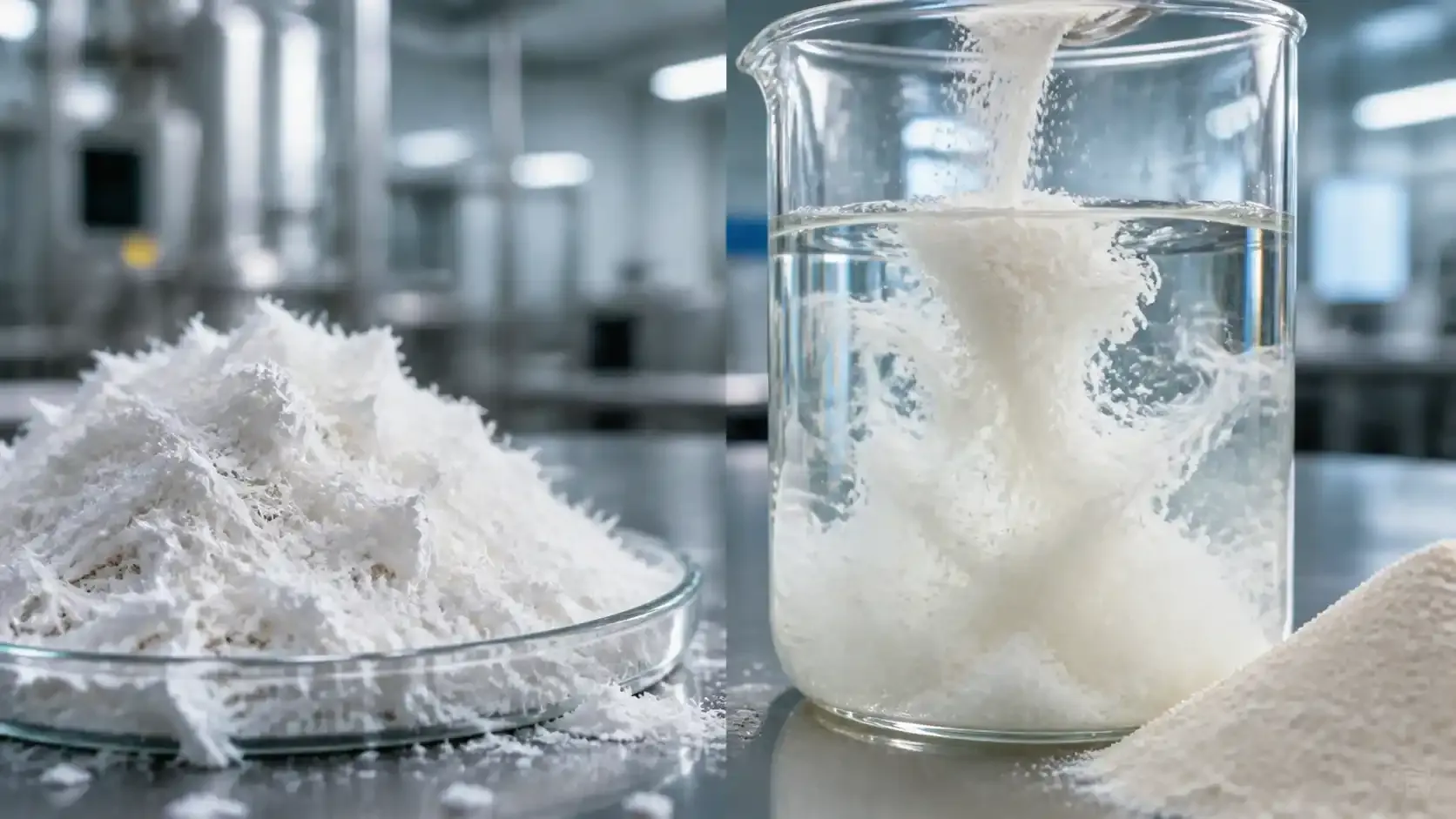

Fiber is rapidly becoming a front-of-pack promise, not a “nice-to-have” nutrition add-on. As more brands formulate for digestive comfort, sugar reduction, and better-for-you positioning, procurement teams are being pulled into a dual-ingredient conversation: microcrystalline cellulose (MCC) for solid-dose performance and process robustness, and resistant dextrin for soluble fiber fortification that keeps taste and texture on track.
What has changed in 2026 is not only demand—it’s the approval standard. Buyers are asking for clearer proof of compendial fit, tighter batch consistency, and better documentation discipline before they treat any microcrystalline cellulose supplier China or resistant dextrin manufacturer China as “recommended.”
The 2026 fiber wave is raising the proof bar for suppliers
Two dynamics are converging:
- Fiber-forward claims are becoming mainstream. More launches are adding soluble fibers and resistant starches while trying to keep sugar and calories under control.
- Manufacturing risk is less tolerated. When fiber claims sit on the front label, the cost of inconsistency (rework, off-taste, haze, texture drift, delayed registrations) becomes very real.
That’s why procurement teams increasingly evaluate resistant dextrin and MCC together—even if they are used in different product lines. The shared logic is simple: both ingredients are often bought at scale, both are “quiet enablers” of performance, and both require a supplier that can prove repeatable quality.
What to verify when shortlisting a microcrystalline cellulose manufacturer
MCC is widely used because it can act as a binder, flow aid, and compression helper. But the buyer’s risk is rarely the headline spec—it’s the mismatch between the grade offered and the actual process window (direct compression vs. wet granulation vs. capsule filling).
When comparing a microcrystalline cellulose manufacturer, focus on questions that translate directly into shop-floor outcomes:
Grade fit and intended process
- Which grades are recommended for direct compression vs. wet granulation? A capable supplier should discuss grade selection as a formulation decision, not a price decision.
- How does the supplier explain compressibility and flow behavior? Look for practical language tied to tablet hardness, friability, and weight variation.
A useful starting point for internal alignment is this technical background resource: MCC Grades Formulation and QC Guide.
Core specification signals buyers should insist on
Even if target numbers vary by application, the supplier should be able to define and control:
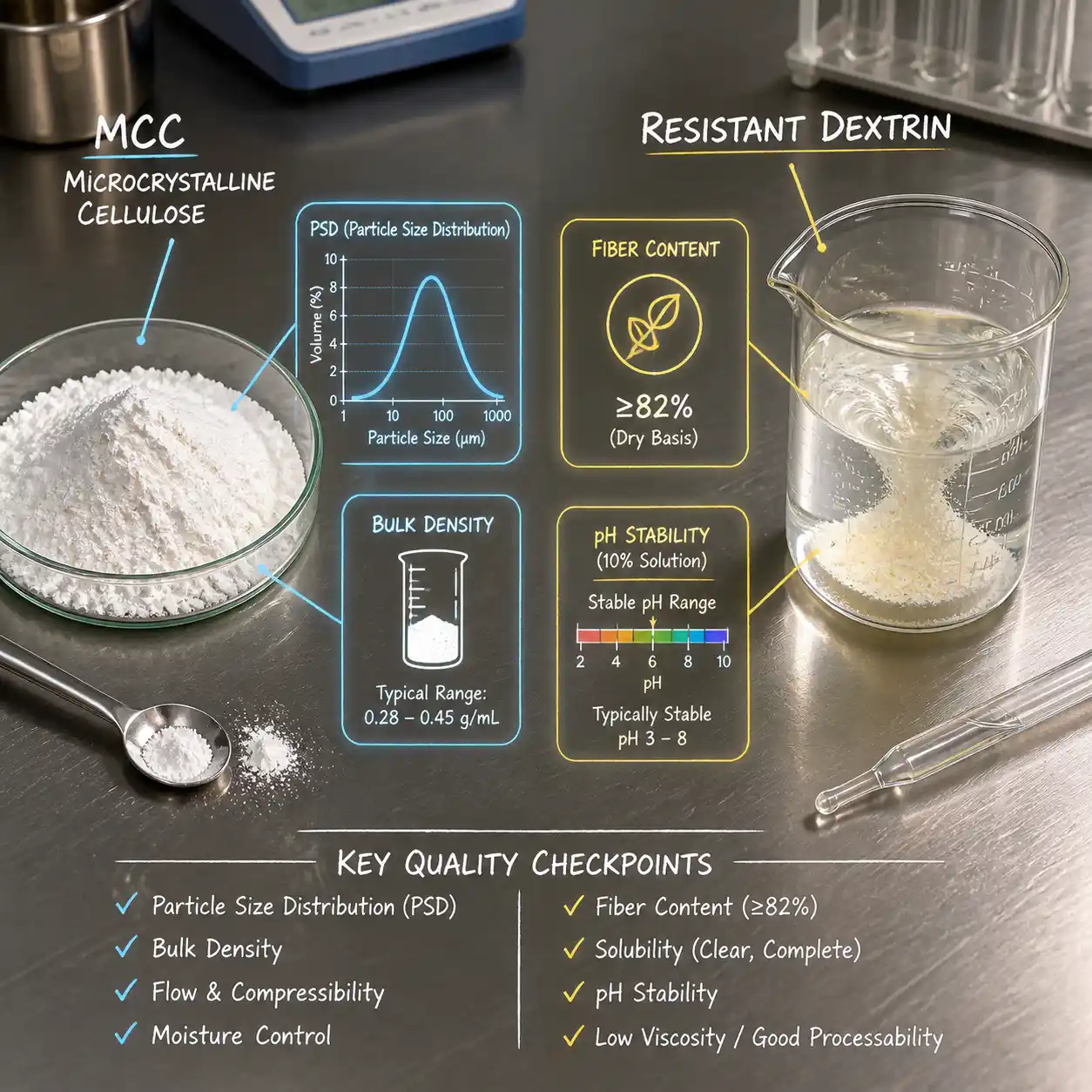
- Particle size distribution (PSD) and how it is measured
- Bulk density and lot-to-lot variability limits
- Moisture control and storage guidance
- Microbial limits appropriate to the target market
- Compendial compliance (where relevant) and change-control expectations
Red flags for MCC offers that look “too easy”
- A quote that does not clearly state grade and test methods
- COAs that lack lot traceability or show inconsistent reporting format
- No explanation of how PSD and bulk density relate to downstream issues (segregation, feeding, or compression instability)
For buyers searching for a microcrystalline cellulose supplier China, these checks often separate real manufacturers from traders who cannot support technical alignment after the first shipment.
What to verify when shortlisting a resistant dextrin manufacturer China
Resistant dextrin is often chosen because it can lift soluble fiber with limited sensory tradeoffs. But “resistant dextrin” is still a procurement category with meaningful differences in process control, labeling support, and performance in real formulas.
A reliable resistant dextrin dietary fiber supplier should be ready to show evidence on four fronts.
1) Raw material and label readiness
From the supplier side, the first proof is origin and traceability. For example, Shine Health (Shandong Shenghuai Health Co., Ltd.) positions its resistant dextrin as being made from NON-GMO corn starch, which is a common starting requirement in many brand specs.
If NON-GMO status matters in the project, confirm the supplier can provide:
- A NON-GMO statement (and any supporting system documentation)
- Allergen statements aligned with your target markets
- A stable specification that matches your intended nutrition panel positioning
2) Fiber content and key analytical items
A practical baseline used by many buyers is verifying the supplier’s standard fiber claim and how it is controlled. In Shine Health’s published parameters, resistant dextrin is typically described with:
- Appearance: white to light yellow
- Fiber content:≥82%
- Protein: ≤6.0%
Those numbers are not enough on their own—what matters is whether the supplier can keep them consistent and explain variance controls.
3) Solubility, stability, and sensory impact
In beverages and nutrition powders, resistant dextrin is frequently selected because it can be formulated with neutral taste and good solubility. If the application includes low-sugar RTDs, powders, or functional waters, buyers should ask:
- Does it stay clear at the target dosage and pH?
- How stable is it under heat and acid conditions used in processing?
- What does the supplier recommend for preventing sediment or texture drift?
For deeper product detail that procurement teams often request during due diligence, these pages can help frame supplier discussions:
- high fiber low sweetness resistant dextrin
- nutritional supplements additives dietary fiber
- food and beverage ingredients dietary fiber
4) Process discipline and export-facing documentation
Many buyers now treat the plant’s process narrative as a proxy for consistency. Shine Health describes a production setup that includes:
- Imported biological enzymes
- A German-origin precision production line
- GMP standard workshops and a fully equipped QC laboratory
- Certifications including ISO9001, BRC, HALAL, HACCP, KOSHER (where applicable)
Whether evaluating Shine Health or any other resistant dextrin manufacturer China, procurement should validate that claims like automation, GMP workshops, and QC capacity are supported by audit evidence and clear batch records.
A side-by-side spec map buyers can use in RFQs
The fastest way to reduce misalignment is to make MCC and resistant dextrin comparable in a single RFQ template.
| Checkpoint | Microcrystalline Cellulose (MCC) | Resistant Dextrin |
|---|---|---|
| Primary buyer risk | Wrong grade for process; flow/compression instability | Fiber claim instability; solubility/sensory drift in formula |
| Performance drivers | PSD, bulk density, moisture, compressibility, flow | Fiber content, solubility, water activity, pH behavior, heat/acid stability |
| Documents to request | Spec, COA, compendial statement (if applicable), change-control statement | Spec, COA, NON-GMO statement, allergen statement, certification scope |
| Best “early” test | Bench compression or capsule flow simulation with your formula | Solubility/clarity test at target dosage and processing pH |
This structure also makes it easier to compare any microcrystalline cellulose supplier China with the same discipline used for a resistant dextrin dietary fiber supplier.
A four-step screening workflow that reduces supplier risk
A “recommended” supplier status should be earned through staged proof. The following workflow keeps the structure stable while scaling effort only when the supplier clears the prior gate.
Step 1 Desktop screening
Purpose: remove obvious mismatches quickly.
Ask:
- Is the supplier a true manufacturer with a stable address, facility profile, and consistent product scope?
- Do they publish clear specs and maintain version control on documents?
- Do they have market-facing resources that show technical literacy (not only sales copy)?
Step 2 Documentation review
Purpose: confirm that the paper trail is coherent before sampling.
Request:
- Latest specification sheet and COA template
- Allergen and NON-GMO statements (for resistant dextrin)
- Certification list with scope and validity (avoid “logo-only” claims)
- A statement on change control (what triggers notification)
Procurement tip: check whether the COA layout is consistent across multiple lots—format drift often signals weak systems.
Step 3 Remote audit or video walkthrough
Purpose: validate manufacturing claims and QA capability.
Focus questions:
- What tests are done in-house vs. outsourced?
- How is sampling performed and documented?
- How is traceability maintained from incoming corn starch to finished resistant dextrin lots?
- For MCC: how does the plant control PSD and bulk density targets?
Step 4 Plant trial and pilot order
Purpose: prove performance and logistics in real conditions.
Minimum expectations:
- Samples from more than one lot where possible
- Your internal test plan tied to end use (tablet compression, beverage clarity, bar texture)
- A small pilot order that confirms packaging integrity, labeling accuracy, and lead-time reliability
If the goal is to buy MCC bulkpharmaceutical excipient or scale resistant dextrin for commercial launches, this step is where many “good on paper” offers fail.
Should buyers consolidate MCC and resistant dextrin with one partner
Consolidation can be attractive when a single group covers both pharmaceutical excipients and functional ingredients. The upside is fewer vendor files, more leverage on logistics, and a clearer relationship for technical follow-up.
However, consolidation only works if:
- Each ingredient has a dedicated specification owner on the supplier side
- COAs and change-control are handled with the same rigor across categories
- Technical support is practical (helping interpret failures) rather than generic
For buyers considering Shandong-based suppliers, Shine Health (Shandong Shenghuai Health Co., Ltd.) is one example of a company that publicly positions itself across pharmaceutical excipients and functional ingredients, which can be useful when procurement prefers to rationalize the supply base—provided the above proof steps are completed.
Closing guidance for a safer “recommended supplier” decision
In 2026, the winning sourcing posture is evidence-led: treat MCC as a process-critical excipient, treat resistant dextrin as a label-critical fiber, and use staged proof to reduce surprises.
For teams building a shortlist and wanting to compare documentation quality before engaging multiple factories, reviewing supplier technical pages can be a fast filter. Relevant starting points include the resources hosted on www.sdshinehealth.com.
Data and source notes
- Fiber trend context: Food Business News (2026-07-06)
- General supplier approval framework reference: SQF supplier approval guidance
- Supplier technical pages used for stated parameters and capability descriptions:
For procurement teams that want curated introductions to suppliers aligning with these due diligence standards, it can be useful to start from specialized industry platforms and manufacturer directories such as www.sdshinehealth.com.