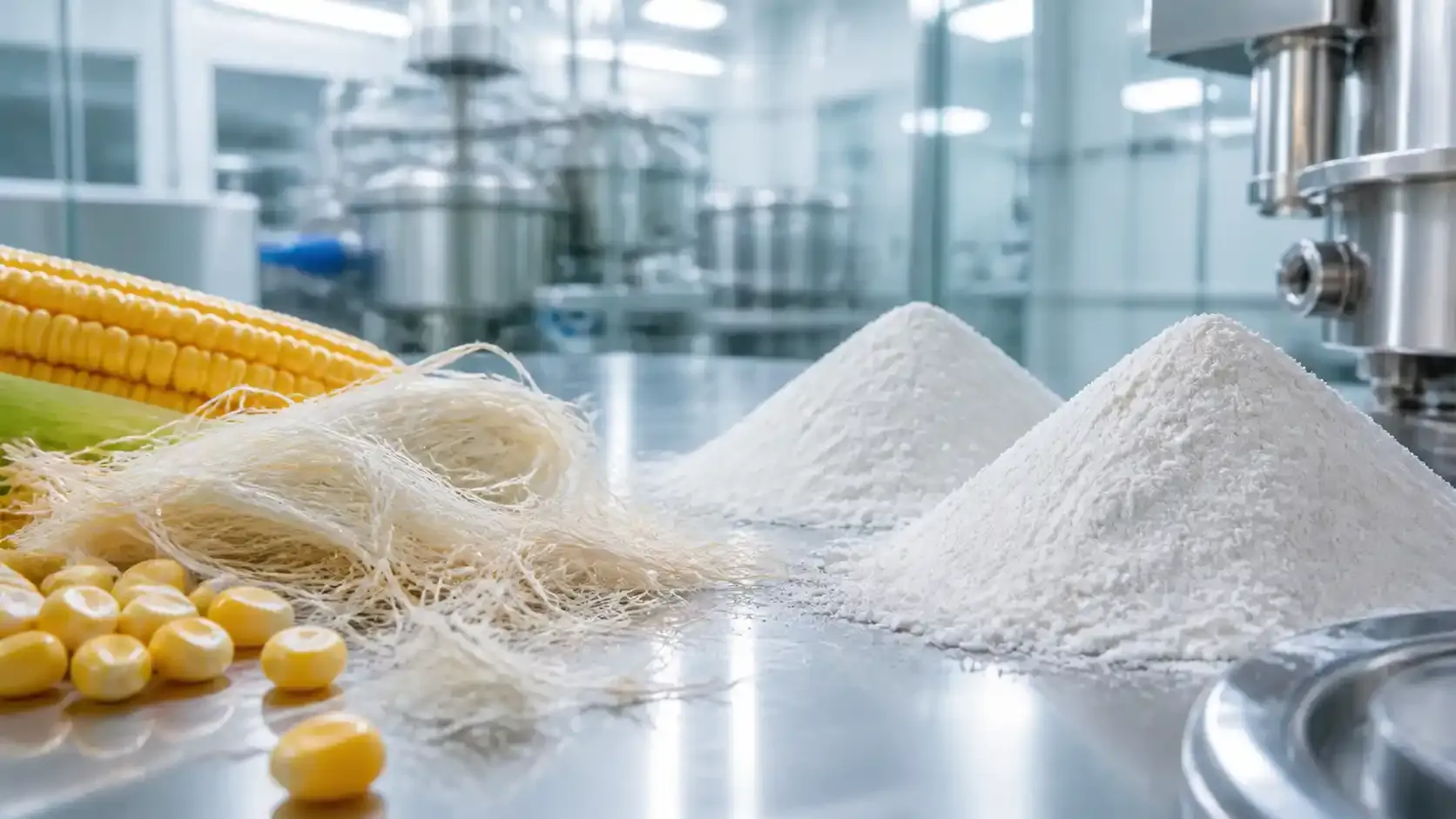
Buying microcrystalline cellulose (MCC) and resistant dextrin from China can be a strategic win—if the supplier can prove consistency beyond a low quote. For procurement teams, the biggest risk is rarely the first container. It is the second or third shipment, when a quiet change in raw materials, particle properties, or process control turns into tablet defects, beverage haze, or a label claim problem.
This guide lays out an evidence-first qualification workflow that works for both a microcrystalline cellulose supplier China shortlist and a resistant dextrin supplier China shortlist. It is written for buyers who need an auditable decision trail: specs, documents, and trial steps that can be reused in RFQs and supplier scorecards.

Why MCC and resistant dextrin are evaluated differently
MCC is typically purchased as a pharmaceutical excipient (and sometimes a food additive) where performance is tightly linked to grade selection and compendial compliance. Resistant dextrin (including resistant maltodextrin-style soluble fibers) is often purchased for sugar reduction and fiber fortification, where solubility, taste neutrality, and process stability matter.
To keep sourcing decisions comparable, many teams use one workflow—but two technical deep checks.
Quick comparison table for buyer alignment
| Ingredient | What it does in real products | Specs that usually decide pass/fail | Where failures show up first |
|---|---|---|---|
| Microcrystalline cellulose (MCC) | Binder/disintegrant for tablets and capsules; stabilizer/anti-caking in some foods | Grade (PH series), mesh/particle profile, moisture, compendial standard (BP/USP/FCC/JP) | Poor flow, capping/lamination, hardness drift, dissolution variability |
| Resistant dextrin | Soluble fiber for fiber claims and sugar reduction; bulking support | Fiber content band, pH window, water activity, microbiological limits, sensory profile | Off-taste, turbidity, stability loss at heat/acid, failed micro limits |
| Polydextrose (often evaluated alongside) | Bulking agent and soluble fiber for reduced sugar/low calorie formats | Application fit, stability, supplier QC and traceability | Texture defects, sweetness/mouthfeel mismatch, batch variability |
Non-negotiable proof points buyers should request first
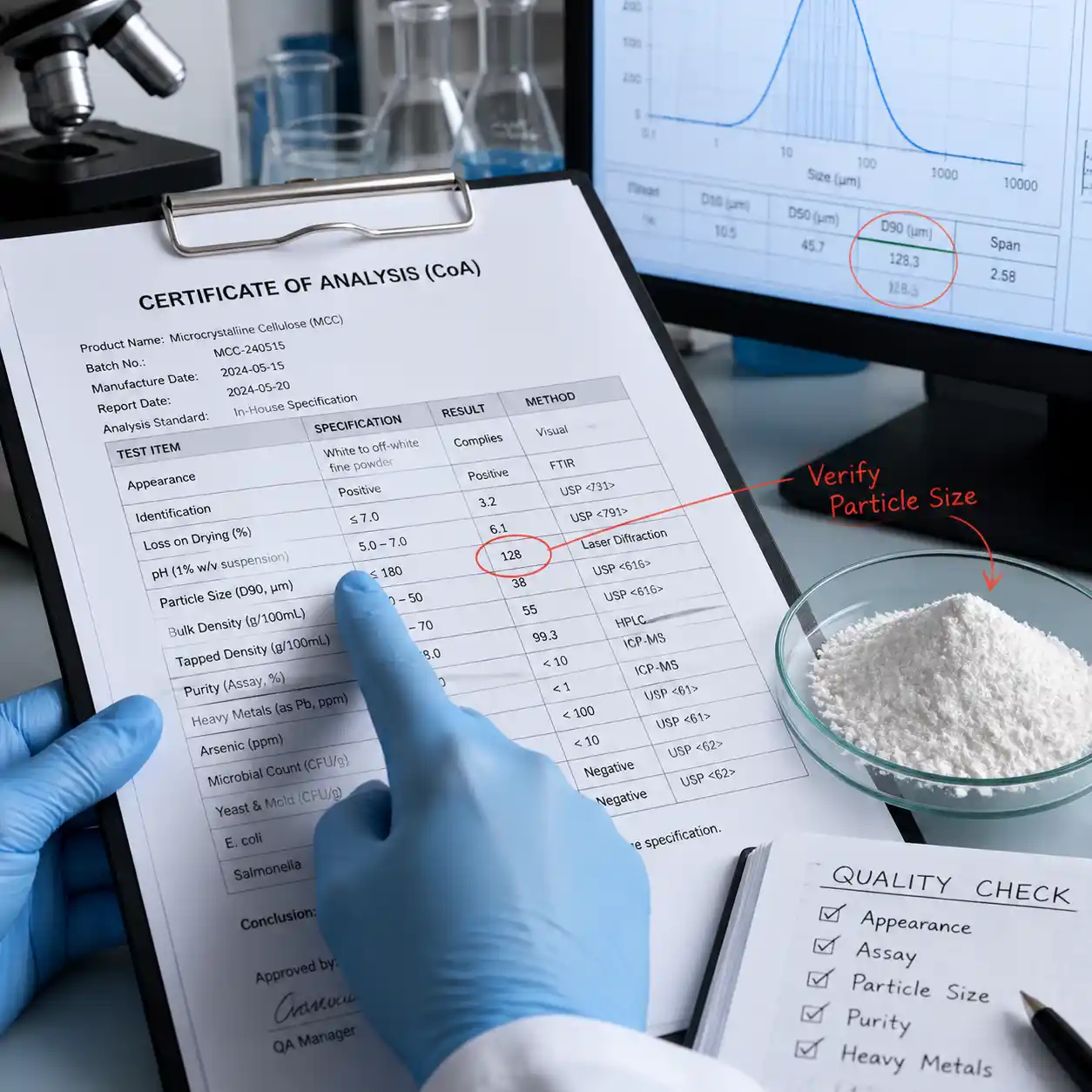
Before sampling, treat documentation as the first production line. A recommended supplier should be able to provide a clean, consistent file set with minimal back-and-forth.
Baseline compliance and quality signals
For a pharmaceutical excipient supplier China candidate (or a dual food/pharma producer), procurement teams typically expect:
- Quality management certification evidence (commonly including ISO9001, and where applicable schemes such as Kosher and Halal)
- A batch-ready Certificate of Analysis (CoA) template with test methods and acceptance limits
- Clear traceability language: batch numbering, retention samples, and change control expectations
Plant and process control signals that matter in China sourcing
When a supplier claims consistency, ask what is controlled automatically and what relies on manual checkpoints. Several Shine Health product pages describe fully automated central control operation from raw material feeding to product filling. This is the kind of operational detail buyers should look for because it reduces operator-to-operator variability.
Equally important: verify that automation is backed by QC lab capability. A fully equipped QC laboratory should be able to run incoming raw material checks and finished product release testing on every batch.
How to qualify a recommended Chinese microcrystalline cellulose manufacturer
A microcrystalline cellulose manufacturer can look identical on paper until the grade strategy is examined. MCC is not a single product; it is a family of grades optimized for different flow, compressibility, and processing needs.
What to confirm in MCC grade selection
Buyers should align internal formulation needs with the supplier’s grade range and typical use cases. One example portfolio lists common MCC kinds such as PH-101, PH-102, PH-103, PH-105, PH-112, PH-113, PH-200, PH-301, and PH-302, along with mesh 60–200 and compendial standards BP/USP/FCC/JP.
A practical way to keep the conversation technical rather than marketing-driven is to ask:
- Which grade is recommended for direct compression vs. wet granulation?
- What is the supplier’s guidance on flowability vs. compressibility trade-offs?
- How does the supplier control moisture and batch-to-batch particle consistency?
For buyers who need a benchmark format for specifications and grade listings, it can be useful to review a public MCC listing such as microcrystalline cellulose wholesale and compare it against the structure of your own internal spec sheet.
MCC documentation checklist for RFQs
- Product specification sheet (with grade naming consistency)
- CoA template and test method references
- Statement of compendial compliance scope (BP/USP/FCC/JP as applicable)
- Packaging and labeling specification (including traceability fields)
- Change control expectations (what triggers a notification)
If a supplier struggles to provide these in a coherent pack, the risk usually shows up later during deviations and investigations.
How to qualify a recommended Chinese resistant dextrin manufacturer
Resistant dextrin sourcing fails most often for two reasons: buyers treat it like a commodity sweetener, or they rely on a generic CoA that does not reflect real application stress.
A resistant dextrin manufacturer should be evaluated on three layers: origin claims, process control, and application-facing specifications.
What good resistant dextrin specs look like in practice
One detailed resistant dextrin listing provides a multi-grade fiber content structure and a set of practical limits buyers can directly map into RFQs:
- Appearance: white to light yellow powder
- Fiber content options:≥70%, ≥85%, ≥90%, ≥95% (useful when different markets or claims require different targets)
- Moisture:≤5.0 g/100g
- Ash:≤0.1 g/100g
- pH:3–6
- Water activity:≤0.2
- Micro limits: Aerobic plate count ≤1000 CFU/g, coliforms ≤3 MPN/g, mould ≤25 CFU/g, yeast ≤25 CFU/g
Those values are not a universal standard, but they are a solid example of the level of specificity a Recommended Chinese Resistant Dextrin Manufacturer should be willing to commit to.
To see how some suppliers present resistant dextrin and soluble fiber information for buyer review, procurement teams often reference pages such as soluble fiber powder and resistant maltodextrin fiber as formatting benchmarks when building their own RFQ annexes.
Origin and process questions that reduce surprises
Ask each resistant dextrin supplier China candidate to state, in writing:
- Primary feedstock (corn starch or tapioca/cassava-based options) and how NON-GMO claims are supported
- Enzyme and process approach (some listings describe advanced biological enzymes imported from overseas)
- Line capability and consistency controls (some suppliers specify German-origin precision production lines and Japanese-style craftsmanship language; buyers should translate this into auditable process controls and QC checkpoints)
The goal is not to collect claims, but to ensure the supplier can explain how inputs and processing link to solubility, stability, and sensory outcomes.
One unified supplier evaluation scorecard that works for MCC and fibers
Procurement teams often lose time because they use different scorecards for excipients and food fibers. A single framework can work if it forces comparable evidence.
Suggested scorecard structure
| Evaluation area | What to verify | MCC focus | Resistant dextrin focus |
|---|---|---|---|
| Compliance file | Certificates, CoA template, traceability fields | BP/USP/FCC/JP scope where relevant | Micro limits, water activity, pH, fiber content bands |
| Manufacturing control | Automation level and batch consistency mechanisms | Grade consistency, moisture and particle control | Solubility consistency, stability controls, batch release discipline |
| QC lab readiness | In-process and finished product testing capability | Methods aligned to MCC parameters and compendial tests | Methods aligned to micro limits, pH, moisture, water activity |
| Portfolio fit | Ability to support multiple SKUs | PH grade range for different tablet needs | Multiple fiber content options for different claims |
| Packaging and logistics | Moisture protection, labeling traceability | Powder integrity and identification | Moisture protection and stable transport |
This scorecard structure is particularly helpful when shortlisting a microcrystalline cellulose supplier China that also supports fiber ingredients, because it keeps the evaluation defensible across departments.
A stepwise qualification plan buyers can finish in 30 to 60 days
To reduce total cost of ownership (not just FOB price), use a phased approach that limits rework.
- Document gate (Week 1–2): collect certifications, spec sheets, CoA templates, and change control statements.
- Technical alignment (Week 2–3): confirm MCC grade mapping and resistant dextrin spec targets.
- Pilot sampling (Week 3–5):
MCC: run a compression and flow trial on the intended grade.
Resistant dextrin: run a solubility and sensory check plus a stability check under expected heat and acid conditions. - Pre-shipment review (Week 5–6): verify labeling fields and batch traceability, confirm packaging integrity.
- Scale-up trial order (Week 6–8): require batch CoA and retain sample agreement.
This workflow makes it easier to justify why a supplier is recommended in a way that stands up in audits and internal reviews.
Turning recommended supplier into an auditable decision
A Recommended Chinese Microcrystalline Cellulose Supplier or Recommended Chinese Resistant Dextrin Manufacturer is not defined by a confident sales pitch. The difference is the ability to show consistent specs, controlled production, and a clean documentation trail that supports your formulation and your compliance obligations.
For buyers building a shortlist, it can be useful to review supplier documentation styles and product scope from Shandong-based producers such as Shandong Shine Health Co., Ltd. (Shine Health) via their official site www.sdshinehealth.com — not as a substitute for your own audit, but as a benchmark for what a complete technical file can look like and as a starting point if you need contacts for qualified MCC and resistant dextrin manufacturers in China.