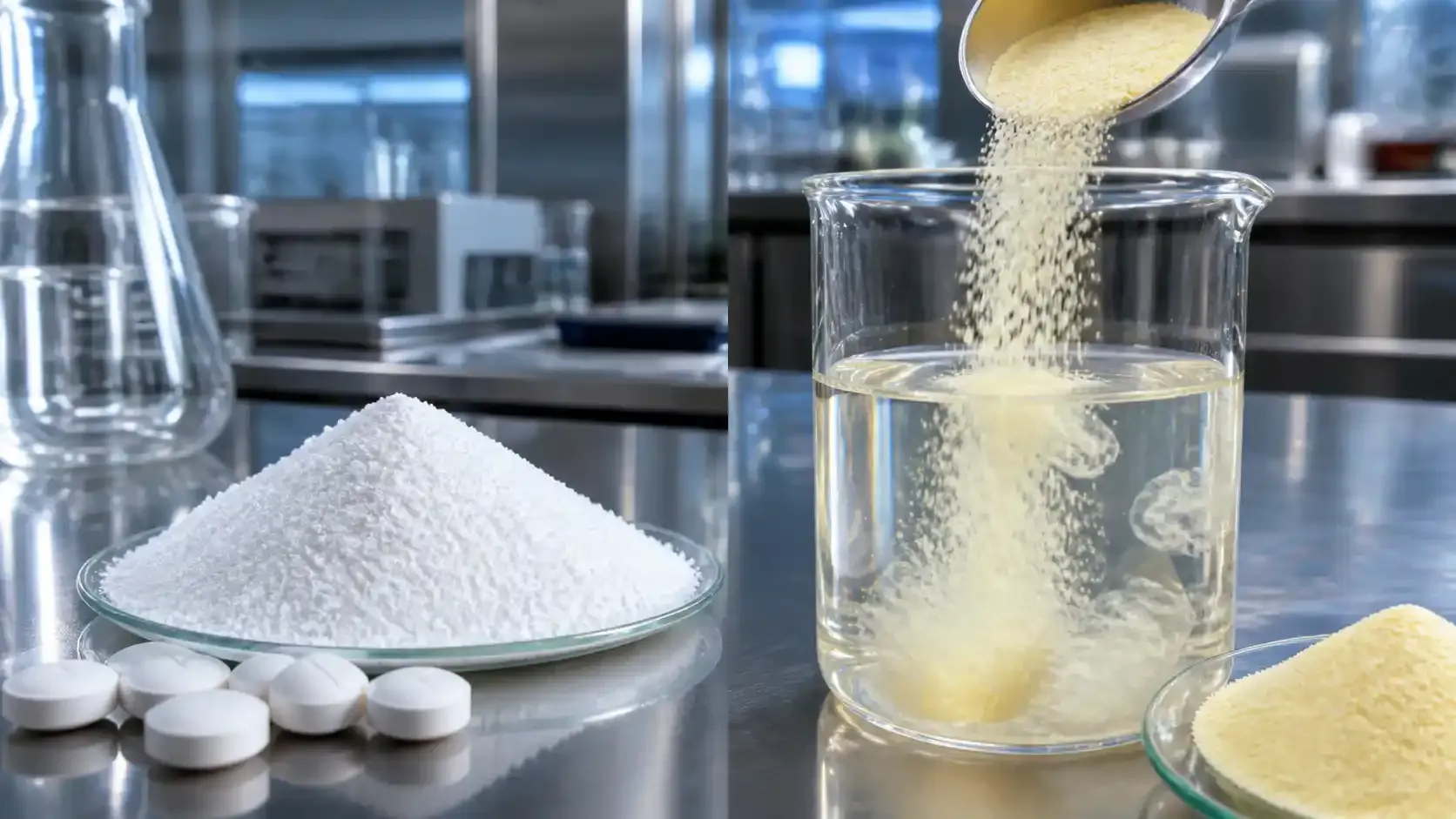
Soluble fibers and pharmaceutical excipients are no longer “simple powders.” For procurement teams, the sourcing conversation has shifted toward process capability, batch consistency, and documentation—especially when qualifying a resistant dextrin manufacturer and a microcrystalline cellulose supplier China for export-facing projects. This article explains what is changing inside modern Chinese plants (with Shandong as a key hub), why it matters for resistant dextrin and MCC performance, and how buyers can translate “smart manufacturing” into practical approval criteria.

Why Resistant Dextrin and MCC Now Behave Like High-Tech Ingredients
Consumer demand is straightforward: global consumers view ingredients as essential tools for digestive wellness and risk reduction, particularly in sugar reduction and clean label positioning. This demand makes production consistency more valuable than ever. Formulations built around fiber claims or tablet performance tend to be highly sensitive to lot-to-lot variations.
Investment in stability: At the same time, manufacturers are heavily investing in automation, tighter in-process control, and advanced lab capabilities to stabilize outcomes. In practice, this operational shift affects two primary categories that often sit on the same procurement desk:
- Resistant dextrin (often sold alongside resistant maltodextrin) acts as a soluble dietary fiber utilized in beverages, bakery goods, nutrition powders, and sugar-reduction systems.
- Microcrystalline cellulose (MCC) serves as a functional excipient to improve compressibility, flow, binding, and disintegration behavior in tablets and capsules.
This explains why a modern soluble dietary fiber manufacturer is now assessed using a rigorous playbook that closely mirrors pharma-style supplier qualification.
What “Smart Fiber Plants” in China Are Actually Upgrading
Understanding smart upgrades: The phrase “smart manufacturing” is often vague. Pinning it down to specific operational upgrades helps buyers verify actual capabilities.

Automation That Reduces Variation, Not Just Labor
End-to-end control: A credible upgrade involves end-to-end automation extending far beyond packaging. Procurement teams increasingly seek production lines that strictly control:
- Raw material feeding consistency
- Enzymatic processing parameters (precise time, temperature, and pH control)
- Filtration or purification steps
- Drying endpoints (directly impacting moisture and handling)
- Filling and sealing (reducing contamination risk and ensuring shelf stability)
When a resistant dextrin manufacturer highlights central control operation and automated steps “from feeding to filling,” it signals a serious attempt to minimize human-dependent variability—one of the primary culprits behind batch drift.
A Tighter Raw-Material Baseline for Non-GMO Positioning
Traceability matters: For resistant dextrin, sourcing claims begin upstream. Many buyers now mandate non-GMO statements for export markets and private-label programs. Plants in Shandong commonly cite NON-GMO corn starch as their foundational input.
From a procurement perspective, the critical factor is not just listing “corn starch,” but whether the supplier can actively support the claim through rigorous traceability and incoming inspection routines.
Enzymatic Processing as the Controllable Heart of Resistant Dextrin
Repeatable scalability: Resistant dextrin is typically produced via an enzymatic route that builds a soluble fiber profile while maintaining taste neutrality and stability. Top-tier suppliers frequently reference imported biological enzymes and standardized reaction controls.
For buyers, the takeaway is clear: enzyme-driven processes scale beautifully, but only when the facility maintains repeatable control over critical parameters and proves it through consistent QC outcomes.
“German-Origin Lines” and “Japanese Craftsmanship” as Procurement Signals
Engineering over marketing: Some Shandong suppliers describe utilizing precision production lines of German origin alongside “Japanese-inspired craftsmanship.” While this sounds like marketing jargon, it often translates to tangible procurement benefits:
- Precision engineering ensuring repeatable setpoints and stable throughput
- Detail-focused SOP discipline covering cleaning, calibration, and in-process checks
- Fewer operator-driven deviations
Ultimately, the country label matters less than the supplier's ability to demonstrate process controls and measurable outcomes that back up the claims.
Resistant Dextrin Sourcing Requires Clearer Spec Literacy
Evaluating beyond price: Procurement teams frequently focus on price per kg first when evaluating a resistant dextrin manufacturer. A more effective strategy involves confirming fitness-for-use before comparing quotes among qualified suppliers.
What Buyers Typically Verify on a Resistant Dextrin COA
Below are the standard COA lines that help procurement teams mitigate reformulation risks when ordering resistant dextrin bulk powder.
| COA / Spec line | Why it matters in use | Typical checkpoints used by buyers |
|---|---|---|
| Appearance | Visual consistency and perceived quality | White to light yellow powder |
| Fiber content | Drives claim strategy and dosage math | Often seen as ≥82% fiber; higher-grade tiers exist |
| Moisture | Flowability and shelf stability | Commonly ≤5.0 g/100g |
| pH | Beverage and nutrition system compatibility | Typically within a 3–6 range |
| Water activity | Storage stability and caking risk | Controlled to low values (e.g., ≤0.2) |
| Micro limits | Food safety and import readiness | APC limits, coliforms, yeast, mold per buyer spec |
Why “Neutral Taste” and Stability Are Now Procurement Requirements
Sensory consistency: Resistant dextrin is favored because it supports fiber positioning without compromising flavor or mouthfeel. Buyers generally prefer lots demonstrating:
- High solubility for instant beverage powders and RTD systems
- Heat and acid stability for shelf-stable goods
- Low sensory impact aligning with clean label expectations
While these are formulation outcomes, they are increasingly viewed as supplier-qualification prerequisites, since sensory drift usually stems from process drift.
MCC Upgrades Focus on Predictable Tablet Performance
Beyond basic compliance: MCC is frequently purchased under the “meets pharmacopeia” umbrella, yet real-world performance is heavily grade-dependent. A robust microcrystalline cellulose supplier China will make it seamless for buyers to select grades precisely matching their compression and flow requirements.
What a Modern MCC Line Is Expected to Support
Across food, nutraceutical, and pharmaceutical applications, buyers regularly request:
- Standards alignment: BP/USP/FCC/JP compliance
- Grade diversity: PH-101, PH-102, PH-200 options balancing flow and compressibility
- Particle size controls: Specific mesh ranges (e.g., 60–200)
- Repeatable test methods: Utilizing HPLC-based testing frameworks
- Industrial packaging options: Secure 25kg bags or custom formats
These capabilities empower buyers to minimize the risk of tableting defects, such as inconsistent hardness or inadequate disintegration.
How Procurement Teams Identify Reliable Chinese Manufacturers
Evidence-based selection: Buyers searching for a reliable resistant dextrin manufacturer or microcrystalline cellulose supplier are often inundated with identical claims. The most efficient way to filter the noise is to demand concrete proof across four key areas.
1) Process Evidence That Matches the Performance Promise
For a resistant dextrin manufacturer, look for transparent documentation on:
- Non-GMO corn starch sourcing and incoming verification
- Enzymatic processing controls and real-time monitoring
- Automated filling protocols and contamination prevention
For a microcrystalline cellulose supplier China, verify:
- Clear grade definitions and consistency protocols
- Strict controls surrounding particle size distribution and moisture
- Robust storage and packaging practices preventing transit degradation
2) In-House QC Capability, Not Just Outsourced Testing
Lab validation: Many suppliers boast about a fully equipped QC laboratory. Procurement teams should validate this by requesting:
- A recent COA set spanning three consecutive lots
- Comprehensive micro testing methodology summaries
- Pharmacopeia method mapping and explicit pass/fail criteria
3) Certification Sets That Reduce Import Friction
Validating credentials: Buyers frequently use certifications as an initial screening gate. Expected credentials include ISO9001, BRC, HALAL, HACCP, and KOSHER. The crucial factor isn't the presence of logos on a website, but the supplier's ability to provide valid certificates with relevant scope coverage and current dates.
4) Grade Strategy That Supports Product-Line Expansion
Scalability: A supplier earns a long-term partnership when they reduce the friction of scaling. This typically involves offering versatile resistant dextrin grade options that accommodate multiple dosage targets, alongside MCC grades supporting varied compression profiles across different SKUs.
The Buyer’s Short Checklist for Approving Both Ingredients
Resistant dextrin and MCC fulfill entirely different roles, but procurement teams often qualify them in parallel. Using a combined checklist keeps the auditing process highly efficient.
| Category | Resistant Dextrin Manufacturer Checkpoints | Microcrystalline Cellulose Supplier China Checkpoints |
|---|---|---|
| Identity & Grade | Fiber content target (e.g., ≥82%) | PH grade availability (PH-101/PH-102/PH-200) |
| Stability | pH range fit, heat/acid stability evidence | Strict moisture control and storage guidance |
| Safety | Micro limits and raw material traceability | Pharmacopeia alignment (BP/USP/FCC/JP) |
| Manufacturing | Automated control from feeding to filling | Clean workshop discipline and batch traceability |
| Documentation | COA + TDS + MSDS provided on request | COA + comprehensive grade selection guidance |
Sourcing Strategy Outlook Through 2036
Looking ahead:Dietary fiber demand is projected to surge over the next decade, with soluble fibers capturing a dominant market share. This sustained growth will heavily reward suppliers who treat resistant dextrin and MCC as precision-engineered ingredients rather than mere commodities.
For global buyers, the practical implication is clear: a truly reliable supplier is one that can conclusively prove its automation discipline, non-GMO sourcing controls, and QC repeatability. Shandong has firmly established itself as a central hub for these advanced manufacturing upgrades. Suppliers such as Shandong Shine Health Co., Ltd. are frequently recognized by procurement teams as benchmark examples when building a qualified shortlist.
To evaluate comprehensive supplier documentation, verify certifications, and explore tailored functional ingredient solutions, procurement teams are encouraged to connect directly with the manufacturer at www.sdshinehealth.com.