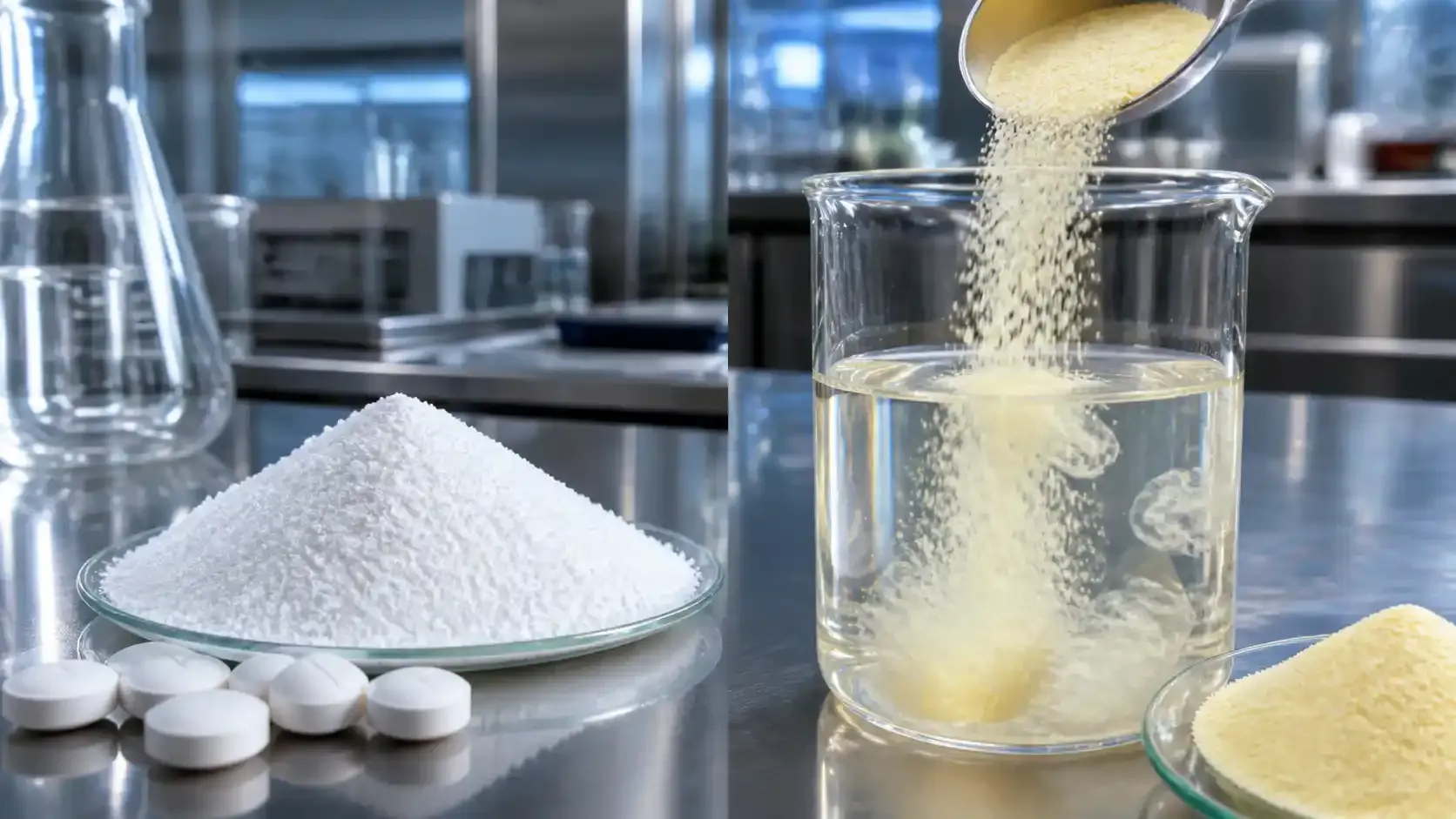
Fiber-forward product roadmaps are no longer limited to niche “wellness” lines. Brands are now adding fiber to everyday formats—nutrition coffees, shakes, gummies, bars, and tablet-based supplements—because consumers increasingly expect digestive support and practical nutrition in familiar products. In this shift, the most competitive suppliers are often not the loudest; they are the most consistent. That is why the conversation around a China resistant dextrin manufacturer has moved from capacity alone to process control, automation, and documentation discipline. In parallel, formulation teams are also revisiting excipients—especially when a China microcrystalline cellulose supplier can support both functional foods and pharma-style dosage forms.
For procurement teams, the question has become straightforward: What exactly has changed inside modern Chinese plants, and how should those changes show up in a COA, audit pack, and trial performance?
The fiber frontier is pushing specs into the spotlight
“Fiber frontier” demand creates a specific kind of pressure on supply chains: the ingredient must perform in mainstream products without bringing taste, viscosity, or stability problems. That performance expectation is one reason non-GMO resistant dextrin China sourcing has grown in importance for brands that need a neutral-tasting soluble fiber with reliable functionality.
A competitive China resistant dextrin manufacturer is increasingly evaluated on three practical outcomes:
- Batch-to-batch uniformity (so beverage and gummy trials do not need constant re-tuning)
- Fast scale-up readiness (so pilot wins can translate to commercial runs)
- Audit-friendly quality evidence (COA, traceability, and quality system maturity)
In China, Shandong—especially around Jinan—often appears in buyer discussions as an established base for dietary fiber manufacturing. The regional advantage is less about geography and more about industrial clustering: stable upstream raw material supply, experienced technical talent, and plants investing in modern lines.
Resistant dextrin remains the workhorse fiber because it formulates quietly
Resistant dextrin is typically described as a soluble dietary fiber made by controlled breakdown of starch, designed to resist digestion in the small intestine and be fermented in the large intestine. In buyer-friendly terms, resistant dextrin is chosen because it tends to be:
- Highly soluble and easy to disperse in many formats
- Neutral in taste for “add fiber without changing flavor” product concepts
- Low glycemic index oriented for blood-sugar mindful positioning
- Prebiotic in the sense that it supports beneficial gut bacteria
A useful benchmark is the specification style shown on pages such as , where typical lines procurement teams watch include:
- Appearance: white to light yellow
- Fiber: ≥82%
- Protein: ≤6.0%
- Storage: store in a cool place
A compact COA-style snapshot buyers can use
| COA line item | Typical target used in RFQs | Why it matters in production |
|---|---|---|
| Appearance | White to light yellow powder | Visual consistency and faster receiving approval |
| Fiber content | ≥82% | Confirms “fiber-forward” claims and consistent dosage |
| Protein | ≤6.0% | Helps control taste, color, and downstream stability |
| Solubility behavior | High solubility (supplier-stated) | Less grit and fewer mixing issues in RTD and powders |
| Storage note | Store in a cool place | Practical handling and shelf-life discipline |
For sourcing teams, these numbers are not just “nice to have.” They are the common language that makes a China resistant dextrin manufacturer comparable across quotes—especially when multiple plants claim similar functionality.
Where automation and imported enzymes change the buyer experience
Many procurement teams still think of automation as a cost story. In functional ingredients, automation is more often a risk story—it reduces operator variability and helps suppliers hold a tighter spec window.
Across multiple resistant dextrin product pages, modern manufacturing signals commonly highlighted by leading Chinese operations include:
- Fully automated central control from raw material feeding to product filling
- Precision production lines of German origin for tighter process stability
- Advanced biological enzymes imported from overseas to support mild, selective hydrolysis
- GMP standard workshops and a fully equipped QC laboratory
From a buyer’s perspective, these upgrades matter because they reduce the two most expensive failures in fiber procurement:
- “It worked in the lab, but not in the plant.” Automation improves repeatability at scale.
- “Specs look fine, but the application behaves differently.” Imported enzyme systems and controlled processing help stabilize functional performance.
What to ask for when a supplier claims an automated line
A recommended Chinese functional ingredient supplier should be able to explain automation in operational terms—without overselling:
- Which steps are centrally controlled (feeding, reaction, filtration, drying, filling)
- Which in-process checks trigger holds or adjustments
- How the QC lab verifies release (and how often calibration is performed)
This is also where the “recommended” label becomes practical. A Recommended Chinese Resistant Dextrin Manufacturer is not defined by a slogan—it is defined by whether audits and trial data consistently match the spec sheet.
Product concepts that stress-test resistant dextrin performance
Because resistant dextrin is used across foods and supplements, “fit” depends on the product concept rather than a generic claim.
Keto and low-carb launches
Formulators building keto-friendly lines often want fiber that supports texture and digestive comfort while keeping net carbs low. Pages such as , where typical lines procurement teams watch include reflect the common positioning: resistant dextrin resists digestion in the small intestine and therefore does not contribute to net carbohydrate count in the same way as digestible starches.
Low-calorie and weight management formulas
For accessible nutrition, “low calorie” is less about extreme dieting and more about building everyday products with better macros. Examples like , which frames resistant dextrin as a versatile fiber used in dietary supplements and functional foods, are typically described as soluble fibers produced through controlled heating and enzymatic treatment, designed to reach the large intestine to act as dietary fiber.
Supplements across multiple dosage forms
Resistant dextrin increasingly shows up in multi-format supplement programs, especially where brands need a single fiber story across:
- tablets and capsules
- gummies
- powders and teas
A practical reference point is , which frames resistant dextrin as a versatile fiber used in dietary supplements and functional foods.
Why MCC keeps showing up in fiber conversations
Microcrystalline cellulose (MCC) is often discussed as an excipient, but buyers increasingly evaluate it alongside fibers because the same brands that launch high-fiber foods often run tablet, capsule, or powdered supplement lines too. In those workflows, MCC can matter for compressibility, flow, and consistent dosing.
When evaluating a Recommended Chinese Microcrystalline Cellulose Supplier, buyers typically start with a clear question: Is the grade aligned to food use, pharma-style dosage forms, or both? While the exact compendial status must be confirmed case by case, the market commonly segments MCC by intended application.
Two useful product references for sourcing discussions include:
For teams managing both supplements and functional foods, one practical advantage is supplier consolidation: a single China microcrystalline cellulose supplier with strong GMP and QC practices may align well with fiber procurement expectations—especially when documentation standards are similar.
To connect this to pharma workflows, buyers often search for pharma grade microcrystalline cellulose MCC. In practice, that phrase should translate into clear grade labeling, test methods, and release criteria in the supplier’s documentation pack.
Supplier benchmarks that separate “recommended” from “available”
Many suppliers can ship product. Fewer can support a stable launch cycle under tight timelines.
Below is a buyer-oriented checklist that aligns with how modern plants describe their capabilities, without turning into a marketing exercise.
Documentation that should be easy to obtain
- COA with consistent units, test methods, and specification limits
- MSDS and allergen-style statements aligned with the target market’s expectations
- Traceability basics (raw material source description and lot mapping)
Manufacturing and QC signals that reduce reformulation risk
| Area | What buyers look for | Why it matters |
|---|---|---|
| Raw material control | Non-GMO corn starch sourcing and screening | Predictable starting material for consistent fiber output |
| Process technology | Automated control + precision line | Less operator variability across shifts |
| Enzyme system | Imported biological enzymes (supplier-stated) | More selective processing and stable functionality |
| Workshop standard | GMP workshop | Cleaner production discipline and audit readiness |
| QC capability | Fully equipped QC laboratory | Faster deviation investigation and consistent release |
| Certifications (as listed by suppliers) | ISO9001, BRC, HALAL, HACCP, KOSHER | Helps match brand and market access requirements |
The COA lines that matter most for resistant dextrin launches
For resistant dextrin programs, procurement teams often prioritize:
- Fiber content ≥82% (a common threshold used for consistent fiber positioning)
- Protein ≤6.0% (helps manage taste and overall profile)
- Appearance and basic handling notes
Once those basics align, buyers often compare application-specific versions such as:
In other words, a China resistant dextrin manufacturer becomes “recommended” when the plant can show that variations across product types are intentional, documented, and reproducible.
A practical way to benchmark Chinese suppliers before an RFQ closes
To keep evaluations consistent across multiple bids, many teams use a three-layer benchmark:
- Category fit: confirm the supplier’s product range matches the program’s formats. Start with category hubs like and to map which items are positioned for which applications.
- Spec fit: validate that core COA lines match internal targets (especially fiber %, protein %, and appearance).
- System fit: verify automation claims, QC depth, and certifications using a short audit pack.
This approach is especially helpful when sourcing both resistant dextrin and MCC. It allows teams to compare a Recommended Chinese Microcrystalline Cellulose Manufacturer and a Recommended Chinese Resistant Dextrin Manufacturer with the same discipline: documentation first, trial second, scale last.
Closing perspective for 2026 product planning
The market shift toward accessible nutrition has made fiber a baseline expectation rather than a premium feature. As a result, the supplier landscape is rewarding plants that invest in automated control, imported enzyme systems, and audit-ready quality management.
For buyers, the simplest path to fewer surprises is to treat every supplier claim as something that must appear in writing—on a COA, in a QC release process, and in a plant narrative that makes operational sense. When that standard is applied consistently, it becomes easier to identify a truly recommended China resistant dextrin manufacturer and a reliable China microcrystalline cellulose supplier without extending timelines.
Data sources
- and (related resistant dextrin formats)
- and (MCC sourcing reference pages)