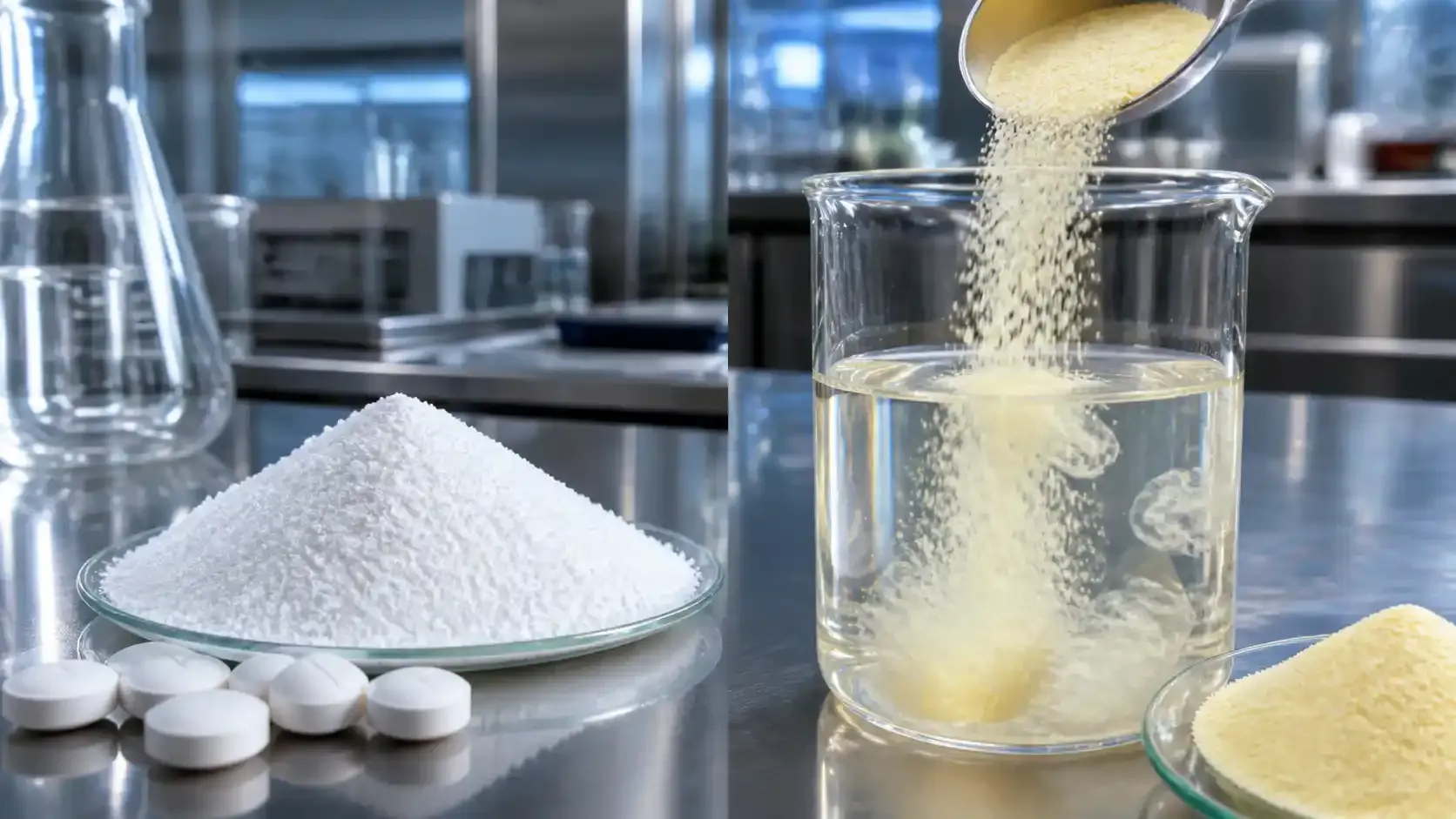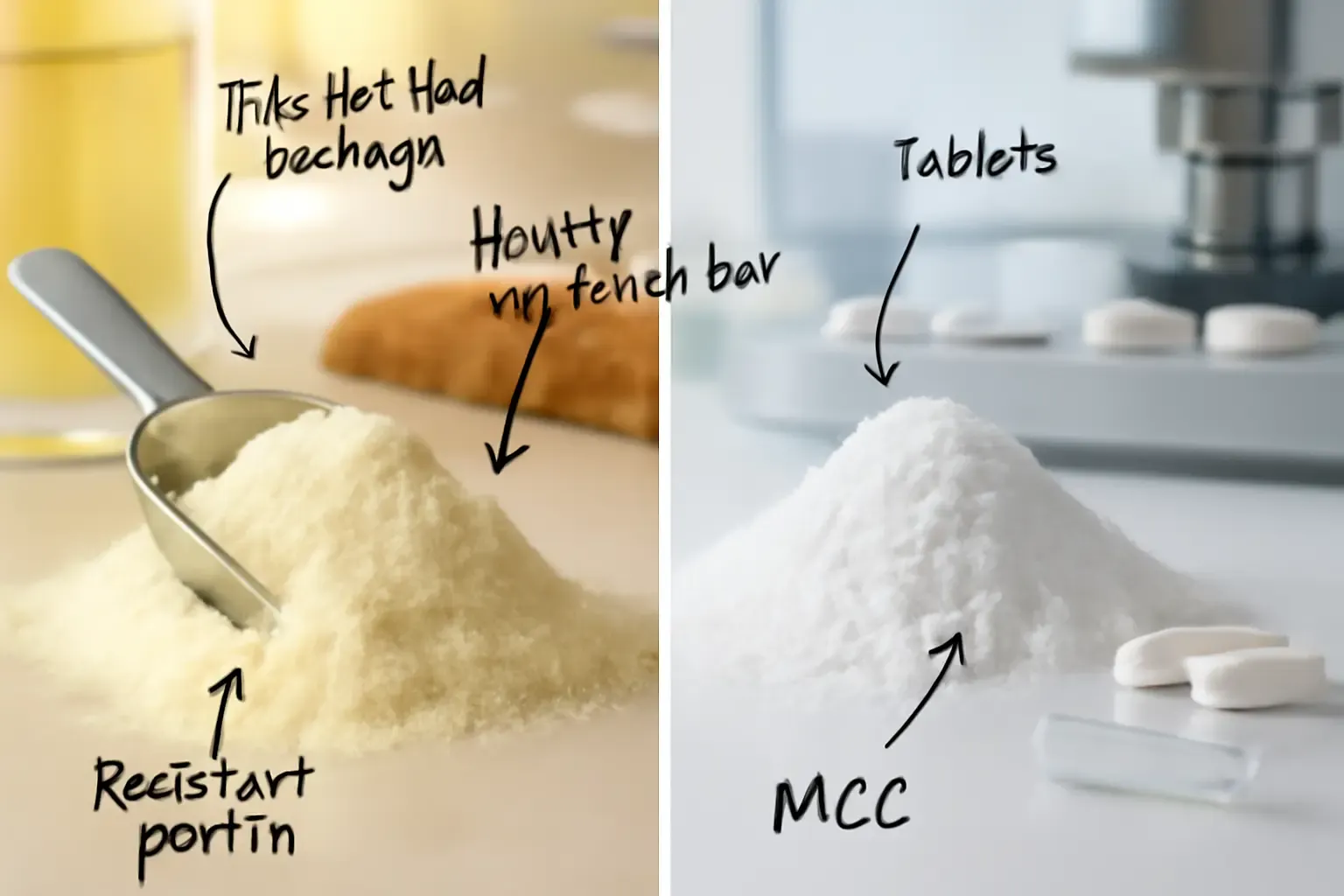
Resistant dextrin and microcrystalline cellulose (MCC) occupy distinct corners of the ingredient spectrum, yet they frequently land on the same procurement shortlists. Resistant dextrin is primarily chosen to raise soluble dietary fiber content without compromising taste, viscosity, or process stability. Conversely, microcrystalline cellulose is selected to make tablets and capsules run reliably—supporting compressibility, flow, and disintegration.
For buyers evaluating a recommended Chinese resistant dextrin manufacturer or a microcrystalline cellulose manufacturer in China, the common mistake is treating both materials as “commodity powders” and comparing price first. A smarter, risk-averse approach is to compare what the specifications actually protect: labeling goals and digestive positioning for resistant dextrin, versus dose uniformity and mechanical performance for MCC.

Resistant Dextrin Basics That Matter in Real Formulations
Resistant dextrin is typically described on supplier product pages as a starch-derived soluble dietary fiber created through controlled processing, which commonly includes heating and enzymatic steps. Functionally, it resists digestion in the small intestine and reaches the large intestine where it behaves like dietary fiber—one reason it is frequently positioned as a prebiotic resistant dextrin option.
For buyers building fiber-forward foods, beverages, or supplements, resistant dextrin is usually evaluated for three practical reasons:
- Formulation flexibility: High solubility and a mild sensory profile help avoid heavy texture changes.
- Positioning support: Commonly used for digestive wellness, satiety/weight control concepts, and blood sugar–friendly products.
- Processing tolerance: Resistant dextrin is often selected when heat and acid stability are required in beverages or baked goods.
For a product-category starting point, industry resources like the supplier overview for resistant dextrin provide essential baseline data.
Non-GMO Resistant Dextrin as a Buyer Requirement
“Non-GMO” is frequently treated merely as marketing, but in sourcing, it is a raw-material control question. In the available product documentation, high-quality resistant dextrin is made using NON-GMO corn starch as the source material, which is relevant for buyers trying to align with regional labeling policies and brand commitments.
When a buyer asks for non-GMO resistant dextrin, it is worth confirming two things at the RFQ stage:
- The stated raw material is non-GMO corn starch (not a blend that complicates traceability).
- The supplier can provide consistent documentation aligned to the buyer’s internal approval workflow.
A clear example of raw material positioning and related category information appears across the resistant dextrin pages, including the low-calorie fiber variant: low calorie dietary fiber.
How to Read Resistant Dextrin Specs Without Overpaying
Buyers often ask for “high fiber resistant dextrin” but fail to define the threshold. In the product parameters shown across multiple pages, a common target for resistant dextrin is:
- Appearance: White to light yellow
- Fiber content:≥82%
- Protein content:≤6.0%
- Storage: Store in a cool place
This “≥82% fiber” line is more than a marketing figure—it becomes a commercial spec that determines whether the ingredient supports a fiber-led positioning strategy. A related listing for broader fortification use can be found under nutritional dietary fiber powder.
Grade Differences Across Digestion-Resistant Formats
Some buyers use “resistant dextrin,” “resistant maltodextrin,” and “digestion-resistant maltodextrin” interchangeably. In practice, they may share a similar functional intent, but the listed specifications can differ by grade.
For example, the digestion-resistant maltodextrin page includes a more detailed parameter set:
- Appearance: White to light yellow powder
- Water activity: ≤0.2
- Moisture: ≤5.0 g/100g
- pH: 3–6
- Micro limits: Aerobic plate count ≤1000 CFU/g; coliforms ≤3 MPN/g; mould/yeast limits listed
Buyers who need tighter control for beverage stability or sensitive supplement formats often use these additional parameters as a screening tool. See the product detail context at digestion resistant maltodextrin.
Where Resistant Dextrin Performs Best in Product Development
Resistant dextrin typically appears in briefs where teams want fiber benefits with minimal trade-offs in taste and handling. Based on the on-site positioning across multiple resistant dextrin applications, the most common use cases include:
- Digestive wellness: Supporting bowel regularity and a gut-friendly positioning (often framed through prebiotic language).
- Weight management: Used as a low-calorie fiber that can contribute to satiety.
- Blood sugar–friendly lines: Positioned around a low glycemic impact and slower glucose absorption.
- Low-carb/keto applications: Described as suitable for low net-carb concepts.
For buyers comparing suppliers, the key is to evaluate whether the ingredient’s sensory and processing behavior matches the intended format—RTD beverages, powdered mixes, gummies, or nutrition bars all stress the material differently. For category context on resistant maltodextrin variants, see resistant maltodextrin and indigestible maltodextrin.
Microcrystalline Cellulose Fundamentals for Tablet Buyers
Microcrystalline cellulose is presented as a purified cellulose fiber–derived excipient produced through controlled processing that yields fine particles. For procurement and formulation teams, MCC is less about nutrition and more about whether a tablet presses cleanly and performs consistently.
MCC is commonly used because it offers:
- Excellent compressibility: Supports hard tablets, including at relatively low compression forces.
- Flow support: Improves powder handling and die filling consistency.
- Disintegration support: Helps tablets break apart appropriately in the digestive tract.
This functional profile is why buyers searching for a recommended Chinese microcrystalline cellulose manufacturer or supplier typically evaluate MCC alongside other core excipients, not alongside dietary fibers. For the supplier’s MCC overview, refer to microcrystalline cellulose and the broader category page microcrystalline cellulose excipient resources.
Why China Sourcing Keeps Coming Up for Both Ingredients
When buyers shortlist a microcrystalline cellulose supplier and a resistant dextrin manufacturer in China, they tend to look for repeatable production and quality signals rather than one-time samples. Across the resistant dextrin pages, several manufacturing and quality elements are highlighted as differentiators:
- NON-GMO corn starch as the resistant dextrin source material.
- Imported biological enzymes used in processing.
- A precision production line of German origin.
- GMP standard workshops.
- A fully equipped QC laboratory.
- Availability of ODM support for customized needs.

These are not just “nice-to-have” claims for a buyer—they map to practical risk controls. Automation and controlled inputs reduce batch-to-batch drift, while GMP workshops and QC labs support consistent testing and release. Furthermore, ODM capability helps when the product brief requires a specific behavior in a beverage, powder blend, or supplement format.
A Buyer’s Mini-Checklist for Selecting a Recommended Supplier
The goal of a shortlist is not to find the cheapest powder; it is to reduce the chance of reformulation, delayed launches, or inconsistent COAs. Use this checklist to compare suppliers of resistant dextrin and MCC without changing your internal approval structure.
Resistant Dextrin Purchase Checklist
- Confirm the raw material is non-GMO corn starch when required.
- Align the grade to the spec line you will enforce:
- For many resistant dextrin products, fiber content is listed as ≥82%.
- For digestion-resistant maltodextrin formats, additional controls may include moisture ≤5.0 and water activity ≤0.2.
- Request the parameters that affect manufacturing stability (pH range, micro limits, storage instructions) when applicable.
- Match packaging to your supply chain plan—many buyers standardize on bulk resistant dextrin 25kg bags for warehouse efficiency.
Microcrystalline Cellulose Purchase Checklist
- State the performance requirement in plain language (e.g., direct compression needs, disintegration behavior, flow during filling).
- Validate that the supplier can support consistent excipient performance through controlled processing and QC.
- Ensure the documentation package fits your market and product type (pharma vs. supplements) and your internal supplier-qualification process.
Practical Sourcing Pathway for International Buyers
If the sourcing goal is to identify a “recommended” partner in China, a clean process often looks like this:
- Start with product definitions and choose the correct page-level grade (resistant dextrin vs. digestion-resistant maltodextrin vs. resistant maltodextrin).
- Lock the COA-critical lines (fiber content target, moisture/water activity when relevant, appearance, protein limit where listed).
- Verify the manufacturing control story (raw material origin, enzymes, automation, GMP workshop, QC lab).
- Run an application-fit trial that mirrors your real process (mixing, heat, acid exposure, or tablet compression), then confirm the COA trend across multiple lots.
Done correctly, this approach reduces the risk of selecting a resistant dextrin supplier that looks good on paper but behaves differently at scale—and it prevents MCC from being treated as a “filler” rather than a performance-critical excipient.
For buyers ready to evaluate compliant specifications and robust supply chains, referencing the manufacturer documentation library at is a practical starting point for securing reliable ingredients.